Monthly Archives: November 2025

Organic Agriculture Research Programs at the USDA

The USDA agencies and programs outlined below are the primary drivers of organic research and extension activities.

Agricultural Research Service (ARS)Research into organic agriculture topics

USDA’s in-house research agency, ARS operates labs and field stations nationwide. Organic research has included projects on cover crop integration in vegetable systems in CA, organic dairy herd health in WI, and long-term crop trials in MD.

National Institute of Food and Agriculture (NIFA)Competitive Grant Programs

While ARS conducts research for the USDA, NIFA’s mission is to provide grants to research institutions, including ARS and the Land-Grant Universities.

  • Organic Research and Extension Initiative (OREI) – The flagship NIFA competitive grant program is dedicated to organic agricultural research. It supports research, education, and extension programs that enhance the ability of organic producers and processors to grow and market high-quality products.
  • Organic Transitions Program (ORG) – Awards grants for production and competitive-based agricultural issues, especially for farmers transitioning to organic production systems.
  • Sustainable Agriculture Research and Education Program (SARE) – USDA’s longest-running sustainable agriculture grants program. While not exclusively organic, SARE has funded thousands of farmer-driven projects, including many led by organic and transitioning producers.
  • Specialty Crop Research Initiative (SCRI) – SCRI is a NIFA competitive grant program that provides resources for research and extension projects for the specialty crop industry. Organic’s share of SCRI-funded projects is highly variable — as low as 3% in 2023, but as high as 13% in 2021 — depending on applicant pool and USDA priorities.
  • Agriculture and Food Research Initiative (AFRI) – AFRI is a research, education, and extension competitive grant program that covers a wide range of topics, from improving rural economies, increasing food production, ensuring food safety and security, enhancing human nutrition, and training the next generation of the agricultural workforce. A range of 2-5% of AFRI funds are awarded to organic topics on an annual basis.

The best way to get these updates from OFRF is to Join the OFRF newsletter.

OFRF’s newsletter provides regular updates to organic agriculture research program at the USDA, including timeline updates, announcements of USDA’s calls for proposals, and advocacy updates via Gordon’s Policy Corner.  We also provide details on how farmers, researchers, and advocates can work with us to protect and bolster federal support for organic farmers and researchers in the US.

By |2025-11-25T11:47:36-05:00November 25th, 2025|Uncategorized|

USDA NIFA Announces 2025 Organic Transitions Program Awards

November 20, 2025

This week USDA-NIFA announced seven new research project awards through the Organic Transitions Program (ORG), totaling over $6 million to support a better understanding of the processes of organic transition and the best ways to support farmers who are in that process.

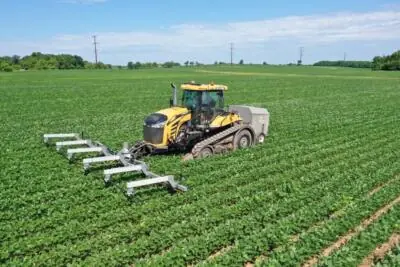
Photo of electric weed control equipment from https://theweedzapper.oldschoolmanufacturing.com/electric-weed-control-organic-farms/

The ORG program funds research and extension work that help those farmers stay competitive during the transition process, while also strengthening our understanding of the ecological benefits related to organic production. This program prioritizes the development of educational tools for farmers, technical service providers, and extension to support a farm during the sometimes tumultuous transition process.

The awards announced are going to Land Grant Universities across the country, and taken together, these projects are tackling some of the most pressing challenges facing organic and transitioning farms. 

The projects represent a continued step towards supporting practical, farmer-focused science that will help more producers transition successfully to organic systems, maintain profitability, and meet growing consumer demand for organic food. 

They also highlight the continued importance of programs like ORG and the Organic Research and Extension Initiative in driving innovation across the organic sector and beyond. We are looking forward to the release of the FY26 OREI and ORG Notice of Funding Opportunities (NOFOs).

Want to stay in the know about opportunities for funding like this? Sign up for our newsletter.

By |2025-11-20T12:57:32-05:00November 20th, 2025|News|

OFRF Launches National Organic Farmer Survey to Shape the Future of Organic Agriculture

SANTA CRUZ, Calif., Nov. 19, 2025 — The Organic Farming Research Foundation (OFRF) has launched its 2025-2026 National Organic Farmer Survey, a nationwide effort to understand the challenges, priorities, and needs of organic and transitioning farmers. The survey will remain open through January 31, 2026, and will inform research, education, and policy decisions that directly impact the future of organic agriculture in the United States and across North America.

Since 1990, OFRF has worked to support the producers who grow the nation’s food and fiber. Farmer input is central to the organization’s work. Insights from previous surveys, including the 2022 National Organic Research Agenda (NORA), have guided farmer-led research projects, influenced university and Extension priorities, and helped policymakers direct more resources to organic producers.

“Organic farmers are experts in their fields, and their perspectives must guide decisions about agricultural research, education, and policy,” said Brise Tencer, executive director of OFRF. “This survey ensures that investments in the organic sector reflect the real needs of producers on the ground.”

The survey is open to all certified and in-transition organic farmers nationwide. Participation takes approximately 25 minutes, and upon completion, all respondents will receive a discount code to Johnny’s Selected Seeds and have the opportunity to enter to win prizes, including boots from The Original Muck Boot Company, FELCO pruners, and a farm consultation with a veteran organic farming expert.

Dr. Alex Woodley, associate professor in the Department of Crop and Soil Sciences at North Carolina State University, emphasizes the importance of this survey: “It’s important to make it clear that the surveys OFRF conducts on farmers’ needs are incredibly valuable. I’ve used the results to justify knowledge gaps in my grants, and that’s been really important. Getting a pulse on what farmers need right now is something we don’t always know—especially because I’m in research, not full Extension—so these surveys have been really important to me.”

Farmers can access by emailing communications[at]ofrf.org. The survey is available in English and Spanish, and paper copies are available upon request. The 2022 NORA report, which shares the findings from the most recent survey, can be found at www.ofrf.org/research/nora/.

– end – 

About Organic Farming Research Foundation

The Organic Farming Research Foundation (OFRF), headquartered in Santa Cruz, California, with a remote team based across the U.S., works to foster the improvement and widespread adoption of organic farming systems. OFRF cultivates organic research, education, and federal policies that bring more farmers and acreage into organic production. For more information about OFRF, please visit our website: www.ofrf.org.


Media Contact

Ashley Dulaney, Communications Director, OFRF
ashley[at]ofrf.org, ‪(518) 310-6771‬‬
P.O. Box 440, Santa Cruz, CA 95061

Photo in featured image: Claire Lichtenfels, Whitestone Mountain Orchard in Tonasket, WA

By |2025-11-19T14:04:05-05:00November 19th, 2025|News, Press Release|

Advancing Organic Agriculture: Examining How to Make the Midwest a Center of Organic Oat and Buckwheat Production with Congressman Scott Fitzgerald

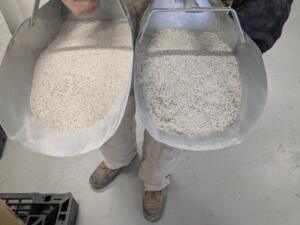
Different buckwheat flour formulations are being tested by evaluating different milling techniques. This photo shows light (left) vs. dark (right) buckwheat flours, which have different flavor and texture properties.

By Dr. Nicole Tautges with support from Vinnie Trometter, OFRF Policy Manager

As the Research Director of the Michael Fields Agricultural Institute in Wisconsin, I recently had the opportunity to meet with Congressman Scott Fitzgerald’s (R-WI-05) staff to discuss how the Organic Agriculture Research and Extension Initiative (OREI) program supports our research developing markets and supply chains for Midwestern organic oat and buckwheat producers.

Growing Small Grains for Big Impact

Carbohydrates make up about 75% of the calories in a typical diet, with most of those carbohydrate calories coming from grains. However, grains have received very little attention in terms of origins/sourcing, health benefits, quality factors, and organic share of consumption. Even for basic grain items like wheat flour, few consumers know where their flour comes from, or the differences among grains other than wheat.

This is where organic oat and buckwheat come in. Not only can these grains replace wheat for many uses but they are also more nutritious and excel in organic crop rotations. Our research focuses on how the Midwest can become a center of oat and buckwheat production in the United States. There is much work to do considering most of the oat and buckwheat consumed in the country is imported. However, there is no reason why these grains cannot be grown right here in the Midwest if the right markets and supply chains are in place.

Our research seeks to accomplish this by highlighting the nutritional and crop rotation benefits while building the knowledge and supply chains needed to make these grains more widely available. We do this by organizing focus groups with farmers and other grain supply chain actors to understand what the problems are, and design research trials to address management knowledge constraints.
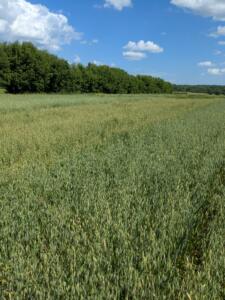
Oat variety trial—different oat varieties that are currently available are being tested in organic production environments (oats are typically not bred under organic conditions, and can perform differently in organic production systems).

Our trials cover all segments of the oat and buckwheat supply chain. On the grower side, we intend to perform organic fertility trials to improve nutrient recommendations for growers. For example, we are testing no-till establishment of spring oats, which helps ensure earlier planting and higher-quality food-grade oats. We have also completed a trial that demonstrates buckwheat can be planted after small grain harvest in the same season, with enough time to produce a harvestable crop. On the processing side, we are performing milling and processing trials with oats and buckwheat. Lastly, we are performing product testing with consumers, to better understand consumer preferences and to provide guidance to organic grain millers.

Collaboration and Networking are Key to Success

We are collaborating on this project with partners such as Dr. Jacob Jungers at the University of Minnesota, the Artisan Grain Collaborative, Rooster Milling in East Troy, WI, and several dedicated organic farmers across the Upper Midwest.

To share our results, we host field days, present at grower conferences, give webinars, and post videos on YouTube and Facebook. These efforts ensure that both farmers and consumers can see what’s happening and why it matters.

Support from the Organic Agriculture Research and Extension Initiative (OREI) has been fundamental for us. OREI is one of the few USDA programs that consistently supports organic research, which has often been neglected compared to conventional agriculture, despite rising consumer demand for agrochemical-free food.

Sharing Organic Research with Midwest Policymakers

It is important now more than ever to communicate to our legislators how organic agriculture research plays out on the ground. Agricultural science can feel abstract and difficult to understand for those outside the field. And let’s be honest—scientists aren’t always the best communicators! By sharing names, faces, and stories from real farms, we help policymakers connect research to human impact in their districts.

Buckwheat is a pseudocereal and a staple grain of northeastern Europe. It is actually in the rhubarb family! It has a pyramidal shaped grain (the dark brown part of the flower as seen above) that can be milled into flour, or dehulled and the “groat” eaten in porridge or granola.

I feel confident that I connected human impact with our research when I spoke with Congressman Fitzgerald’s staff. I deeply appreciated how receptive his office was to learning about innovative farming practices happening right here in the 1st Wisconsin Congressional District and across the Midwest. With so many demands on their time, it meant a lot to see agriculture innovation recognized as important.

I’m incredibly grateful to the Organic Farming Research Foundation (OFRF) for facilitating this meeting. Without their support, I wouldn’t have had the chance to share our stories directly with lawmakers.

Looking ahead, whether it be research trials or policymaker conversations, our work is about building bridges—between farms and markets, between science and consumers, and between research and policy. Oats and buckwheat may be small grains, but they represent a big opportunity for healthier diets, more resilient farming systems, and stronger local food economies in the Midwest.

Use Your Voice

Interested in sharing your research with legislators and the importance of continued public investment in organic research? Enroll in OFRF’s self-paced email course, Communicating with Legislators. This free, educational workshop is designed to equip researchers within the organic farming community with the tools and resources they need to effectively engage with and educate policymakers about the impact of their work.

Dr. Nicole Tautges
By |2025-11-11T10:09:01-05:00November 10th, 2025|News|

How OFRF is Building Bipartisan Support for Organic Research Programs in Congress

Written by Vinnie Trometter and Gordon Merrick

As we alluded in last month’s Policy Corner, there is some semblance of good news legislatively regarding OFRF’s policy priorities!  Reps. Eugene Vindman (D-VA-07) and Mike Lawler (R-NY-17) introduced OFRF’s flagship marker bill, the Organic Science and Research Investment (OSRI) Act in the House of Representatives with broad sector support. With a companion bill already introduced in the Senate by Sens. Fetterman (D-PA) and Schiff (D-CA), this legislation is now introduced in both chambers.

At its core, the OSRI Act is about finally investing in the research capacity needed to keep pace with a fast-growing organic sector. This bill would:

  • Increase funding for the only two USDA research programs dedicated to organic research: the Organic Research and Extension Initiative (OREI) and the Organic Transitions Program (ORG).
  • Direct USDA’s Research, Education, and Economics (REE) mission area to catalog existing organic research and recommend pathways to expand the work.
  • Charge the USDA’s Economic Research Service (ERS) to examine the economic impact of organic agriculture on rural and urban communities.
  • Continue the growth of the Organic Data Initiative, ensuring robust market and production data remains available to farmers, businesses, researchers, and policymakers.

Taken together, these provisions would strengthen the scientific foundation of organic agriculture, ensure farmers have access to regionally relevant research, and support a new generation of scientists committed to agroecological approaches.

Bipartisan By Design

The bipartisan approach we are pursuing is an intentional attempt to communicate that the growth of the organic agriculture sector is a national priority, not a partisan project, and we aim to have the cosponsor list reflect that reality.

While quiet support for organic agriculture does exist across both parties, public leadership on organic issues has historically been stronger among Democrats. That’s shifting. Interest in soil health, regenerative systems, and farmer-driven innovation is growing in Republican circles, but many offices prefer to see key agricultural interests and members support policies before they cosponsor legislation.

This strategy is especially important because the House introduction occurred at the outset of what has become the longest federal government shutdown in U.S. history. In an environment where basic governing has become difficult, moving new legislation requires patience, persistence, and a fundamentally nonpartisan posture. That is exactly how OFRF operates, and we are here to meet this moment.

Moving Forward

Because of the current political landscape exacerbated by the current shutdown, Farm Bill 2.0 discussions have slowed to a standstill. But this pause also creates space. As Congress turns back toward core Farm Bill negotiations in the coming months, the OSRI Act is well-positioned to gain traction, especially if organic research is understood as an economic development and competitiveness package rather than a niche priority.

That’s why your outreach matters.

Over the coming months, OFRF will continue to share targeted district-level information, elevate producer voices, and build bipartisan support so that organic research is properly valued, and fully funded, in the next Farm Bill. Check out our Communicating with Legislators course and reach out to us to get started!

OFRF and our allies are continuing to meet with Congressional offices to highlight how organic research delivers tangible benefits to farmers through practical tools to strengthen on farm resilience, expanded market opportunities, and rural economic revitalization.

At a moment when the organic sector is the fastest growing segment of U.S. agriculture, the need for its fair share of research investments has never been clearer. Farmers are on the front lines of climate disruption and supply-chain volatility, and organic research projects have actively provided methods to help them continue to thrive.

When the tide rises for organic research, all producers benefit.

Stay tuned for more, and thanks for being in this work with us.

Vinnie and Gordon

By |2025-11-05T13:00:46-05:00November 5th, 2025|Gordon's Policy Corner, News|
Go to Top