OFRF’s Board of Directors brings together farmers, researchers, and industry leaders who share a common belief: organic agriculture is a proven solution and deserves investment to match. In this conversation, we sat down with board member Carrie-Anne Palmeri, Organic Program Manager at Nature’s Path Organic Foods, to talk about her path into organic farming and policy, what draws her to OFRF’s work, and where she sees the biggest opportunity for organic research to make a difference.
Meet Carrie-Anne
Tell us about yourself and how you became involved with Nature’s Path.
 My name is Carrie-Anne Palmeri, and I serve as the Organic Program Manager at Nature’s Path Organic Foods, North America’s largest independent organic breakfast and snack food company. In my role, I oversee the strategic development of Nature’s Path’s Organic Program and help lead the company’s work in organic advocacy, regulatory affairs, and public education to protect organic integrity and expand access to organic food. I also sit on OFRF’s Board of Directors as Secretary and as President of the Board of Directors at the Canada Organic Trade Association.
My journey into organics began as a diversified organic vegetable and berry farmer in Vermont. From there, I spent more than a decade living and working throughout Mexico and Latin America as a farmer, technical extension agent, community organizer, and regulator, helping advance organic agriculture, food security, and sustainable farming systems. That work gave me a deep appreciation for the interconnectedness of farming, policy, markets, and environmental stewardship. Today, I bring that systems-level perspective to Nature’s Path, where I am proud to help strengthen and grow the organic movement alongside farmers, researchers, industry partners like OFRF, and organic advocacy groups across North America.
And Nature’s Path itself, how does the company’s work connect to organic agriculture and research?
At Nature’s Path, we believe organic agriculture is much more than a way of growing food. It is a pathway to healthier ecosystems, more resilient communities, and a food system that leaves the Earth better than we found it. As a family-founded and independently owned organic food company, we have spent over 40 years championing organic farming, investing in supply chains that support growers, and helping make organic food more accessible to families across North America.
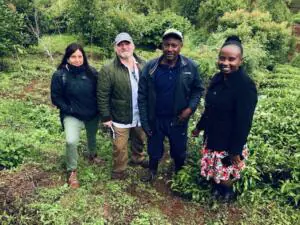
Carrie-Anne visiting a farm in Kenya with Nature’s Path.
Our work intersects with both organic agriculture and research because we understand that the future of organic depends on continuous learning and innovation. Through initiatives like our Regenerative Organic Oats (ROO) Program, we collaborate with farmers, researchers, nonprofits, and industry partners to test and scale practices that improve soil health, strengthen farm resilience, and support long-term environmental outcomes. We also actively engage in organic standards development, policy discussions, and industry leadership to ensure organic agriculture continues to evolve while maintaining the integrity that consumers trust.
For us, research is not confined to laboratories or academic institutions. It happens in farmers’ fields, across supply chains, and through partnerships that connect scientific knowledge with real-world agricultural practice. By helping bridge those worlds, our team works to ensure that organic agriculture remains a powerful solution and increasingly chosen option for advancing biodiversity, climate resilience, healthy food systems, and thriving rural communities for generations to come.
What draws you to organic on a personal level?
For me, the way we grow our food and the food we choose to eat is a deeply personal and communal endeavor—a lifestyle, a life’s purpose, and a socio-environmental movement that I deeply believe in.

Carrie-Anne got her start working at an organic farm in Vermont.
I came to organic through farming. As a small-scale organic farmer—first in Vermont and then in Mexico for many years—I experienced firsthand the intimate and deeply healing practice of tending a piece of land and, in return, being tended by it. Farming has taught me patience, humility, and reciprocity. It has shown me that healthy food begins long before harvest, fundamentally with healthy relationships between people and the living agroecology that we steward and become a part of on our farms.
That experience opened the door to a now two-decade career working alongside farmers around the world. I was fortunate to spend years working hands-on with small- and medium-scale farming communities throughout Mexico and Central America, learning not only from their agricultural practices but from their wisdom, resilience, and commitment to caring for the land. Those experiences gave me a profound appreciation for the central role farmers play in shaping both our present and our future. Farmers are among the original stewards of our landscapes, and every day they make decisions that influence the health of ecosystems, communities, and generations to come.
What inspires me most about organic is that it recognizes these connections.
“Organic is rooted in the understanding that the health of our planet and the health of the people we love and communities we serve cannot be separated.”
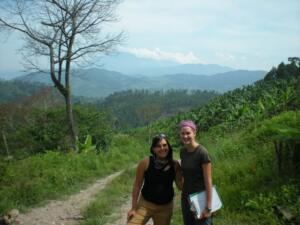
Carrie-Anne visiting a farm in Honduras.
It asks us to view food as more than a commodity to be consumed and instead as a relationship and a deeply nuanced conversation between people and the places they inhabit.
For me, organic is also fundamentally about justice and equity. Justice in our food system depends on the deeply entwined decisions farmers make in the field and consumers make in the marketplace. Those choices create ripples that extend far beyond the farm, shaping and determining the livelihoods of farming communities, the resilience of local economies, the protection of biodiversity, and the future of our food system. Organic gives me an opportunity to align the seemingly simple decision in the marketplace with values that deeply resonate with me: stewardship, fairness, and long-term care.
Organic in the U.S. and Canada: Shared Roots, Different Paths
What are the similarities and differences in the successes and challenges of organic agriculture in the United States and Canada?
The organic movement in both the United States and Canada really comes from the same place. In both countries, it started as a grassroots effort led by farmers, environmental advocates, and consumers who believed agriculture could be about more than simply producing as much food as possible. It was rooted in a set of values: caring for the soil, protecting ecosystems, strengthening communities, and recognizing that a healthy food system is at the heart of a healthy society.
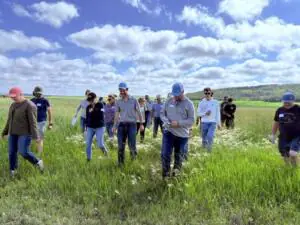
Carrie Anne tours an organic farm with the Canada Organic Trade Association.
When you step back and look at how far organic has come, it’s actually pretty remarkable. What started as a collection of local and regional movements has grown into a federally regulated system with enforceable standards, accredited certification bodies, and international recognition. In both Canada and the U.S., organic has evolved from a niche movement into one of the most recognized and trusted certifications in the marketplace. That’s no small accomplishment.
At the same time, I think both countries are grappling with many of the same challenges. Organic has proven itself. Farmers, researchers, businesses, and consumers have demonstrated its value over and over again. Yet public policy, research investments, and agricultural support programs haven’t always kept pace. Organic delivers benefits that extend well beyond the farm gate, from healthier soils and greater biodiversity to cleaner water, climate resilience, and stronger rural economies. But many of the systems that shape agricultural funding and policy were designed around conventional production models, and organic farmers still often find themselves trying to fit a square peg into a round hole.
There are definitely differences between the two countries, especially when it comes to scale. The U.S. has a much larger domestic organic market, greater research capacity, and larger institutions supporting the sector. Canada’s organic community is smaller, but in many ways that’s led to an incredible culture of collaboration. With more limited resources, there’s often a greater emphasis on working together across organizations and sectors to move shared priorities forward.
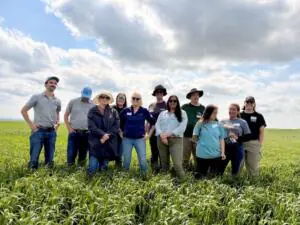
Carrie-Anne is the President of the Board of Directors at the Canada Organic Trade Association.
A great example of that is what we’re seeing right now through the Canadian Organic Alliance. Our colleagues at the Canada Organic Trade Association, Organic Federation of Canada, and Canadian Organic Growers have come together to build a stronger, more unified voice for organic on Parliament Hill. Their recent release of the first National Organic Action Plan for Canada is a tremendous milestone. It lays out a roadmap for strengthening everything from research and extension to market development, transition support, data collection, and government investment.
Honestly, I think it’s something the U.S. organic community can learn from. We have an incredibly vibrant and committed organic sector, but we also have a very diverse and sometimes fragmented ecosystem of organizations and stakeholders. It’s been more than a decade since the U.S. had a comprehensive National Organic Action Plan, and Canada’s recent effort shows what can happen when farmers, researchers, businesses, certifiers, nonprofits, and policymakers come together around a shared vision and coordinated set of priorities.
What gives me hope is that organic continues to punch above its weight in both countries. Despite limited resources, the movement has stayed remarkably true to its roots while growing into a sophisticated regulatory and market system. That’s not an easy balance to strike. Organic today is both a standards system and a broader vision for how agriculture can contribute to healthier ecosystems, stronger communities, and a more just and resilient food system. And I think that combination of values and practicality is exactly what has allowed the movement to endure and continue growing.
Why OFRF?
What draws you to OFRF’s work specifically?
We know organic systems are fundamentally different from conventional systems, and organic farmers need science that is designed specifically for the realities they face. What I appreciate about OFRF is that it starts with farmers and is a powerful platform for organic farmers’ needs to be heard and met. For decades, I have admired OFRF as a central convener—they work with farmers to help identify the problems that need solving, they work with researchers critical to helping develop solutions that meet farmers where they’re at, and they tirelessly convene actors and resources across the system to get those tools back to farmers in the field in the most impactful way possible.
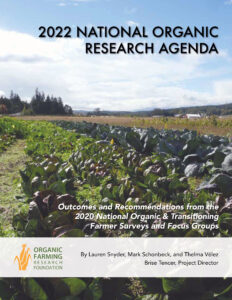
OFRF’s 2022 National Organic Research Agenda. The 2026 Report will launch early next year.
A perennial resource for me, and I think for many others across the organic community, is OFRF’s National Organic Farmer Survey and the resulting National Organic Research Agenda (NORA). These two initiatives are absolutely essential because they ensure that the national organic research agenda is informed directly by the people stewarding the land every day. Rather than researchers, funders, or policymakers deciding in isolation what organic farmers need, OFRF starts by (and returns to) listening to farmers and systematically identifying their most pressing production challenges, innovation needs, and knowledge gaps.
The National Organic Farmer Survey is a critical pulse check on the state of organic agriculture and NORA does a great job of translating the findings into actionable research priorities. What do they do truly at the end of the day? They help direct scarce research dollars toward the issues that matter most. They also provide researchers with a farmer-validated roadmap for developing projects that can deliver real-world impact and for those of us advocating on Capitol Hill, we’re able to point to a nationally representative body of farmer input that clearly articulates where barriers exist, where opportunities lie, and where additional public investment can have the greatest return. It lends credibility, depth, rigor and integrity to whatever ask we bring forward about the need for greater structural support for organic agriculture, so we’re not just relying on anecdotes.
Organic farmers are some of the most creative problem-solvers I’ve met, and they shouldn’t have to do that work alone. The research & advocacy support that OFRF has offered for decades has been essential to ensuring that organic becomes an accessible, viable and resilient choice for the farming community.
The Next Chapter: Investing in Organic Like It Matters
In your opinion, what is the most pressing challenge in agriculture that organic research can address?
To me, the next chapter of organic is not about proving whether organic works. Farmers, researchers, and consumers have already demonstrated that. The challenge for us all now is ensuring that public policy, research investment, and agricultural support systems fully recognize organic agriculture as a proven public good and invest in it accordingly.
“The question now is less ‘Does organic work?’ and more ‘Are we willing to invest in it like it matters?'”
That’s one of the reasons I’m so drawn to OFRF’s work. It sits right in that space between the organic movement’s grassroots roots and the research, education, and policy infrastructure needed to help the movement grow and thrive over the long term.
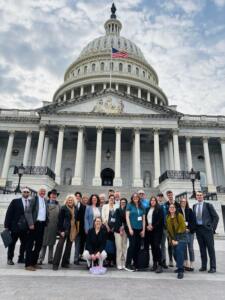
The Nature’s Path team advocating for organic in Washington D.C.
As I shared earlier, there are persistent structural gaps in public investment and federal agricultural programming needed to support organic. Despite representing a significant and growing segment of the food economy, organic research funding has historically lagged far behind the sector’s contribution and capacity for impact. Organic products account for roughly 6% of U.S. food sales, yet organic research receives well under 2% of USDA research funding.
I also hear consistently from farmers that many federal agricultural programs weren’t really designed with organic systems in mind. Whether we’re talking about conservation programs, crop insurance, or risk management tools, organic producers often have to work harder to access support for practices they’re already implementing on their farms. In many cases, organic farmers are delivering outcomes that policymakers say they want more of, things like improved soil health, biodiversity, water quality, and climate resilience, but the programs themselves haven’t always evolved to fully recognize that.
There are also some really practical gaps that don’t get talked about enough. Programs that support certification cost-share, organic data collection, transition assistance, market development, and organic integrity often find themselves back on the table during every Farm Bill or appropriations debate. For farmers, that uncertainty can be frustrating. For the sector, it makes long-term planning difficult.
And then there’s the transition to organic itself. A lot of farmers are interested in organic production, but those transition years can be financially and operationally challenging. You’re changing your practices, taking on new risks, and often not yet receiving the market premium that comes with certification. If we want more farmers to make that leap, we have to make the path more navigable. That’s why continued investment in transition support, technical assistance, farmer mentoring, and research is so important.
Organic is sitting at a crossroads. It is no longer an emerging movement, yet it still doesn’t receive the level of policy support it merits given the public benefits it delivers.
Supporting Farmer-Led Research
Conversations like this one are a reminder of why farmer-informed research matters. If you want to see what’s driving OFRF’s research priorities, explore our NORA Organic Producer Needs Assessment (2026 edition to be available in January). And if Carrie-Anne’s perspective resonated with you, consider supporting the work that makes farmer-led research possible.
Carrie-Anne serves as Secretary on OFRF’s Board of Directors. Her work at Nature’s Path Organic Foods and across the organic advocacy landscape reflects the same conviction driving OFRF’s research: organic farmers deserve science, policy, and investment built for the systems they actually farm.