

Two Oʻahu Farmers Share Wins & Challenges Accessing CSP Support
Written by Mary Elizabeth Kidd, OFRF Communications Associate
OFRF is currently working to increase farmer and community awareness of the federal funding opportunities available to organic and transitioning farms.
As part of our work with the West region of the USDA’s Transition to Organic Partnership Program (TOPP), we’re spotlighting two Hawaiʻi farms—Maigee Chang of Farm of the Fearless Monkey and Timothy Clark of Sunshine Farm Foundation—that received funding and support through the Natural Resource Conservation Service’s (NRCS) Conservation Stewardship Program (CSP).
Their story offers a transparent look at what it’s really like to work with NRCS: the benefits, the obstacles, and the lessons they’ve learned. We hope other farmers can use their experience to navigate the process of applying for and implementing CSP contracts more easily.
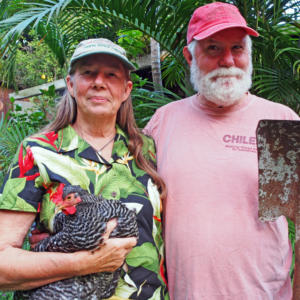
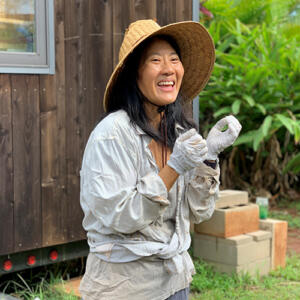
Meet Maigee Chang of Farm of the Fearless Monkey
 Source: Terri Dux, NRCS
Location: Kailua, Hawaiʻi (island of Oʻahu, Honolulu County)
Established: 2017
Acres: 2.25
Production: Okra, eggplant, pumpkin, ginger, turmeric, roselle/hibiscus, and perennials: ulu, dragonfruit, papaya, citrus, cacao, lilikoi, and jackfruit
Certification: Uses organic practices
Staffing: 2 volunteers (in exchange for living quarters)
Markets: CSA, a local organic grocery store, restaurants, and Facebook Marketplace; ulu is sold to a chip company
Social media: Instagram
Read more: Growing Organic at the Farm of the Fearless Monkey from the USDA’s Farmers.gov blog.
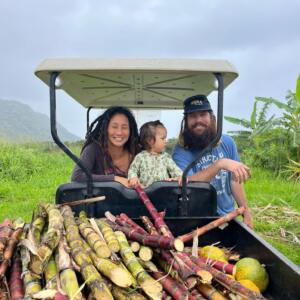
Meet Timothy Clark of Sunshine Farm Foundation
 Source: Sunshine Farm Foundation
Location: Mokulēʻia, Hawaiʻi (island of Oʻahu, Honolulu County)
Established: 2020
Acres: 15
Production: Mangoes, bananas, ulu, citrus, avocados, plus grazing animals including sheep, pigs, goats
Certification: Uses organic practices, not yet certified
Markets: Bananas are marketed through a neighboring farmer’s CSA
Social media: Facebook
About the Farmers
Maigee Chang (Farm of the Fearless Monkey) has lived in Hawaiʻi for over 30 years and came into her farming career after working at the intersection of local politics and agriculture, where she met farmers and attended farming workshops.
As her passion for farming grew, she found the land that would become Farm of the Fearless Monkey and set about getting the training and support she needed.
Maigee began her journey through the University of Hawaiʻi’s College of Tropical Agriculture and Human Resources program: GoFarm Hawaiʻi, where she connected with farmers, mentors, and Extension agents, and continued to strategically plug into support systems.
 Source: Sunshine Farm Foundation
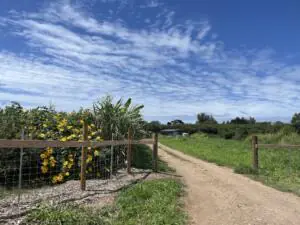
The entrance to Sunshine Farm Foundation.
Timothy Clark (Sunshine Farm Foundation) was born and raised in Florida and moved to Oʻahu in 2012, where he started farmwork via permaculture and permablitz projects, working in community and volunteering to plant food and forestry yardscapes in Hawaiʻi.
In 2020, he and his partners acquired the 15-acre land site, which they continue to develop to provide education and, eventually, food for those experiencing hunger. Their first farm, established in 2018, focused on education and permaculture practices.
Their current property is structured as a tenants-in-common ownership model with 27 farming plots and the goal of one day becoming an organic farming zone. Working with CSP has represented a supportive bridge in the journey towards wider production and becoming USDA-certified organic.
We recently spoke to Maigee and Tim about their experience as organic farmers navigating NCRS support systems. Below, we’re sharing the conversation and their valuable insight.
Why Organic?
Maigee (Farm of the Fearless Monkey): I don’t like spraying, and I don’t want any of that near my workers or me. Also, chemicals are very expensive.
I trained with OMRI-approved products; I’m comfortable using those, and they’re a lot simpler. I mainly use soap, neem, and BT (Bacillus thuringiensis, organic pest control); if something’s awry, I pull the plant and toss it. We do a lot of crop rotations and companion planting, and I’ve seen the effect of that. With mulching and healthy soil, my plants are stronger.
Tim (Sunshine Farm Foundation): Growing up, my father was a medical doctor who later moved into alternative medicine, focusing on supporting patients who had cancers with organic diets and homeopathic treatments. We always ate organic foods. When I started farming, I didn’t think that there was another way.
And working with the permaculture crew and kind of learning that methodology, and getting into agroforestry, you know, it was never a question of whether or not to use organic treatments for pests or fertilization.
We try to use permaculture and agroforestry designs that make pest management easier, such as attracting beneficial insects and utilizing native plants. This is where NRCS has been helpful.
Context & Challenges
 Source: Farm of the Fearless Monkey
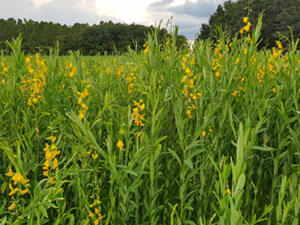
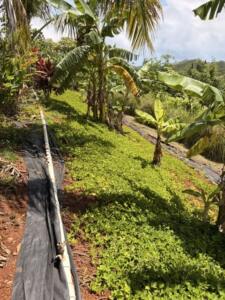
Perennial peanut cover cropping at Farm of the Fearless Monkey.
Maigee (Farm of the Fearless Monkey): The constant pest is the coconut rhinoceros beetle (CRB), so we’re trying to address that using various techniques. We do netting around the crown of the tree, we keep our mulch piles covered and rotate them at least every two months, and send the chickens in to scratch through.
We’re in a spot that hasn’t been hit too hard by the recent flooding; the water flows off of our area. Those storms came when we were doing cover crop, which helped the cover crop, and we didn’t lose anything. The vetiver (cover crop) is great and stopped everything from a massive flow.
Tim (Sunshine Farm Foundation): We had about 100 coconut trees wiped out by the coconut rhinoceros beetle. So we’re doing a pilot program to see if we can control the beetle with about 60 dwarf coconuts in high tunnels with netting (supported by EQIP).
We had about three or four storms this spring (2026), which caused a lot of damage to our property. That said, we’re in a drought area on the island, and water supply and power are a concern.
Our main focus is planting drought-tolerant crops. Water can go out for several days when they’re fixing lines, so we’ve signed up for a backup storage and water-pump program through NRCS.
Working with NRCS
Application Process
 Source: Farm of the Fearless Monkey
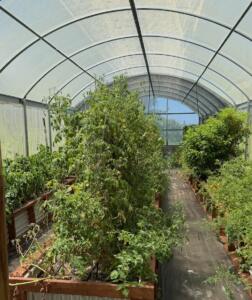
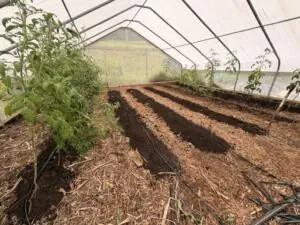
EQIP-funded hoop house with mulching at Farm of the Fearless Monkey.
Maigee (Farm of the Fearless Monkey): From working with the agriculture committee and then as secretary of the Waimānalo chapter of the Hawaii Farmers Union, I was familiar with NRCS representatives. I got a hoop house through the Environmental Quality Incentives Program (EQIP), and then we started working on a conservation plan.
Getting through the CSP application process was straightforward. I knew what I wanted to do, it was covered by the program, and my CSP agent walked me through everything. It’s been a smooth process; she sends me documents and deadline reminders, so it feels manageable.
Tim (Sunshine Farm Foundation): I found CSP through research and initially found it difficult to navigate until I connected with the first in a series of very helpful representatives who helped me begin a windbreak program and subsequent plans. You have to persevere. Our first contract phase was three years ago; now we’re in the second year of our second contract.
Implementation
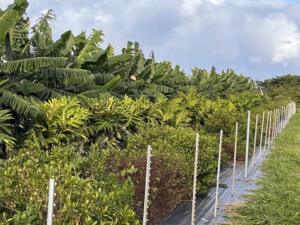 Source: Sunshine Farm Foundation
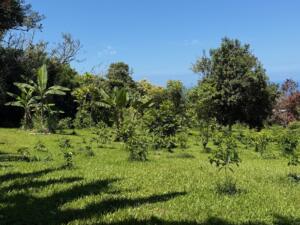
A row of banana trees and shrubs serves as a windbreak to protect crops at Sunshine Farm Foundation.
Maigee (Farm of the Fearless Monkey): We’re doing mulching and cover cropping and crop rotation, paid in bulk at the end of every year. For mulching, it was a five-year contract; payment started at $2,000 a year, then jumped to $4,000. Cover cropping started as a three-year contract, which has been renewed. The reimbursements mainly help cover labor costs for practices I’d do anyway.
Tim (Sunshine Farm Foundation): Our CSP contract includes $6,000 per year for five years ($4,000 cropland and $2,000 homestead), and practices include perennial cover crop (Bermuda grass) and establishing a native forestry zone.
We’re getting compost reimbursements (paying only for the delivery charges), and we have a contract to mulch over our orchard. It’s been great. And I was able to get a tree trimmer as well.
Outcomes & Challenges
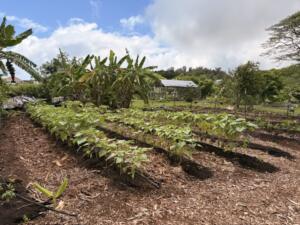 Source: Farm of the Fearless Monkey
Mulching and labor was covered by CSP contract at Farm of the Fearless Monkey.
Maigee (Farm of the Fearless Monkey): My soil is amazing right now. The plants are really happy. Mulching has reduced water use, and soil testing showed a pH shift from acidic to alkaline, which changed my fertilizer approach.
One big challenge is soil testing, not just getting the tests, but shipping them to the mainland (Oregon) in refrigerated/cooler boxes within 24 hours, and the airport where we ship them from is almost an hour away. If we could do that locally, it would save a lot of hassle.
Tim (Sunshine Farm Foundation): We get support from everyone at NRCS, they’re great! They’ve really helped us navigate programs.
I am in a predicament, however, because when they came out to inspect, even though I had the animals and I had the orchard, we were categorized as orchard-only, meaning I can’t transition to my original plan of getting the animal management care, such as internal grazing fencing.
So we missed something there and can’t go back or risk losing the program and having to reapply. So we’ll complete the contract as is and then apply for this longer-term plan.
Advice to Farmers
Maigee (Farm of the Fearless Monkey): If farmers are considering applying for CSP, you should totally do it. One, because it’s good practice. And two, it’s a good program. For a farm of my size, it wasn’t that complicated.
Tim (Sunshine Farm Foundation): When you’re preparing the paperwork, be sure to think long term. Consider the next five years and what may need to be a part of your application.
I also recommend applying with as comprehensive a plan as possible, including multiple conservation practices, to potentially give your application a higher ranking and likelihood of success.
And don’t forget outreach to other farmers, we have to share what programs we’re benefiting from.
Next Steps & Resources
Interested in transitioning your farm for organic certification in the West/Southwest or beyond? Explore these key resources and connect with mentors, certifiers, and Technical Support Providers (TSP) near you.
Locating Support Providers and Mentors:
- Connect with a local TOPP Mentor or Become a Mentor
- Find a local Technical Service Provider (TSP)
- Organic Certifier locator
- Conservation Technical Assistance (CTA)
Organic Farming Research Foundation resources:
- All Transition to Organic Partnership Program (TOPP) resources
- Events, Resources, and News for Northwest TOPP
- OFRF Resource Hub
USDA resources:
- TOPP General Interest Form
- NOP Handbook: Guidance & Instructions for Certifying Agents & Certified Operations
- Organic Recordkeeping: Guides, Templates, and Other Resources
- National List of Allowed and Prohibited Substances
Connect with OFRF: