
(Versión en español a continuación / Spanish version below)
Written by Mary Elizabeth Kidd, OFRF Communications Associate
OFRF is currently working to increase farmer and community awareness of the federal funding opportunities available to organic and transitioning farms.
As part of our work with the West region of the USDA’s Transition to Organic Partnership Program (TOPP), we’re spotlighting two Hawaiʻi farms—Maigee Chang of Farm of the Fearless Monkey and Timothy Clark of Sunshine Farm Foundation—that received funding and support through the Natural Resource Conservation Service’s (NRCS) Conservation Stewardship Program (CSP).
Their story offers a transparent look at what it’s really like to work with NRCS: the benefits, the obstacles, and the lessons they’ve learned. We hope other farmers can use their experience to navigate the process of applying for and implementing CSP contracts more easily.
Meet Maigee Chang of Farm of the Fearless Monkey
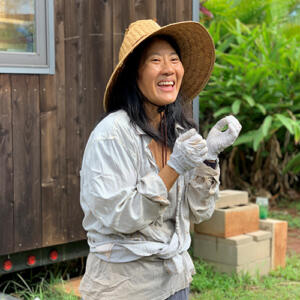
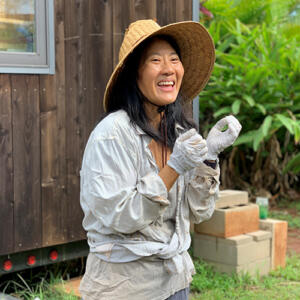 Source: Terri Dux, NRCS
Location: Kailua, Hawaiʻi (island of Oʻahu, Honolulu County)
Established: 2017
Acres: 2.25
Production: Okra, eggplant, pumpkin, ginger, turmeric, roselle/hibiscus, and perennials: ulu, dragonfruit, papaya, citrus, cacao, lilikoi, and jackfruit
Certification: Uses organic practices
Staffing: 2 volunteers (in exchange for living quarters)
Markets: CSA, a local organic grocery store, restaurants, and Facebook Marketplace; ulu is sold to a chip company
Social media: Instagram
Read more: Growing Organic at the Farm of the Fearless Monkey from the USDA’s Farmers.gov blog.
Meet Timothy Clark of Sunshine Farm Foundation
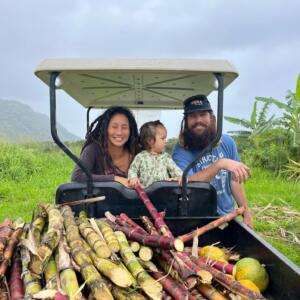
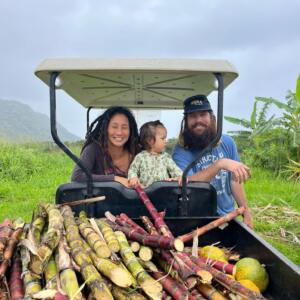 Source: Sunshine Farm Foundation
Location: Mokulēʻia, Hawaiʻi (island of Oʻahu, Honolulu County)
Established: 2020
Acres: 15
Production: Mangoes, bananas, ulu, citrus, avocados, plus grazing animals including sheep, pigs, goats
Certification: Uses organic practices, not yet certified
Markets: Bananas are marketed through a neighboring farmer’s CSA
Social media: Facebook
About the Farmers
Maigee Chang (Farm of the Fearless Monkey) has lived in Hawaiʻi for over 30 years and came into her farming career after working at the intersection of local politics and agriculture, where she met farmers and attended farming workshops.
As her passion for farming grew, she found the land that would become Farm of the Fearless Monkey and set about getting the training and support she needed.
Maigee began her journey through the University of Hawaiʻi’s College of Tropical Agriculture and Human Resources program: GoFarm Hawaiʻi, where she connected with farmers, mentors, and Extension agents, and continued to strategically plug into support systems.
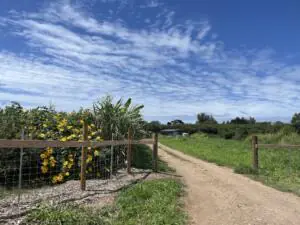 Source: Sunshine Farm Foundation
The entrance to Sunshine Farm Foundation.
Timothy Clark (Sunshine Farm Foundation) was born and raised in Florida and moved to Oʻahu in 2012, where he started farmwork via permaculture and permablitz projects, working in community and volunteering to plant food and forestry yardscapes in Hawaiʻi.
In 2020, he and his partners acquired the 15-acre land site, which they continue to develop to provide education and, eventually, food for those experiencing hunger. Their first farm, established in 2018, focused on education and permaculture practices.
Their current property is structured as a tenants-in-common ownership model with 27 farming plots and the goal of one day becoming an organic farming zone. Working with CSP has represented a supportive bridge in the journey towards wider production and becoming USDA-certified organic.
We recently spoke to Maigee and Tim about their experience as organic farmers navigating NCRS support systems. Below, we’re sharing the conversation and their valuable insight.
Why Organic?
Maigee (Farm of the Fearless Monkey): I don’t like spraying, and I don’t want any of that near my workers or me. Also, chemicals are very expensive.
I trained with OMRI-approved products; I’m comfortable using those, and they’re a lot simpler. I mainly use soap, neem, and BT (Bacillus thuringiensis, organic pest control); if something’s awry, I pull the plant and toss it. We do a lot of crop rotations and companion planting, and I’ve seen the effect of that. With mulching and healthy soil, my plants are stronger.
Tim (Sunshine Farm Foundation): Growing up, my father was a medical doctor who later moved into alternative medicine, focusing on supporting patients who had cancers with organic diets and homeopathic treatments. We always ate organic foods. When I started farming, I didn’t think that there was another way.
And working with the permaculture crew and kind of learning that methodology, and getting into agroforestry, you know, it was never a question of whether or not to use organic treatments for pests or fertilization.
We try to use permaculture and agroforestry designs that make pest management easier, such as attracting beneficial insects and utilizing native plants. This is where NRCS has been helpful.
Context & Challenges
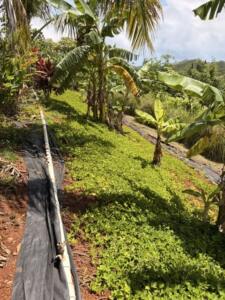 Source: Farm of the Fearless Monkey
Perennial peanut cover cropping at Farm of the Fearless Monkey.
Maigee (Farm of the Fearless Monkey): The constant pest is the coconut rhinoceros beetle (CRB), so we’re trying to address that using various techniques. We do netting around the crown of the tree, we keep our mulch piles covered and rotate them at least every two months, and send the chickens in to scratch through.
We’re in a spot that hasn’t been hit too hard by the recent flooding; the water flows off of our area. Those storms came when we were doing cover crop, which helped the cover crop, and we didn’t lose anything. The vetiver (cover crop) is great and stopped everything from a massive flow.
Tim (Sunshine Farm Foundation): We had about 100 coconut trees wiped out by the coconut rhinoceros beetle. So we’re doing a pilot program to see if we can control the beetle with about 60 dwarf coconuts in high tunnels with netting (supported by EQIP).
We had about three or four storms this spring (2026), which caused a lot of damage to our property. That said, we’re in a drought area on the island, and water supply and power are a concern.
Our main focus is planting drought-tolerant crops. Water can go out for several days when they’re fixing lines, so we’ve signed up for a backup storage and water-pump program through NRCS.
Working with NRCS
Application Process
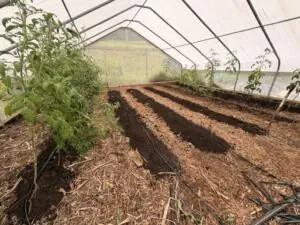 Source: Farm of the Fearless Monkey
EQIP-funded hoop house with mulching at Farm of the Fearless Monkey.
Maigee (Farm of the Fearless Monkey): From working with the agriculture committee and then as secretary of the Waimānalo chapter of the Hawaii Farmers Union, I was familiar with NRCS representatives. I got a hoop house through the Environmental Quality Incentives Program (EQIP), and then we started working on a conservation plan.
Getting through the CSP application process was straightforward. I knew what I wanted to do, it was covered by the program, and my CSP agent walked me through everything. It’s been a smooth process; she sends me documents and deadline reminders, so it feels manageable.
Tim (Sunshine Farm Foundation): I found CSP through research and initially found it difficult to navigate until I connected with the first in a series of very helpful representatives who helped me begin a windbreak program and subsequent plans. You have to persevere. Our first contract phase was three years ago; now we’re in the second year of our second contract.
Implementation
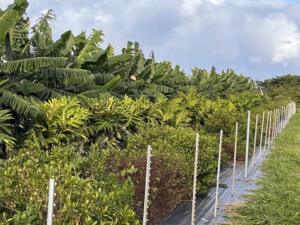 Source: Sunshine Farm Foundation
A row of banana trees and shrubs serves as a windbreak to protect crops at Sunshine Farm Foundation.
Maigee (Farm of the Fearless Monkey): We’re doing mulching and cover cropping and crop rotation, paid in bulk at the end of every year. For mulching, it was a five-year contract; payment started at $2,000 a year, then jumped to $4,000. Cover cropping started as a three-year contract, which has been renewed. The reimbursements mainly help cover labor costs for practices I’d do anyway.
Tim (Sunshine Farm Foundation): Our CSP contract includes $6,000 per year for five years ($4,000 cropland and $2,000 homestead), and practices include perennial cover crop (Bermuda grass) and establishing a native forestry zone.
We’re getting compost reimbursements (paying only for the delivery charges), and we have a contract to mulch over our orchard. It’s been great. And I was able to get a tree trimmer as well.
Outcomes & Challenges
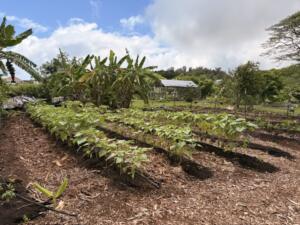 Source: Farm of the Fearless Monkey
Mulching and labor was covered by CSP contract at Farm of the Fearless Monkey.
Maigee (Farm of the Fearless Monkey): My soil is amazing right now. The plants are really happy. Mulching has reduced water use, and soil testing showed a pH shift from acidic to alkaline, which changed my fertilizer approach.
One big challenge is soil testing, not just getting the tests, but shipping them to the mainland (Oregon) in refrigerated/cooler boxes within 24 hours, and the airport where we ship them from is almost an hour away. If we could do that locally, it would save a lot of hassle.
Tim (Sunshine Farm Foundation): We get support from everyone at NRCS, they’re great! They’ve really helped us navigate programs.
I am in a predicament, however, because when they came out to inspect, even though I had the animals and I had the orchard, we were categorized as orchard-only, meaning I can’t transition to my original plan of getting the animal management care, such as internal grazing fencing.
So we missed something there and can’t go back or risk losing the program and having to reapply. So we’ll complete the contract as is and then apply for this longer-term plan.
Advice to Farmers
Maigee (Farm of the Fearless Monkey): If farmers are considering applying for CSP, you should totally do it. One, because it’s good practice. And two, it’s a good program. For a farm of my size, it wasn’t that complicated.
Tim (Sunshine Farm Foundation): When you’re preparing the paperwork, be sure to think long term. Consider the next five years and what may need to be a part of your application.
I also recommend applying with as comprehensive a plan as possible, including multiple conservation practices, to potentially give your application a higher ranking and likelihood of success.
And don’t forget outreach to other farmers, we have to share what programs we’re benefiting from.
Next Steps & Resources
Interested in transitioning your farm for organic certification in the West/Southwest or beyond? Explore these key resources and connect with mentors, certifiers, and Technical Support Providers (TSP) near you.
- Download a printable summary of the key takeaways for farmers to consider when applying to NRCS CSP in English (click here) and Spanish (click here).
Locating Support Providers and Mentors:
- Connect with a local TOPP Mentor or Become a Mentor
- Find a local Technical Service Provider (TSP)
- Organic Certifier locator
- Conservation Technical Assistance (CTA)
Organic Farming Research Foundation resources:
- All Transition to Organic Partnership Program (TOPP) resources
- Events, Resources, and News for Northwest TOPP
- OFRF Resource Hub
USDA resources:
- TOPP General Interest Form
- NOP Handbook: Guidance & Instructions for Certifying Agents & Certified Operations
- Organic Recordkeeping: Guides, Templates, and Other Resources
- National List of Allowed and Prohibited Substances
Connect with OFRF:
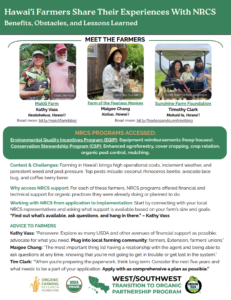
Dos agricultores de Oʻahu comparten sus logros y desafíos al acceder al apoyo del CSP del NRCS
Por Mary Elizabeth Kidd, asociada de comunicaciones
La OFRF trabaja actualmente para aumentar la conciencia de los agricultores y las comunidades sobre las oportunidades de financiamiento federal disponibles para las granjas orgánicas y en transición hacia lo orgánico.
Como parte de nuestro trabajo con la región Oeste del Programa de Alianzas para la Transición a lo Orgánico (Transition to Organic Partnership Program, TOPP) del USDA, destacamos dos granjas de Hawaiʻi —Maigee Chang, de Farm of the Fearless Monkey, y Timothy Clark, de Sunshine Farm Foundation— que recibieron financiamiento y apoyo a través del Programa de Administración de la Conservación (Conservation Stewardship Program, CSP) del Servicio de Conservación de Recursos Naturales (NRCS).
Su historia ofrece una mirada transparente de lo que realmente implica trabajar con el NRCS: los beneficios, los obstáculos y las lecciones aprendidas. Esperamos que otros agricultores puedan aprovechar su experiencia para transitar más fácilmente el proceso de solicitar e implementar los contratos del CSP.
Conozca a Maigee Chang, de Farm of the Fearless Monkey
 Source: Terri Dux, NRCS
Ubicación: Kailua, Hawaiʻi (isla de Oʻahu, condado de Honolulu)
Fundada: 2017
Superficie: 2.25 acres
Producción: Okra, berenjena, calabaza, jengibre, cúrcuma, roselle/hibisco, y perennes: ulu (fruta del pan), pitahaya, papaya, cítricos, cacao, lilikoi (maracuyá) y yaca
Certificación: Usa prácticas orgánicas
Personal: 2 voluntarios (a cambio de alojamiento)
Mercados: Agricultura apoyada por la comunidad (CSA), una tienda local de comestibles orgánicos, restaurantes y Facebook Marketplace; el ulu se vende a una empresa de snacks (chips)
Redes sociales: Instagram
Lea más: Growing Organic at the Farm of the Fearless Monkey del blog Farmers.gov del USDA.
Conozca a Timothy Clark, de Sunshine Farm Foundation
 Source: Sunshine Farm Foundation
Ubicación: Mokulēʻia, Hawaiʻi (isla de Oʻahu, condado de Honolulu)
Fundada: 2020
Superficie: 15 acres
Producción: Mangos, plátanos, ulu (fruta del pan), cítricos, aguacates, además de animales de pastoreo como ovejas, cerdos y cabras
Certificación: Usa prácticas orgánicas, aún no certificada
Mercados: Los plátanos se comercializan a través de la CSA (agricultura apoyada por la comunidad) de un agricultor vecino
Redes sociales: Facebook
Sobre los agricultores
Maigee Chang (Farm of the Fearless Monkey) ha vivido en Hawaiʻi por más de 30 años y llegó a su carrera agrícola tras trabajar en la intersección entre la política local y la agricultura, donde conoció a agricultores y asistió a talleres de agricultura.
A medida que crecía su pasión por la agricultura, encontró el terreno que se convertiría en Farm of the Fearless Monkey y se dedicó a conseguir la capacitación y el apoyo que necesitaba.
Maigee comenzó su camino a través del programa College of Tropical Agriculture and Human Resources de la University of Hawaiʻi: GoFarm Hawaiʻi, donde se conectó con agricultores, mentores y agentes de Extensión, y siguió integrándose estratégicamente a los sistemas de apoyo.
Timothy Clark (Sunshine Farm Foundation) nació y creció en Florida y se mudó a Oʻahu en 2012, donde comenzó el trabajo agrícola mediante proyectos de permacultura y permablitz, trabajando en comunidad y como voluntario para plantar alimentos y paisajes forestales en Hawaiʻi.
Source: Sunshine Farm FoundationEntrada a Sunshine Farm Foundation.
En 2020, él y sus socios adquirieron el terreno de 15 acres, que siguen desarrollando para brindar educación y, con el tiempo, alimentos para las personas que padecen hambre. Su primera granja, fundada en 2018, se centró en la educación y las prácticas de permacultura.
Su propiedad actual está estructurada como un modelo de propiedad en común (tenants-in-common) con 27 parcelas de cultivo y la meta de convertirse algún día en una zona de agricultura orgánica. Trabajar con el CSP ha representado un puente de apoyo en el camino hacia una mayor producción y hacia obtener la certificación orgánica del USDA.
Hablamos recientemente con Maigee y Tim sobre su experiencia como agricultores orgánicos al desenvolverse en los sistemas de apoyo del NRCS. A continuación, compartimos la conversación y sus valiosas reflexiones.
¿Por qué orgánico?
Maigee (Farm of the Fearless Monkey): No me gusta fumigar y no quiero nada de eso cerca de mis trabajadores ni de mí. Además, los productos químicos son muy caros.
Me capacité con productos aprobados por OMRI; me siento cómoda usándolos y son mucho más simples. Uso principalmente jabón, neem y BT (Bacillus thuringiensis, control orgánico de plagas); si algo anda mal, arranco la planta y la desecho. Hacemos muchas rotaciones de cultivos y siembra asociada, y he visto el efecto de eso. Con el acolchado (mulch) y un suelo sano, mis plantas son más fuertes.
Tim (Sunshine Farm Foundation): Cuando yo crecía, mi padre era médico y luego se pasó a la medicina alternativa, enfocándose en apoyar con dietas orgánicas y tratamientos homeopáticos a pacientes con cáncer. Siempre comíamos alimentos orgánicos. Cuando empecé a cultivar, no pensé que hubiera otra manera.
Y trabajando con el equipo de permacultura y aprendiendo esa metodología, y adentrándome en la agrosilvicultura, nunca fue cuestión de si usar o no tratamientos orgánicos para las plagas o la fertilización.
Procuramos usar diseños de permacultura y agrosilvicultura que facilitan el manejo de plagas, como atraer insectos benéficos y utilizar plantas nativas. Aquí es donde el NRCS ha sido de ayuda.
Contexto y desafíos
Source: Farm of the Fearless MonkeyCultivo de cobertura de maní perenne en Farm of the Fearless Monkey.
Maigee (Farm of the Fearless Monkey): La plaga constante es el escarabajo rinoceronte del cocotero (coconut rhinoceros beetle, CRB), así que intentamos enfrentarlo con varias técnicas. Colocamos malla alrededor de la corona del árbol, mantenemos cubiertas nuestras pilas de acolchado (mulch) y las rotamos al menos cada dos meses, y metemos a las gallinas para que escarben.
Estamos en un lugar que no ha sido muy afectado por las inundaciones recientes; el agua se escurre de nuestra zona. Esas tormentas llegaron cuando estábamos sembrando cultivo de cobertura, lo que benefició al cultivo de cobertura, y no perdimos nada. El vetiver (cultivo de cobertura) es excelente y frenó todo de un flujo enorme.
Tim (Sunshine Farm Foundation): El escarabajo rinoceronte del cocotero acabó con unos 100 cocoteros. Así que estamos realizando un programa piloto para ver si podemos controlar el escarabajo con unos 60 cocoteros enanos en túneles altos con malla (financiado por el EQIP).
Tuvimos unas tres o cuatro tormentas esta primavera (2026), que causaron muchos daños a nuestra propiedad. Dicho esto, estamos en una zona de sequía de la isla, y el suministro de agua y de electricidad es una preocupación.
Nuestro enfoque principal es plantar cultivos tolerantes a la sequía. El agua puede cortarse por varios días cuando reparan las tuberías, así que nos inscribimos en un programa de almacenamiento de reserva y bombeo de agua a través del NRCS.
Trabajar con el NRCS
Proceso de solicitud
Source: Farm of the Fearless MonkeyEQIP-invernadero financiado por el EQIP con acolchado. Foto cortesía de Farm of the Fearless Monkey.
Maigee (Farm of the Fearless Monkey): Por trabajar con el comité de agricultura y luego como secretaria del capítulo de Waimānalo del Hawaii Farmers Union, ya conocía a los representantes del NRCS. Obtuve un invernadero a través del EQIP, y luego empezamos a trabajar en un plan de conservación.
Superar el proceso de solicitud del CSP fue sencillo. Sabía lo que quería hacer, estaba cubierto por el programa y mi agente del CSP me guio en todo. Ha sido un proceso fluido; ella me envía documentos y recordatorios de fechas límite, así que se siente manejable.
Tim (Sunshine Farm Foundation): Encontré el CSP investigando y al principio me resultó difícil de manejar, hasta que me contacté con el primero de una serie de representantes muy serviciales que me ayudaron a iniciar un programa de cortavientos (windbreak) y planes posteriores. Hay que perseverar. Nuestra primera fase de contrato fue hace tres años; ahora estamos en el segundo año de nuestro segundo contrato.
Implementación
Source: Sunshine Farm FoundationUna hilera de plátanos y arbustos sirve de cortavientos para proteger los cultivos. Foto cortesía de Sunshine Farm Foundation.
Maigee (Farm of the Fearless Monkey): Estamos haciendo acolchado, cultivo de cobertura y rotación de cultivos, que se pagan en conjunto al final de cada año. El acolchado fue un contrato de cinco años; el pago comenzó en $2,000 al año y luego subió a $4,000. El cultivo de cobertura empezó como un contrato de tres años, que se ha renovado. Los reembolsos ayudan principalmente a cubrir los costos de mano de obra de prácticas que yo haría de todos modos.
Tim (Sunshine Farm Foundation): Nuestro contrato del CSP incluye $6,000 al año durante cinco años ($4,000 para tierras de cultivo y $2,000 para la propiedad familiar), y las prácticas incluyen un cultivo de cobertura perenne (pasto Bermuda) y el establecimiento de una zona forestal nativa.
Estamos recibiendo reembolsos de compost (pagando solo los cargos de entrega), y tenemos un contrato para aplicar acolchado sobre nuestro huerto. Ha sido estupendo. Y también pude conseguir una podadora de árboles.
Resultados y desafíos
Source: Farm of the Fearless MonkeyAcolchado y mano de obra cubiertos por el contrato del CSP. Foto cortesía de Farm of the Fearless Monkey.
Maigee (Farm of the Fearless Monkey): Mi suelo está increíble en este momento. Las plantas están muy contentas. El acolchado ha reducido el uso de agua, y los análisis de suelo mostraron un cambio de pH de ácido a alcalino, lo que cambió mi enfoque de fertilización.
Un gran desafío son los análisis de suelo: no solo hacer las pruebas, sino enviarlas al continente (Oregon) en cajas refrigeradas o con hielera dentro de las 24 horas, y el aeropuerto desde donde las enviamos está a casi una hora. Si pudiéramos hacerlo localmente, nos ahorraría muchas complicaciones.
Tim (Sunshine Farm Foundation): Recibimos apoyo de todo el personal del NRCS, ¡son excelentes! De verdad nos han ayudado a desenvolvernos en los programas.
Sin embargo, estoy en un aprieto, porque cuando vinieron a inspeccionar, aunque yo tenía los animales y el huerto, nos clasificaron solo como huerto, lo que significa que no puedo pasar a mi plan original de obtener el cuidado del manejo de animales, como el cercado interno para pastoreo.
Así que se nos escapó algo ahí y no podemos retroceder, o correríamos el riesgo de perder el programa y tener que volver a solicitar. Por eso completaremos el contrato tal como está y luego solicitaremos este plan de más largo plazo.
Consejos para los agricultores
Maigee (Farm of the Fearless Monkey): Si un agricultor está considerando solicitar el CSP, definitivamente debería hacerlo. Primero, porque es una buena práctica. Y segundo, porque es un buen programa. Para una granja de mi tamaño, no fue tan complicado.
Tim (Sunshine Farm Foundation): Cuando esté preparando la documentación, asegúrese de pensar a largo plazo. Considere los próximos cinco años y lo que podría necesitar incluir en su solicitud.
También recomiendo presentar la solicitud con un plan lo más completo posible, que incluya varias prácticas de conservación, para dar potencialmente a su solicitud una mejor clasificación y mayor probabilidad de éxito.
Y no olvide difundir la información entre otros agricultores; tenemos que compartir de qué programas nos estamos beneficiando.
Próximos pasos y recursos
¿Le interesa hacer la transición de su granja para la certificación orgánica en la región Oeste/Suroeste o más allá?
Explore estos recursos clave y conéctese con mentores, certificadores y Proveedores de Apoyo Técnico (Technical Support Providers, TSP) cerca de usted.
Cómo localizar proveedores de apoyo y mentores:
- Conéctese con un mentor local del TOPP o conviértase en mentor
- Encuentre un Proveedor de Servicios Técnicos (Technical Service Provider, TSP) local
- Buscador de certificadores orgánicos
- Asistencia Técnica en Conservación (Conservation Technical Assistance, CTA)
Recursos de la Organic Farming Research Foundation:
- Todos los recursos del Programa de Alianzas para la Transición a lo Orgánico (TOPP)
- Eventos, recursos y noticias del TOPP del Noroeste
- Centro de recursos de la OFRF
Recursos del USDA:
- Formulario de interés general del TOPP
- Manual del NOP: orientación e instrucciones para agentes certificadores y operaciones certificadas
- Registros de operaciones orgánicas: guías, plantillas y otros recursos
- Lista Nacional de Sustancias Permitidas y Prohibidas
Conéctese con la OFRF: