Insects & Diseases

How One Kona Farm Made Federal Funding Work for Organic Agriculture

Written by Mary Elizabeth Kidd, OFRF Communications Associate

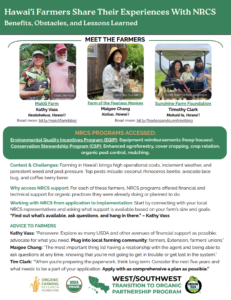
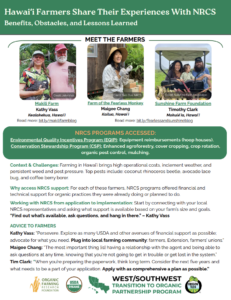
OFRF is currently working to increase farmer and community awareness of the federal funding opportunities available to organic and transitioning farms. As part of our work with the West region of the USDA’s Transition to Organic Partnership Program (TOPP), we’re spotlighting the experience of one farm—Makili Farm in Kealakekua, Hawaiʻi—that received funding and support through the Natural Resource Conservation Service’s Conservation Stewardship Program (CSP).

Their story offers a transparent look at what it’s really like to work with NRCS: the benefits, the obstacles, and the lessons they’ve learned. We hope other farmers can use their experience to navigate the process of applying for and implementing CSP contracts more easily.

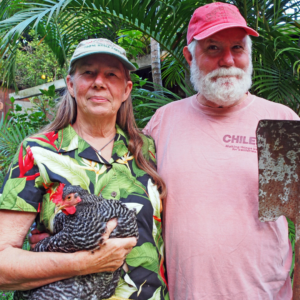
Meet Kathy Vass of Makili Farm

Location: Kealakekua, Hawaiʻi (west coast of Hawaiʻi Island)

Established: 2013

Acres: 5.8

Production: Coffee, macadamia nuts, cacao, citrus, vanilla, vegetables, tropical fruit, and pineapples

Certification: USDA Certified Organic since 2017

Staffing: Two part-time team members, plus seasonal staff (macadamia harvest)

Markets: Wholesale (grocery stores and local distributors)

Context & Challenges

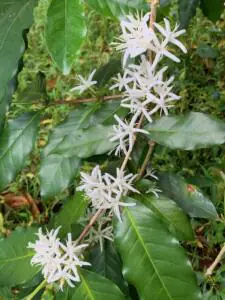
Coffee flowers.Source: Makili Farm

Coffee flowers in bloom.

OFRF team members recently spoke to Kathy Vass, owner and primary farmer at Makili Farm, sitting on almost 6 acres at an elevation of 1,500 feet on the west coast of Hawaiʻi Island.

She shared a realistic and dedicated vision of organic farming on Hawaiʻi Island, where approximately 85% of food is imported, operational costs are high, and pest and environmental pressures are tremendous. Seasonal cyclones and recent earthquakes bring even more obstacles.

Her commitment to provide organic, locally-produced food for her community is palpable and powerful: “We’re all struggling financially. I know very few farms that aren’t. We’re providing enough income to live on. But the ones I know who are succeeding are organic.”

Kathy has been working in the soil for over 55 years, from her previous career as a landscape contractor in Long Island, New York, to her 13 years of farming at Makili Farm.

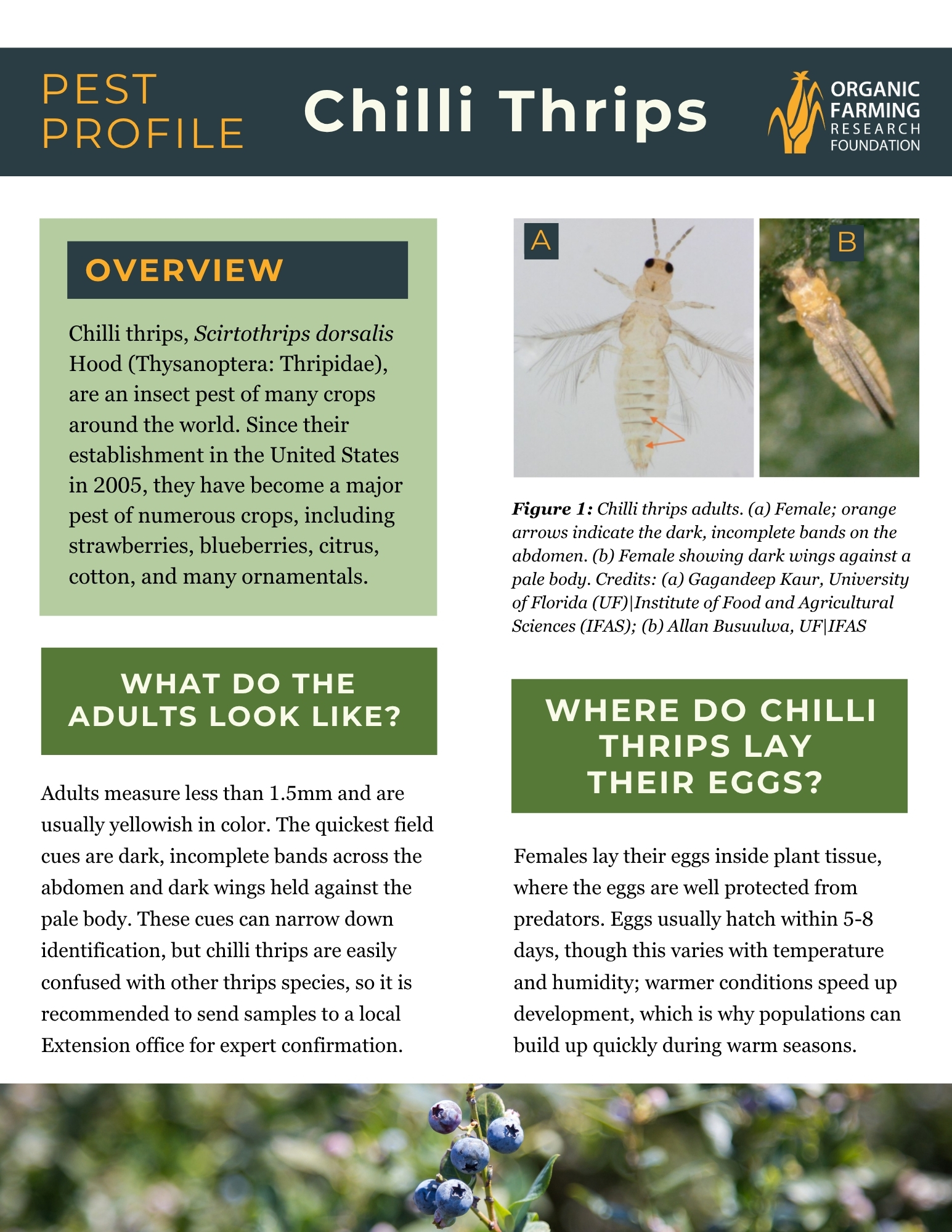
Kathy notes that in the last 5-10 years, pests and invasive weeds have surged. The avocado lace bug and the coffee berry borer, in addition to nematodes, continue to wreak particular damage to her key crops; coffee leaf rust has also led to crop loss.

>> Read more: Kathy and five other farms participated in a 2021 OFRF research grant exploring Organic Farming Systems Options for Controlling Coffee Leaf Rust (CLR) in Kona Coffee.

The impact of these pests and diseases is the primary reason Kathy sought support from programs like the Natural Resource Conservation Service’s (NRCS) Conservation Stewardship Program (CSP). The knowledge and financial support they provide have been a lifeline for her business.

Why Organic?

Vanilla bean orchid. Source: Makili Farm

Vanilla bean orchid.

“I have always, for 55 years, done nothing but organic methods.”

Despite so many challenges, Kathy’s commitment to organic practices remains unshaken. She continues, “organic farming is, whether certified or not, so important for the health of our soil, our water, and our air. It’s just so important to me to have healthy food from healthy soil.”

The higher market value for organic products was also appealing; organic coffee cherries get $1 more per pound than conventional ones.

That said, each year Kathy questions her desire to remain certified. “It feels like a burden,” she shared, “Every year when it’s time for me to start doing the paperwork, I weigh whether I really want to keep doing the certification. I would always continue to be organic, regardless of whether I’m certified or not. I’m not sure that the price difference makes a big difference.”

Accessing Support through NRCS CSP

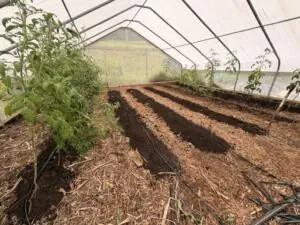
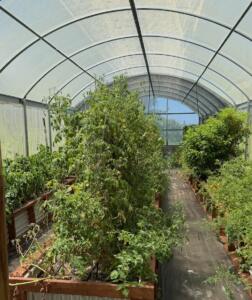
Plants growing in raised beds inside a hoop house. Source: Makili Farm

EQIP-supported hoop house.

Kathy’s daughter-in-law, also a local farmer, suggested Kathy contact Laura Nelson, who leads the Kealakekua Natural Resources Conservation Service (NRCS) office.

Kathy first worked with Laura to secure Environmental Quality Incentives Program (EQIP) reimbursement for approximately half the cost of a 20-foot-by-72-foot hoophouse, enabling her to increase production.

Laura then encouraged and supported Kathy through the CSP application process. While Kathy was initially apprehensive of another paperwork-laden application process, her existing documentation for organic certification was already comprehensive and helped expedite the CSP application.

Kathy then worked with Laura to develop goals and objectives for a 5-year contract, which reimburses her $5,000 per year to support her conservation efforts.

CSP Goals & Learnings

Together, Kathy and Laura honed in on two goals for the 5-year CSP contract:

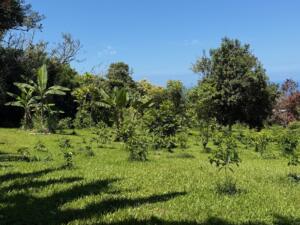
  1. Enhance agroforestry with additional trees and shrubs (primarily fruit-bearing).
  2. Continue ongoing organic pest control practices on the farm.
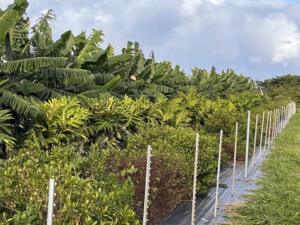
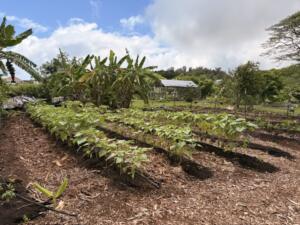
Various trees, including bananas, planted on a farm. Source: Makili Farm

Agroforestry in motion.

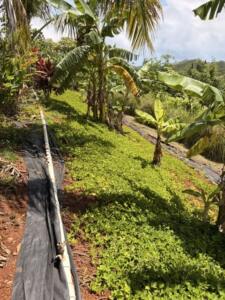
In her first year, she successfully planted cacao, bananas, breadfruit, and cherimoya, expanding her market offerings.

She’s now in the fourth year of her five-year contract and continuing the focus on pest management. A few recent tasks supported by her CSP contract: planting 600 new coffee trees, mulching them, and planting a nitrogen-fixing ground cover, perennial peanut.

While much of her work remains the same—tenacious, focused, and curious—the financial and community support help her stay the course and represent her primary CSP wins. “Having those connections with other farmers has been good…really, really good.”

After her current contract winds down, Kathy is considering another CSP offering focused on native plants. She heavily cites the expertise and accessibility of her NRCS agent, Laura Nelson, as a success-driving factor in her experience with CSP.

Advice to Farmers

“Persevere,” Kathy shared without hesitation. She urges farmers to explore as many USDA and other avenues of financial support as possible, never shying away from doggedly advocating for what they need with USDA agents and representatives. She also recommends plugging into the local farming community, including other farmers, your local Extension, and farmers’ unions.

“Find out what’s available, ask questions, and hang in there.”

Ready to Apply? Here Are a Few Helpful Resources

If you’re a farmer considering applying for CSP or other NRCS programs, here are some helpful tools to get started:

Additional Resources & Reading

Manejo Orgánico de Plagas y Malezas para Proveedores de Servicios en el Sur

Guía de manejo orgánico de plagas y malezas para agentes de extensión y proveedores de servicios técnicos

Esta ficha informativa tiene como objetivo proporcionar a los agentes de extensión y a los proveedores de servicios técnicos del sur una visión general del manejo orgánico de plagas y malezas, y aumentar el conocimiento de los sistemas orgánicos para apoyar eficazmente a los agricultores orgánicos y a aquellos en transición hacia la agricultura orgánica.

¿Prefieres escuchar? Mira nuestro seminario web sobre Manejo Orgánico de Plagas y Malezas para Agentes de Extensión en el Sur.

El control de plagas y malezas es uno de los desafíos más importantes para los productores orgánicos, ya que afecta el rendimiento de los cultivos, la calidad del producto y la sostenibilidad económica de las explotaciones. En las condiciones cálidas y húmedas de la región sur, estas presiones son especialmente intensas, por lo que contar con estrategias de manejo eficaces y conformes con las normas NOP es fundamental para cualquier asesor agrícola.

Esta sesión de 75 minutos está diseñada específicamente para extensionistas, proveedores de servicios técnicos (PST) y otras personas que apoyan a los agricultores orgánicos y en transición en el Sur. Los ponentes analizan los insectos, enfermedades y malezas más comunes en la región SSARE, desde el gusano cogollero y el nematodo de las agallas hasta el amaranto y la juncia, y relacionan este contexto regional con los requisitos de manejo de plagas descritos en el Programa Nacional Orgánico. Basándose en investigaciones realizadas en el Sur, la sesión se centra en estrategias prácticas y con respaldo científico que los extensionistas y los PST pueden brindar directamente a los agricultores a quienes sirven, abarcando enfoques para el manejo de malezas, el control de insectos y enfermedades, y el marco de Manejo Integrado de Plagas (MIP) de “muchos pequeños martillos” que sustenta la producción orgánica.

El control de plagas y malezas es uno de los desafíos más importantes para los productores orgánicos, ya que afecta el rendimiento de los cultivos, la calidad del producto y la sostenibilidad económica de las explotaciones. En las condiciones cálidas y húmedas de la región sur, estas presiones son especialmente intensas, por lo que contar con estrategias de manejo eficaces y conformes con las normas NOP es fundamental para cualquier asesor agrícola.

Esta sesión de 75 minutos está diseñada específicamente para extensionistas, proveedores de servicios técnicos (PST) y otras personas que apoyan a los agricultores orgánicos y en transición en el Sur. Los ponentes analizan los insectos, enfermedades y malezas más comunes en la región SSARE, desde el gusano cogollero y el nematodo de las agallas hasta el amaranto y la juncia, y relacionan este contexto regional con los requisitos de manejo de plagas descritos en el Programa Nacional Orgánico. Basándose en investigaciones realizadas en el Sur, la sesión se centra en estrategias prácticas y con respaldo científico que los extensionistas y los PST pueden brindar directamente a los agricultores a quienes sirven, abarcando enfoques para el manejo de malezas, el control de insectos y enfermedades, y el marco de Manejo Integrado de Plagas (MIP) de “muchos pequeños martillos” que sustenta la producción orgánica.

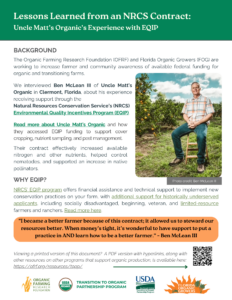
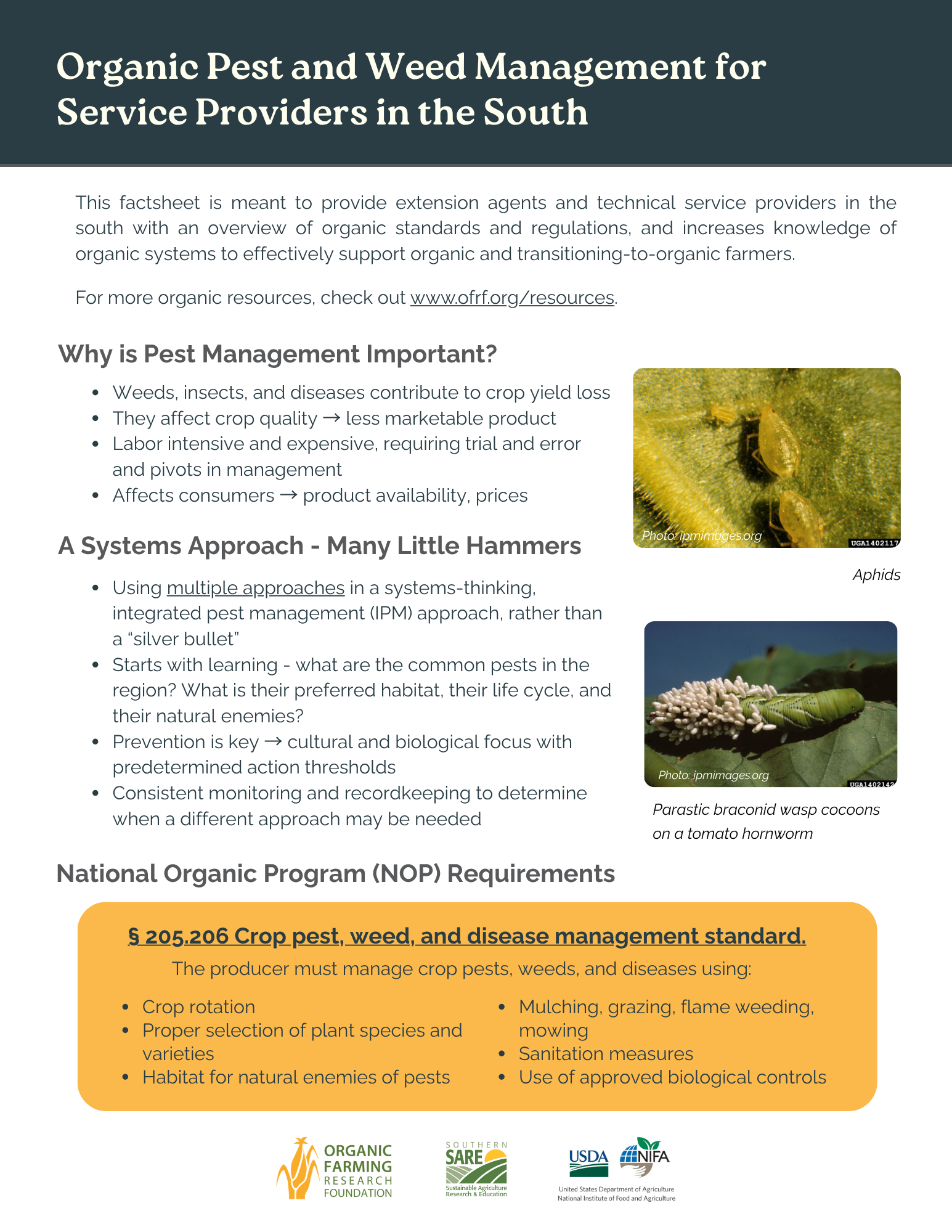
Image of the front page of a four-page factsheet on organic pest and weed management for extension agents in the west.

Organic Pest and Weed Management for Service Providers in the South

An Organic Pest and Weed Management Guide for Extension Agents and Technical Service Providers (TSPs).

This factsheet is meant to provide extension agents and technical service providers in the south with an overview of organic pest and weed management, and increase knowledge of organic systems to effectively support organic and transitioning-to-organic farmers.

Prefer to listen? Watch our Organic Pest and Weed Management for Extension Agents in the South webinar.

Pest and weed pressure is one of the most significant challenges facing organic producers — affecting crop yields, product quality, and the economic sustainability of farming operations. In the hot, humid conditions of the southern region, these pressures are especially intense, making effective, NOP-compliant management strategies essential knowledge for anyone advising farmers in the field.

This 75-min session is designed specifically for extension agents, technical service providers (TSPs), and others who support organic and transitioning farmers in the South. Presenters walk through the most common insects, diseases, and weeds found across the SSARE region — from armyworm and root-knot nematode to pigweed and nutsedge — and connect that regional context to the pest management requirements outlined in the National Organic Program. Drawing on research conducted in the South, the session focuses on practical, science-backed strategies that extension agents and TSPs can bring directly to the farmers they serve, covering approaches to weed management, insect and disease control, and the “many little hammers” IPM framework that underpins organic production.

Image of the front page of a four-page factsheet on organic pest and weed management for extension agents in the west.
By |2026-06-23T10:53:27-04:00June 11th, 2026|Certification & Compliance, Insects & Diseases, Resource|

An Organic Approach to Increasing Resilience

Few farmers need official reports to tell them that “increasing weather volatility” and climate change threaten their livelihoods and the resilience of their farming and ranching operations. With historic droughts, wildfires, flooding, and hurricanes in recent years, more farms are facing variable yields, crop losses, increased weed, pest, and disease pressures, and intensifying soil degradation, erosion, and compaction.

By utilizing organic and sustainable practices to build soil health, farmers and ranchers can improve their resilience and reduce risk as our climate changes. While practices can vary depending on your operation, establishing optimum soil organic matter (SOM) and biological
activity will help your operation through the difficult times to come.

Organic Research in the Balance: What’s Happening in Wisconsin

Written by Brian Geier, OFRF Communications Manger. This article was originally published in the Spring 2025 Organic Broadcaster by Marbleseed.

In labs in Wisconsin and Indiana, researchers are studying how microbial communities found on different varieties of carrots might help lead to disease resistance on organic farms. At a field day in Illinois, ten varieties of carrots are served on paper plates to attendees, who taste and rate the sweetness, texture, and color. And on forty farms across the country, farmers try the new carrot varieties on-farm, via a decentralized trial service called Seedlinked. All are part of the “Carrot Improvement for Organic Agriculture” (CIOA) project, led by Dr. Phillipp Simon at the University of Wisconsin (UW) and partnered with the Organic Seed Alliance (OSA). The effort aims to develop and release new seed lines that can support a surging organic carrot industry that already represents 12% of the carrots grown in the US and is valued at over $120 million annually.

Advanced breeding lines of carrots are being evaluated at the Hoagland Lab at Purdue University, a partner on the CIOA project. To learn more, visit CIOA’s eOrganic page. Photo credit: Purdue University.

The CIOA is one of several projects developed and led in Wisconsin that are responding to the needs of various organic industries and doing critical work to empower farmers to elevate their operations. It serves as just one example of how the organic community in Wisconsin is leading the way toward new innovations through research, helping to advance organics nationwide.

Organics in Wisconsin

Wisconsin is undoubtedly a leader in organic farming. It ranks 5th in the nation in terms of organic market value, after having grown 16% in just two years to $312 million in 2021. The state has the highest number of organic farms of any state outside California, with 1,455 certified operations, representing 8% of the nation’s total. And, Wisconsin is the nation’s leader in the number of organic farmers statewide in several commodities: field crops, livestock and poultry, layer chicken farms, and pig farms. 

By many indicators, the growth trend for organic in Wisconsin is poised to continue: the state ranks second in the number of non-certified farms with transitioning organic acres, an indicator of the potential for growth in a state’s organic sector. And according to UW, the majority of organic farmers in the state (80%) plan to maintain or increase their organic production.

Federally-Funded Research in Wisconsin

To begin a discussion on Federal funding, it can be useful to decode some alphabet soup. Organic research funding reaches Wisconsin through the USDA’s National Institute of Food and Agriculture (NIFA) via the Organic Research and Extension Initiative (OREI), the Organic Transitions Program (ORG), and the Agricultural Research Service (ARS). Project leads are often researchers at universities, but many projects involve collaborative teams of researchers in other states, and many have organic farmers collaborating in research as well.  

Project leads often have ongoing connections to organic farmers, and ideas for research can come from a variety of places including formal surveys or simply through discussions with growers. According to the 2022 National Organic Research Agenda, a comprehensive survey of organic producers across the country conducted by the Organic Farming Research Foundation (OFRF), organic farmers in the Great Lakes ag-ecoregion have identified three key research concerns: 

  • Climate adaptation and resilience. 
  • Weed, pest, and disease management.
  • Soil health.

NIFA has awarded over $19 million in grants to the state’s research institutions for organic research to address these and other concerns. These grants translate to over $380 million in economic activity, since every dollar invested in agricultural research generates about $20 in benefits, according to a long-term study by the USDA’s Economic Research Service (ERS). UW has played a crucial role, securing and investing $8 million of those grants. The ARS has historically funded 20 projects in the state researching organic topics, but currently, only two of those remain active, revealing a gap in the institution’s portfolio.

Innovative Projects Ongoing in Wisconsin

Research led by Dr. Yang, left, seen here standing in his lab alongside business collaborator Daniel Burgin, is bringing new biological agents to organic growers that can help protect apple, tree, and citrus trees from disease. Photo credit: UW.

Organic research underway in Wisconsin serves a diverse range of production systems, from vegetables to tree fruits and dairy. 

Besides the CIOA, which is funded through OREI, another project at UW-Madison, led by Dr. Rebecca Larson and funded by ORG, is partnering with organic dairy farmers through the Organic Valley Cooperative. The team is developing life-cycle analysis models for eight dairy-producing regions so farmers can measure and meet conservation goals. Also funded by ORG but headquartered at UW-Milwaukee, a project led by Dr. Ching-Hong Yang is working to boost the efficacy of a bacterial strain in controlling fire blight in organic apple and pear trees. Dr. Yang, along with a business partner and researchers at the University of Florida, is also testing the same strain for efficacy in lessening the severity of citrus greening.

Wisconsin’s organic producers have a diverse range of operations, and the challenges that organic farmers face are varied. Researchers are answering the calls with strong collaborations, multi-state networks, and dissemination components to bring key findings that farmers can use to inform decisions on their operations. 

Resources and Insights from Research Completed in Wisconsin

Celery variety trials at UW. Photo credit: The Organic Center.

The Organic Alternatives to Conventional Celery Powder project, led by Dr. Erin Silva at UW, addressed a constraint of the organic processed meat industry. This was a timely project, as the National Organic Program (NOP) was about to sunset the allowance of non-organic celery powder. But the question remained: can organic systems produce celery powder with the nitrate content needed for curing meat? The project verified that organic production systems can produce celery powder with sufficient N content for the industry.

Another project, called Connecting Community to Strengthen Organic Seed Breeding and Research and led by the OSA, responded to an urgent need to recruit and train a new generation of plant breeders specializing in cultivar development for organic systems. Plant breeders whose methods comply with organic standards have become an endangered species. The needs of organic seed farmers were collected and presented in OSA’s 2022 State of Organic Seed Report. And yes, 2022 is the same year as OFRF’s NORA report mentioned above. In fact, OFRF and OSA collaborated on an OREI-funded project to conduct the surveys and produce both reports!

OSA’s seed-breeding project conducted the Student Organic Seed Symposium (SOSS), an annual networking and professional development opportunity for graduate students in plant breeding and seed production for organic systems. The symposium was held at West Virginia University to convene a greater geographical and ethnic diversity of students. A speed-mentoring activity amongst participants was found to be especially valuable in identifying the next steps in their professional development. Reflecting on the Symposium, one seed-breeder-in-training stated: “It takes all of us (farmers, researchers, chefs, storytellers) to further our aims of creating genetic diversity and adapting to climate change.”

While research projects in Wisconsin may have been born from the challenges that Wisconsin’s organic farmers face, the knowledge and resources created by projects in the state have made significant contributions to the broader organic community.

Advocacy to Protect Federal Funding for Organic

Certified organic produce now makes up more than 15% of total produce sales in the United States. Organic dairy and eggs now constitute more than 11% of the total market. And overall, organic sales have doubled over the last 10 years and in 2024 made up about 6% of the total US food market. By most measurements, organic food is trending upward nationally, not just in Wisconsin. Most notably, the growth of organic sales is consistently outpacing the growth of the overall food market. To say it another way, we might be heading into a future that is more and more organic! 

But will we get there? 

Despite the growth of the organic sector, organic agriculture research funding makes up less than 2% of the total research budget at the USDA, and less than 1% of the Agricultural Research Service’s (ARS) budget. Additionally, much of the research focused on conventional agriculture relates to chemical applications or genetic traits—technologies that organic producers do not, and if certified, can not, use. To put it another way, organic research benefits all farmers, including conventional ones, but not the other way around.

In order to sustain the growth in organic acreage, producers, and products, it is crucial that more USDA funding be organic and applicable to all farmers. National policy priorities identified by OFRF include:

  • Increasing USDA’s research funding for organic research through both competitive grant programs at the National Institute of Food and Agriculture (NIFA) and intramural research at ARS to reflect its market share and growth trajectory.
  • Fully funding the Organic Data Initiative to provide the necessary market analysis of an increasingly sophisticating sector. 
  • Expanding the accessibility and applicability of technical and financial assistance programs for organic farmers. 

At the time of this article’s writing (early 2025), uncertainty abounds within the organic community as federal funds for a number of programs related to organic farming, addressing climate change or support for specific farming communities ,are currently inaccessible due to executive action by the new administration in January. A federal judge recently ruled against the, but congressionally appropriated funds for active, ongoing organic research, conservation practices, and other services that organic farmers and researchers rely on remain inaccessible. This is causing immense uncertainty and disruption. 

The moment calls for steadfast advocacy and a commitment to organic research programs. OFRF offers resources and ways to get involved: join OFRF’s newsletter to stay informed, share your story if you are a farmer or researcher impacted by interruptions or resumptions of Federal funding, and visit OFRF’s advocacy page to learn more.
By |2025-12-09T17:40:32-05:00April 30th, 2025|Insects & Diseases, Livestock, News, Plant Breeding & Variety Selection|

What’s Happening with Organic Farming Research in Pennsylvania

Written by Brian Geier, OFRF Communications Manger. This article was originally published in Pennsylvania Certified Organic’s (PCO) Organic Matters publication. See the article in PCO’s Winter/Spring 2025 edition.

Before diving into the importance and impact of organic research in Pennsylvania, let’s start with some national context. Nationwide, certified organic produce now makes up more than 15% of total produce sales in the United States. Organic dairy and eggs now constitute more than 11% of the total market. And overall, organic sales have doubled over the last 10 years and in 2024 made up about 6% of the total US food market. By most measurements, organic food is trending upward. Most notably, the growth of organic sales is consistently outpacing the growth of the overall food market. To say it another way, we might be heading into a future that is more and more organic! 

But will we get there? 

Despite the growth of the organic sector, organic agriculture research funding makes up less than 2% of the total research at the USDA, and less than 1% at the Agricultural Research Service (ARS). Additionally, much of the research focused on conventional agriculture relates to chemical applications or genetic traits—technologies that organic producers do not, and if certified, can not, use. To put it another way, organic research benefits all farmers, including conventional ones, but not the other way around.

In order to sustain the growth in organic acreage, producers, and products, it is crucial that more USDA funding be organic and applicable to all farmers. National policy priorities identified by the Organic Farming Research Foundation (OFRF) include:

  • Increasing USDA’s research funding for organic research through both competitive grant programs at the National Institute of Food and Agriculture (NIFA) and intramural research at ARS to reflect its market share and growth trajectory.
  • Fully funding the Organic Data Initiative to provide the necessary market analysis of a rapidly sophisticating sector. 
  • Expanding the accessibility and applicability of technical and financial assistance programs for organic farmers. 

To learn more about this policy work that supports organic nationwide and in Pennsylvania, visit OFRF’s advocacy page.

Organic Research in the Keystone State

Pennsylvania is a powerhouse of organic agriculture. It ranked 4th in the nation with over 100,000 certified acres and 1,200+ farms generating $1 billion in sales in 2021, according to the latest organic survey by the National Agricultural Statistics Service.

The USDA’s NIFA has awarded over $28 million in grants to the state’s research institutions for organic research. Penn State University has played a crucial role, investing $12 million. The ARS has historically funded 17 projects in the state researching organic topics, but currently has no active projects. 

Organic farmers in the state and region have identified three key research concerns (according to the 2022 National Organic Research Agenda): 

  • Climate adaptation and resilience. 
  • Pest management.
  • Soil health.

Active Research Projects in Pennsylvania

Recent NIFA investments, through programs like the Organic Research and Extension Initiative (OREI) and the Organic Transitions Program (ORG), have provided nearly $12 million over the past four years to ongoing projects with an organic focus in Pennsylvania. Key projects at Penn State focus on intensifying production and improving resilience of organic grains, developing a nitrogen decision support tool, testing anaerobic soil disinfection (ASD) in fields and in high tunnels, tracking foraging patterns of organic bees, evaluating perennial crop rotations, and developing parasite resistance in dairy cattle. Another project looking at immersive experiential education of urban educators is underway at Drexel University.

Front cover of OFRF's Organic state Factsheet for the state of Pennsylvania

OFRF’s State-By-State leave-behinds provide data on the organic industry and organic research in states, and can be used to help farmers, researchers, and advocates when articulating needs for proposals or advocating for policy.

OREI-funded research on organic grain production (led by Dr. John Wallace) builds on previous research on reduced and no-til strategies, including planting into high-residue cover crops. Credit: Penn State Weed Science.

Besides providing new knowledge to organic growers, each of these research projects have other direct and indirect benefits worth noting. The Economic Research Service estimates that every $1 spent on agricultural research generates an additional $20 in benefits to the economy. In Pennsylvania, that means the $28 million for organic research translates to $560 million in economic activity. This effect can be seen given the growth of the value in Pennsylvania’s organic production between 2019 and 2021. In 2019, Pennsylvania had 1,039 organic farms with over $740 million in farmgate sales. In 2021, those numbers grew to 1,123 organic farms generating over $1 billion. Research provides real economic opportunities to farms looking to maximize both their economic return and their ecological impact.

Additionally, organic research provides professional training opportunities for undergraduates, graduates, and postdoctoral fellows on organic systems, and promotes symbiosis between up-and-coming researchers and the organic community. As Dr. Ajay Nair, newly appointed as the Department of Horticulture Chair at Iowa State University explained in a recent interview with OFRF, OREI “is the foundation for several of the organic projects that happen across the country. It serves as a good platform for us to reach out to organic growers and for organic growers to reach out to us and say, ‘Hey, can we address this particular issue that is coming up?’ These OREI grants,” he explains, are “actually helping to build our network…to help us build teams across the country.” 

How Pennsylvania Research Benefits Growers Across the Eastern US

Just as organic research can be applicable to all farmers, multi-state projects led in Pennsylvania are bringing new findings to organic farmers facing similar challenges across regions. For example, the OREI-funded project assessing ASD in field, led by Dr. Gioia at Penn State, includes similar research plots led by Dr. Xin Zhao at University of Florida. Results from Pennsylvania may provide insights for growers in the Northeast who face challenges managing soil borne diseases, while the plots in Florida reflect conditions faced by organic growers in the Southeast, but results from each region might inform growers who face similar challenges to similar cropping systems. Growers interested in managing soil health with ASD in the Upper Midwest or the Southeast might find the eOrganic webinar from Dr. Zhao valuable. The webinar focuses on selecting the right carbon source for the organic practice of ASD, which includes insights from the trials on Pennsylvania farms. All growers who want to use ASD to support their transition period to organic farming may be interested in the additional grant awarded to Dr. Gioia and his team to assess the economic viability of using ASD during the transition to organic to control pests and weeds. Additionally, any grower using or considering using ASD can share their story and contribute to the project. “The survey,” Dr. Gioia explains “is part of the bottom-up approach our team have been using to improve the ASD application method and make sure that our research is relevant to growers and meets their needs.”

Source: Francesco Di Gioia/Penn State

Research at Penn State evaluates the impacts of cover crop residues combined or not with wheat bran and molasses as a carbon source for ASD applications on lettuce. The project supports similar research being conducted at the University of Florida. Credit: Francesco Di Gioia/Penn State.

Completed Projects Provide New Resources for Organic Growers

Aside from the active projects above, several NIFA-funded organic research projects have been completed in Pennsylvania. While they may be concluded, the benefits of these organic projects continue. The results of these studies are not limited to publication in academic scientific journals or relevant only to scientists. Researchers, farmers, and extension specialists often collaborate to share the results of studies in ways that are meaningful and applicable to farmers. 

Take soil microbial management, for example. An OREI-funded study led by Dr. Jason Kaye at Penn State involved adding different sources of microbes (composts, forest soils, and other sources) to soils and measuring microbial populations. The project partnered with Pasa Sustainable Agriculture to collaborate with working farmers to conduct studies on working farms. While measurements of soil microbes may not be enough to provide specific recommendations to growers, the knowledge of how microbe populations change under management conditions and how they interact with plant crops can help farmers make better decisions.

Assuming soil microbes are fascinating to everyone with an interest in organic matters, let’s digress here for a moment. There are a myriad of ways that microbes can help or hinder organic systems: Microbes called biostimulants can release hormones into the soil that can help increase plant growth, while others can degrade the stress chemicals that plants produce during drought, helping plants become more resilient. Some microbes called biofertilizers can unlock nutrients in soils that plants cannot access themselves, helping where there may be excess nutrients, while other biofertilizers exchange nutrients directly with the plants in exchange for carbon. And get this—some perform better than others. That is, some biofertilizers that exchange phosphorus for carbon, called arbuscular mycorrhizal fungi (AMF), offer plants more phosphorus in exchange for the same amount of carbon when compared with other AMFs. 

When research-generated insights like these are made available and then accessed, farmers can make better-informed decisions for years to come. All of this fascinating information and more is available to farmers on eOrganic (see Management of Soil Microbes on Organic Farms and Soil Microbes in Organic Cropping Systems 101). Launched in 2009, eOrganic is a national, internet-based, interactive, user-driven, organic agriculture information system for farmers and agricultural professionals.

Want To keep Up With Organic Research in Your State or Nationally?

Aside from using eOrganic, growers and researchers can look forward to a new Organic Content Hub being developed by the OFRF, coming in early 2025. The Content Hub will be searchable by topic, crop, and region, and will provide users with the most current research relevant to organic farming. (Follow OFRF on social media and sign up for our newsletter to get updates on the Content Hub, organic research updates, new organic resources, and more.)

A figure developed by a graduate student (Laura Kaminsky) working on an OREI-funded project during 2019-23 at Penn State, illustrates examples of beneficial microbes. The left diagram shows nitrogen-fixing bacteria, housed either in nodules on legume roots or free-living in the soil. The right diagram illustrates arbuscular mycorrhizal fungi (AMF) (pink) associated with plant roots. See Soil Microbes in Organic Cropping Systems 101.

Moving Forward With Organic Research 

Organic farming research is generating economic activity in Pennsylvania, providing professional development to researchers and students across the east, forming regional networks between researchers and growers, and producing publications being used by organic growers across the country. One might say that the current state of research in Pennsylvania is healthy and humming! 

Looking to the future, it is critical that federal funding keeps up with the growth of the organic movement nationally and in the state. OFRF and partners work daily to bolster and protect this funding, and we are always looking for farmer and researcher partners in this work. If you are an organic farmer or researcher and are willing to share your story, your experiences can be some of the best fodder for advocating for or directing future organic research in Pennsylvania.

By |2025-12-09T17:39:38-05:00March 20th, 2025|Cover Crops & Crop Rotation, Insects & Diseases, News, Soil Health, Weeds|

Farmer-Led Trials Forum 2024

OFRF believes in supporting organic farmers and ranchers in their constant search for innovation and farm profitability. The Farmer-Led Trials (FLT) program puts farmers in the driver’s seat and recognizes their wisdom, experimentation, and problem-solving skills. Built in the spirit of curiosity and collaboration, this program supports farmers and ranchers in conducting impactful research that can address their unique challenges. The FLT provides farmers with technical assistance and a small amount of funding to investigate and learn about solutions to their most pressing production challenges.

In this forum, you will hear from four of the organic farmers in the 2024 FLT cohort:

  • Maggie Dungan (Salad Days Farm, KY),
  • Jorge Reyes (Reyes Vineyard, CA),
  • Nathan Lada (Green Things Farm Collective, MI), and
  • Rhianna Simes (Verdant Phoenix Farm, OR).

OFRF staff will also provide an overview of steps to conduct on-farm research trials, share opportunities to participate in the program, and explain how it can impact your farm operation.

Organic Management of Honey Bees

This resource provides a comprehensive factsheet based on Penn State research comparing conventional, chemical-free, and organic honey bee management systems across 288 colonies. It highlights critical findings on colony health, overwintering survival, and the surprising economic superiority of organic methods, which yielded the highest honey production and net profit.

Download the factsheet to discover how organic miticides and mechanical interventions can effectively manage pests like Varroa mites to support resilient, high-yielding apiaries without the use of synthetic chemicals.

image of two-page pdf factsheet on the organic management of honey bees
By |2026-03-02T12:27:24-05:00February 12th, 2024|Insects & Diseases, On-Farm Research, Resource|

Crop Livestock Integration with John Bitter

In OFRF’s 2022 National Organic Research Agenda (NORA), organic farmers and ranchers across North America shared a common concern about the lack of technical assistance and educational resources available for Integrated Crop-Livestock Systems (ICLS). Integrating crops and livestock results in numerous benefits, however the process can also lead to increased complexity, especially for farmers who must adhere to National Organic Program rules and regulations.

This series of resources focused on Crop-Livestock Integration is informed by interviews with four highly-experienced organic producers that shared their challenges, successes, and advice for others interested in integrating livestock and crops on their organic farms.

This video features John Bitter, Production Manager and co-owner of Frog Song Organics. Frog Song is a diversified organic farm producing vegetables, orchard crops, herbs, flowers, pork, and eggs. Operating on 62 acres in north Florida, Frog Song employs about 30 full-time workers, supplies direct and wholesale markets in several nearby cities, and runs an online, customizable CSA program. In this video, John talks about integration of crop and animal production systems at this thriving organic farm.

Plants sprouting with the Organic Farming Research Foundation Logo
Go to Top