Certification & Compliance

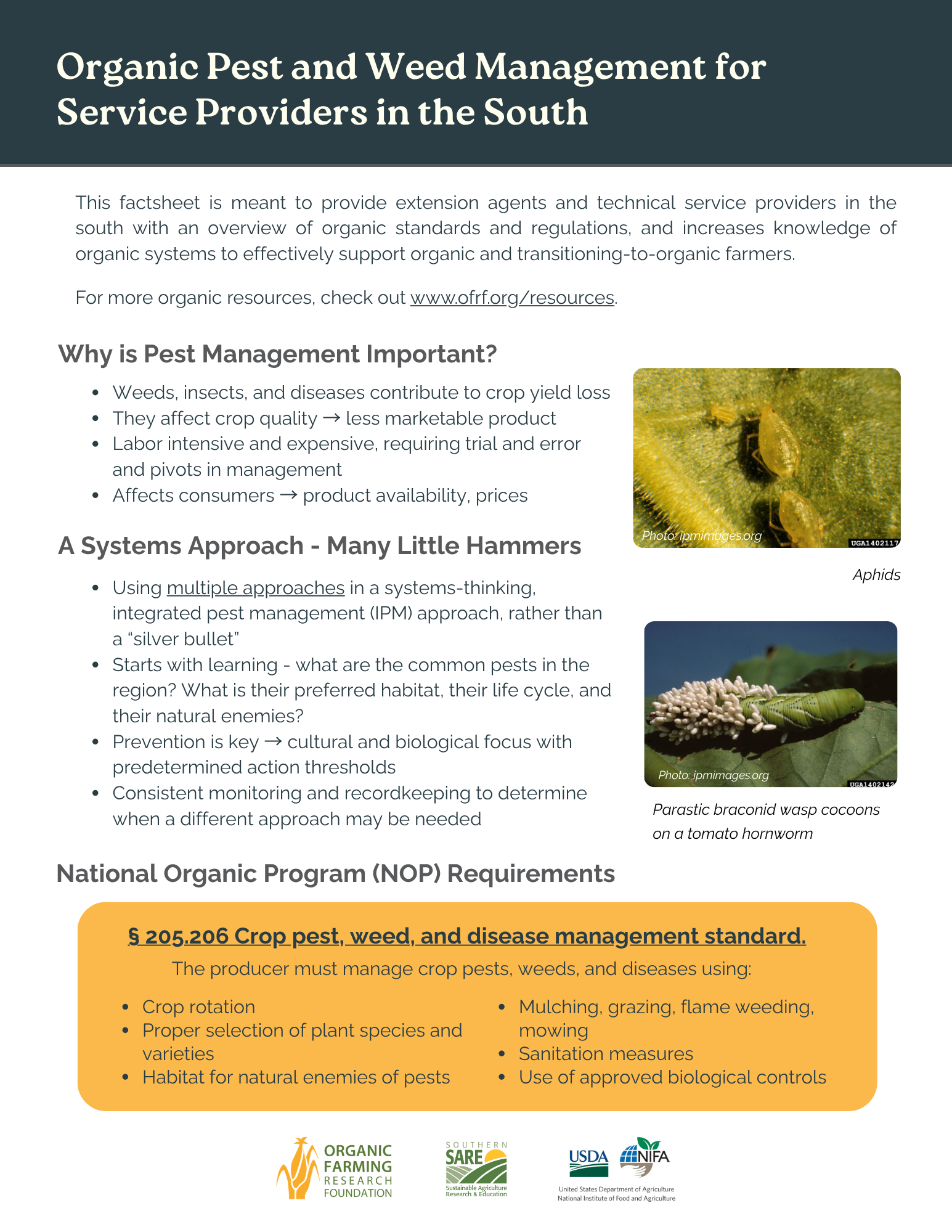
Organic Pest and Weed Management for Service Providers in the South

An Organic Pest and Weed Management Guide for Extension Agents and Technical Service Providers (TSPs).

This factsheet is meant to provide extension agents and technical service providers in the south with an overview of organic pest and weed management, and increase knowledge of organic systems to effectively support organic and transitioning-to-organic farmers.

Prefer to listen? Watch our Organic Pest and Weed Management for Extension Agents in the South webinar.

Pest and weed pressure is one of the most significant challenges facing organic producers — affecting crop yields, product quality, and the economic sustainability of farming operations. In the hot, humid conditions of the southern region, these pressures are especially intense, making effective, NOP-compliant management strategies essential knowledge for anyone advising farmers in the field.

This 75-min session is designed specifically for extension agents, technical service providers (TSPs), and others who support organic and transitioning farmers in the South. Presenters walk through the most common insects, diseases, and weeds found across the SSARE region — from armyworm and root-knot nematode to pigweed and nutsedge — and connect that regional context to the pest management requirements outlined in the National Organic Program. Drawing on research conducted in the South, the session focuses on practical, science-backed strategies that extension agents and TSPs can bring directly to the farmers they serve, covering approaches to weed management, insect and disease control, and the “many little hammers” IPM framework that underpins organic production.

Image of the front page of a four-page factsheet on organic pest and weed management for extension agents in the west.
By |2026-06-11T15:25:35-04:00June 11th, 2026|Certification & Compliance, Insects & Diseases, Resource|

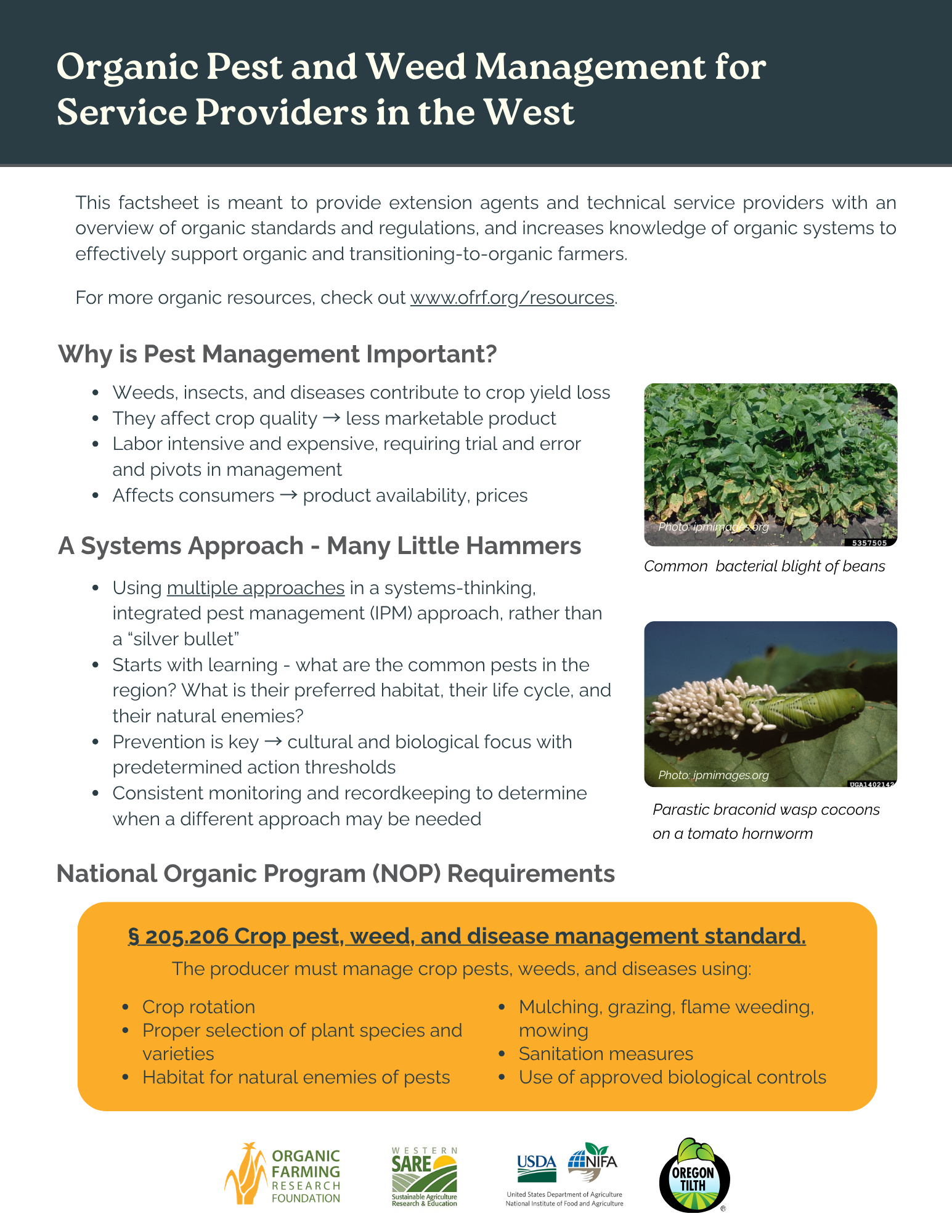
Organic Pest and Weed Management for Service Providers in the West

An Organic Pest and Weed Management Guide for Extension Agents and Technical Service Providers (TSPs).

This factsheet is meant to provide extension agents and technical service providers in the west with an overview of organic pest and weed management, and increase knowledge of organic systems to effectively support organic and transitioning-to-organic farmers.

Prefer to listen? Watch our Organic Pest and Weed Management for Extension Agents in the West webinar.

In this 75-minute session, presenters will walk through the most common insects, diseases, and weeds found across the WSARE region — from apple maggot and wheat stem sawfly to kochia and field bindweed — and connect that regional context to the pest management requirements outlined in the National Organic Program. Drawing on research conducted in the West, the session will focus on practical, science-backed strategies that extension agents and TSPs can bring directly to the farmers they serve, covering approaches to weed management, insect and disease control, and the “many little hammers” IPM framework that underpins organic production.

Image of the front page of a four-page factsheet on organic pest and weed management for extension agents in the west.
By |2026-06-04T15:56:27-04:00June 4th, 2026|Certification & Compliance, Resource|

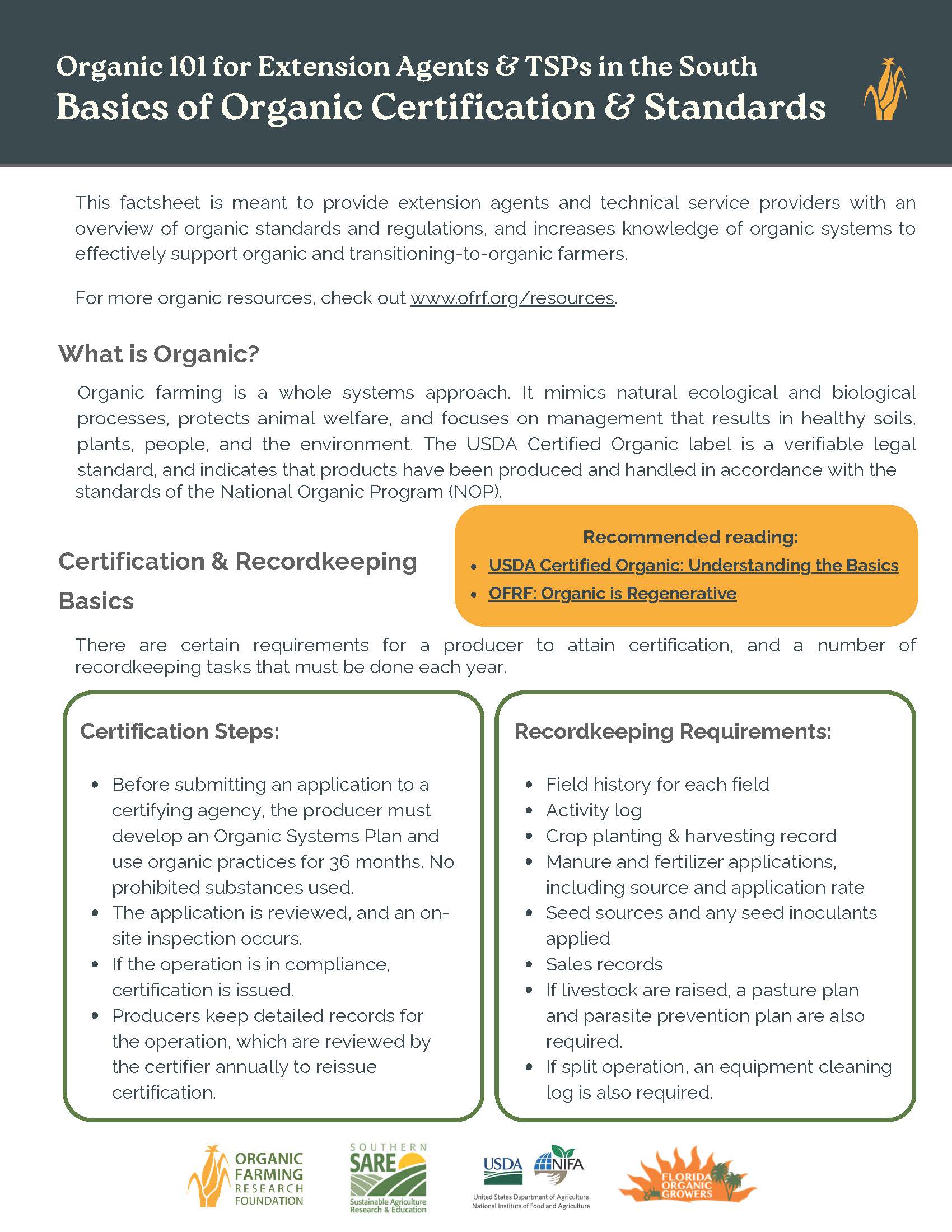
Basics of Organic Certification & Standards for Extension Agents in the South

A foundational guide for Extension Agents and Technical Service Providers (TSPs).

This factsheet provides a concise overview of the USDA National Organic Program (NOP) regulations, designed to help you effectively support farmers in the south as they navigate organic certification and the 36-month transition period.

What’s Covered:

  • The Certification Roadmap: A step-by-step breakdown from developing an Organic Systems Plan (OSP) to the final on-site inspection.
  • Recordkeeping Essentials: A checklist of mandatory logs, including field history, seed sources, and soil amendments.
  • Crop & Land Standards: Rules on buffer zones, crop rotations, and OMRI-approved materials.
  • Livestock & Pasture: Requirements for organic management timelines, grazing (DMI), and animal welfare.

Additionally, three organic experts based in the south, Eva Worden (Worden Farm, Punta Gorda, FL), Juan Carlos Rodriguez (Florida Organic Growers), and Danielle Treadwell (University of Florida) share advice for extension agents and technical service providers when working with organic producers.

Prefer to listen? Watch our Organic 101 for Extension Agents in the South webinar.

In the first half of this informative session, you will learn the basic principles of organic certification and become familiar with organic standards. During the second half, three organic specialists share their experiences with collaborative work involving organic farmers and extension agents.

Certified Crop Advisors can earn 1.0 Professional Development Continuing Education Unit (CEU) following completion of the webinar.

By |2026-04-09T16:18:03-04:00April 9th, 2026|Certification & Compliance, Resource|

Basics of Organic Certification & Standards for Extension Agents in the Northwest

A foundational guide for Extension Agents and Technical Service Providers (TSPs).

This factsheet provides a concise overview of the USDA National Organic Program (NOP) regulations, designed to help you effectively support farmers in the Northwestern US as they navigate organic certification and the 36-month transition period.

What’s Covered:

  • The Certification Roadmap: A step-by-step breakdown from developing an Organic Systems Plan (OSP) to the final on-site inspection.
  • Recordkeeping Essentials: A checklist of mandatory logs, including field history, seed sources, and soil amendments.
  • Crop & Land Standards: Rules on buffer zones, crop rotations, and OMRI-approved materials.
  • Livestock & Pasture: Requirements for organic management timelines, grazing (DMI), and animal welfare.

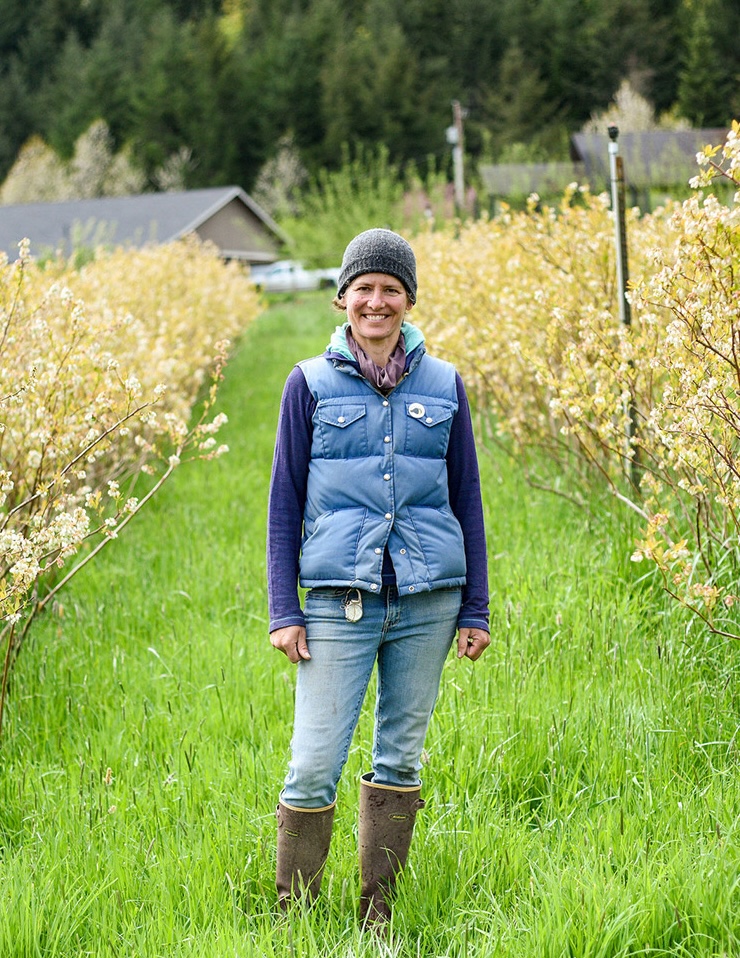
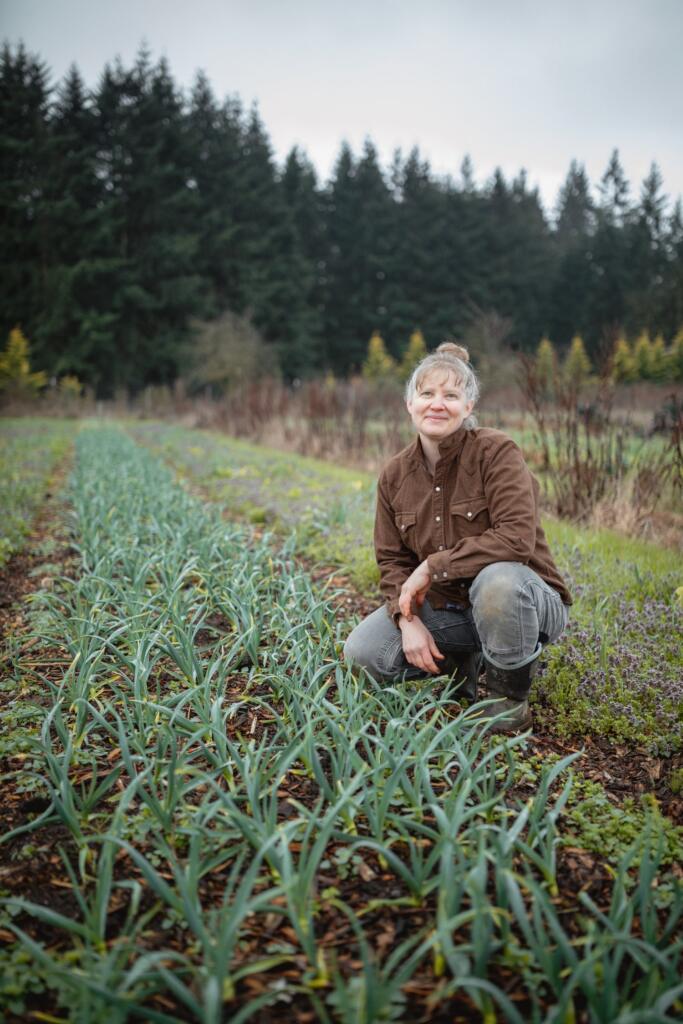
Additionally, three organic farmers based in the Northwest, Beth Hoiknaki of Goodfoot Farm in Philomath, Oregon, April Jones Thatcher of April Joy Farm in Ridgefield, Washington, and Diane Green of Greentree Naturals in Sand Point, Idaho, share advice for extension agents and technical service providers when working with organic producers.

Prefer to listen? Watch our Organic 101 for Extension Agents in the West webinar.

In the first half of this informative session, you will learn the basic principles of organic certification and become familiar with organic standards. During the second half, three farmer panelists share their experiences in becoming certified organic producers in the West.

Certified Crop Advisors can earn 1.0 Professional Development Continuing Education Unit (CEU) following completion of the webinar.

screenshot of the front page of a factsheet titled "Organic 101 for Extension Agents and TSPs - Basics of Organic Certification and Standards"
By |2026-04-08T17:06:01-04:00February 18th, 2026|Certification & Compliance, Resource|

Adding the “O”: Farmer Perspectives and Experiences Transitioning to Organic in the Northwest

Farmers transitioning to organic production face unique challenges that require technical assistance on a wide range of production and non-production issues. During the transition period, farmers must consider financially viable strategies for the three-year transition period, how to restore soil health while learning to manage weeds without herbicides, acquiring new equipment and infrastructure needed for organic production, and navigating NOP-related paperwork during the last year of transition and first year of certification. This webinar features three farmers who have worked through these issues and share their experiences and thoughts for demystifying some of the challenges they faced in the process. In this session, we feature three farmers in the Northwest who have built resilience and a dynamic organic system:

  • Lynn Schaal, Life Springs Farm in Idaho
  • Tracey Dion, Yellowstone River Farms in Montana
  • Aaron Flansburg, Flansburg Farm in Washington

About the Seeds of Success Series

OFRF has partnered with the Organic Farmers Association (OFA) and National Organic Coalition (NOC) to lead a series of virtual farmer-to-farmer networking sessions. These facilitated events will be engaging opportunities for farmers to share their challenges and successes, and will be accompanied with relevant resources you can use.

To learn more about these and other events from OFRF, visit: https://ofrf.org/events/. Funding for this series is provided by a cooperative agreement between OFRF and USDA-NIFA to highlight research investments made through both the OREI and ORG grant programs.

By |2026-03-02T12:28:14-05:00January 15th, 2026|Certification & Compliance, Resource|

Adding the “O”: Farmer Perspectives and Experiences Transitioning to Organic

Are you beginning the process of transitioning your farm to certified organic? Are you wondering how others have overcome the hurdles of certification? Would you like to hear directly from farmers who have successfully made their transition to organic?

This webinar features two farmers that share their experiences and thoughts for demystifying some of the challenges they faced in the process.

Our Farmer Panelists:

  • Mike Bronkema of Shady Side Farm in Michigan began his journey in 1992 with a conventional layer operation. With the help of his wife, Mike has now transitioned 150 acres into a diversified farm of 20 different varieties of edible dry beans as well as heritage small grains, such as einkorn and spelt, and open-pollinated corn. https://shadysidefarm.com/
  • Dakota Moore of Moore Family Farm in Michigan began the transition in 2019. Dakota was raised on the historic Moore Family Farm in Warsaw, North Carolina, which has been around since 1833. He and his father work together on the farm where they specialize in the production of Watermelon, Cantaloupe, Cauliflower, Collard Greens, Cabbage, Butterhead and Romaine Lettuce.
By |2026-03-02T11:55:38-05:00November 18th, 2024|Certification & Compliance, Resource|

Farmer-Led Trials Forum 2024

OFRF believes in supporting organic farmers and ranchers in their constant search for innovation and farm profitability. The Farmer-Led Trials (FLT) program puts farmers in the driver’s seat and recognizes their wisdom, experimentation, and problem-solving skills. Built in the spirit of curiosity and collaboration, this program supports farmers and ranchers in conducting impactful research that can address their unique challenges. The FLT provides farmers with technical assistance and a small amount of funding to investigate and learn about solutions to their most pressing production challenges.

In this forum, you will hear from four of the organic farmers in the 2024 FLT cohort:

  • Maggie Dungan (Salad Days Farm, KY),
  • Jorge Reyes (Reyes Vineyard, CA),
  • Nathan Lada (Green Things Farm Collective, MI), and
  • Rhianna Simes (Verdant Phoenix Farm, OR).

OFRF staff will also provide an overview of steps to conduct on-farm research trials, share opportunities to participate in the program, and explain how it can impact your farm operation.

NRCS Organic Practice 823: Strategies and Best Practices

During this session of the Seeds of Success series OFA explores NRCS Organic Practice 823.

The National Resources Conservation Service (NRCS) has many programs to help farmers convert to organic farming operations. The Environmental Quality Incentives Program (EQIP) is a conservation program that helps farmers, ranchers and forest landowners integrate conservation into working lands. Under EQIP, Organic Transition Initiative 823 (OTI) is specifically meant to help those transitioning to organic operations, by cost-sharing and providing technical support on practices organic and transitioning farmers want to implement on their farms.

This program is relatively new, and a little different than other NRCS practices. Hear directly from ag professionals and farmers about their experiences with 823 and their ideas regarding how to best utilize this valuable conservation planning tool.

By |2026-03-02T11:54:58-05:00July 29th, 2024|Certification & Compliance, Federal Assistance, Resource|

Organic Transition Initiative (OTI)

OFRF has developed a PDF to help farmers communicate with NRCS about accessing the Organic Transition Initiative.

It is available in both English and Spanish. >>>

“How to talk to your NRCS office about the
Organic Transition Initiative (OTI) resources available for you”

“Cómo hablar con su oficina del NRCS sobre los
programas de apoyo para la transición a orgánico”

Organic farmers must manage their land without prohibited inputs for 3 years for their products to be certified. This transitioning period can be incredibly challenging as farmers and their land adjust to new production practices. OTI is intended to help producers implement conservation activities required for certification, receive expert technical support, and recover foregone income due to reduced yields during the transition period through EQIP.

Step 1. Research your options.

Step 2. Connect with USDA. Create or update your account at Farmers.gov, and contact your local NRCS office to get started. Your conservation specialist will confirm your eligibility and help you identify which projects & practices best suit your operation. Directing the agent to NRCS-sponsored webinars and training modules the Organic Farming Research Foundation and Oregon Tilth have developed for NRCS field agents may be helpful.

Contact your state office for additional assistance:

Guiding Questions: Check out our “How to talk to NRCS about the OTI” PDF for additional topics, available above!

  • I __own/rent__ my land. What documents will you need for completion of my EQIP application by the deadline?
  • I am eligible for the increased and advanced payment option for Historically Underserved farmers. How will this change my application process?
  • My farm is __certified/transitioning_ to organic. What additional information will you need for completing my conservation plan and application by the deadline?
  • Can I get financial assistance for conservation work I have already started or completed?
  • Can NRCS help me develop and implement a comprehensive conservation plan that is tailored to my organic operation?
  • When is the deadline for the next EQIP ranking period?

Step 3. Schedule your conservation plan development. Your NRCS conservation specialist will work with you to develop a conservation plan for your operation and complete the AD 1026 form.

Step 4. Gather your application documents.

  • Official tax ID (Social Security Number or Employer Identification Number)
  • Adjusted gross income certification (Form CCC-941), which requires your Taxpayer ID Number and AGI from the previous 3 tax years.
  • Deed, or property lease agreement and written authorization from the landowner to install structural or vegetative practices.
  • Farm tract number (obtained from Farmers.gov or FSA membership).
  • Documentation of organic certification (if applicable).
  • Documentation of your land’s irrigation history (if applicable to project).
  • Documentation of previous improvements made to the property.

Step 5. Complete your application & submit! Your NRCS conservationist will assist you in finalizing your application. 

Step 6. Implement your plan. If you’re selected, you can choose whether to sign the contract for the work to be done. You’ll be provided with guidelines and a timeframe for implementing your plan. You will be reimbursed after your work is inspected and approved. Advanced payments not expended within 90 days of receipt must be returned to NRCS.

As essential stewards of the land, organic farmers deserve support. Don’t let funding be a barrier to realizing your farm’s potential. Take the first step towards growth and sustainability by applying for assistance through the Organic Transition Initiative before your state’s deadline.

Note: all of this information is available below in Spanish. Obtain additional translated materials, or schedule interpretation services for phone calls or in-person visits, https://www.farmers.gov/translations, or request personalized Spanish language support for any USDA resource, https://www.farmers.gov/translations#spanish-request.

By |2026-01-15T10:15:37-05:00January 31st, 2024|Certification & Compliance, Federal Assistance, News, Spanish Resources|

Demystifying the National Organic Standards Board (NOSB) for Farmers

Organic producers and processors must follow strict standards to become certified—but who decides what is and isn’t allowed on organic farms? Not your certifier! The USDA National Organic Program (NOP), in consultation with the National Organic Standards Board (NOSB), sets these rules.

In 2024, the National Organic Coalition (NOC) hosted a Seeds of Success virtual session for organic and transitioning farmers, where a panel of farmers and advocates demystified the NOSB. Panelists explained the Board’s role in shaping organic standards, how decisions are made, and how written and oral comments can influence outcomes.

Panelists included Steve Ela (Former NOSB Chair, NOC NOSB Specialist, Ela Family Farms, CO), Harriet Behar (Former NOSB Chair, NOC Advisor, OFA Farmer Services Consultant, Sweet Springs Farm, WI), and Amy Bruch (Current NOSB Vice Chair, Cyclone Farms, NE).

screenshot of mp4 recording of Demystifying the NOSB webninar
By |2026-03-02T11:52:33-05:00January 30th, 2024|Certification & Compliance, Resource|
Go to Top