
By Vinnie Trometter, OFRF Policy Manager, and Gordon Merrick, former OFRF Policy Director
Both public and private investments in agricultural research are essential. But they play different roles, and the balance between them matters.
There’s a quiet assumption that has been increasingly showing up in a lot of policy conversations: if something is valuable, the private sector will figure it out. For organic agricultural research, that assumption quickly breaks down.
Private investment in agricultural research is, by necessity, focused on outcomes that support profitability, intellectual property development, and, ultimately, return on investment opportunities. Public agricultural research is fundamentally about the public good or for topics that private investment might view as difficult to capitalize. Both are vital for our agricultural system, but they are not interchangeable. Understanding and appreciating that difference is the reason publicly funded agricultural research remains essential for organic agriculture.
The characteristics of organic agriculture make it more suitable for public research investment than private. Organic agriculture is systems-based and prohibits the use of most synthetic fertilizers and agrochemicals, as required by the USDA National Organic Program (NOP). As a result, researchers in organic agriculture focus on topics like best management practices, cultivar development, localized pest management strategies, and other production priorities, often at regional levels. Unfortunately, private investment often does not look at these research themes as lucrative. For these reasons, organic research is primarily publicly funded.
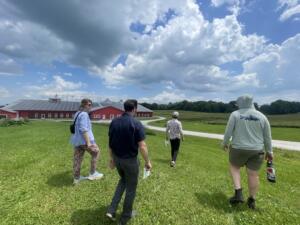
OFRF staff tour University of Vermont’s Nordic Farm, which works in partnership with USDA ARS.
Our nation’s land-grant universities (LGU’s) are major sources of public agriculture research. Outside of competitive grants and cooperative agreements with the Agricultural Research Service (ARS), they receive capacity grants distributed by the federal government with a one-to-one, non-federal, usually state, match. These grants are non-competitive and awarded on a formula basis to states to conduct agriculture research projects, with the formula being based on a state’s rural and farm populations across national averages.
For land-grant universities established in 1862, capacity funding for research comes through regular and multi-state Hatch Act funding, which supports state agriculture research stations and regional projects. The Evans-Allen Act provides federal funding for research programs at 1890 land-grant institutions, or Historically Black Colleges and Universities (HBCU’s). 1994, or tribal land-grant institutions, receive funding through the Tribal College Endowment Program.
Hatch Act and Evans-Allens funding accounts for roughly 30% of all federal dollars received by land-grant universities to conduct agricultural research. Though, since these grants require one-to-one matching from non-federal sources, the total amount these grants disburse to land-grants universities is much larger.
Since capacity funding is meant to support broad agriculture research conducted at land-grant universities, capacity funding has a history of supporting organic agriculture research. However, it is hard to quantify the scope. Just having a project that contains organic research does not mean the whole project was dedicated to it. Regardless, capacity funding is an important source for public agriculture research, for all farmers—organic and non-organic—across the nation.
Public Agricultural Research Makes Outcomes That Markets Won’t
Public agricultural research frequently delivers outcomes that are indispensable to farmers, but are oftentimes unattractive to the private sector from a revenue-generating perspective. These include cultivar development, practice, input, or equipment evaluations, and localized pest management strategies.
Cultivar Development
When it comes to cultivar development, the details matter. The private sector generally focuses on the large commodities and maximizing production and compatibility with their inputs. Public-funded cultivar development operates with a different set of risk/value considerations. There are many examples of cultivars identified and developed through public breeding programs, especially for organic production.
One specific example of this is potato breeding in New York: plant breeders there focus heavily on resistance to golden nematode, a quarantine pest confined to just eight counties in the state. Because of coordinated public management and breeding efforts, the pest has remained geographically limited since it was first identified in 1941. All potatoes grown in New York must be golden nematode resistant. No private company breeds potatoes specifically for New York, meaning the only entity capable of maintaining this protection is the public potato breeding program at the LGU, Cornell University. Without it, growers could lose the ability to ship soil-bearing commodities well beyond potatoes, with ripple effects across vegetable and nursery sectors.
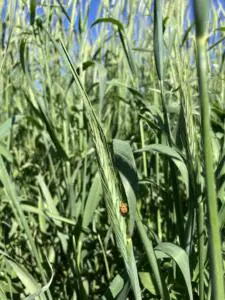
Cover crop research at the U.S. Agricultural Research Station in Salinas, California.
Practice, Input, and Equipment Evaluation
Evaluation of farm inputs, practices, and equipment can be incredibly valuable information for a farmer, and is another area where public research plays an outsized role. Fine-tuning seeding rates, fertilizer recommendations, or grazing strategies often leads to reduced input purchases. That’s good for farmers and ecosystems, but it doesn’t generate new product sales.
Similarly, decades of publicly funded research on cover cropping helped establish agronomic benefits long before robust private seed markets existed. Without that foundational work, many of today’s cover crop value chains would not exist at all.
Localized, Integrated Pest Management
Another highlight of the structural differences between publicly-and privately-funded research is integrated pest management (IPM). Best practices often involve management changes rather than purchases: crop rotation, timing adjustments, cover crops, and mechanical control. These approaches frequently reduce pesticide use; this is good for farmers, ecosystems, and long-term resilience, but not for product sales.
Private-sector research has focused on profitable technologies like genetically-engineered crops paired with proprietary chemicals. This has resulted in a predictable outcome of widespread herbicide resistance in weed populations. In contrast, public research remains one of the few avenues for exploring weed and pest management systems that reduce reliance on chemical inputs, precisely because these approaches don’t generate steady product revenue. You can’t patent a new way to plant cover crops, or hedgerows for pest management; therefore, businesses that aim to maximize shareholder value have no incentive to conduct this research.
What Happens if Capacity Funding is Cut
Congress and the White House have divergent perspectives on the importance of capacity funding for research under the Trump Administration. The President’s budgets for Fiscal Year 2026 and 2027 zeroed out all Hatch Act funding for agriculture research at 1862 land-grant universities. A federal budget that eliminates Hatch Act funding would not just trim around the edges of the U.S. agricultural research system: it would fundamentally destabilize it. Thankfully, Congress maintained Hatch Act funding for 2026 and proposed stable funding for 2027.
Without capacity funding, the baseline support that allows land-grant universities and agricultural research stations to maintain personnel, infrastructure, and long-term research programs cannot be sustained. These funds enable states to respond to regionally specific challenges, maintain breeding programs that span decades, and support beginning or applied research that is essential to farmers but unlikely to win private investment or competitive awards.
Eliminating capacity funding would create cascading effects across the entire research ecosystem. States would lose the flexibility to allocate research dollars based on local needs. Long-running cultivar development and pest management programs would be disrupted or shut down entirely. Faculty positions tied to applied research would disappear, narrowing the pipeline of expertise available to farmers and extension systems. Competitive grant programs, rather than filling the gap, would become harder to access as institutions lose the staffing and administrative capacity needed to apply for and manage them.
Perhaps most concerning, cutting capacity funding would accelerate an already troubling shift in the research landscape: away from farmer-driven, place-based, public-interest research and toward a system increasingly shaped by private incentives and short funding cycles. These conditions are not favorable for organic agriculture research. Once lost, this infrastructure is not easily rebuilt. Breeding programs, long-term trials, and regional research networks take decades to establish and only a single budget cycle to dismantle.
Capacity funding is not redundant or outdated. It is the connective tissue that allows public agricultural research to function as a coherent system. Removing it would weaken not only state and regional research, but the national research enterprise that depends on it.
Where This Leaves Us
In recent decades, U.S. public investment in agricultural research has declined as a share of total research & development (R&D), while private investment has grown. Internationally, we are seeing similar shifts. Between 2019 and 2021, China invested roughly twice as much public funding in agricultural R&D as the United States. According to Virginia Tech’s 2025 Global Agricultural Productivity (GAP), U.S. agricultural productivity growth slowed while countries like China, Brazil, and India continued to see gains.
The reasons for this slowdown are complex, but reductions in public research investment and shifts away from research that improves input efficiency and farm-level resilience are likely part of the story. Public agricultural research is not about replacing private innovation. It’s about ensuring that farmers have access to knowledge, tools, and systems that serve long-term productivity, resilience, and public benefit. Especially when those outcomes don’t align neatly with quarterly earnings.
If we want a food system that can adapt to climate stress, regional challenges, and evolving markets, sustained public investment in agricultural research isn’t optional. It’s foundational.