
Written by Clare Boland, OFRF Communications Manager
Chris Barnett: Finding a Path into Organic Farming
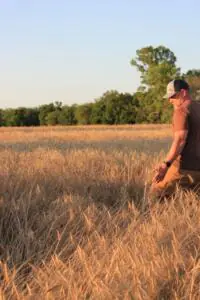 Source: Christopher Organic Farm
Chris Barnett of Christopher Organic Farm.
Chris Barnett describes himself as “a second-generation rancher and first-generation farmer.” He is the owner and operator of Christopher Organic Farm, a 1,600-acre livestock and organic row-crop farm in Fort Scott, Kansas. His family has been stewarding their land in Southeast Kansas for over 40 years, all without chemical inputs.
Returning to his family’s ranch as an adult, Chris took a leap into pursuing organic row crops in addition to ranching. In 2025, he began growing organic wheat, obtaining organic certification through OCIA.
After years of careful stewardship, Chris is beginning to see the results of his hard work: the native prairie is flourishing, wildlife is returning, and the health of his 300-head cow-calf herd is improving.
“It’s a whole ecosystem boost,” Chris says. “Everything is just flourishing out there. It’s been a beautiful process.”
As a first-generation farmer, and an organic farmer at that, mentorship was pivotal for Chris. Diving into certification, Chris said that the administrative side was daunting. He decided to enroll in the Transition to Organic Partnership Program (TOPP) to ease the process.
“I wouldn’t be where I’m at, doing what I’m doing, without the TOPP program,” Chris shared. Through the TOPP program, he was matched with mentor Jack Geiger, of Geiger Grains in Robinson, Kansas. Since Chris’s land had been farmed without synthetic inputs, he was able to break sod and plant organic row crops in his first year. Throughout the process, Jack was a go-to source of information. “Because of my mentor, I successfully harvested a wheat crop my first year farming.”
Through the program, he was also able to plug into existing organic markets and build relationships with other farmers. One of these farmers was Alan Wilson, of Renegade Farms.
Alan Wilson: Starting From Scratch
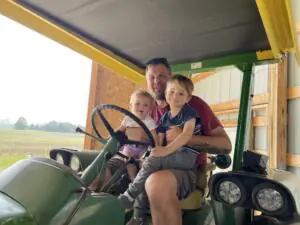 Source: Renegade Farms
Alan Wilson of Renegade Farms and his children.
Alan Wilson has started a farm from scratch—twice. A first-generation farmer, Alan began farming in 2015 with “zero acres and zero experience” in Northeast Kansas, before moving to Huntington, Indiana, where he has been farming for the last five years. Alan is the owner and operator of Renegade Farms, newly renamed, growing organic row crops including soybeans, corn, oats, and wheat. Cover crops are central to Alan’s farming philosophy: “We like to have something living in the ground 340 days out of the year, if we can get away with it.”
Alan first turned to organic for a reliable income stream: “From the initial starting point, it was like how are we going to make farming work as a business and not a really expensive hobby?” But over time, the benefits to the land, and especially the soil, became more clear. “I understand that we’re taking [from the land], but we’re trying to give back at the same time.”
Alan’s farm has been certified since 2018—of their 475 acres, 170 is certified organic, and about 275 are in transition. “I don’t think there’s been a year yet that we have not been transitioning land in some way, shape, or form.” Starting from scratch, starting over in a new location, and consistently transitioning land have had a steep learning curve for Alan, and, like Chris, he found guidance through peer networks and mentorship.
Alan first met Jack at a farming event and began to pick his brain about organic row crops to see if it would possibly be viable for his operation. Since then, Jack has been his main source of guidance. “I talk to him almost daily,” Alan shares.
Jack Geiger: Building a Network of Farmers
 Source: Geiger Farms Youtube channel
Jack Geiger of Geiger Grains on his YouTube channel.
Jack Geiger’s family has been farming their land in Kansas since 1856, but the decision to farm organically was spurred by the 1980’s farm crisis. As the price of synthetic inputs became prohibitively expensive, organic methods presented a path to economic viability. Since Jack’s father certified the farm in the 1980s, they have been growing organically ever since.
Today, Jack owns and operates Geiger Grain in Robinson, Kansas, growing organic wheat and seed, and raising organically managed cattle. For Jack, sharing knowledge has been foundational to his farming career. At the time the farm became certified, “the organic movement” was still relatively new. To learn more about organic farming practices, he sought out other farmers in a similar situation. “I’m part of a class of five guys who all started out at basically the same time. We were young kids when the organic thing took off. And so we formed a peer network.”
In 2016, Jack began posting farming how-to videos on YouTube as Geiger Farms. The response was enthusiastic—the videos amassed over 3 million views on the platform, and farmers began reaching out to Jack for advice.
That’s how Jack met the first of his mentees. More recently, Jack became a mentor through the TOPP program. He says joining the program has encouraged him to “be more professional” in his mentoring. One example was creating a group chat for his mentees.
“Peer-to-peer learning is the most important. And the reality is, I am not a peer to most of them. They consider me to be like a subject matter expert. So when I started hooking the guys up amongst themselves, wonderful things happened.”
Both Alan and Chris mentioned the 15-20 person group chat, where they share crop prices, input sources, marketing information, and practical advice. For Alan and Chris, who are both surrounded by conventional farming operations, the ability to get multiple perspectives from growers working in different regions, and quickly, has been a huge help. “I have the group listed as Jack’s Misguided Children,” Alan jokes.
Reciprocal Learning
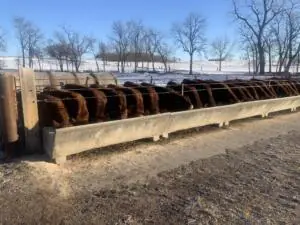 Source: Geiger Grain
Calves on the bunk at Geiger Grain.
For organic farmers, learning is an essential principle. “So much of organic is knowledge-based, but it’s also learning how to fine-tune that knowledge base to your particular climate and your particular skill set,” Jack shares. He sees a fundamental difference between what he calls conventional agriculture’s “farming by prescription” and the management required in organic agriculture. “There are basic rules and principles that all organic farmers are bound to, in the National Organic Standard, but you have to tune them to your abilities and to your environment. And that is the trick, because everybody has different abilities, and everybody has different skills.”
What works on Jack’s farm might not be a perfect fit for his mentees’ farms, but through adaptation, they can still learn from these organic strategies. One example of this is Alan incorporating livestock into his operation. Jack’s farm benefits from the integrated use of cattle, reducing his need for soil inputs and increasing the overall health of his land through grazing. Alan doesn’t raise livestock, but his neighbor does. This year, Alan began bringing his neighbor’s cows onto his land to help with his soil fertility.
Jack’s mentees have also challenged him to rethink some of his own practices, particularly their interest in organic no-till and lower-mechanization systems. Jack is a mechanized, full-till farmer. Their questions have pushed him to reconsider his own approach. “Their pursuit of no-till has inspired me over the last, you know, decade to increase my use of cover crops and reduce my tillage.”
“Mentoring is a two-way street,” Jack shares. “My mentees actually teach me just as much as I teach them. It’s a wonderful exercise where we both learn from each other.”
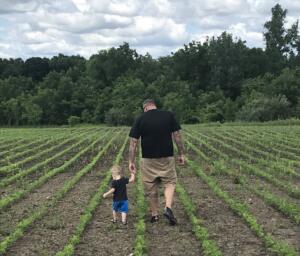 Source: Renegade Farms
Alan walks the farm with his son.
Alan echoed this sentiment, reflecting on how his relationships with other farmers have improved his craft. Farming takes a lot of trial and error, and learning through the organic farming community, you can save yourself some mistakes. “If you can learn something that’s going to save you two or three years’ worth of mistakes, that’s a big deal. It can save you a lot of time and a lot of heartache and a lot of financial stress as well.”
“I think that the organic farming community is one of the most open groups of people that are in competition with each other, maybe on the planet,” Alan says.
Chris agreed, sharing “TOPP is the most meaningful and impactful program available to anyone seeking to start or transition into organic farming.”
Fostering these types of relationships is what Jack sees as the greatest benefit of the TOPP program. “[It’s] a wonderful program. The things that we have built and the relationships, they’re going to continue on long after this.” The farmers who receive guidance today may become mentors themselves, carrying knowledge into new communities and new farms. “I think of it as teaching teachers.”
For Chris, Alan, and Jack, TOPP didn’t just create mentor-mentee relationships; it created a growing network of farmers learning from each other.
“The best way to go through life,” Alan says. “To be continuously learning. And when you find something you love doing, learning isn’t painful, it’s enjoyable.”
Learn more about the Transition to Organic Partnership Program: