Certification & Compliance

Organic Transition Initiative (OTI)

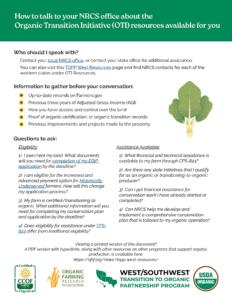
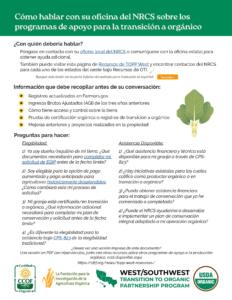
OFRF has developed a PDF to help farmers communicate with NRCS about accessing the Organic Transition Initiative.

It is available in both English and Spanish. >>>

“How to talk to your NRCS office about the
Organic Transition Initiative (OTI) resources available for you”

“Cómo hablar con su oficina del NRCS sobre los
programas de apoyo para la transición a orgánico”

Organic farmers must manage their land without prohibited inputs for 3 years for their products to be certified. This transitioning period can be incredibly challenging as farmers and their land adjust to new production practices. OTI is intended to help producers implement conservation activities required for certification, receive expert technical support, and recover foregone income due to reduced yields during the transition period through EQIP.

Step 1. Research your options.

Step 2. Connect with USDA. Create or update your account at Farmers.gov, and contact your local NRCS office to get started. Your conservation specialist will confirm your eligibility and help you identify which projects & practices best suit your operation. Directing the agent to NRCS-sponsored webinars and training modules the Organic Farming Research Foundation and Oregon Tilth have developed for NRCS field agents may be helpful.

Contact your state office for additional assistance:

Guiding Questions: Check out our “How to talk to NRCS about the OTI” PDF for additional topics, available above!

  • I __own/rent__ my land. What documents will you need for completion of my EQIP application by the deadline?
  • I am eligible for the increased and advanced payment option for Historically Underserved farmers. How will this change my application process?
  • My farm is __certified/transitioning_ to organic. What additional information will you need for completing my conservation plan and application by the deadline?
  • Can I get financial assistance for conservation work I have already started or completed?
  • Can NRCS help me develop and implement a comprehensive conservation plan that is tailored to my organic operation?
  • When is the deadline for the next EQIP ranking period?

Step 3. Schedule your conservation plan development. Your NRCS conservation specialist will work with you to develop a conservation plan for your operation and complete the AD 1026 form.

Step 4. Gather your application documents.

  • Official tax ID (Social Security Number or Employer Identification Number)
  • Adjusted gross income certification (Form CCC-941), which requires your Taxpayer ID Number and AGI from the previous 3 tax years.
  • Deed, or property lease agreement and written authorization from the landowner to install structural or vegetative practices.
  • Farm tract number (obtained from Farmers.gov or FSA membership).
  • Documentation of organic certification (if applicable).
  • Documentation of your land’s irrigation history (if applicable to project).
  • Documentation of previous improvements made to the property.

Step 5. Complete your application & submit! Your NRCS conservationist will assist you in finalizing your application. 

Step 6. Implement your plan. If you’re selected, you can choose whether to sign the contract for the work to be done. You’ll be provided with guidelines and a timeframe for implementing your plan. You will be reimbursed after your work is inspected and approved. Advanced payments not expended within 90 days of receipt must be returned to NRCS.

As essential stewards of the land, organic farmers deserve support. Don’t let funding be a barrier to realizing your farm’s potential. Take the first step towards growth and sustainability by applying for assistance through the Organic Transition Initiative before your state’s deadline.

Note: all of this information is available below in Spanish. Obtain additional translated materials, or schedule interpretation services for phone calls or in-person visits, https://www.farmers.gov/translations, or request personalized Spanish language support for any USDA resource, https://www.farmers.gov/translations#spanish-request.

By |2026-01-15T10:15:37-05:00January 31st, 2024|Certification & Compliance, Federal Assistance, News, Spanish Resources|

Demystifying the National Organic Standards Board (NOSB) for Farmers

Organic producers and processors must follow strict standards to become certified—but who decides what is and isn’t allowed on organic farms? Not your certifier! The USDA National Organic Program (NOP), in consultation with the National Organic Standards Board (NOSB), sets these rules.

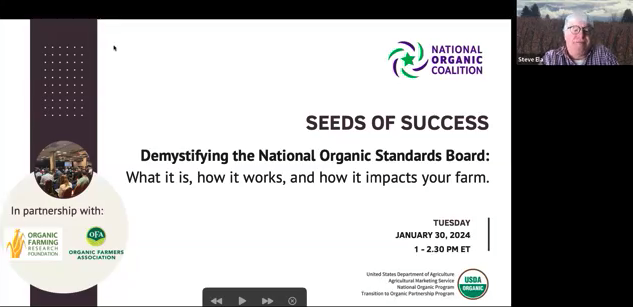
In 2024, the National Organic Coalition (NOC) hosted a Seeds of Success virtual session for organic and transitioning farmers, where a panel of farmers and advocates demystified the NOSB. Panelists explained the Board’s role in shaping organic standards, how decisions are made, and how written and oral comments can influence outcomes.

Panelists included Steve Ela (Former NOSB Chair, NOC NOSB Specialist, Ela Family Farms, CO), Harriet Behar (Former NOSB Chair, NOC Advisor, OFA Farmer Services Consultant, Sweet Springs Farm, WI), and Amy Bruch (Current NOSB Vice Chair, Cyclone Farms, NE).

screenshot of mp4 recording of Demystifying the NOSB webninar
By |2026-03-02T11:52:33-05:00January 30th, 2024|Certification & Compliance, Resource|

Organic Certification Cost Share Program (OCCSP)

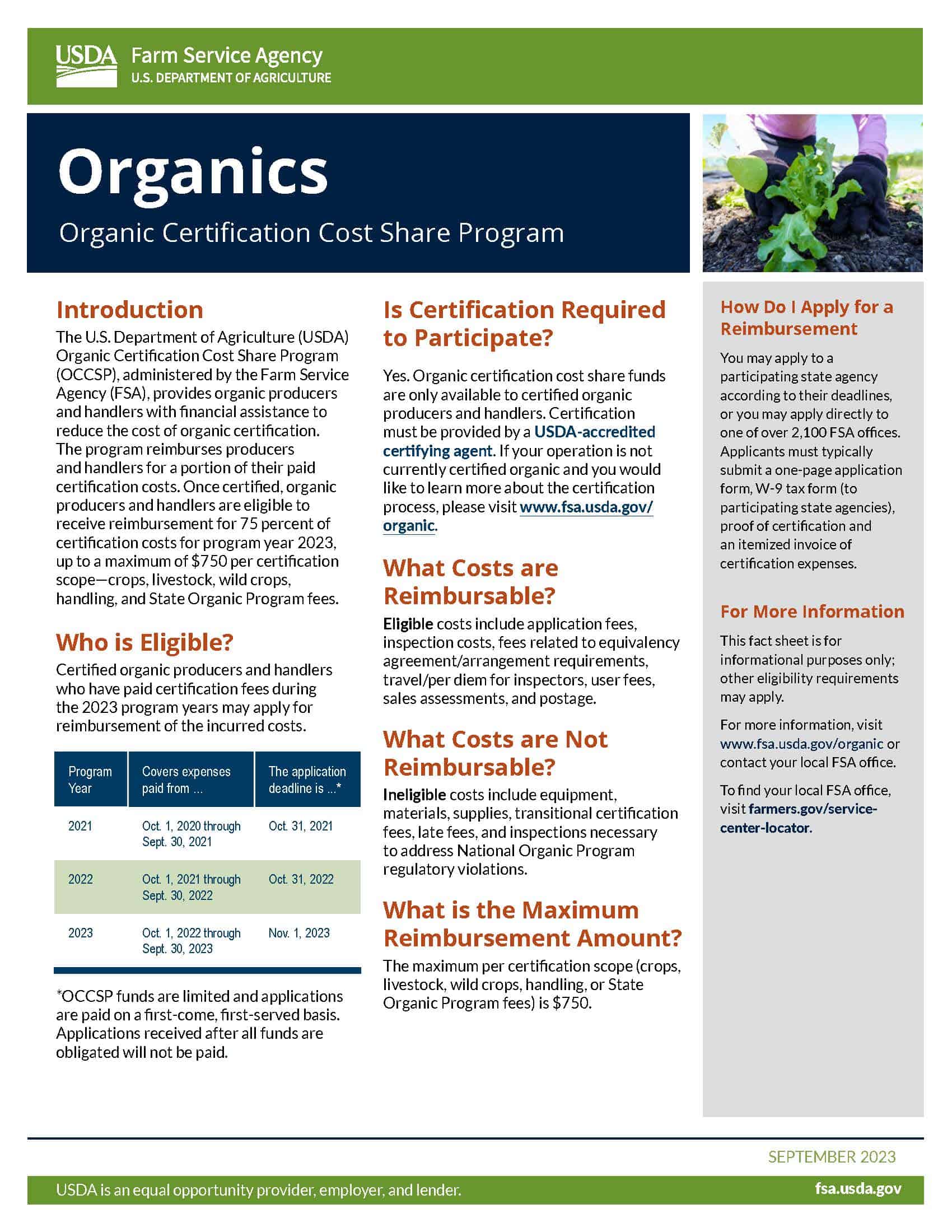
Farmers across the U.S. may now receive up to $750 per scope for organic certification costs

As a farmer or a technical service provider to farms, you understand the importance of organic certification. It not only adds value to your products but also opens doors to a growing market of health-conscious consumers. However, the process of obtaining and maintaining organic certification can be costly. Financial assistance was last available in 2024, through the Organic Certification Cost Share Program (OCCSP) to help ease this burden. In this blog post, we’ll walk you through the basic steps to access up to $750 in financial assistance for each organic certification scope if this program funding is available.

Note: all of this information is summarized in printable, downloadable PDF’s, available in English and Spanish, at the bottom of this blogpost.

Nota: toda esta información se resume en archivos PDF imprimibles y descargables, disponibles en inglés y español, al final de esta publicación de blog.

1. Start with Research

Before diving into the application process, it’s wise to build up some knowledge of the program and who you will apply to. The OCCSP is administered by the USDA, and their website provides a wealth of general information. Additionally, some states may have their own supplements to the program; consider checking your state’s agriculture agency website for state-specific resources.

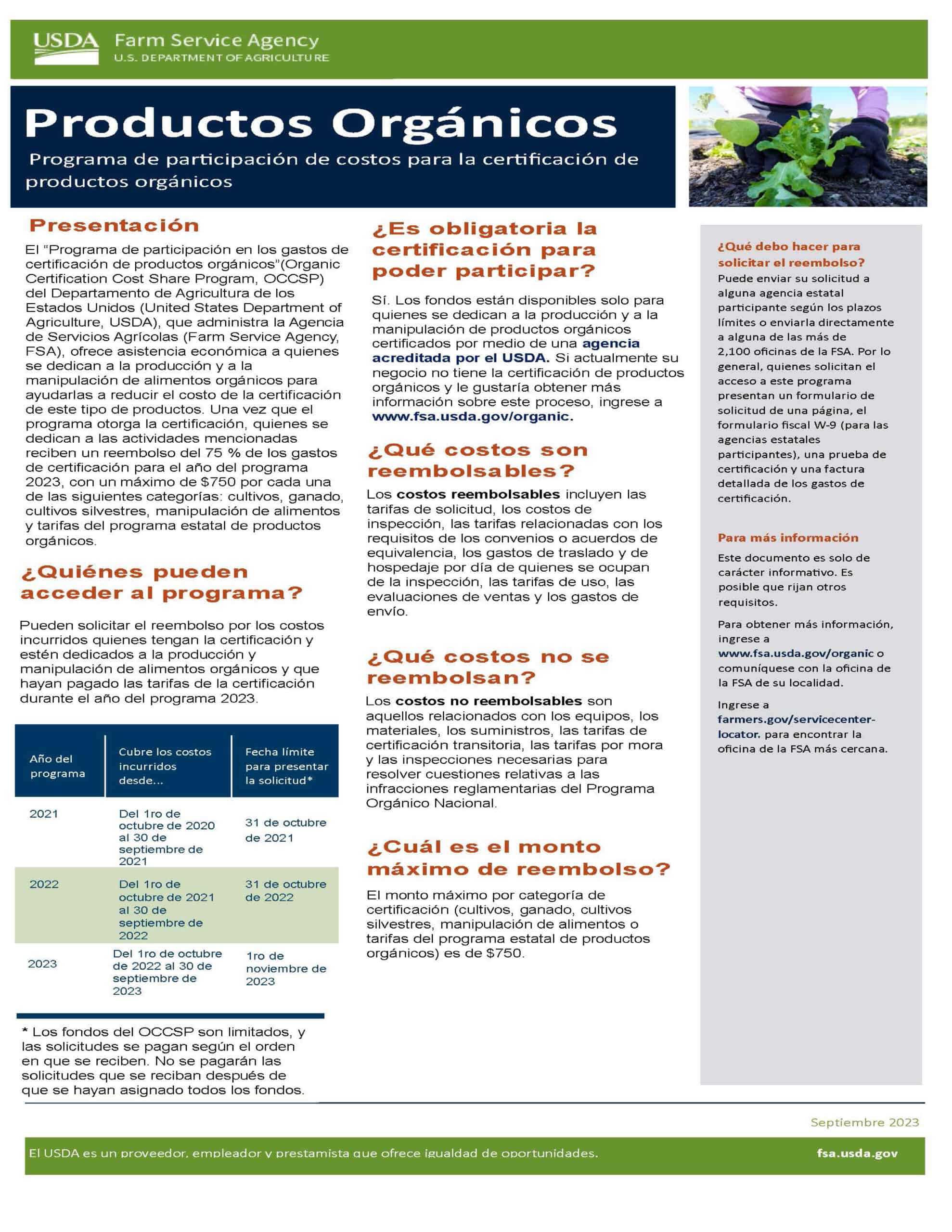
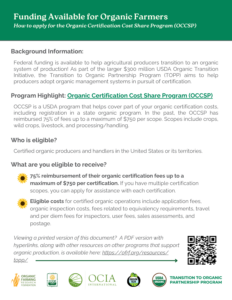
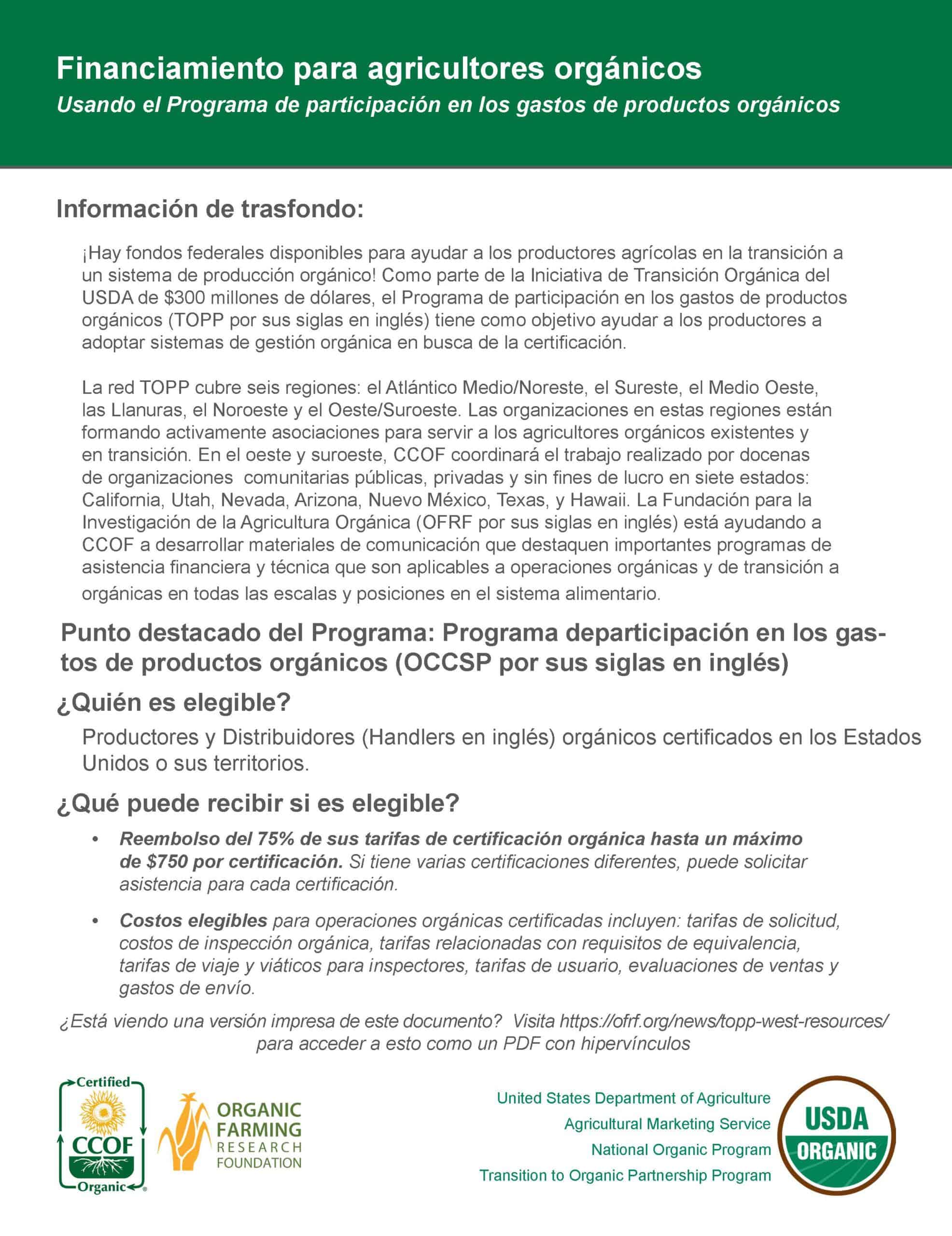
Below are factsheets from the USDA about the OCCSP, one in English and one in Spanish.

There is not an updated 2025-6 flyer in Spanish at this time.

2. Finding the Right Application 

Certified organic operations can apply for OCCSP assistance through their local Farm Service Agency (FSA) office or, in some cases, through a participating State Agency. Here’s how to proceed:

Through FSA: If you choose to apply through the FSA, you’ll need to use their specific OCCSP application form and follow the instructions provided. This ensures that your application is processed smoothly and efficiently.

Through a State Agency: If your state participates in the OCCSP, you likely have the option to apply through your state agency. In this case, use the application form provided by your state’s program. States like Arizona and California have their own forms, while Texas offers an online application platform along with a Request for Assistance (RFA) providing information.

3. Gathering Financial Information

To access government payments through OCCSP, you’ll need to provide certain financial information. The information must be provided in the correct format, depending on how you are applying. Here’s a brief explanation of the options in the Southwest: 

FSA: If you’re applying through the FSA, they typically require an IRS W-9 form as part of your application.

California: In California, you’ll need to complete a Payee Data Record Form as part of your application.

Arizona: In Arizona, they require an AZ W-9 form to be submitted along with your application.

Texas: If you’re applying through Texas’ online platform, you’ll need to provide a Tax ID to operate on their system, obtain one here.

4. Compiling Required Documents

Alongside your application and financial information, you’ll also need to include certain documents:

  • A copy of your organic certification.
  • Proof of payment for your certification fees.
  • Itemized receipts for any other covered expenses related to organic certification that you’re seeking reimbursement for.

Covered expenses under the OCCSP include application fees, inspection costs, fees related to equivalency agreement/arrangement requirements, travel/per diem for inspectors, user fees, sales assessments, and postage. However, covered expenses do not include equipment, materials, supplies, transitional certification fees, late fees, and inspections necessary to address National Organic Program regulatory violations.

5. Submission

Once you’ve gathered all the required information and documents, it’s time to submit your OCCSP application. Double-check your application to ensure everything is complete and accurate. Ensure you send this information to the appropriate state or federal agency office based on your chosen application method.

The OCCSP can be a valuable resource for farmers and technical service providers seeking financial assistance for their organic certifications. By following these steps and meeting the program’s requirements, you can access up to $750 to support your commitment to organic farming practices.

For more detailed information and access to specific application forms, be sure to visit the OCCSP USDA website or consult your state’s agriculture agency website if they operate their own OCCSP program (Arizona, California, Texas). Your organic journey just got a little more affordable.

Apply for OCCSP assistance now, and reap the benefits of a more affordable path to organic certification. Your commitment to organic farming deserves the support it needs.

All of this information is summarized in a printable, downloadable PDF below, available in English and Spanish.
Farmers are Researchers: Conducting your own on-farm research

Farmers and ranchers conduct experiments all the time. They constantly test and modify new or improved ways to farm. In this webinar, farmers will learn about adding a few scientific steps to their farm tests that can produce more reliable results that they can trust. OFRF is excited to present this workshop as part of the new OFRF Farmer-led Trials Program (FLT) and the accompanying publication Farmers Guide to On Farm Research.

This webinar recording covers the official launch of OFRF’s Farmer-Led Trials Program, which promotes farmer-led innovations in organic farming. Learn how this program can support farmers and ranchers like you in conducting practical, on-farm research.

By |2026-03-02T12:03:51-05:00November 11th, 2023|Certification & Compliance, On-Farm Research, Resource|

Food Safety and Crop-Livestock Integration

In OFRF’s 2022 National Organic Research Agenda (NORA), organic farmers and ranchers across North America shared a common concern about the lack of technical assistance and educational resources available for Integrated Crop-Livestock Systems (ICLS). Integrating crops and livestock results in numerous benefits, however the process can also lead to increased complexity, especially for farmers who must adhere to National Organic Program rules and regulations.

This series of resources focused on Crop-Livestock Integration is informed by interviews with four highly-experienced organic producers that shared their challenges, successes, and advice for others interested in integrating livestock and crops on their organic farms.

Food safety is a critical concern for any farmer, and those with integrated systems must take extra precautions. Learn how organic farmers identify and mitigate critical points for food safety and where you can find assistance in developing a food safety plan for your farm.

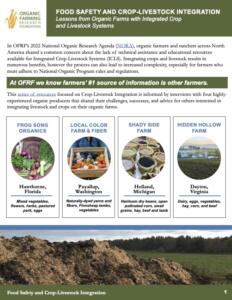
Food Safety and Crop Livestock Integration report cover
Go to Top