
(Versión en español a continuación / Spanish version below)
Written by Mary Elizabeth Kidd, OFRF Communications Associate
OFRF is currently working to increase farmer and community awareness of the federal funding opportunities available to organic and transitioning farms. As part of our work with the West region of the USDA’s Transition to Organic Partnership Program (TOPP), we’re spotlighting the experience of one farm—Makili Farm in Kealakekua, Hawaiʻi—that received funding and support through the Natural Resource Conservation Service’s Conservation Stewardship Program (CSP).
Their story offers a transparent look at what it’s really like to work with NRCS: the benefits, the obstacles, and the lessons they’ve learned. We hope other farmers can use their experience to navigate the process of applying for and implementing CSP contracts more easily.
Meet Kathy Vass of Makili Farm
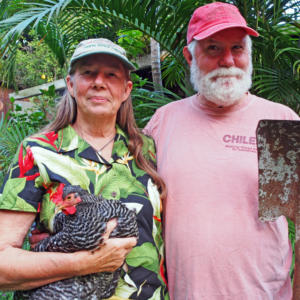 Source: Makili Farm, Credit: John Vass
Location: Kealakekua, Hawaiʻi (west coast of Hawaiʻi Island)
Established: 2013
Acres: 5.8
Production: Coffee, macadamia nuts, cacao, citrus, vanilla, vegetables, tropical fruit, and pineapples
Certification: USDA Certified Organic since 2017
Staffing: Two part-time team members, plus seasonal staff (macadamia harvest)
Markets: Wholesale (grocery stores and local distributors)
Context & Challenges
 Source: Makili Farm
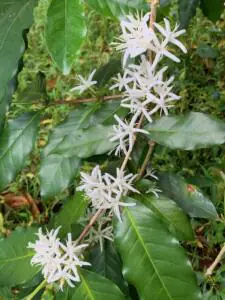
Coffee flowers in bloom.
OFRF team members recently spoke to Kathy Vass, owner and primary farmer at Makili Farm, sitting on almost 6 acres at an elevation of 1,500 feet on the west coast of Hawaiʻi Island.
She shared a realistic and dedicated vision of organic farming on Hawaiʻi Island, where approximately 85% of food is imported, operational costs are high, and pest and environmental pressures are tremendous. Seasonal cyclones and recent earthquakes bring even more obstacles.
Her commitment to provide organic, locally-produced food for her community is palpable and powerful: “We’re all struggling financially. I know very few farms that aren’t. We’re providing enough income to live on. But the ones I know who are succeeding are organic.”
Kathy has been working in the soil for over 55 years, from her previous career as a landscape contractor in Long Island, New York, to her 13 years of farming at Makili Farm.
Kathy notes that in the last 5-10 years, pests and invasive weeds have surged. The avocado lace bug and the coffee berry borer, in addition to nematodes, continue to wreak particular damage to her key crops; coffee leaf rust has also led to crop loss.
>> Read more: Kathy and five other farms participated in a 2021 OFRF research grant exploring Organic Farming Systems Options for Controlling Coffee Leaf Rust (CLR) in Kona Coffee.
The impact of these pests and diseases is the primary reason Kathy sought support from programs like the Natural Resource Conservation Service’s (NRCS) Conservation Stewardship Program (CSP). The knowledge and financial support they provide have been a lifeline for her business.
Why Organic?
 Source: Makili Farm
Vanilla bean orchid.
“I have always, for 55 years, done nothing but organic methods.”
Despite so many challenges, Kathy’s commitment to organic practices remains unshaken. She continues, “organic farming is, whether certified or not, so important for the health of our soil, our water, and our air. It’s just so important to me to have healthy food from healthy soil.”
The higher market value for organic products was also appealing; organic coffee cherries get $1 more per pound than conventional ones.
That said, each year Kathy questions her desire to remain certified. “It feels like a burden,” she shared, “Every year when it’s time for me to start doing the paperwork, I weigh whether I really want to keep doing the certification. I would always continue to be organic, regardless of whether I’m certified or not. I’m not sure that the price difference makes a big difference.”
Accessing Support through NRCS CSP
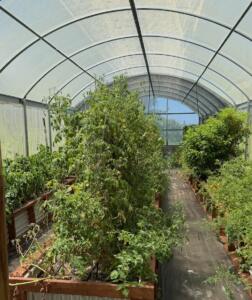 Source: Makili Farm
EQIP-supported hoop house.
Kathy’s daughter-in-law, also a local farmer, suggested Kathy contact Laura Nelson, who leads the Kealakekua Natural Resources Conservation Service (NRCS) office.
Kathy first worked with Laura to secure Environmental Quality Incentives Program (EQIP) reimbursement for approximately half the cost of a 20-foot-by-72-foot hoophouse, enabling her to increase production.
Laura then encouraged and supported Kathy through the CSP application process. While Kathy was initially apprehensive of another paperwork-laden application process, her existing documentation for organic certification was already comprehensive and helped expedite the CSP application.
Kathy then worked with Laura to develop goals and objectives for a 5-year contract, which reimburses her $5,000 per year to support her conservation efforts.
CSP Goals & Learnings
Together, Kathy and Laura honed in on two goals for the 5-year CSP contract:
- Enhance agroforestry with additional trees and shrubs (primarily fruit-bearing).
- Continue ongoing organic pest control practices on the farm.
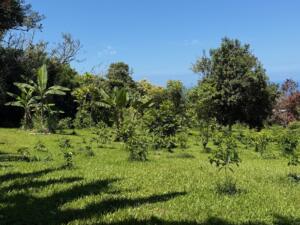 Source: Makili Farm
Agroforestry in motion.
In her first year, she successfully planted cacao, bananas, breadfruit, and cherimoya, expanding her market offerings.
She’s now in the fourth year of her five-year contract and continuing the focus on pest management. A few recent tasks supported by her CSP contract: planting 600 new coffee trees, mulching them, and planting a nitrogen-fixing ground cover, perennial peanut.
While much of her work remains the same—tenacious, focused, and curious—the financial and community support help her stay the course and represent her primary CSP wins. “Having those connections with other farmers has been good…really, really good.”
After her current contract winds down, Kathy is considering another CSP offering focused on native plants. She heavily cites the expertise and accessibility of her NRCS agent, Laura Nelson, as a success-driving factor in her experience with CSP.
Advice to Farmers
“Persevere,” Kathy shared without hesitation. She urges farmers to explore as many USDA and other avenues of financial support as possible, never shying away from doggedly advocating for what they need with USDA agents and representatives. She also recommends plugging into the local farming community, including other farmers, your local Extension, and farmers’ unions.
“Find out what’s available, ask questions, and hang in there.”
Ready to Apply? Here Are a Few Helpful Resources
If you’re a farmer considering applying for CSP or other NRCS programs, here are some helpful tools to get started:
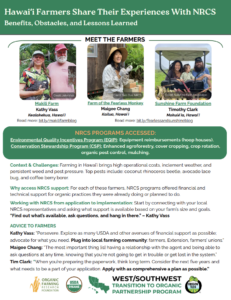
- Download a printable summary of the key takeaways for farmers to consider when applying to NRCS CSP in English (click here) and Spanish (click here).
- Read how Catherine Nguyen of Mora Mora Farm, a newly certified farmer, uses CSP to bridge the gap between generating income and investing in conservation.
- Download OFRF’s CSP flyer for more information on the federal funding program, including eligibility and application details, available in English and Spanish here.
- Connect with your local NRCS office to start developing a conservation plan: nrcs.usda.gov/contact.
- Know your eligibility. Farmers who are classified as beginning, limited-resource, socially disadvantaged, or veterans may qualify for higher reimbursement rates and advance payments.
Additional Resources & Reading
Cómo una granja de Kona logró que los fondos federales funcionaran para la agricultura orgánica
Por Mary Elizabeth Kidd, asociada de comunicaciones
La OFRF trabaja actualmente para aumentar la conciencia de los agricultores y las comunidades sobre las oportunidades de financiamiento federal disponibles para las granjas orgánicas y en transición hacia lo orgánico. Como parte de nuestro trabajo con la región Oeste del Programa de Alianzas para la Transición a lo Orgánico (Transition to Organic Partnership Program, TOPP) del USDA, destacamos la experiencia de una granja —Makili Farm, en Kealakekua, Hawaiʻi— que recibió financiamiento y apoyo a través del Programa de Administración de la Conservación (Conservation Stewardship Program, CSP) del Servicio de Conservación de Recursos Naturales (NRCS).
Su historia ofrece una mirada transparente de lo que realmente implica trabajar con el NRCS: los beneficios, los obstáculos y las lecciones aprendidas. Esperamos que otros agricultores puedan aprovechar su experiencia para transitar más fácilmente el proceso de solicitar e implementar los contratos del CSP.
Conozca a Kathy Vass, de Makili Farm
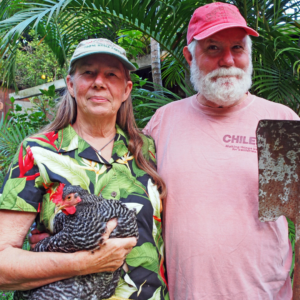 Source: Makili Farm, Credit: John Vass
Los agricultores Kathy y Rob Vass.
Ubicación: Kealakekua, Hawaiʻi (costa oeste de Hawaiʻi Island)
Fundada: 2013
Superficie: 5.8 acres
Producción: Café, nueces de macadamia, cacao, cítricos, vainilla, hortalizas, fruta tropical y piñas
Certificación: Certificada como orgánica por el USDA desde 2017
Personal: Dos integrantes de tiempo parcial, más personal de temporada (cosecha de macadamia)
Mercados: Venta al por mayor (tiendas de comestibles y distribuidores locales)
Contexto y desafíos
Source: Makili FarmFlores de café.
Integrantes del equipo de la OFRF hablaron recientemente con Kathy Vass, dueña y agricultora principal de Makili Farm, ubicada en casi 6 acres a una altitud de 1,500 pies en la costa oeste de Hawaiʻi Island.
Ella compartió una visión realista y comprometida de la agricultura orgánica en la isla de Hawaiʻi, donde aproximadamente el 85 % de los alimentos son importados, los costos operativos son altos y las presiones de plagas y ambientales son enormes. Los ciclones estacionales y los terremotos recientes suman aún más obstáculos.
Su compromiso de brindar alimentos orgánicos y de producción local a su comunidad es palpable y poderoso: “Todos tenemos dificultades económicas. Conozco muy pocas granjas que no las tengan. Generamos ingresos suficientes para vivir. Pero las que conozco que están teniendo éxito son orgánicas.”
Kathy lleva más de 55 años trabajando la tierra, desde su carrera anterior como contratista de paisajismo en Long Island, New York, hasta sus 13 años de agricultura en Makili Farm.
Kathy señala que en los últimos 5 a 10 años han aumentado las plagas y las malezas invasoras. El chinche de encaje del aguacate (avocado lace bug) y la broca del café (coffee berry borer), además de los nematodos, siguen causando un daño particular a sus cultivos clave; la roya del café (coffee leaf rust) también ha provocado pérdidas de cosecha.
>> Lea más: Kathy y otras cinco granjas participaron en 2021 en una subvención de investigación de la OFRF que exploró Opciones de sistemas de agricultura orgánica para controlar la roya del café (Coffee Leaf Rust, CLR) en Kona Coffe.
El impacto de estas plagas y enfermedades es la razón principal por la que Kathy buscó apoyo en programas como el Programa de Administración de la Conservación (Conservation Stewardship Program, CSP) del Servicio de Conservación de Recursos Naturales (NRCS). El conocimiento y el apoyo económico que brindan han sido un salvavidas para su negocio.
¿Por qué orgánico?
Source: Makili FarmOrquídea de vainilla.
“Siempre, durante 55 años, no he usado más que métodos orgánicos.”
A pesar de tantos desafíos, el compromiso de Kathy con las prácticas orgánicas permanece firme. Ella continúa: “La agricultura orgánica, esté certificada o no, es muy importante para la salud de nuestro suelo, nuestra agua y nuestro aire. Para mí es fundamental tener alimentos sanos que provengan de un suelo sano.”
El mayor valor de mercado de los productos orgánicos también resultaba atractivo; las cerezas de café orgánico se pagan $1 más por libra que las convencionales.
Dicho esto, cada año Kathy se cuestiona su deseo de mantener la certificación. “Se siente como una carga”, compartió. “Cada año, cuando llega el momento de empezar con la documentación, me planteo si de verdad quiero seguir con la certificación. Siempre seguiría siendo orgánica, esté certificada o no. No estoy segura de que la diferencia de precio marque una gran diferencia.”
Cómo acceder al apoyo a través del CSP del NRCS
Source: Makili FarmInvernadero tipo túnel financiado por el EQIP.
La nuera de Kathy, también agricultora local, le sugirió que contactara a Laura Nelson, quien dirige la oficina del Servicio de Conservación de Recursos Naturales (NRCS) de Kealakekua.
Kathy trabajó primero con Laura para obtener el reembolso del Programa de Incentivos para la Calidad Ambiental (Environmental Quality Incentives Program, EQIP) por aproximadamente la mitad del costo de un invernadero de 20 por 72 pies, lo que le permitió aumentar la producción.
Luego, Laura animó y acompañó a Kathy durante el proceso de solicitud del CSP. Aunque al principio a Kathy le inquietaba otro proceso de solicitud lleno de trámites, la documentación que ya tenía para la certificación orgánica era muy completa y ayudó a agilizar la solicitud del CSP.
Después, Kathy trabajó con Laura para desarrollar las metas y los objetivos de un contrato de 5 años, que le reembolsa $5,000 al año para apoyar sus esfuerzos de conservación.
Metas y aprendizajes del CSP
Juntas, Kathy y Laura se enfocaron en dos metas para el contrato del CSP de 5 años:
- Fortalecer la agrosilvicultura con árboles y arbustos adicionales (principalmente frutales).
- Continuar las prácticas de control orgánico de plagas ya existentes en la granja.
Source: Makili FarmAgrosilvicultura en acción,
En su primer año, plantó con éxito cacao, plátanos, fruta del pan (ulu) y chirimoya, ampliando su oferta de mercado.
Ahora está en el cuarto año de su contrato de cinco años y sigue enfocada en el manejo de plagas. Algunas tareas recientes apoyadas por su contrato del CSP: plantar 600 cafetos nuevos, aplicarles acolchado (mulch) y sembrar una cobertura vegetal fijadora de nitrógeno, el maní perenne.
Aunque gran parte de su trabajo sigue igual —tenaz, enfocado y curioso—, el apoyo económico y comunitario le ayuda a mantener el rumbo y representa sus principales logros con el CSP. “Tener esas conexiones con otros agricultores ha sido bueno… muy, muy bueno.”
Cuando termine su contrato actual, Kathy está considerando otra oferta del CSP centrada en plantas nativas. Ella destaca en gran medida la experiencia y la disponibilidad de su agente del NRCS, Laura Nelson, como un factor clave del éxito de su experiencia con el CSP.
Consejos para los agricultores
“Perseveren”, compartió Kathy sin dudarlo. Ella insta a los agricultores a explorar tantas vías de apoyo económico del USDA y de otras fuentes como sea posible, sin dudar en defender con tenacidad lo que necesitan ante los agentes y representantes del USDA. También recomienda integrarse a la comunidad agrícola local, incluidos otros agricultores, el servicio de Extensión local y los sindicatos de agricultores.
“Averigüen qué hay disponible, hagan preguntas y no se rindan.”
¿Listo para solicitar? Aquí tiene algunos recursos útiles
Si es un agricultor que está considerando solicitar el CSP u otros programas del NRCS, aquí tiene algunas herramientas útiles para comenzar:
- Descargue el folleto del CSP de la OFRF para obtener más información sobre el programa de financiamiento federal, incluidos los detalles de elegibilidad y de solicitud, disponible en inglés y español aquí.
- Comuníquese con su oficina local del NRCS para comenzar a desarrollar un plan de conservación: nrcs.usda.gov/contact.
- Conozca su elegibilidad. Los agricultores clasificados como principiantes, de recursos limitados, socialmente desfavorecidos o veteranos pueden calificar para tasas de reembolso más altas y pagos por adelantado.
Recursos y lecturas adicionales