

Using Synergy, Conservation Practices, and NRCS Support to Save Citrus with Uncle Matt’s Organic
Written by Mary Elizabeth Kidd, OFRF Communications Associate
OFRF is currently working to increase farmer and community awareness of the federal funding opportunities available to organic and transitioning farms.
As part of our work with the Southeast region of the USDA’s Transition to Organic Partnership Program (TOPP), we’re spotlighting the experience of Uncle Matt’s Organic and McLean Family Farms in Clermont, Florida, that received funding and support through the Natural Resource Conservation Service’s Environmental Quality Incentives Program (EQIP).
Their story offers a transparent look at what it’s really like to work with NRCS: the benefits, the obstacles, and the lessons they’ve learned. We hope other farmers can use their experience to navigate the process of applying for and implementing contracts more easily.
Meet Ben McLean III of Uncle Matt’s Organic and McLean Family Farms
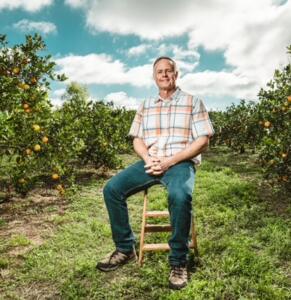
Location: Clermont, Florida (Lake County, west of Orlando)
Established: family farm established in the 1880s, Uncle Matt’s Organic established in 1999
Acres: 50
Production: Citrus
Certification: USDA Certified Organic via QCS since 2003
Staff: 15 full-time employees (as of EQIP contract phase)
Markets: Sell directly to grocery outlets including Whole Foods, Target, Publix, and more (20,000+ locations)
As the Head of Research with Uncle Matt’s Organic and a fourth-generation citrus farmer with McLean Family Farms, Ben McLean III is harnessing science, a robust network of experts and support, and family legacy to help safeguard the future of citrus in Florida and around the world.
Members of the OFRF team recently spoke to Ben to learn more about his experience accessing NRCS’ Environmental Quality Incentives Program (EQIP) and how this program and its resulting wins and learnings can help fellow growers.
>> Learn more: Listen to Ben McLean III on the Food for You and the Planet podcast.
About the Farmers
Angus Benjamin McLean, Ben McLean III’s great-grandfather, began citrus farming on the family’s Bartow, Florida, property in the 1880s. Ben’s grandfather, father, and siblings have continued the family legacy, weathering the uncertainties of ecological and economic change to help keep citrus farming alive in central Florida.
Ben received his master’s degree in Horticulture Science from the University of Florida and consistently works closely with university researchers and members of the USDA’s Agricultural Research Service (ARS) to explore and advance citrus research and conservation efforts. He’s traveled to Mexico, Costa Rica, Brazil and South Africa to learn from citrus growers around the world and to share his knowledge, including learnings from his EQIP contract with NRCS.
His ability to activate a synergistic network of grower organizations, learning opportunities through these organizations and the USDA, and a community of experts, researchers, and farming peers continues to create opportunities for him to grow the family farm business and act as a leader in the citrus and sustainable agriculture spaces.
Context & Challenges
The top concern of Ben, his team, and the researchers they work with is citrus greening disease, also known as Citrus Huanglongbing, or Citrus HLB. Within the last 30 years, this disease caused by the bacterium (Candidatus Liberibacter asiaticus) and vectored by the Asian citrus psyllid has destroyed over 75% of Florida’s citrus production.
Citrus greening continues to cripple Florida’s citrus production, and Ben is on a mission to facilitate research to protect Florida citrus. His NRCS EQIP contract, discussed below, played a role in the promising research they’re facilitating towards this mission.
The McLean family originally managed over 1,200 acres in organic citrus production in 2008, which dropped to 600 acres in 2015, and now hovers around 50 acres, with 15 acres focused heavily on research to combat the disease.
This dramatic drop in acreage is also the result of weather events and real estate development. Since 2004, Ben cites five major hurricanes (with landfall), tropical storms, and dramatic variations in temperature and precipitation with wreaking significant damage to their citrus groves. Their humid, subtropical climate means that weeds thrive almost year-round and represent a key challenge and focus point in their organic research and practices.
Real estate development has impacted both land and labor availability. In the past, farmers like the McLeans could rely on a steady supply of H-2A workers (temporary agricultural labor), particularly during harvest season. However, many of those workers are now drawn to the abundance of higher paying job opportunities associated with urban development.
Why Organic?
In Ben’s almost 30-year career farming organically, he and his family have witnessed the resilience and fortifying biodiversity that organic practices bring to their crops. “Trying to withstand these increased environmental, pest, and other pressures, you have to create resilience. And conservation practices help you create that resilience in your property, your soil, with your own biology.”
Ben credits his grandfather, a vocal proponent of conservation practices like cover cropping, for introducing him to the benefits of organic farming practices. In the era before conventional herbicides and pesticides became the norm, his grandfather was using methods that are now labeled as organic and sustainable, but were then considered reliable, “old way” farming practices. From the focus on hand labor and simple tools to organic fertilizers such as Feather Meal, to natural pesticides such as botanical oils derived from Neem trees to liquid lime sulfur, Ben cites that today “the toolbox for the organic production of citrus is solid.”
Practically speaking, as Ben and his father and brother were establishing Uncle Matt’s Organic Farm Plan and citrus acreage: “we wanted to be price makers, not price takers,” focusing on high quality and nutrient density- and the market for organic fresh fruit and juices supported their decision to certify and remain organic.
Ben first learned about the opportunity to receive reimbursements for organic practices through farming peers in the Florida Organic Growers network who had success with NRCS programs such as EQIP and CSP.
Working with NRCS
Application Process
Ben’s first experience with federal funding for farmers came via Farm Service Agency (FSA) support after a series of hurricanes devastated central Florida in the early 2000s. Registering with the FSA became a catalyst for other emergency relief and would eventually streamline their application process for their EQIP contract around 2009.
Ben shared: “I encourage any grower to go visit your local FSA office, get your property registered, and get on their mailing list. You’ll find out about workshops, visiting researchers, conferences, and programs.”
One challenge farmers often cite in both the organic certification process and the process of applying for NRCS support is paperwork and recordkeeping. This presented a unique challenge for the McLeans as portions of their farm plan included separate groves that were leased, or were owned by other investors. While the Farm Plan as a whole is managed organically and operates cohesively, the individual leased or separately owned components required more complex recordkeeping, with some properties required to have their own EQIP contracts. Fortunately, their office manager, a trained accountant and bookkeeper, plus a supportive NRCS rep ensured a relatively smooth process.
“Ask your NRCS agent. I asked a lot of questions, and I got a lot of help. We can’t be afraid to ask the questions.”
Implementation
Between 2009 and 2012, Ben and his team implemented an EQIP contract focused on cover cropping (primarily cowpea), nutrient sampling (through soil and leaf analysis), and pest management.
Why cover cropping? “One last challenge we all face is water, right?” Ben shared, “With our location and development along the coastlines, we get saltwater intrusion and limitations on water usage, which is why these conservation efforts, especially cover crops and composting, are so important for water use and drought management.”
While cover cropping was already a familiar practice to the McLeans, getting EQIP compensation for this work helped propel them towards better testing and enabled them to bring on a full-time team member to manage the practices.
They continue cover cropping and conducting related research to this day, thanks in part to their successful EQIP contract.
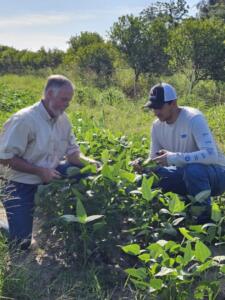
Cowpea cover crop planted working with UF Researcher, Courtesy of Ben McLean III
Outcomes & Challenges
For him, the primary benefit of implementing cover cropping was the increase in available nitrogen and other nutrients; the secondary benefit was root exudates that help in managing nematodes, and the unexpected benefit was the increase in native pollinators.
Through soil sampling and other analysis, they were able to measure 25% more manganese availability within 90 days of planting. And the resulting biodiversity from cover cropping meant that their orchard, with its 6-foot strips of flowering cowpea and sunn hemp, created wonderful insectaries with honeybees, bumblebees, native pollinators, beetles, and other deterrents to harmful insect pathogens.
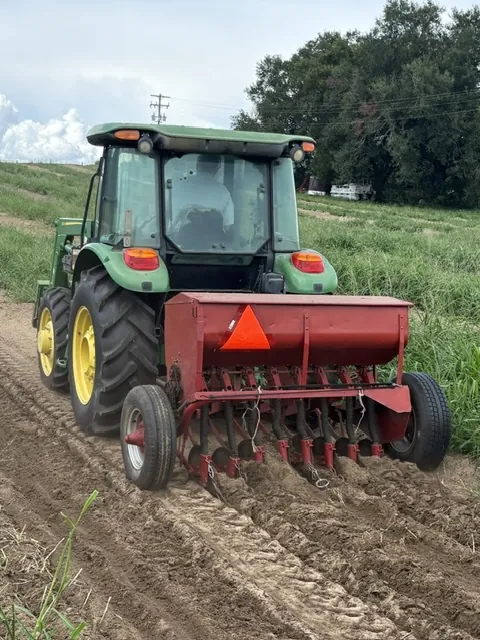
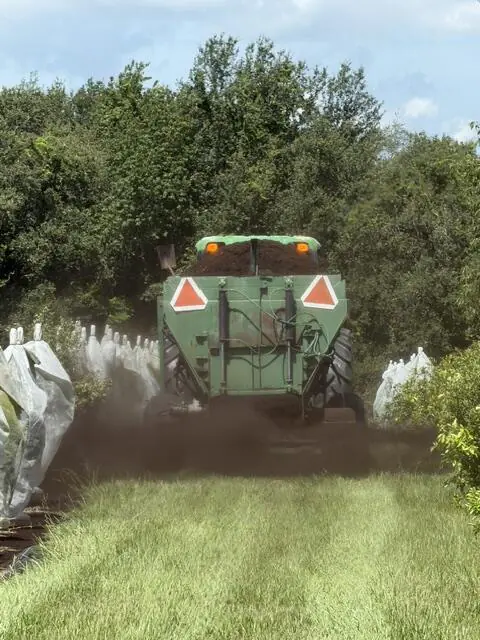
Cover cropping continues in 2026 with University of Florida researchers and Jarred Eddy of Central Florida Ag Services. Pictured above: a Massey Ferguson Grain Drill planting cover crops (left) and compost spreader utilizing Florida-based Veransa compost (right). Photos courtesy of Ben McLean III.
Advice to Farmers
“The good news that I would share with anybody considering either the transition to organic or applying for NRCS support: it can be done.” Ben continues, “It was easier than I thought, and I received excellent help from our local FSA and NRCS staff in both Lake County and Polk County. There is paperwork, but it’s worth doing, and it creates value in your long-term farm plan. It opens doors to you, and you’ll get access to information you may not have had.”
He also cites thorough recordkeeping and the support of staff and recordkeeping accountants as a key factor in the smoothness of the process.
Furthermore, he echoes familiar farmer advice: lean on other farmers and mentors. Networks and neighbors can both serve as tremendous support for growers at any experience level.
“I encourage farmers to go to your Extension workshops, go to your university workshops, go to USDA workshops or field days. And get to know your neighbors, get to know other farmers, join your grower organizations. This is where you’ll meet people from NRCS and can ask about their programs. Don’t be afraid to ask a lot of questions.”
Ready to Apply? Here Are a Few Helpful Resources
If you’re a farmer considering applying for EQIP or other NRCS programs, here are some helpful tools to get started:
- Download a printable summary of the key takeaways for farmers to consider when applying to NRCS EQIP here.
- Explore our overview of the Environmental Quality Incentives Program (EQIP) and download summary flyers in English and Spanish.
- Explore our overview of the Conservation Stewardship Program (CSP) and download summary flyers in English and Spanish.
- Connect with your local NRCS office to start developing a conservation plan: nrcs.usda.gov/contact
- Know your eligibility. Farmers who are classified as beginning, limited-resource, socially disadvantaged, or veterans may qualify for higher reimbursement rates and advance payments.
Additional Resources & Reading:
- Two Oʻahu Farmers Share Wins & Challenges Accessing CSP Support
- Conservation at Work: Cover Cropping through CSP at Mora Mora Farm
- OFRF Farmer Stories
Organic Farming Research Foundation Resources:
- All Transition to Organic Partnership Program (TOPP) resources
- Transition to Organic Partnership Program (TOPP) Southeast resources
- OFRF Resource Hub
Connect with OFRF: