

Microgreen Mediums: Testing Jute Verses Soil
Written by Mary Hathaway, OFRF’s Research & Education Program Manager, and Tiffany Sanders, FLT Program participant
This on-farm trial at Sanders Funny farm will compare the effectiveness of jute fiber mats verses soil as the growing medium for a variety of microgreens. Results from this study will help organic farmers produce healthier microgreens and reduce crop losses.
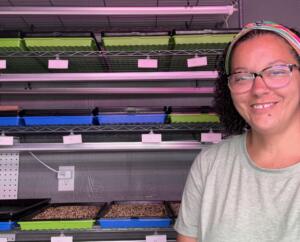
Farmer Tiffany Sanders in her microgreen production greenhouse.
Mike and Tiffany Sanders, co-founders of Sanders Funny Farm in Indianapolis, Indiana, didn’t come to farming through a traditional path. With 11 kids, 2 grandkids, and “a revolving door of critters,” the name Funny Farm practically chose itself. At the heart of their operation is a thriving greenhouse microgreens enterprise, where Tiffany grows a diverse lineup of nutrient-dense crops–broccoli, radish, chia, arugula, wheatgrass, and more–sold through their online farm market and delivered directly to customers across Indiana.
Tiffany is committed to growing her operation to make local food easy, consistent, and affordable. Recently her farm and greenhouse became certified through California Certified Organic Farmers (CCOF). Looking ahead, Tiffany envisions expanding her microgreens line to include more specialty and difficult-to-grow varieties, making her farm a more resilient and diverse supplier. To do that, she knows she needs reliable, data-backed answers about which growing systems actually work, and which ones work best.
Growing Better Microgreens
Since launching her microgreens operation, Tiffany has relied primarily on jute fiber mats, a hydroponic-style growing medium standard in the industry, to grow her crops. Jute mats are convenient, clean, and widely-used, performing well for many varieties. But as Tiffany expanded her lineup and worked to grow more challenging crops, cracks began to show. Varieties like arugula and cilantro struggled with mold and moisture issues on jute. Each failed tray represented not just lost revenue, but a missed opportunity to serve her customers.
At the same time, Tiffany began wondering whether soil-grown microgreens might offer advantages she hadn’t fully explored, like better germination consistency, sturdier stems, more vibrant color, and improved shelf life. These qualities matter enormously in a market where perishability directly affects whether a product can be sold. A tray of microgreens that wilts quickly or arrives limp at market is as good as no tray at all.
The challenge was that Tiffany didn’t have rigorous, side-by-side data to compare the two mediums. Her observations were real, but anecdotal. She needed a structured trial that could tell her, with confidence, whether soil was worth integrating into her production system and, if so, determine which varieties and under what conditions. That question became the foundation of her application to OFRF’s Farmer-Led Trials program.
On-Farm Trial Plan
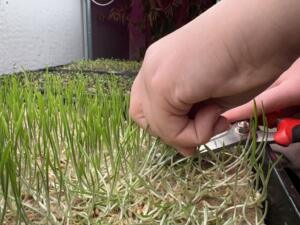
Harvesting microgreens grown on a jute mat.
With technical support from OFRF, Tiffany designed a controlled experiment to compare organic soil mix against jute fiber mats as growing mediums for microgreen production. The trial uses a randomized complete block design, with six replications per treatment, running one variety at a time to eliminate confounding variables like differing light requirements and shelf position. Each experimental unit consists of two 10 by 20 inch trays (one soil, one jute), alternated across the six shelves of a dedicated greenhouse rack. Broccoli is a consistent staple of her product line and will serve as the first variety tested, with radish and black chia to follow in sequential trials.
Key measurements include yield by weight at harvest, a cost analysis tracking seed, growing medium, and labor expenses per tray. She will also take observational data on disease incidence and post-harvest perishability, including color and limpness. Watering volume, light cycle, seed variety, and seed quantity are standardized across treatments to ensure a fair and meaningful comparison.
Trial Updates
The broccoli trial is currently underway. Trays were seeded on May 24, 2026, and harvested on June 6, 2026. Early observations during the germination phase noted that jute trays germinated more quickly and evenly, while soil trays started patchier but caught up noticeably by days 8–12, growing taller, greener, and with sturdier stems. By harvest, the yield data told a striking story: soil trays produced approximately 8–11 oz per tray, compared to roughly 3–5 oz per tray on jute–a more than double difference across six replications. Qualitative observations also favored the soil-grown crop for color vibrancy and fullness. Data collection for the radish and chia trials is planned to follow.
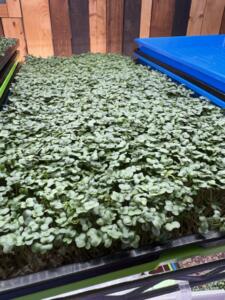
Broccoli consistently does well at Sanders Funny Farm, so it was the first variety to be tested.
“As a grower you hear a lot of opinions about what works best, but I wanted real data from my own farm. This trial has already challenged some of my assumptions and shown me that soil may have some real advantages for certain crops. Having those answers will help me make better decisions, reduce losses, and provide a better product for the families and communities we serve.”
– Tiffany Sanders, FLT Program Participant
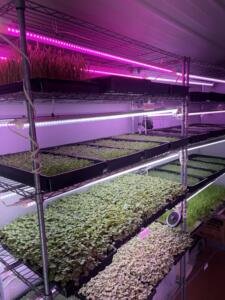
Jute and soil trays are alternated between shelves.
This is part of a series of blogs highlighting farmers who are participating in OFRF’s Farmer-Led Trials program. Farmers receive technical support to address their production challenges through structured on-farm trials. To learn more about OFRF’s Farmer-Led Trials Program, visit our website page at https://ofrf.org/research/farmer-led-research-trials/
To learn more about Sanders Funny Farm, visit sandersfunnyfarm.com or follow along on their Facebook, Instagram, and YouTube channels.