
Have you ever seen a “Map of Joy” before? What would you add to it? Along with several other interactive projects, the Map of Joy in the Food System is one of the tools that the UVM Institute for Agroecology employs to help build collaboration and shared vision of a thriving local food system.
Learning from the UVM Institute for Agroecology
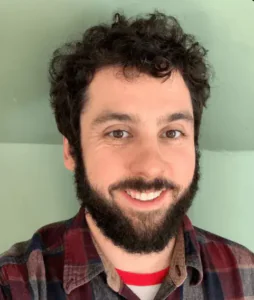
Shane Rogers, UVM, IFA
Earlier this year, OFRF staff met with Shane Rogers, of the University of Vermont’s Institute for Agroecology, to learn more about their work. In mid-2025, Food Solutions New England (FSNE) transitioned much of its programming from their longtime home at the University of New Hampshire to a new institutional partnership with the University of Vermont’s Institute for Agroecology (IFA). As they navigate this transition, IFA is continuing FSNE’s communications and narrative strategy work, as well as regional policy efforts like the New England Integrated Policy Program.
Shane is the Outreach and Narrative Lead for IFA. With a background in journalism, he worked at a number of community newspapers after college, and eventually found himself in Washington D.C.. His love for food eventually combined with a desire to work in advocacy and brought him to rural Vermont, where he became involved with statewide and regional food systems organizations. More recently, he has honed in on a focus on narrative strategy, answering the question of what it means to organize a network of communicators to do this work together.
So, What is Narrative Strategy?
Shane describes narrative as a “shared interpretation of how the world works.” In other words, it’s “the guiding ideas behind the communications or the work that you’re putting out there.” Developing a shared narrative takes time, trust, and relationship building within the group or community. But Shane also points out that many folks working in movement-building spaces probably already have a shared narrative, even if we haven’t taken the time to define it or write it down. It’s the messages that resonate with the people you work with. Developing a narrative framework within a collaborative group can take time. But Shane emphasized that moving slowly with collective energy behind you is stronger in the long run than “going it alone” and then trying to convince everyone else that your way is the right way.
Identifying the messaging that makes sense for your community is key to understanding shared narrative, for instance, the environmental benefits of organic farming practices, or the peace of mind that comes from feeding your family organic food.
Once you’ve identified that narrative, using it strategically is the practice of intentionally shaping public understanding. It’s using those stories to communicate and share values, and build culture. Narrative strategy is the way that movements build the overarching stories that influence what people see as normal, acceptable, or possible. First, you identify the core narrative. Then you frame it intentionally for specific audiences.
Shared Vision, Different Vocabulary
Having a shared narrative doesn’t mean that everyone will talk about it in the same way. Shane explained that when a group or organization creates a shared narrative, it’s often in lofty language, almost nonprofit jargon. But each participating organization or group can take that vision and translate it into the language that works for their community or audience. Narrative is also not limited to the words you use. If you think of it as a way to build and shape culture, you can widen the frame to see that narrative includes the space you meet in, the programming you offer, the ways that you engage, and how you show up. These are all ways that you create a story, shift an understanding of what is normal or acceptable, and begin to create culture that is aligned with the values of your shared narrative.
Shane also reiterated that individuals or even individual organizations aren’t the only carriers of the narrative. It’s essential to look at who else is telling a similar story, and to seek out opportunities to lift those voices up.
Along those lines, Shane also pointed out that, as narratives are created within communities, it is critical to ensure that all voices and perspectives are represented. One way to do this is to invite specific groups to be reviewers. Especially if there are essential perspectives you want to include, but who don’t want to be part of the work of crafting the narrative. This can be a way to offer people or groups a seat at the table, while giving them the opportunity to opt out of all the “legwork” involved in identifying the narrative.
How Does a Map of Joy Fit In?
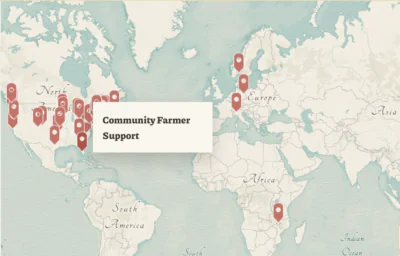
Map of Joy, from IFA
Shane told us the story of working with a community of practice to identify their shared narrative. As part of the process, they realized that joy was something that was often forgotten in their work in the food system. It just “didn’t fit” into the work most of the time, and they wanted to change that. They decided to celebrate joy, and to allow people to define what joy meant to them individually. The result is the Mapping Joy in the Food System project, which Shane pointed out is brilliant in its simplicity. It utilizes a free ArcGIS mapping tool and collects input through a Google Form, which then populates the map. The process allows individuals to define their own joy, sharing a sentence or a short story, and sometimes a photo of a moment or experience of joy in the food system. The map currently includes things like a story of a farm giving someone who was “down on their luck” a job, and who then ended up staying on for 5 years! Other points on the map include the bite of a fresh berry, all the amazing insects, and sharing carrots with neighbors. The project has seen entries come in from all over the world, and IFA now releases a monthly moment of joy to highlight the experience and multiply that joy through sharing it—an example of narrative strategy in action.
“Because in trying to articulate what, perhaps, joy is, it has occurred to me that among other things—the trees and the mushrooms have shown me this—joy is the mostly invisible, the underground union between us, you and me, which is, among other things, the great fact of our life and the lives of everyone and thing we love going away. If we sink a spoon into that fact, into the duff between us, we will find it teeming. It will look like all the books ever written. It will look like all the nerves in a body. We might call it sorrow, but we might call it a union, one that, once we notice it, once we bring it into the light, might become flower and food. Might be joy.” – Ross Gay, The Book of Delights
To learn more about IFA, their work, and get involved, visit https://www.uvm.edu/instituteforagroecology.
We also strongly recommend joining IFA’s Food System Communicators Community of Practice and reviewing Shane’s guide on helping organizers develop, align, and test shared narratives: Strategic Collective Communications: A Workbook for Building Solidarity and Reshaping Communications.