
Investigating Seeding Rate of Cover Crops for Biomass and Nutrient Content
Written by Mary Hathaway, OFRF’s Research & Education Program Manager, and Anthony Reyes, FLT Program participant

Anthony Reyes, FLT Program Participant. Photo credit Washington Soil Health Initiative, https://washingtonsoilhealthinitiative.com/2025/02/soil-health-ambassador-anthony-reyes-cover-crops/
Oxbow Farm & Conservation Center is a nonprofit farm in the floodplains of Snoqualmie Valley, WA. Anthony Reyes, the Agricultural Program Manager, manages 81 acres of certified organic land by experimenting and trialing climate adaptive and resilient agricultural practices. Along with his team, he works to reconcile our expanding human needs and the health of our ecosystem through sustainable agriculture, thoughtful management of our forests, ecological restoration, and education.
Oxbow Farm cultivates a variety of different crops well suited to the Snoqualmie Valley floodplain, and maintains a crop rotation to allow the soil to recover and regenerate. Anthony strategically removes fields from production each year and leaves them fallowed in cover crop to help protect the watershed, build up nutrients, and manage weeds, pests, and diseases.
Finding a Cover Crop that Works
Anthony was interested in understanding how to find a cover crop that would meet the needs of the farm – managing climatic challenges, erosion, and weed pressure. Ideally, anything that would be planted would help add biomass and could withstand drought conditions. Manipulating the seeding rate of the cover crops had been one way that the farm had considered better coverage of the soil, and Anthony was curious if the recommended seeding rate was the right density for their soil.
Farm Trial Plan
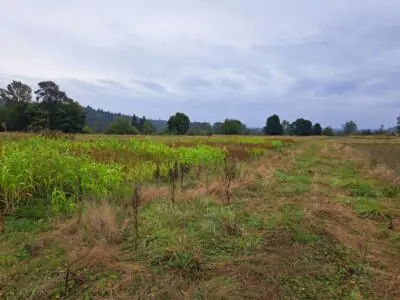
A portion of the cover cropped trial field.
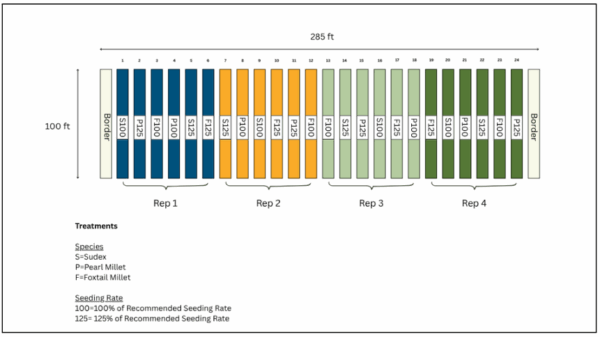
With technical support from OFRF, Anthony is investigating the impact of seeding rate on biomass and nutrient content for German Foxtail, Pearl Millet, and Sudex cover crops. He will plant single varieties at two different seeding rates: the recommended rate and 25% above the recommended drilling rate.
The trial was arranged in a randomized complete block design, with 24 rows, each 100’ x 10’ wide, with 1’ pathways and borders on outside rows. Each of the 4 replications contained 6 plots (3 varieties at 2 different seeding rates), for a total of 24 plots.
Measurements were taken from a random 3×3’ quadrat from each plot, including a biomass and leaf tissue sample. These samples were sent to Ward Lab for analysis of biomass, nutrient content, dry matter, and C:N ratio of the crop matter.
Trial updates
The quadrat samples were taken in September and lab results were returned in late October. The OFRF team reviewed the data with Anthony, read a full report on how the trial went and findings from the data below.
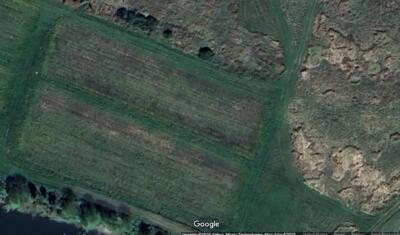
Trial fields at Oxbow Farm and Conservation Center
“I have long been interested in conducting and furthering our on-farm research, having worked on and set up many trials throughout my career. The Farmer-Led Trial Program goes beyond and centers the experience and voice of farmers by identifying us as the content experts and by playing a highly supportive and facilitative role in creating sound research from our identified goals. I have greatly valued the time and care given by OFRF staff and am so appreciative of this program.”
– Anthony Reyes, Oxbow Farm and Conservation Center

An overhead drone shot of Oxbow Farm and Conservation Center
Research Results
For this Famer-Led Trial project, Anthony wanted to find a cover crop that would meet the needs of the farm – managing climatic challenges, erosion, and weed pressure. Ideally, anything that would be planted would help add biomass and could withstand drought conditions. In addition to testing a few new cover crops, Anthony was interested in manipulating the seeding rate of the cover crops to achieve better soil cover, and was curious to know if the recommended seeding rate was adequate for their soil and growing conditions.
Key Findings
- German Foxtail Millet and Sudex were identified as high yielding cover crops in this trial. There was an early season drought, which likely affected the cover crops, especially Pearl Millet.
- Sudex demonstrated the most vigor and produced more tillers, while the German Foxtail Millet was shorter and more upright, and did not form a closed canopy.
- Under these conditions, higher seeding rates were unnecessary, as the 125% rate offered no yield benefit and diluted nitrogen concentration, making the standard 100% rate more cost-effective.
Anthony is interested in trialing these crop varieties again, in a more fertile field and ideally under typical rainfall conditions.
For full details on the study’s methodology and results, read the final report.
This is part of a series of blogs highlighting farmers who are participating in OFRF’s Farmer-Led Trials program. Farmers receive technical support to address their production challenges through structured on-farm trials. To learn more about OFRF’s Farmer-Led Trials Program, visit our website page at https://ofrf.org/research/farmer-led-research-trials/
To learn more about Oxbow Farm and Conservation Center, visit their website at https://www.oxbow.org/