The Organic Research Hub
By Brian Geier, OFRF Communications Manager. This article was originally published in the Fall 2025 Organic Broadcaster by Marbleseed.
Every day, farmers make decisions that can have short-term and long-term effects on our farms. And as organic farmers, we depend on complex, intertwining relationships amongst all the moving parts of an organic system to work with us: plants, animals, soils, climate, microbes, workers, insects, processors, consumers, and more. To put it mildly, good information is key for our success, and wrong or misguided information can be costly.
Many farmers will tell you that the best information comes from our experiences on the land. “A farmer’s footstep is the best fertilizer,” they say. Our second-best source of information, reflected in survey after survey, is the information farmers get from other farmers. Third may arguably be what we find using the internet. But there, we risk running into an overwhelming array of sources of info with varying degrees of reliability, which may or may not be accessible or useful to anyone, let alone organic farmers!
Introducing the Organic Research Hub
A new tool seeks to remedy this overwhelm, and it is worthy of a close look. The Organic Research Hub, launched in early 2025 by the Organic Farming Research Foundation (OFRF), is a curated collection of scientific and technical resources to help organic farmers understand and solve their challenges. It is a gateway to research and resources that are applicable to organic farmers, and it is a connection place between farmers, researchers, technical service providers, and extension agents.
Ohio dairy farmer Jordan Settlage, who serves on the Organic Stewardship Council for OFRF, described his first experience testing out the “Hub” at a recent advisory meeting:
“We’re changing our compost management right now, and I had some questions about it. I searched the site, and within about 30 seconds, I found the answers I was looking for. I thought, ‘Wow, this is a powerful tool. This is fantastic.’ What really stood out is that it wasn’t just some random person on YouTube or a questionable link from Google. The information came from Rodale and other credible sources. It was actually helpful—and I was able to make real management decisions based on what I read.” –Jordan Settlage, Settlage and Settlage Farms

The Hub is easy to use. It can be searched by typing a keyword, by selecting from one or more of 17 topics (for example, Cropping Systems, Tools and Technology, or Livestock Feeding), by choosing a USDA-SARE region, or filtering by production category. You can also combine these options for a more refined search. Let’s take a look at how it works, using the Great Lakes region as an example.
Challenges for Organic Farmers in the Great Lakes Agro-Ecoregion
The Great Lakes agro-ecoregion, as defined by the National Organic Research Agenda (NORA), includes Michigan, Minnesota, and Wisconsin. (National data and larger USDA-SARE regions, including the “Northcentral” region, are also used in the NORA report. Smaller agro-ecoregions like the Great Lakes are used to provide a finer scale of categorization that reflects geographical specialization of farm commodities, and regional differences in soil types, climates, and environmental stressors.) In the NORA report, Great Lakes organic farmers identified the following challenges:
- The top production challenges are: controlling weeds (66% of respondents struggle with this), maintaining adequate yields (50%), and managing production costs (45%).
- The non-production challenges are: finding and developing markets for organic products (56%) and accessing labor (52%).
- The preferred source of information is other organic farmers (91% of respondents say so, a preference observed in all regions but strongest in the Great Lakes).
- The most influential methods for learning are field days, followed by printed materials, then online resources, and then conferences.
The top concerns are organic fraud and integrity, industrial organic, crop contamination, imbalance of domestic certified organic supply and demand, and funds for organic research.
Addressing the Top Organic Production Challenge of the Great Lakes: Weed Management
What would an organic farmer find on the Hub if they chose the Weed Management topic and the North Central region? At the time of this writing, this search generates 19 resources that farmers in the Great Lakes may find helpful when addressing their #1 production issue.
For example, farmers using plastic mulches might be interested in a study at Michigan State University that looked at the effects of several weed prevention strategies (cultivation, dead mulch, living mulch cover crops, and mowing) between plastic mulch rows on weed control, soil health, and cash crop quality/yield.
Producers interested in using reusable black tarps to smother weeds might note that in a recent study at Cornell, it only took 3 weeks to kill weeds with tarps, and results suggest that following tarping, mechanical cultivation, or field prep can be accomplished with less depth (and fuel).
And, with other results from this search, any farmer could:
- Sharpen knowledge of major weed families using this eOrganic virtual tour.
- Integrate new strategies like flame weeding or increased field sanitation as laid out by Dr. Alan Leslie in this article on integrated weed management.
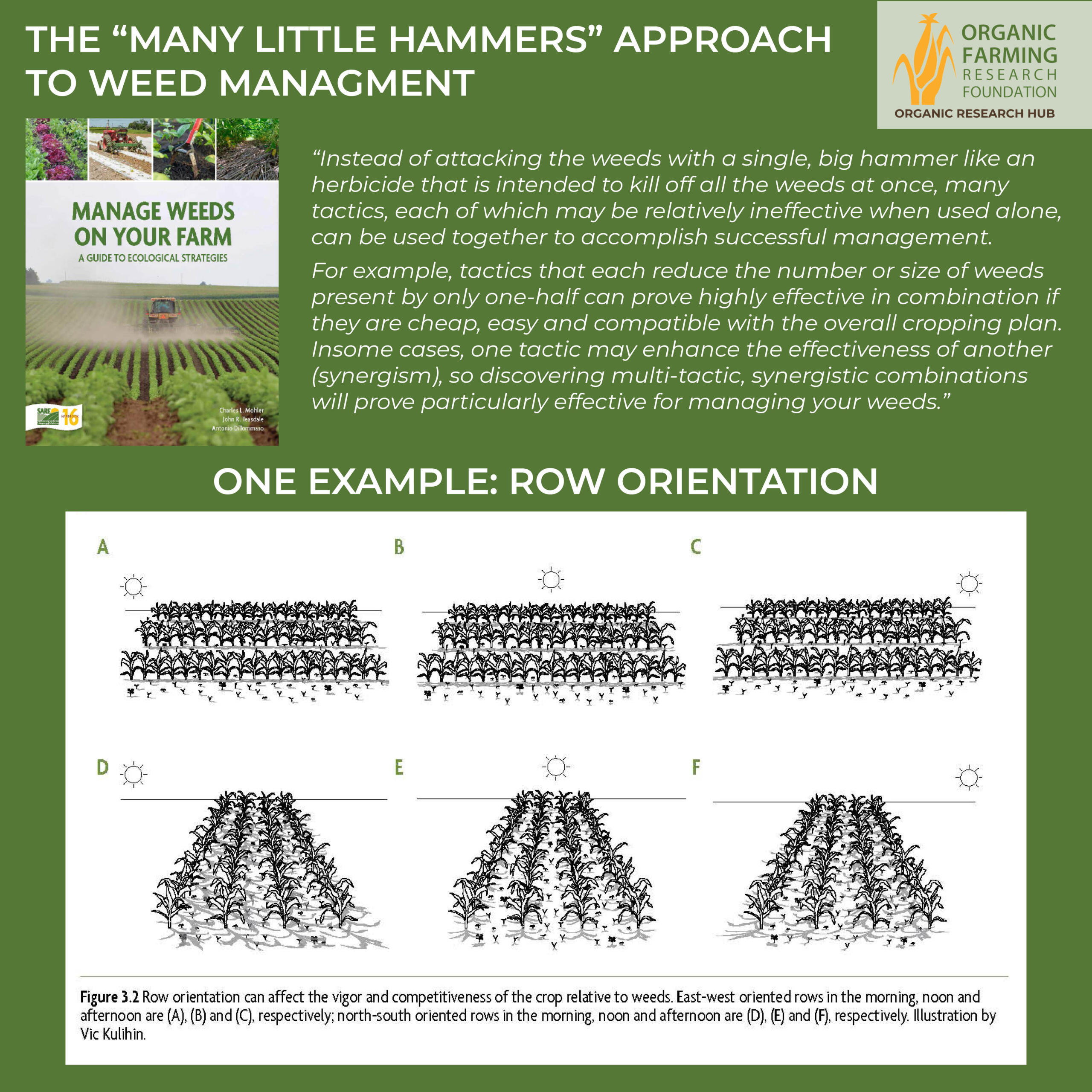
- Take the “many little hammers” approach to weed management outlined in the visual below and discussed by organic weed specialist Dr. Eric Gallandt in this guide to ecological strategies for weed control from SARE.
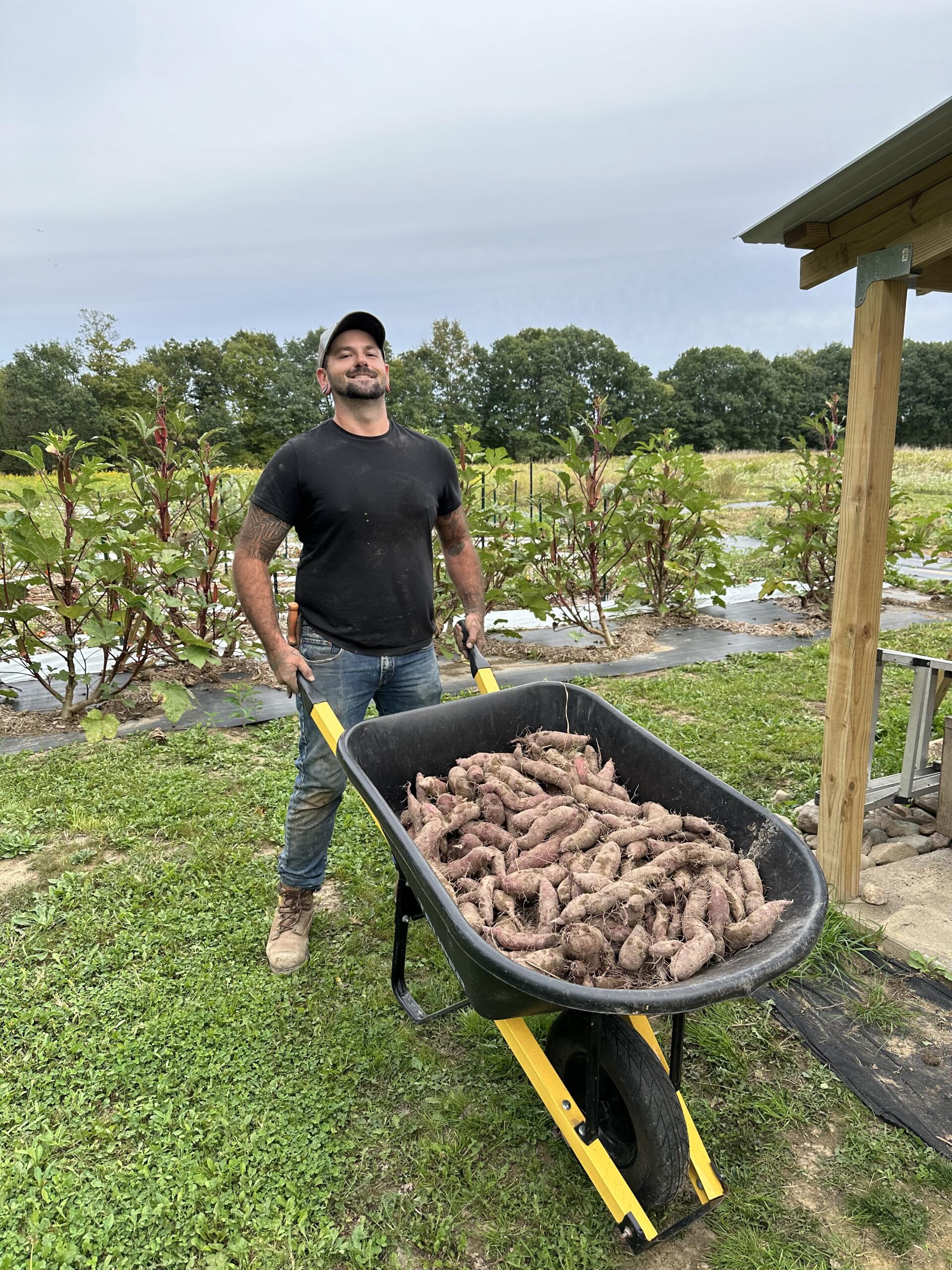
Mike Lucas, of Farmacea in Munith, Michigan, like most organic farmers in the Great Lakes, is looking for ways to successfully address weed management. An on-farm research trial led by Farmacea is looking at comparing synthetic and living mulches. Results are forthcoming and will be available on the Hub.
Resources for the Top Non-production Challenge: Finding and Navigating Markets
Over half of the organic farmers in the Great Lakes say that finding and navigating organic markets is a significant challenge. Looking at Hub results for the “Managing Production Costs: Business and Marketing” topic and the Northcentral region reveals an array of resources that provide valuable insights.
There are podcasts like Field, Lab, Earth Podcast, where filmmaker Anders Gurda and agricultural professional Paul Dietmann discuss finding markets for organic grains and the business side of transitioning to organic. A video from the Organic Agronomy Training Service explains the opportunities with locking in prices for future sales using ‘forward contracts’. Another publication could help producers price organic products where organic markets may not already be established. And although not directly market-related, another search result is a podcast with farmer Tom Frantzen exploring the importance of long-term planning and thinking for organic farmers.
Organic Farming Extension Directory and Other Resources From OFRF
In addition to digital resources like factsheets, videos, and podcasts, farmers can now find a list of Extension agents and Technical Service Providers with organic expertise on the Hub. At the time of this writing, the Hub’s “Organic Farming Extension Directory” lists 15 organic farming experts in Wisconsin, two in Michigan, and nine in Minnesota. More specialists are expected to be added, and nominations are welcome (see below).
In addition to the Hub and Directory, this Resource page is the go-to spot for OFRF factsheets, webinars, networking sessions, and farmer-led resources like this suite on Crop-Livestock Integration. The Advocacy page also hosts our Organic Research State-by-State factsheets, which detail the size of the organic market, the importance of organic research investments, local organic research projects, and regional research priorities in each state, including Michigan, Minnesota, and Wisconsin.
Building and Farming Into the Future
The Hub and the Directory are living resources open to additions. Feedback or suggestions for additions can be submitted via this form or by contacting OFRF staff at the email on the form. If farmers, ranchers, researchers, extension agents, or anyone has suggestions for additions to these resources, OFRF welcomes your input!
Results from on-farm trials being conducted by organic farmers in the Great Lakes are among the latest additions to the Hub. OFRF’s Farmer-Led Trials (FLT) program provides financial and technical support to organic farmers to investigate and learn about solutions to their most pressing production challenges. Applications for the next round of FLT projects will be open this fall. Recent and forthcoming additions to the Hub from Great Lakes farmers in the FLT program include:
- Results of in-row seed spacing & root crop yield from the Green Things Farm Collective, Ann Arbor, Michigan.
- Effects of living clover mulches from farmers Mike Lucas and Rollin Baker of Farmacea, in Munith, Michigan.
Results on anaerobic fermentation as a closed-loop farm-made fertilizer from Samantha Otto of The Woven Trifecta, in Whitehall, Michigan.
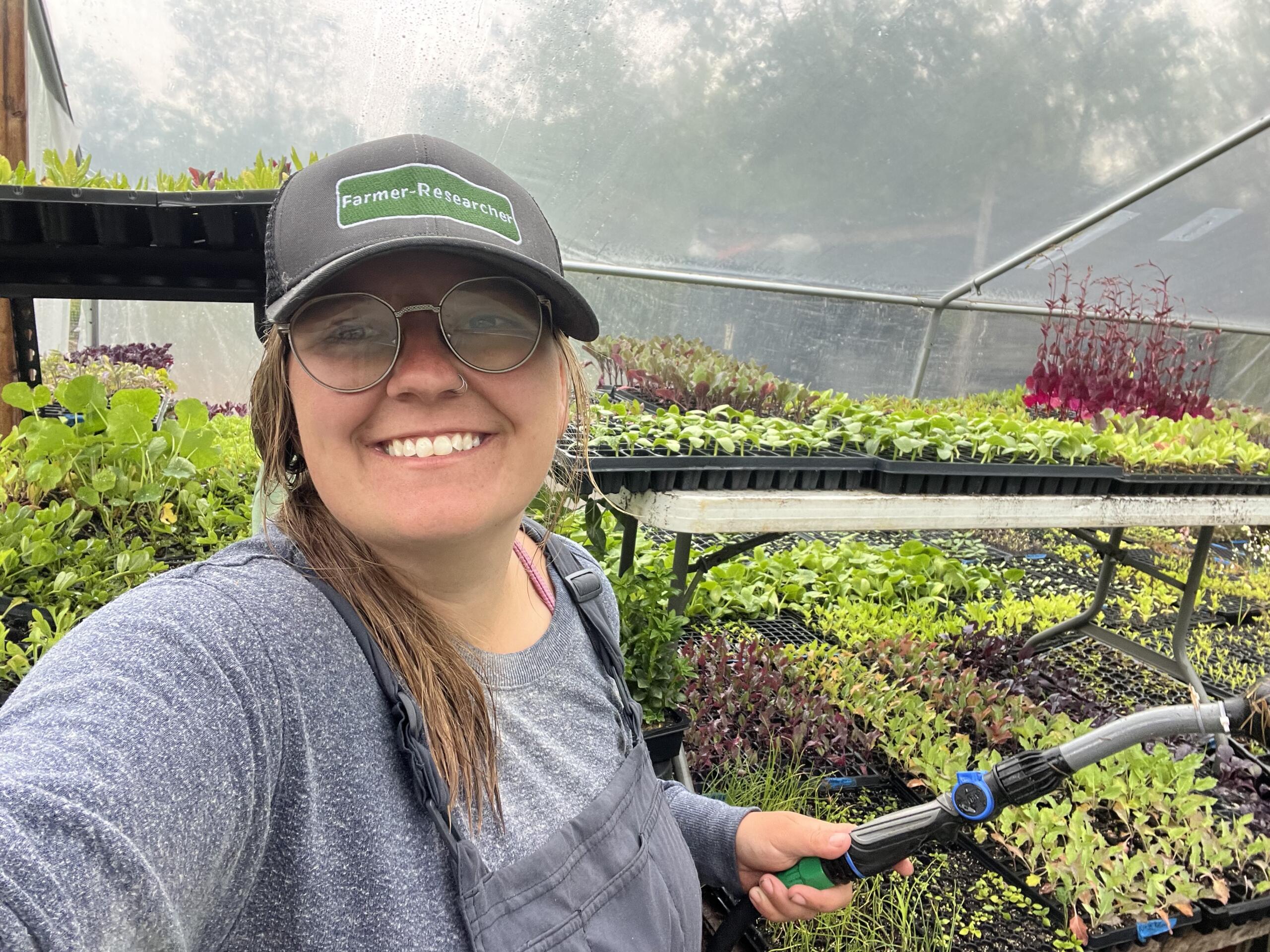
Samantha Otto, at The Woven Trifecta in western Michigan, leads an on-farm trial looking at incorporating waste from her livestock and compost into anaerobic ferments to improve soil fertility and plant health. Results are forthcoming and will be posted on the Hub.
Addressing the myriad of challenges organic farmers face is not easy or formulaic. We need relevant, updated information from a wide swath of science areas. We want to see real results on working farms. Our information needs to be specific to production systems and regional factors. The Hub is a powerful step in this direction, and I hope readers will join me in using it and sharing it.
Want to stay up-to-date with OFRF? The best way is to join our monthly newsletter, where you’ll receive alerts about new resources, upcoming events and webinars, paid internships with the organization, federal programs and funding for organic farmers and research, and policy updates relevant to the organic community.