
By Clare Boland, Communications and Outreach Fellow
For many farmers, transitioning to certified organic production presents a learning curve. During the three-year transition period, farmers face unique challenges in the field (restoring soil health, managing weeds without herbicides, acquiring new equipment and infrastructure) and off (maintaining financial viability, navigating National Organic Program (NOP) paperwork, and recordkeeping). At a recent Seeds of Success panel, three farmers with roots in conventional agriculture shared their experience of transitioning to organic in the Northwest, demystifying some of the challenges they faced and offering their advice on the process.
Their stories reveal not only the technical challenges of organic production, but also the mindset shifts, economic realities, and long-term resilience that come with farming in an organic system.
About the Farmers
 Source: Flansburg Farm
Aaron Flansburg, of Flansburg Farm in Palouse, Washington, is a fifth-generation farmer. After graduating from Washington State University in 2002, he returned to work with his parents on the family farm. Now in his 23rd crop year, Aaron farms roughly 2,000 acres of dryland wheat, barley, peas, lentils, chickpeas, canola, and alfalfa alongside his wife and three children.
Aaron says his family has always been “innovative and progressive in terms of trying to maintain soil, keep it in place, and, in general, doing farming practices the best that we can.” Because of this, transitioning to organic felt like a logical next step.
Aaron began transitioning to organic production in 2020 with 50 acres. Today, 160 acres are certified organic, with additional acreage currently in transition and more planned. Six years into farming without chemical inputs, Aaron’s main focus is self-sufficiency – controlling costs, limiting soil input, and building resilient domestic markets so he can rely less on foreign inputs and global trade.
 Source: Yellowstone River Farms
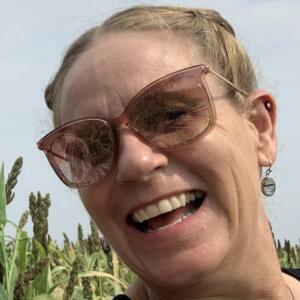
Tracey Dion is a third-generation farmer at Yellowstone River Farms in Terry, Montana. Tracey and her husband transitioned their 500-acre family operation from conventional sugar beet production to a diversified, certified organic cattle and crop farm.
When she first acquired the farm from her parents, she continued to farm conventionally until it “dawned on me that I didn’t have any worms and I was working with land that was devoid of life.” That realization spurred her decision to transition to organic, starting by growing 10 acres of alfalfa on previously unfarmed land. Gradually, they transitioned the entire farm using practices like rotational livestock grazing and cover crops. They now produce alfalfa, specialty crops, certified organic cattle, and, as of 2024, the farm expanded into selling lamb to restaurants.
Tracey believes healthy soil is the foundation of agriculture’s future. She currently serves as chair of the Montana Organic Association and mentors transitioning farmers through the Great Northwest Healthy Soils Program.
 Source: Life Springs Farm
Lynn Schaal of Life Springs Farm in Twin Falls, Idaho, was raised in a multi-generational farming and ranching family in eastern Colorado. Growing up on a sugar beet farm, he experienced severe reactions to agricultural chemicals. “I had told myself back then that if I ever had a chance to farm myself, I would never use chemicals.”
Today, Lynn and his wife farm more than 70 acres of certified organic land, producing wheat, barley, dry beans, silage corn, buckwheat, and alfalfa for organic dairy and beef operations, as well as organic lamb and poultry for restaurants.
After purchasing land that had been fallow for over two decades, they transitioned it to organic production and have been farming without chemical inputs for more than 15 years. Life Springs Farm is guided by their belief that soil is a living organism that must be nurtured, not merely a medium to hold plants. Now entering his 16th year at Life Springs Farm, Lynn also mentors other transitioning farmers in the Northwest.
Navigating the First Three Years of Transition
The NOP requires a three-year transition period for land previously farmed with prohibitive inputs, which can cause uncertainty around markets, land management, and financial risk for farmers.
For Lynn, the transition was eased by the fact that part of his land qualified for immediate certification. Located in dairy country, organic barley provided a ready market. During the transition, he farmed organic and conventional barley side by side and was struck by the price difference: “The conventional barley got one-third of what the organic barley got.” While income was limited until the entire farm was certified, the family was fully committed to becoming organic as quickly as possible.
He noted that input costs are drastically different from conventional systems, using strategies like cover cropping rather than using traditional soil inputs. “It seems like a lot of people want to concentrate on yield, you know, how many bushels to the acre are you gonna get? But to that question, I’d say, what are your input costs?” However, the comparison is not always cut-and-dry on the accounting books – while conventional farms spend more money on inputs, organic farming requires more labor and time.
 Source: Flansburg Farm
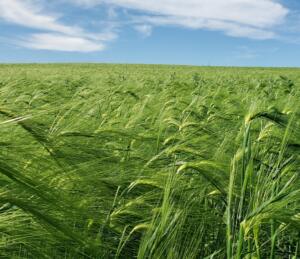
Scots Bere barley growing at Flansburg Farm.
Aaron’s transition began with growing hemp seed in 2020. Because hemp could not be treated with most conventional chemicals, organic production made economic sense. The next year, severe drought further reinforced his decision to move towards organic: conventional wheat with full chemical inputs yielded only modestly better than volunteer wheat grown with no inputs at all. “I thought, huh, I actually really like growing half the crop for twice the price. That led me into thinking that [organic production] would work.”
Tracey’s transition was shaped by the physical layout of her farm, which is parceled out into separate fields. They transitioned these parcels in phases, starting with growing alfalfa to suppress weeds and rebuild nitrogen naturally. Over time, she noticed that weed species common under conventional sugar beet production began to disappear after going organic. While yields initially dropped, soil health eventually rebounded, and long-term resilience improved.
Soil Health in Organic Systems
Moving from conventional to organic, all three farmers emphasized the overall improvement in soil health after transitioning. Rather than depending on purchased soil inputs, they focus on systems that build fertility from within the farm.
Lynn uses a closed-loop approach that integrates livestock, compost, and crop rotation. Cattle play a central role in nutrient cycling, rotating alfalfa and straw help suppress weeds, and compost is applied annually, though dry conditions in the area slow on-farm compost production. He closely monitors soil health; “I go out at night and check my worms. That tells me how healthy my soil is.”
For Aaron, his perspective on tillage has evolved significantly over time. “I thought tillage was a four letter word at one point,” he shared. Now, he sees it as a practical tool, especially on a non-irrigated farm that depends solely on rainfall. Without the ability to manage weeds by controlling water, he has had to adapt, experimenting by incorporating older, mechanical tillage equipment, some of it dating back to the 1980s and 1990s. Crop rotation, planting timing, seeding direction, and cover crops all play a role in suppressing weeds as well. “My whole perspective has shifted,” Aaron shared. “I found that the soil is healing itself on the organic ground in a way I never would’ve expected. Bacteria, fungus, soil micro- and macro- organisms are working to get soil aggregation back without being suppressed by the use of chemical fertilizers, fungicides, and herbicides.”
Tracey emphasized a similar mindset shift: “You’re looking at things completely differently when you are trying to do nothing but create life.” Her farm uses manure, livestock grazing, tillage, and diverse cropping systems to build soil naturally. She views weeds as indicators of soil imbalance and uses them as diagnostic tools rather than enemies to be eradicated.
 Source: Yellowstone River Farms
Livestock grazing helps build soil health at Yellowstone River Farms.
Learning from Fellow Farmers
“The organic community is my best resource.”
-Tracey Dion, Yellowstone River Farms
When asked about key resources, all three farmers pointed to people as their most valuable source of knowledge.
Tracey relies heavily on conversations with other farmers, learning through trial and error and shared experience. “The organic community is my best resource,” she said. Lynn echoed this, drawing inspiration from older generations who farmed without chemicals and relied on observation and experimentation. “[Older generations] didn’t have the latest and greatest, they didn’t have chemicals, they didn’t have herbicides and all of that stuff available at their fingertips, yet they produced some great crops.” He continues to try out older equipment and find inspiration in traditional agricultural knowledge.
Aaron was able to find support through mentorship within the Transition to Organic Partnership Program. Farming in an area without many organic growers, seeking out fellow organic farmers through the TOPP program and attending conferences has helped him build community. Aaron also supplements farmer-to-farmer learning with books, shouting out two of his favorites: “When Weeds Talk” by Jay L. McCaman and “Weeds Control Without Poisons” by Charles Walters Jr.
Recordkeeping
For transitioning farmers, the recording-keeping associated with organic certification can seem daunting at first. To counter this, Lynn committed to managing everything digitally from day one. He scanned and digitized all applications, receipts, and documentation, creating an organized, searchable system that made inspections seamless. Using an app called Genius Scan, he converts documents into PDFs and files them instantly, eliminating the need for bulky paper records and reducing the risk of lost paperwork. The process has led to smoother inspections and less stress. He encourages other organic farmers to adopt digital recordkeeping to simplify certification requirements.
Looking Ahead
Despite the challenges presented by the organic transition period, all three farmers agreed that the results were worth it for the overall health of their farms.
“Big picture, your land is more resilient,” Tracey shared. “Yes, there’s market volatility, but you can weather the storms if you have life in your soil.” For Tracey, organic farming has deepened her sense of responsibility to the farm and its future. Her focus now includes long-term viability, succession planning, and creating a farm her children might one day want to inherit.
In the coming years, Aaron plans to transition more acres. To help with the lower yields and weed pressure during the transition period, he plans to develop a consistent crop rotation and incorporate fallow years to rebuild soil fertility. He encourages other farmers not to be discouraged by those early challenges, emphasizing that organic farming is a learning process that requires patience and adaptability. As his operation grows, he has even added labor, reflecting his belief that organic agriculture creates opportunities to bring more people back into rural communities. “I think there’s a lot of positivity for the future of organic,” Aaron said. “And I hope some of you will join the movement and be inspired the way I have been.”
Lynn is looking forward to mentoring more producers through the TOPP program. “T here’s been some great successes. And there’s also been some failures. There’s been some learning curves. But it’s been a wonderful journey.”
All three farmers’ experiences highlight that organic farming is not simply a change in inputs, but a perspective shift. While the transition can be difficult, the result is a more resilient farm, both economically and ecologically.
 Source: Yellowstone River Farms
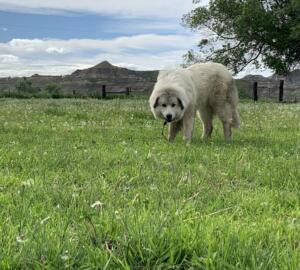
A sheepdog roams the pastures at Yellowstone River Farms.