
By Clare Boland, Communications Manager
Earth Day is a reminder that the health of our planet is intrinsically tied to the way we grow food. No one understands that connection more than farmers! To celebrate Earth Day, we’re featuring four organic farms from across the country that prioritize the health of the planet through stewardship, working in partnership with natural systems, and caring for the land for future generations.
Vilicus Farms
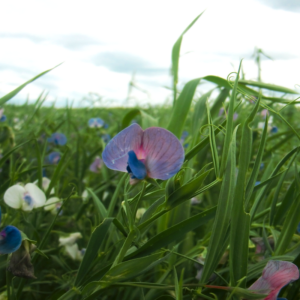
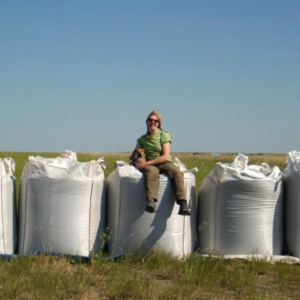
Doug Crabtree and Anna Jones-Crabtree are the owners and operators of Vilicus Farms, a first-generation organic dryland crop farm in Northern Hill County, Montana. For Anna and Doug, organic farming is rooted in a deep commitment to stewardship and working with natural systems to improve the health of the land. As Doug explains, “We philosophically don’t believe you should grow food using poison or subject the earth to the kind of products that are used in non-organic production. We’re committed to stewardship. That really drives what we do, how we do it, and why.”
Anna echoes this philosophy, emphasizing that “organic farming is not a recipe… it’s not a checklist,” but rather “a process of continuous improvement and actually being a partner with your natural systems.” She highlights the importance of building relationships—with land, plants, animals, and customers—and using practices that support soil health, which in turn leads to healthier food and communities. Their approach is reflected in Vilicus Farms’ focus on soil-building, carbon sequestration, pollinator-friendly conservation, minimal-disturbance tillage practices, and utilizing a seven-year crop rotation.
You can follow Vilicus Farms on Facebook and Instagram (@vilicusfarms).
 Source: Vilicus Farms
“We’re committed to stewardship. That really drives what we do, how we do it, and why.”
– Doug Crabtree, Vilicus Farms
 Source: Vilicus Farms
Hiddendale Farm
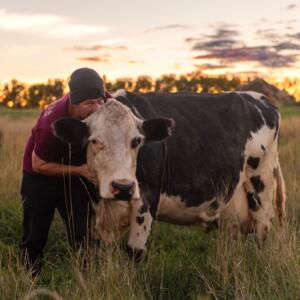
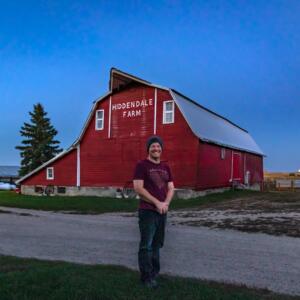
Glen Philbrick is the operator of Hiddendale Farm, a fifth-generation family farm in Turtle Lake, North Dakota. The 700-acre farm includes certified organic cropland and rangeland, a cow-calf livestock system, and a wide range of experimental horticultural and specialty crops. Research is central to Glen’s farming operation: he regularly conducts variety trials, soil health experiments, and crop rotation testing, and collaborates with organizations like the Organic Seed Alliance and the Natural Resources Conservation Service (NRCS).
Growing up, the farm used some conventional practices, like spraying herbicides, and Glen noticed that 1.) it wasn’t working and 2.) it was adversely affecting the health of farmers and livestock. ”I recognize the dangers of it over and over again,” he said of herbicides. Hiddendale Farm has been certified organic since 2016 and uses practices like limited tillage, rotational grazing, and cover cropping. And being a research-focused farm, Glen prioritizes soil testing, working from the results to balance PH and manage nutrient levels to inform overall soil health. “It is the health of me, of people, of my livestock, and of the whole ecosystem,” Glen shared. “That’s why organic is important to me.”
 Source: Hiddendale Farm
“It is the health of me, of people, of my livestock, and of the whole ecosystem. That’s why organic is important to me.”
– Glen Philbrick, Hiddendale Farm
 Source: Hiddendale Farm
Stephens Land & Cattle
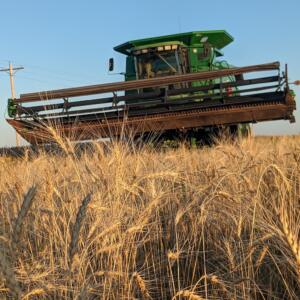
Stephens Land & Cattle is a fifth-generation family farm located in Jennings, Kansas, managed by Demetria Stephens, who has been farming the land since she was a teenager. The farm raises livestock and grows organic Turkey Red wheat, which grows well in the semi-arid region of northwest Kansas. In addition to being certified organic for over 30 years, the farm is also certified biodynamic, a holistic approach to farming that centers on the interconnectivity of the natural landscape. Becoming certified biodynamic was a long-term goal of her parents, who studied anthropology and were interested in the human role in fostering ecological systems. Demetria uses organic and biodynamic principles as a framework: “I think of organic as a guide for me to be a better farmer, more than the rules that restrict me from doing things. It is more saying, no pesticides, no synthetics, no GMOs, and those kinds of things.”
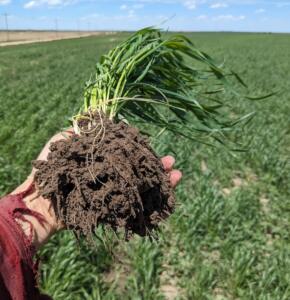
Growing in a region with mostly conventional agriculture, and without formal agronomy training, organic principles propel her learning and investment in the land. Stephens Land & Cattle uses practices like limited tillage, cover cropping, and green manures. “I think [of organic as] a way for me to be a more professional farmer,” Demetria shares. “And also raise good food for the next generation.”
 Source: Stephens Land & Cattle
“I think of organic as a guide for me to be a better farmer, more than the rules that restrict me from doing things. It is more saying, no pesticides, no synthetics, no GMOs, and those kinds of things.”
– Demetria Stephens, Stephens Land & Cattle
 Source: Stephens Land & Cattle
PrairieSun Organics
PrairieSun Organics is a diversified organic, family farm in Vermillion, South Dakota, owned and operated by Angela Jackson-Pulse and her husband. Spanning about 20 acres, the farm integrates poultry (meat and eggs), livestock (sheep and cattle), fruits and vegetables, and specialty grains. Angela keeps half the land in crop production, and the other half in perennial pasture for livestock grazing. Angela originally managed the farm using more conventional organic methods, but transitioned into using regenerative organic practices in 2019 after experiencing declining soil health, and increased disease and livestock mortality. She is now certified regenerative through the Regenerative Organic Alliance. “It put the joy back into farming,” she said of the switch.
At the heart of her farming practices is land stewardship: “stewarding this beautiful ecosystem, that is interrelated and interconnected, and making sure it functions as healthy as it possibly can be.” By focusing on minimizing soil disturbance, expanding crop rotations, integrating cover crops, and prioritizing soil biology, Angela saw her farm come alive again. She highlights the importance of a systems-based approach, centering the overall health of the land to set her farm up for the best possible future: “It’s a blessing that we have [this land] and I want to take really good care of it. I know that it’s not going to be in my possession forever. And so I want to leave it to the next generation, whoever that is, so it can be the best possible thing for the next family.”
You can follow PrairieSun Organics on Facebook.
“At the heart of it is stewardship. Stewarding this beautiful ecosystem that is interconnected and making sure that the whole farm functions as healthy as it possibly can be.”
– Angela Jackson-Pulse, PrairieSun Organics
Want to Learn More About Organic?
These farmer interviews were conducted as part of OFRF’s work with the Transition to Organic Partnership Program (TOPP). Check out our resources for organic farmers: