
Print Resources Available
Let us send you free organic farming resources!
*Limited to farmers and ranchers in the TOPP Midwest region
(Arkansas, Illinois, Indiana, Iowa, Kentucky, Michigan, Minnesota, Missouri, Ohio, Tennessee, and Wisconsin).
As part of our mission to foster the improvement and widespread adoption of organic farming systems, we have a large library of free resources available on a wide variety of topics related to organic farming, soil health, and conservation agriculture. This full library of resources is always available to download for free on our site.
Through our work with the Midwest region of the USDA’s Transition to Organic Partnership Program (TOPP), we secured funding to print and ship some of our most popular resources (see below)—the ones farmers turn to most on OFRF’s website—directly to you, completely free.
Explore these print resources available to you below, use the button to order what you need, and we’ll print & ship them to you!
DEADLINE: All orders must be submitted by Friday, August 21, 2026!
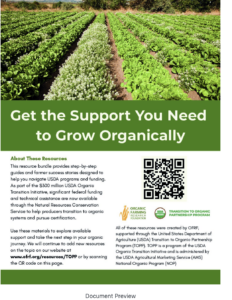
USDA Transition to Organic Partnership Program (TOPP): Federal Support and Programs
As part of the $300 million USDA Organic Transition Initiative, significant federal funding and technical assistance are now available through the Natural Resources Conservation Service to help producers transition to organic systems and pursue certification.
This resource bundle provides step-by-step guides and farmer success stories designed to help you navigate USDA programs and funding, including: Environmental Quality Incentive Program (EQIP), Sustainable Agriculture Research and Education (SARE) Program Grants, Whole Farm Revenue Protection Program (WFRP), Organic Transition Initiative (OTI), Technical Note 12 – Conservation Activities in Organic Farming Systems (aka Tech Note 12).
Conservation and Soil Health Practices for Organic Production Systems: Cover Cropping
Over the past 30 years, cover cropping has emerged as a key soil health and resource conservation practice for annual crop production. Truly sustainable agriculture must maintain effective vegetative cover of the soil, even when the field is not in production.
This 8-page guide provides an overview of utilizing cover crops in an organic farming system. Topics include selecting, implementing, and managing cover crops along with other tips and resources.

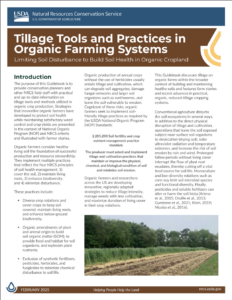
Tillage Tools and Practices in Organic Farming Systems
Organic farmers recognize healthy, living soil as the foundation of successful farming, and many seek practical means to reduce tillage in order to protect the soil organic matter, soil life, and improved tilth build up through green manures, compost applications, and other organic practices.
This 32-page guide provides an in-depth overview of tillage use in organic systems, including challenges, practical guidelines, real-world case studies, additional resources, and current science on conservation tillage for organic systems based on an analysis of USDA OREI and ORG research.
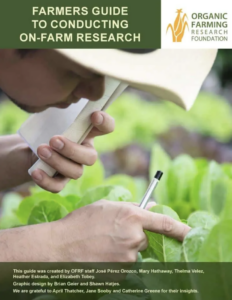
Farmers’ Guide to Conducting On-Farm Research
Organic farmers and ranchers like you are always testing and experimenting with new ideas to improve their farming operations. This guide is specifically for the organic farmer or rancher who is curious about conducting some type of trial or experiment on-farm in a more structured way. Whether you are looking to reduce the use of off-farm inputs, minimize disease pressure, try new crop varieties or animal feed, or test new cover crop techniques or irrigation sensors, this practical 56-page guide was created to assist you along the way. It covers the seven steps of on-farm trials: identifying your research question, identifying what you will measure, choosing an experimental design, choosing your location, establishing the trial and collecting data, analyzing data, and drawing a conclusion. Additionally, it includes several farmer-researcher profiles and example datasheets.
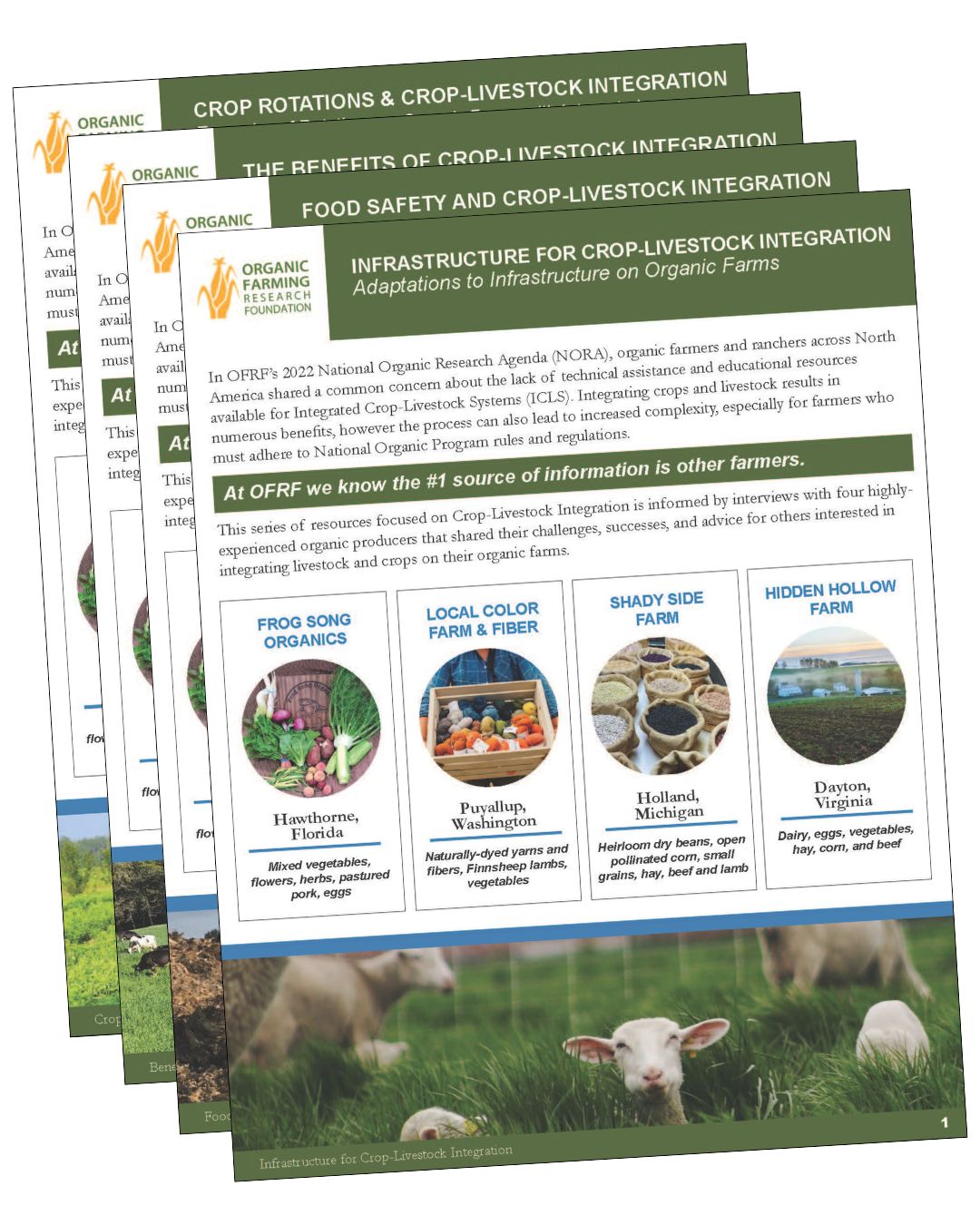
Crop-Livestock Integration Resources Packet
Crop-livestock integration is a holistic system that integrates the production of cash crops and livestock on the same piece of land or within the same farming operation. While farms implementing crop-livestock integration can lower input costs and reap many benefits, this integration can also lead to increased complexity, especially for farmers who must adhere to National Organic Program rules and regulations.
OFRF developed a Crop-Livestock Integration series informed by interviews with highly experienced organic producers across the US whose farming operations have benefited from integrated crop and livestock production. The series includes four farmer stories, a video presentation, and four factsheets on key topics: The Benefits of Crop-Livestock Integration, Food Safety, Infrastructure, and Crop Rotations.
The print resource includes the four factsheets.
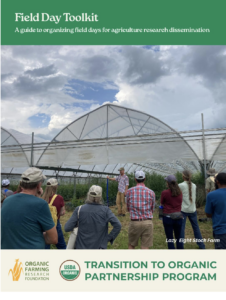
Midwest Field Day Toolkit: A Guide to Organizing Field Days for Agriculture Research Dissemination
Field days are research dissemination events that provide a great way for agriculture industry professionals, farmers and ranchers, and researchers to engage with and learn from one another. Simultaneously, it is a way for farmers to communicate their observations and experiences on their operations to researchers to help highlight emerging issues, real-world applicability, and build relationships with the research community and each other.
This 19-page toolkit provides a road map to plan a successful field day event and optimize the reach of your organization or farm’s research and extension activities, including setting objectives and outlining the event, establishing event details, event outreach, and implementation.
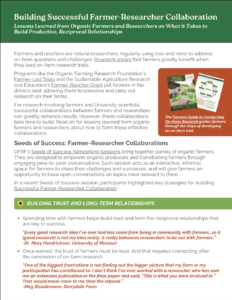
Building Successful Farmer-Researcher Collaborations
Farmers and ranchers are natural researchers, regularly using trial-and-error to address on-farm questions and challenges. Research shows that farmers greatly benefit when they lead on-farm research trials.
These collaborations take time to build, and this two-page resource summarizes lessons learned from organic farmers and researchers on what it takes to build productive, reciprocal relationships.
(Coming Soon!) Midwest Resource: Regional Hub & Extension Directory Factsheets
Whatever production challenge you’re working through on your organic farm, this printable, one-page flyer is built to help you solve it. It pulls from the Organic Research Hub, a free, USDA-funded library of research and resources built for organic farmers, and narrows it down to what’s actually relevant where you farm: regional farming resources, nearby organic farming experts, and a QR code that takes you straight to a page curated just for your region.