
By Vinnie Trometter, OFRF Policy Manager
Last month I joined OFRF’s Executive Director Brise Tencer at the Organic Trade Association’s (OTA) annual Organic Week conference in Washington D.C. We gathered at a momentous time for agriculture, as the Senate Agriculture Committee had just successfully marked up their version of the Farm Bill after failing in their first attempt in early August.
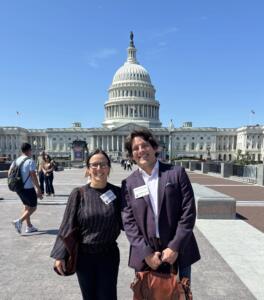
Executive Director Brise Tencer and Policy Manager Vinnie Trometter at the Capitol Building during Organic Week.
The return of Senate Agriculture Committee Member Senator Mitch McConnell (TN-R) made it possible to push the bill out of Committee on a party-line vote. Insiders informed us that there would be no chance to offer amendments. Thus, onlookers only had to look at the draft text—which did not include key organic priorities like improvements to organic research or organic infrastructure—to know what was going to be in the draft bill. The process made the outcome of the markup feel predetermined, outside of unexpected fireworks by the Senators from Iowa who tried to force amendments around nullifying Proposition 12 and finalizing Biden-era Packers and Stockyard Act anti-trust rules.
The bill now heads to the Senate Floor, where it is unlikely to pass due to disagreements over delaying the Supplemental Nutrition Assistance Program (SNAP) cost-share provision from the One Big Beautiful Bill—a disagreement I’ve explained in an earlier blog post. It is looking likely that parts of the Farm Bill will get lumped into a year-end funding bill.
The timing of Organic Week was a breath of fresh air, allowing me to focus on the enlightening presentations and meet fellow organic industry professionals, rather than getting bogged down in the lackluster results of the Senate Agriculture Committee.
And goodness me, there was lots to be impressed by! Some memorable moments included hearing how a potato farmer chose to transition over to organic because his farm’s small size made his spuds close to last in the pecking order in conventional processing. Choosing organic moved him up the line, as he was no longer so small in an organic supply chain.
I also heard from Whole Foods how organic accounts for 30% of their meat and 64% of their produce and floral sales. Additionally, “Better for You” brands (organic, grass-fed, regenerative, etc.) comprise about 25% of all sales across the grocery landscape. They also mentioned that about 40% of their organic sales come from Gen Z and Millennials. The take away was clear—the demand for organic products is there, and the industry is building momentum.
Inaction on Capitol Hill and being around all the wonderful conference attendees also helped me appreciate how just down driven organic farmers are. Things like private and public infrastructure, research, data collection, technical assistance, and risk management tools have skewed towards conventional agriculture because of the relatively small size of organic and profit margins. Despite this lack of resources, the organic industry punches above its weight. Federal and state programs that support farmers have to be amended to incorporate organic agriculture. In some cases, entirely new programs have to be created, like dedicated organic agriculture research. These actions are crucial in making sure that organic farmers have the assistance, tools, and insights that are necessary for any industry to thrive.
True to its roots, the organic industry remains “organically grown,” having nowhere near the same support as conventional agriculture, despite consumer demand. The farmers I spoke to during Organic Week not only believe in (and demonstrate) the success of organic systems, they also find deep fulfillment in using practices that better the earth and their community. To put it plainly, sometimes loving what you do overcomes the obstacles in your way. To me, it’s this determination that shows how unstoppable the future growth of organic will be.
Stay up to date with our policy work by signing up for our newsletter: