
2025 Research Summary on Conservation Benefits of Organic Management
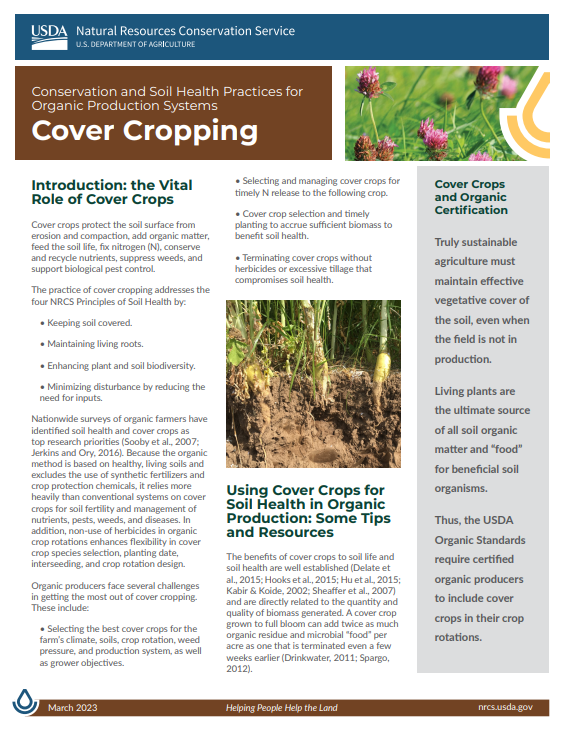
This document provides a summary of the latest organic agriculture research across a variety of topics, meant to provide NRCS staff, organic producers, and other interested parties with in-depth educational information on the conservation benefits of organic management.
This research summary was produced with support from the United States Department of Agriculture’s Natural Resources Conservation Service (USDA-NRCS) under Cooperative Agreement No. FBC24CPT0013867. The contents are solely the responsibility of the authors and do not necessarily reflect the views of USDA-NRCS.

Adding the “O”: Farmer Perspectives and Experiences Transitioning to Organic in the Northwest
Farmers transitioning to organic production face unique challenges that require technical assistance on a wide range of production and non-production issues. During the transition period, farmers must consider financially viable strategies for the three-year transition period, how to restore soil health while learning to manage weeds without herbicides, acquiring new equipment and infrastructure needed for organic production, and navigating NOP-related paperwork during the last year of transition and first year of certification. This webinar features three farmers who have worked through these issues and share their experiences and thoughts for demystifying some of the challenges they faced in the process. In this session, we feature three farmers in the Northwest who have built resilience and a dynamic organic system:
- Lynn Schaal, Life Springs Farm in Idaho
- Tracey Dion, Yellowstone River Farms in Montana
- Aaron Flansburg, Flansburg Farm in Washington
About the Seeds of Success Series
OFRF has partnered with the Organic Farmers Association (OFA) and National Organic Coalition (NOC) to lead a series of virtual farmer-to-farmer networking sessions. These facilitated events will be engaging opportunities for farmers to share their challenges and successes, and will be accompanied with relevant resources you can use.
To learn more about these and other events from OFRF, visit: https://ofrf.org/events/. Funding for this series is provided by a cooperative agreement between OFRF and USDA-NIFA to highlight research investments made through both the OREI and ORG grant programs.
Strategies for Successful Researcher Farmer Collaboration
Have you ever wondered how to connect with a farmer or researcher to conduct on-farm research? This Researcher- Farmer Virtual Networking event highlights the successes and challenges of engaging in farmer-researcher partnerships and focuses on building positive outcomes for farmer and researcher collaboration in organic agriculture. OFRF are joined by four speakers that have participated in successful organic research projects funded by USDA NIFA. Two researchers: Julie Grossman and Eric Gallandt, and their farmer collaborators, Seth Kroeck and KaZoua Berry, share details on their experience and the process of engaging in on-farm research. The session begins with a brief introduction on USDA-NIFA organic programs and featured facilitated conversations on the topic of collaborative farmer-researcher projects that will support information sharing and identify possibilities for future research partnerships. This is the first in the Seeds of Success Networking Sessions from OFRF, from October 2023. To learn more about these and other events from OFRF visit: https://ofrf.org/events/ Funding for this series is provided by a cooperative agreement between OFRF and USDA- NIFA to highlight research investments made through both OREI and ORG grant programs.
Impacts of OFRF Berry Research
This report offers a detailed review and impact assessment of OFRF-funded research on organic
berry production, with a focus on strawberries. These research projects address the most pressing
issues in the industry and this evaluation clearly indicates that OFRF investments have resulted
in important advances in organic berry production knowledge and practices, especially in
California. Overall, OFRF grant funding has advanced scientific knowledge and improved the
practices, ecological sustainability, and economic prosperity of organic berry farming. This
report recommends continued research support for organic insect, disease, and weed
management research efforts in berry production.

2021 CALIFORNIA ORGANIC RESEARCH AGENDA
California is the nation’s top producer of organic agricultural commodities and specialty crops. Thus, it
is imperative to understand the unique needs of the organic growers in the nation’s most agriculturally
productive state. The 2021 CORA report provides up-to-date information on the stewardship practices
used by organic producers across the state and identifies the most pressing production and non-production
challenges faced by organic California growers. The findings presented in this report: 1) highlight the soil
health management practices that organic producers in California are currently implementing, 2) outlines the most pressing challenges and needs of certified organic producers in California, and 3) outlines priorities and recommendations to address those needs through public policy, research, and Extension programs.

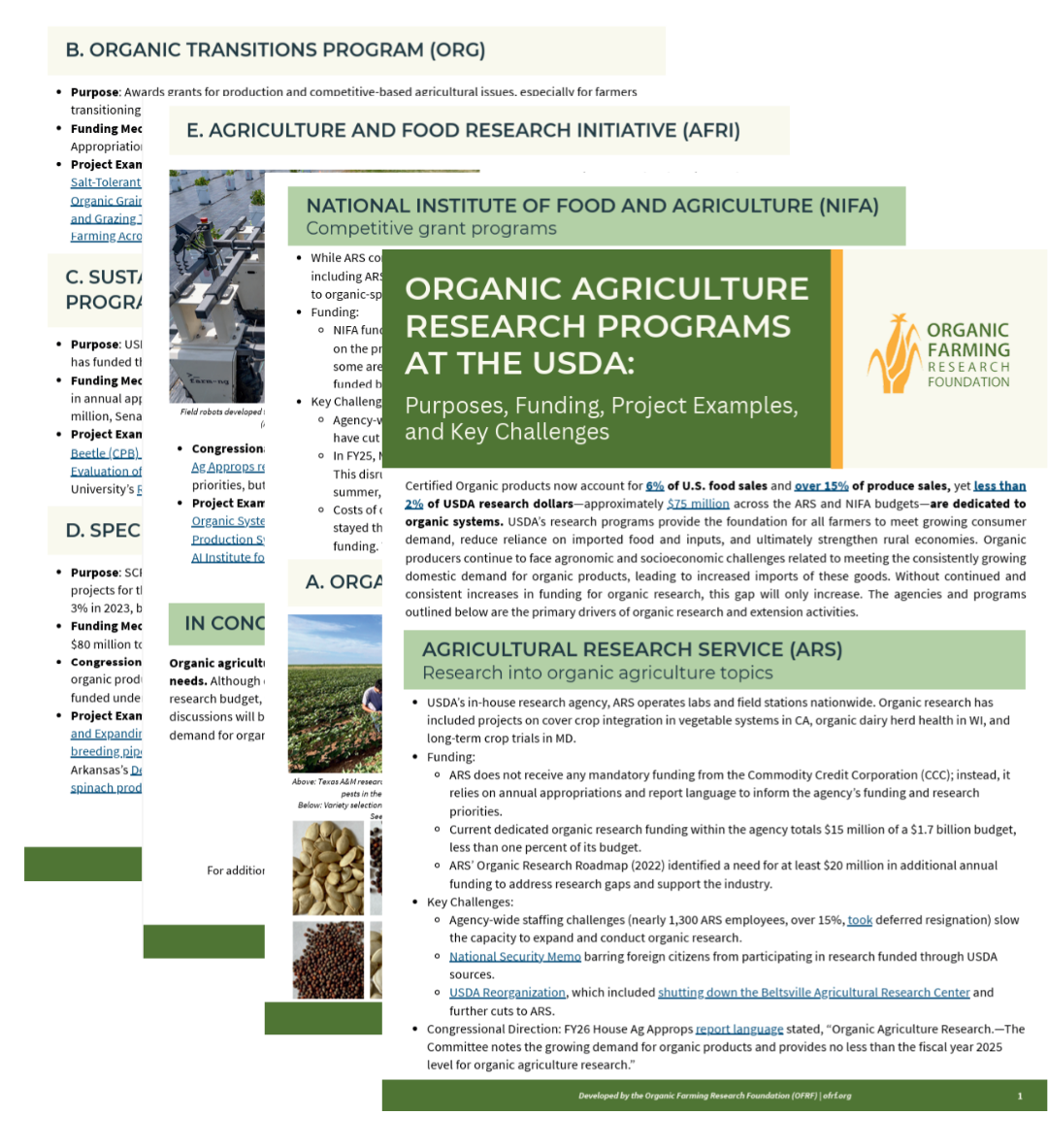
Organic Agriculture Research Programs at the USDA
The USDA agencies and programs outlined below are the primary drivers of organic research and extension activities.
Agricultural Research Service (ARS) – Research into organic agriculture topics
USDA’s in-house research agency, ARS operates labs and field stations nationwide. Organic research has included projects on cover crop integration in vegetable systems in CA, organic dairy herd health in WI, and long-term crop trials in MD.
National Institute of Food and Agriculture (NIFA) – Competitive Grant Programs
While ARS conducts research for the USDA, NIFA’s mission is to provide grants to research institutions, including ARS and the Land-Grant Universities.
- Organic Research and Extension Initiative (OREI) – The flagship NIFA competitive grant program is dedicated to organic agricultural research. It supports research, education, and extension programs that enhance the ability of organic producers and processors to grow and market high-quality products.
- Organic Transitions Program (ORG) – Awards grants for production and competitive-based agricultural issues, especially for farmers transitioning to organic production systems.
- Sustainable Agriculture Research and Education Program (SARE) – USDA’s longest-running sustainable agriculture grants program. While not exclusively organic, SARE has funded thousands of farmer-driven projects, including many led by organic and transitioning producers.
- Specialty Crop Research Initiative (SCRI) – SCRI is a NIFA competitive grant program that provides resources for research and extension projects for the specialty crop industry. Organic’s share of SCRI-funded projects is highly variable — as low as 3% in 2023, but as high as 13% in 2021 — depending on applicant pool and USDA priorities.
- Agriculture and Food Research Initiative (AFRI) – AFRI is a research, education, and extension competitive grant program that covers a wide range of topics, from improving rural economies, increasing food production, ensuring food safety and security, enhancing human nutrition, and training the next generation of the agricultural workforce. A range of 2-5% of AFRI funds are awarded to organic topics on an annual basis.
The best way to get these updates from OFRF is to join the OFRF newsletter.
OFRF’s newsletter provides regular updates to organic agriculture research programs at the USDA, including timeline updates, announcements of USDA’s calls for proposals, and advocacy updates via Gordon’s Policy Corner. We also provide details on how farmers, researchers, and advocates can work with us to protect and bolster federal support for organic farmers and researchers in the US.