
TOPP West

Organic Certification Cost Share Program (OCCSP)

Farmers across the U.S. may now receive up to $750 per scope for organic certification costs

As a farmer or a technical service provider to farms, you understand the importance of organic certification. It not only adds value to your products but also opens doors to a growing market of health-conscious consumers. However, the process of obtaining and maintaining organic certification can be costly. Financial assistance is available for the 2025 and 2026 calendar years through the Organic Certification Cost Share Program (OCCSP) to help ease this burden. In this blog post, we’ll walk you through the basic steps to access up to $750 in financial assistance for each organic certification scope if this program funding is available.

Note: all of this information is summarized in printable, downloadable PDF’s, available in English and Spanish, at the bottom of this blogpost.

Nota: toda esta información se resume en archivos PDF imprimibles y descargables, disponibles en inglés y español, al final de esta publicación de blog.

1. Start with Research

Before diving into the application process, it’s wise to build up some knowledge of the program and who you will apply to. The OCCSP is administered by the USDA, and their website provides a wealth of general information. Additionally, some states may have their own supplements to the program; consider checking your state’s agriculture agency website for state-specific resources.

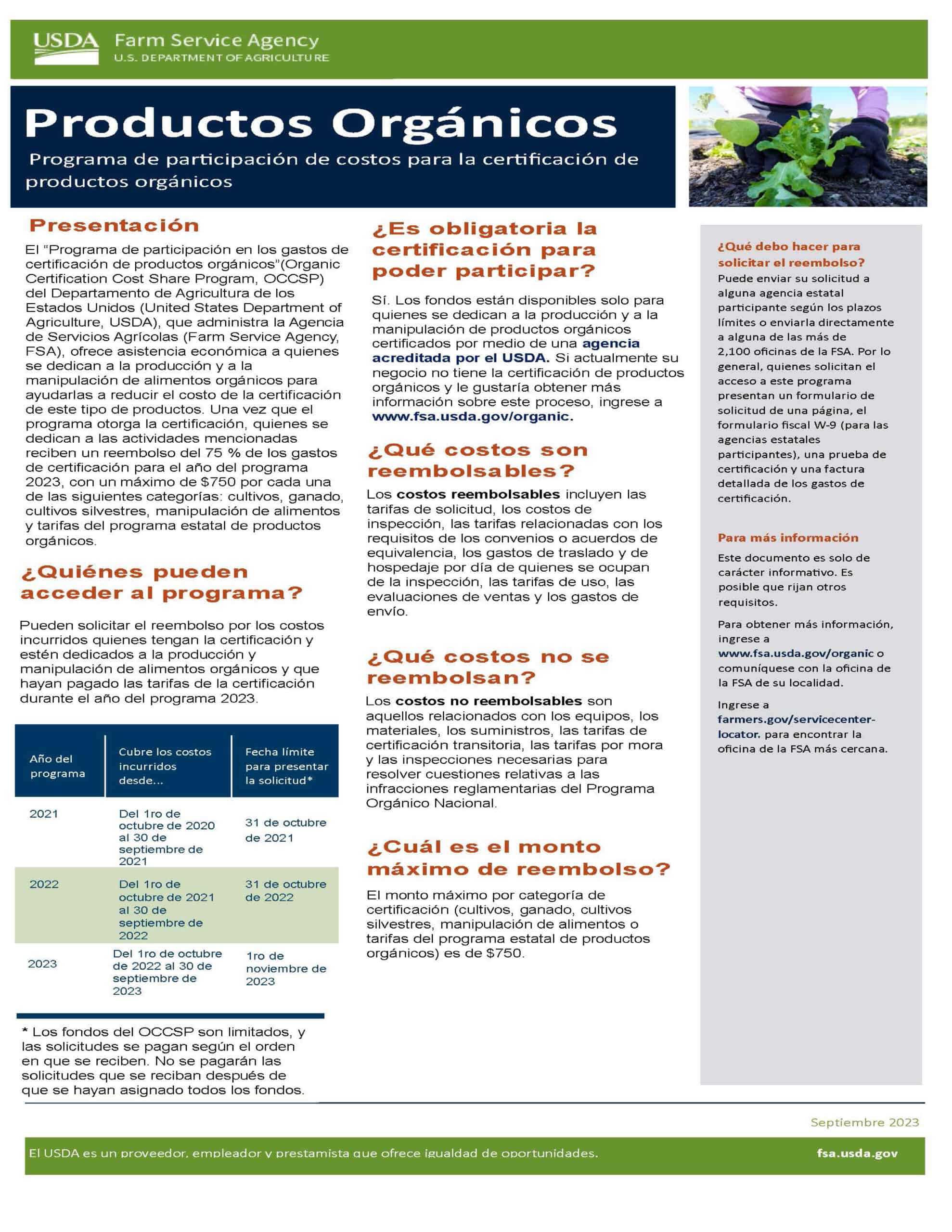
Below are factsheets from the USDA about the OCCSP, one in English and one in Spanish.
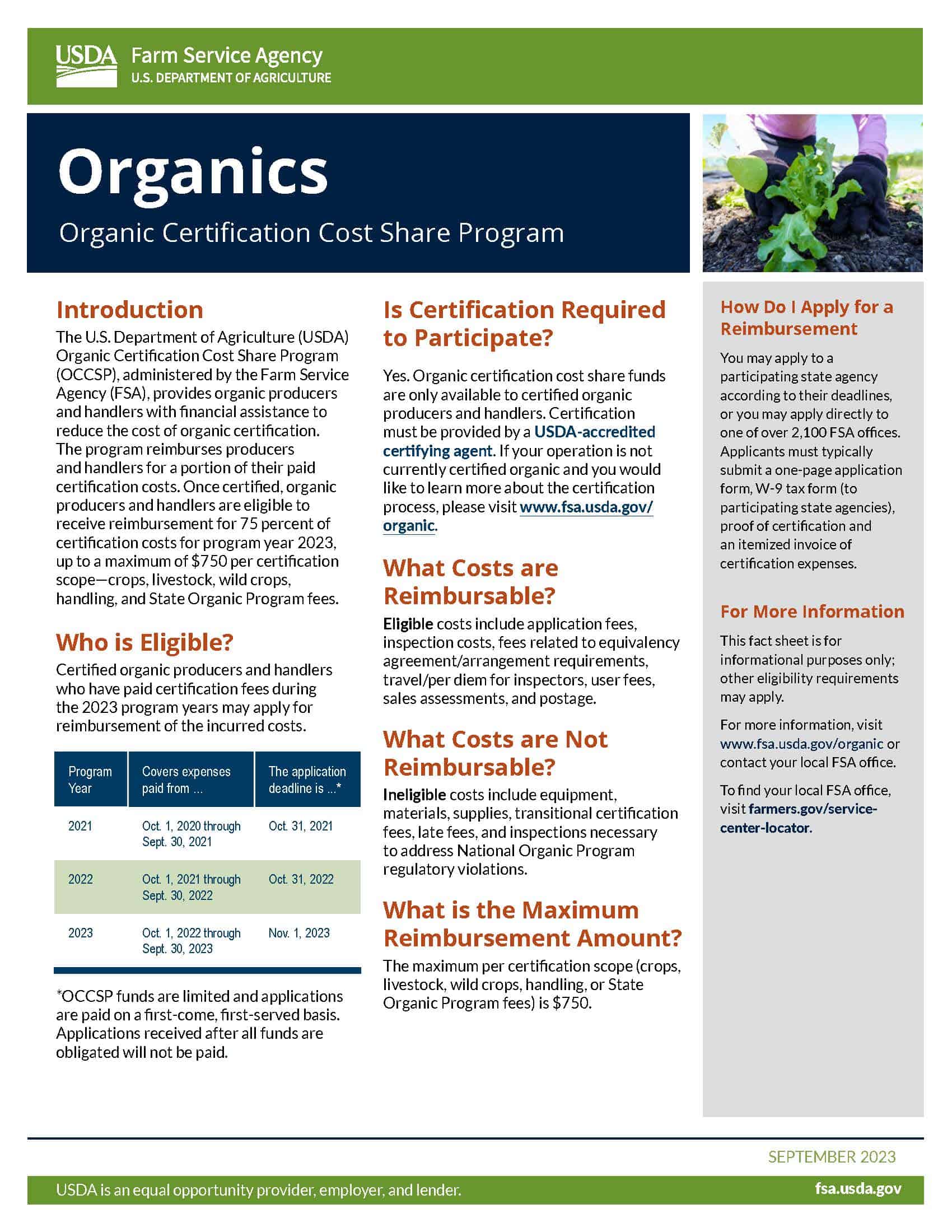
There is not an updated 2025-6 flyer in Spanish at this time.

2. Finding the Right Application 

Certified organic operations can apply for OCCSP assistance through their local Farm Service Agency (FSA) office or, in some cases, through a participating State Agency. Here’s how to proceed:

Through FSA: If you choose to apply through the FSA, you’ll need to use their specific OCCSP application form and follow the instructions provided. This ensures that your application is processed smoothly and efficiently.

Through a State Agency: If your state participates in the OCCSP, you likely have the option to apply through your state agency. In this case, use the application form provided by your state’s program. As of July 2026, it has not been announced which states will be facilitating the programs though state agencies. 

3. Gathering Financial Information

To access government payments through OCCSP, you’ll need to provide certain financial information. The information must be provided in the correct format, depending on how you are applying. 

FSA: If you’re applying through the FSA, they typically require an IRS W-9 form as part of your application.

State agencies: State offices may require additional records.

4. Compiling Required Documents

Alongside your application and financial information, you’ll also need to include certain documents:

  • A copy of your organic certification.
  • Proof of payment for your certification fees.
  • Itemized receipts for any other covered expenses related to organic certification that you’re seeking reimbursement for.

Covered expenses under the OCCSP include: application fees, inspection costs, fees related to equivalency agreement/arrangement requirements, travel/per diem for inspectors, user fees, sales assessments, and postage. However, covered expenses do not include equipment, materials, supplies, transitional certification fees, late fees, and inspections necessary to address National Organic Program regulatory violations.

5. Submission

Once you’ve gathered all the required information and documents, it’s time to submit your OCCSP application. Double-check your application to ensure everything is complete and accurate. Ensure you send this information to the appropriate state or federal agency office based on your chosen application method.

The application deadline for 2025 and 2026 OCCSP funds is December 31, 2026. 

The OCCSP can be a valuable resource for farmers and technical service providers seeking financial assistance for their organic certifications. By following these steps and meeting the program’s requirements, you can access up to $750 to support your commitment to organic farming practices.

For more detailed information and access to specific application forms, be sure to visit the OCCSP USDA website or consult your state’s agriculture agency website if they operate their own OCCSP program. Your organic journey just got a little more affordable.

Apply for OCCSP assistance now, and reap the benefits of a more affordable path to organic certification. Your commitment to organic farming deserves the support it needs.

All of this information is summarized in a printable, downloadable PDF below, available in English and Spanish.
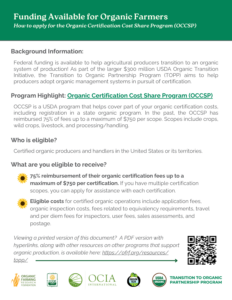
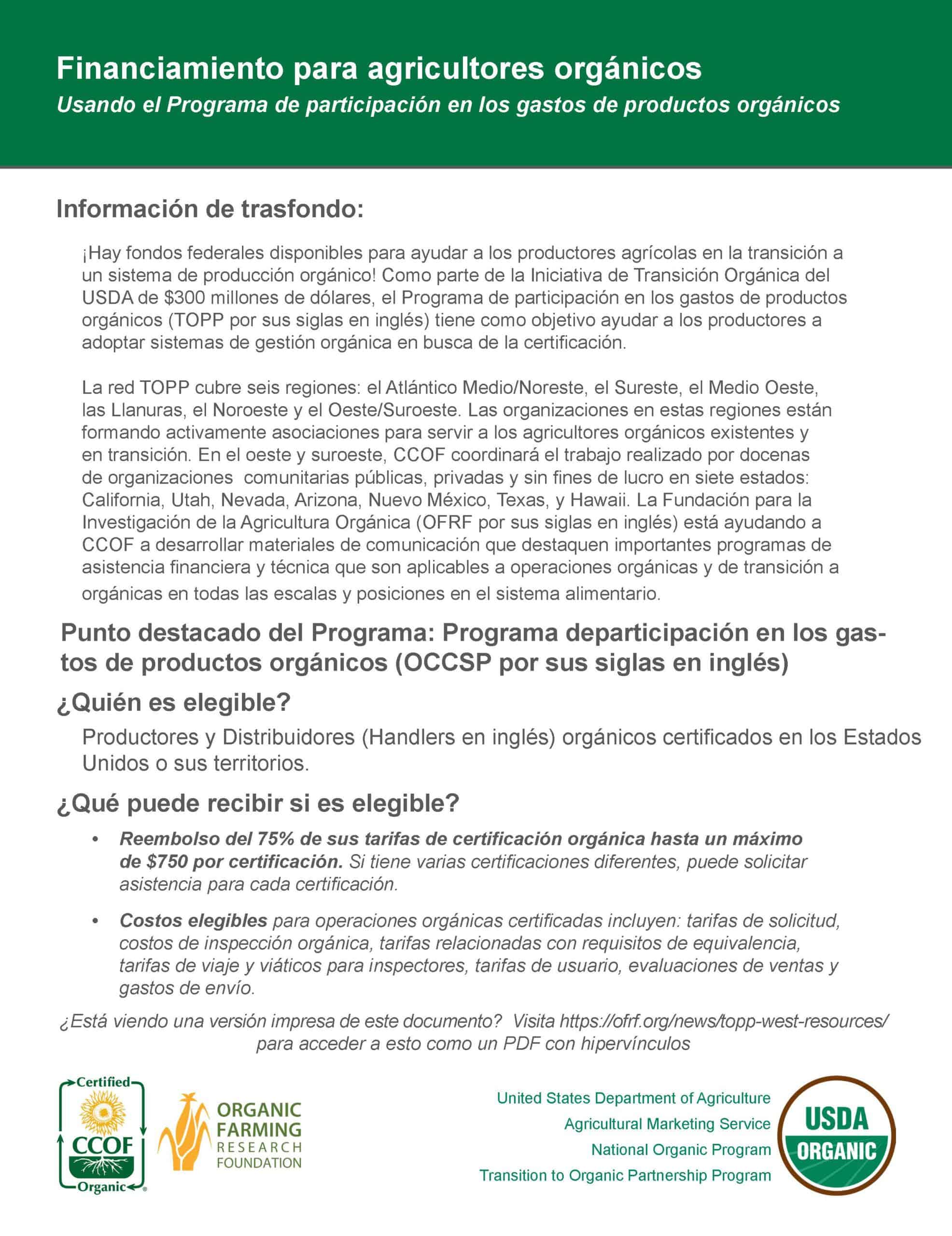
TOPP OCCSP Flyer cover page in English

TOPP West and Southwest Resources

Federal funding is available to help agricultural producers transition to an organic system of production.  As part of the larger $300 million USDA Organic Transition Initiative, the Natural Resource Conservation Service has begun to make $70 million available to help producers adopt organic management systems in pursuit of certification.  The following resources provide information on specific USDA technical assistance and funding support programs available to farmers. We will continue to update this with additional resources, so be sure to check back often. 

Whole-Farm Revenue Protection (WFRP): Insurance Options for Organic and Transitioning Growers

New farmer-friendly resource breaks down how to access whole-farm insurance coverage.

Whole-Farm Revenue Protection program for organic and transitioning growers on background image of diverse crops at a marketOrganic and transitioning-to-organic producers face unique risks that aren’t always covered by traditional crop insurance. Fortunately, USDA’s Whole-Farm Revenue Protection (WFRP) program was designed with small-scale and diverse operations in mind, offering flexible, revenue-based coverage for farms of all sizes, including those growing specialty and organic crops. To help farmers better understand and access this program, OFRF has developed a new Whole-Farm Revenue Protection toolkit. LEARN MORE ABOUT WFRP TODAY.
Lessons Learned from an NRCS Contract

One organic farmer’s journey through federal funding.

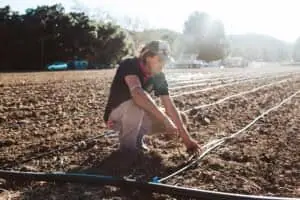
Source: Three Feathers FarmWe are spotlighting the experience of one organic farm—Three Feathers Farm in California—that received funding and support through the Natural Resource Conservation Service’s (NRCS) Environmental Quality Incentives Program (EQIP). Their story offers a transparent look at what it’s really like to work with NRCS: the benefits, the obstacles, and the lessons they’ve learned. We hope other farmers can use their experience to navigate the process of applying for and implementing EQIP contracts more easily. Read Héktor’s story.

Field Day Toolkit

A guide to organizing field days for agriculture research dissemination

Field days provide a unique space for farmers, researchers, and agricultural professionals to come together to share insights, learn from one another, and foster future collaborations. Discover a roadmap and customizable materials to plan, host, and follow up on hosting a successful event at your farm or research site with OFRF’s new Field Day Toolkit. View the full Field Day toolkit here.

Utilizing NRCS Support on Organic Farms: Tech Note 12

Tech Note 12 provides a wealth of knowledge needed to effectively support the unique requirements of organic producers.

The USDA’s Natural Resources Conservation Service (NRCS) offers funding and technical assistance to help farmers enhance their farming operations, including increasing support for transitioning to organic practices. However, farmers, field agents, and Technical Service Providers (TSPs) may not always be familiar with how NRCS programs can support organic practices. To address this, OFRF collaborated with NRCS to develop a document that equips farmers and field agents with the knowledge needed to effectively support the unique requirements of organic producers. That document is Technical Note 12 (TN-12). Learn more about Tech 12 today.

The Organic Certification Cost Share Program (OCCSP)

Farmers across the U.S. may now receive up to $750 per scope for organic certification costs.

As a farmer or a technical service provider to farms, you understand the importance of organic certification. It not only adds value to your products but also opens doors to a growing market of health-conscious consumers. However, the process of obtaining and maintaining organic certification can be costly. The good news is that financial assistance is available through the Organic Certification Cost Share Program (OCCSP) to help ease this burden. In this blog post, we’ll walk you through the basic steps to access up to $750 in financial assistance for each organic certification scope, covering expenses paid between October 1, 2022, and September 30, 2023. Find out how to get started here

Environmental Quality Incentives Program (EQIP)

Farmers across the U.S. are eligible for significant technical and financial assistance from the Natural Resource Conservation Service (NRCS).

Farmers and technical service providers know firsthand that the most significant barriers to developing sustainable infrastructure and production practices are due to time and resource scarcity. NRCS’s EQIP program offers financial assistance and technical support to implement new conservation practices on your farm, with additional support for historically underserved applicants, including socially disadvantaged, beginning, veteran, and limited-resource farmers and ranchers. In this blog post, we’ll provide an overview of what EQIP has to offer and the steps to utilizing this program. Learn more.

Organic Transition Initiative (OTI)

$75M in cost-share grant funding is available to certified organic and transitioning-to-organic growers under EQIP to meet NRCS’s Conservation Practice Standard for Organic Management (CPS-823).

Organic farmers must manage their land without prohibited inputs for 3 years for their products to be certified. This transitioning period can be incredibly challenging as farmers and their land adjust to new production practices. OTI is intended to help producers implement conservation activities required for certification, receive expert technical support, and recover foregone income due to reduced yields during the transition period through EQIP. Read more today.

By |2025-08-04T21:08:00-04:00September 26th, 2023|News, TOPP West|
Go to Top