
Written by Annika Sampson, OFRF’s Donor Stewardship & Engagement Manager
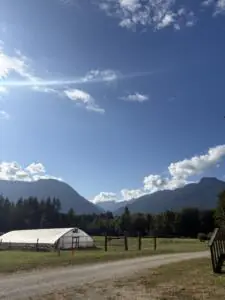
General Mills donated Cascadian Farms to Rodale in 2022 to become the site of their Pacific Northwest Center.
Nestled between the ice-blue Skagit River and the North Cascades foothills is Rodale Institute’s Pacific Northwest (PNW) Center. For decades, this 90-acre organic farm in Washington state was home to Cascadian Farm, General Mills’ organic grocery line. General Mills donated the farm site to Rodale in 2022, acknowledging the organization’s pivotal role in shaping the future of regenerative and organic agriculture. The site has a rich history–the original owner, Gene Khan, was an organic pioneer in the 1970s who changed the course of organic farming in Washington state.
Washington has a robust and growing organic food system. According to the Rodale Center, there are more than 900 certified organic farms in the state, representing 145,000 acres in certified organic production and $795 million in farmgate sales.
Decades of organic management, as well as current organic market conditions, have made the PNW Center a fertile ground for research, education, and outreach. In late July 2026, the Rodale team hosted a Field Day for local farmers, conservation district professionals, researchers, and regenerative stakeholders to learn more about their latest projects, including cover cropping, aronia, elderberry, and kiwi berry production, and hazelnut agroforestry. They hope these projects will inform and assist local farmers as they navigate increasing climate pressure (the Pacific Northwest faces wildfires, flooding, and drought) as well as manage pests and weeds.
Arianna Bozzolo, Western Region Research Director at Rodale Institute, has big dreams for Rodale’s impact on the region, driven by community. “I’m excited by the idea of being part of the community here. The center is relatively new, but people are really welcoming and looking forward to seeing us up and running, and understanding what we want to do.”
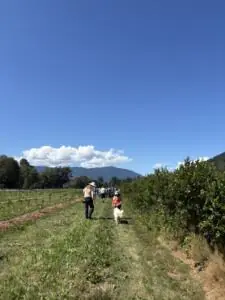
Field day attendees tour Rodale’s perennial berry plantings.
One of the ongoing goals for the Center is to serve as a demonstration and research hub for farmers, showcasing organic and regenerative organic methods at work. Recently, the team PNW has established several new perennial plantings–aronia berries, elderberries, and hazelnuts–in addition to their established and beloved blueberry fields. Little research has been done on growing aronia in the region, but the initial results of the project look promising: “It has great potential.” Bozzolo reflects. “Our early observations are promising. Aronia is a hardy crop with relatively low water requirements, which makes it particularly interesting to evaluate for diversified perennial systems in this region.”
Rodale also strives to evaluate how organic and regenerative practices can support both environmental outcomes and farm viability. There’s a growing market for aronia berries and elderberries. Aronia is also attracting interest as a potential source of natural food colorants because of its high concentration of anthocyanins, and herbal and wellness companies increasingly seek domestic elderberries for their products. A representative from Mountain Rose Herbs, a supplier of organic herbs and botanicals, attended the Field Day to discuss the growing demand for domestically produced organic elderberries and the opportunity this emerging market could represent for regional growers. Bozzolo shares, “It’s a new market, and a really important one to have. [Mountain Rose Herbs] is a big company and they buy certified organic products and botanicals.”
The farm also has an established U-pick site, which Cascadian Farm ran for many years. “We have the blueberries, and they’re very, very well known. With crops such as raspberries, kiwi berries, and potentially aronia complementing the established blueberries, there may be opportunities to extend the U-pick season and diversify the farm’s direct-to-consumer offerings.”
These new and existing markets are a keystone of Rodale’s mission at the PNW Center. “Ideally, I’d like to see this be a farm that’s up and running as organic and regenerative, demonstrating to farmers that you can farm organic and regenerative and still have an income and support your crew and your employees,” Bozzolo says.
As the Field Day attendees strolled and nibbled their way through the u-pick blueberries, questions about soil health, weed management, and alley cropping floated through the air. As people shared about their own farms, projects, and ideas, it became clear–Rodale is well on its way to continuing the organic and regenerative legacy of this well-loved and well-tended land.