TOPP National

Your Region, Your Research: What’s New on the Organic Research Hub

Written by: Ashley Dulaney, OFRF’s Communications Director

Versión en español a continuación.

If you farm organic, you already know the problem: the research you need is out there, but finding it means digging through university extension sites, government databases, and search results that are built for conventional agriculture—not yours.

That’s exactly why OFRF built the Organic Research Hub and why we’re excited to share what’s new. 

What Is the Organic Research Hub?
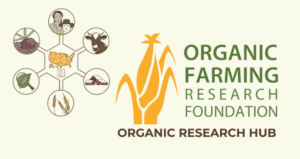
OFRF's Organic Research Hub logo with an illustration of a hub-and-spoke visual with different illustrations in each spoke (farmers, cow, barn, wheat, magnifying glass over a leaf, beet in soil) with a map of the US with stars spread across it and a report-looking illustration below it, in the center of the illustration

The Organic Research Hub is a free, USDA-funded, searchable library of research-backed resources built specifically for organic and transitioning producers. Whether you’re navigating a conservation program like the Natural Resources Conservation Service’s Environmental Quality Incentives Program (EQIP) or Conservation Stewardship Program (CSP), working through your organic transition, or troubleshooting a challenge on the farm, the Hub puts practical, science-backed answers in one place, instead of scattered across the internet.

For many of the studies in the Hub, you don’t have to wade through a dense academic paper to get what you need. Our team translates the research into plain-language summaries that lay out the methods and outcomes up front, so you can see what was tested and what it means for your farm in a few minutes. Many resources already have summaries, and for those that don’t, we’re adding more all the time.

We’ve spent over three decades as a trusted source of organic farming research and technical guidance. The Hub makes that trove of knowledge searchable in one place for the first time.

What’s New on the Hub

Over the past few months, we’ve been adding new features based on what organic farmers have told us they need. Here’s what’s new:

Pages built for your region. 

The Hub now has dedicated pages for each of the six TOPP regions—Midwest, Northeast, Northwest, Plains, Southeast, and West/Southwest—bringing together the resources, experts, and grants most relevant to your climate, soil, and growing conditions. No more filtering through results that don’t apply to you. 

A bigger Directory of Experts. 

You can now search over 300 verified Extension agents, researchers, and technical service providers nationwide by name, state, region, or on a clickable map of the U.S. Every person listed is vetted by OFRF and works in organic or organic-adjacent agriculture, so you’re not sorting through contacts who don’t know the difference between organic and conventional practices. If you’d rather talk through a decision with a real person than read another factsheet, this is where to start.

You can now view the Hub in Spanish.

Growers can select their preferred language, English or Spanish, so more research is accessible to more farmers.

A dedicated USDA Organic Research Grant Database. 

Curious what organic research is currently being funded? You can now browse USDA OREI (Organic Agriculture Research & Extension Initiative) and ORG (Organic Transition Program) grant projects and reports directly, searchable by keyword, program, year, or award number.

Alerts that do the searching for you.

Set up a free, personalized alert by topic, region, or keyword, and new matching resources will land in your inbox daily, weekly, monthly, or as soon as they’re posted. Subscribe once, and stop searching the same terms over and over.

Get Your Region’s Resource Factsheet

Alongside the Hub itself, we’ve put together a printable, one-page factsheet for each region. It’s a quick reference guide to the research, tools, and local experts curated specifically for your area, plus a QR code straight to your region’s page on the Hub. 

Download your region’s factsheet below as it becomes available:
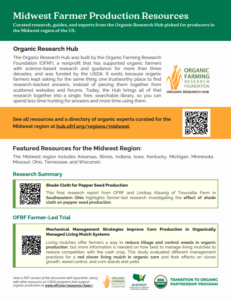
Front page of TOPP Midwest Organic Research Hub Regional factsheet

AR, IL, IN, IA, KY, MI, MN, MS, OH, TN, WI

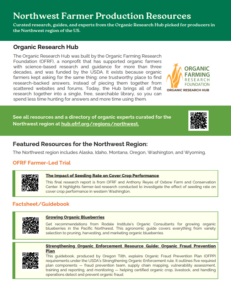
Front page of TOPP Northwest Organic Research Hub Regional factsheet

AK, ID, MT, OR, WA, WY

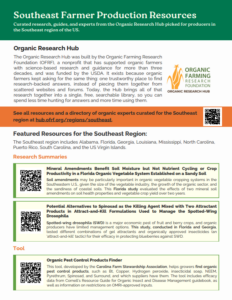
Front page of TOPP SE Organic Research Hub Regional factsheet

AL, FL, GA, LA, MS, NC, PR, SC, USVI

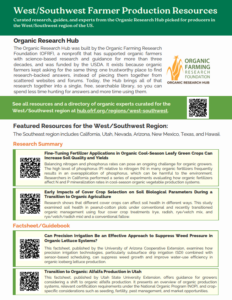
Front page of TOPP West/Southwest Organic Research Hub Regional factsheet

 AZ, CA, HI, NV, NM, TX, UT

Coming Soon!

Plains
(CO, KS, NE, ND, OK, SD)

Northeast/Mid-Atlantic
(CT, DE, ME, MD, MA, NH, NJ, NY, PA, RI, VT, VA, WV)

Want more organic farming resources for your region? Sign up here, and we’ll email them to you as they become available.

Explore What’s Been Built for You

The research, tools, and people you need to farm organically with confidence are already gathered in one place: the Organic Research Hub, built for your region, now in Spanish, and free to use.

Have a resource that should be included, or a question about what you find? Reach out to our team; we’re always adding to the Hub.

Su región, su investigación: lo nuevo en el Organic Research Hub

Si usted produce de manera orgánica, ya conoce el problema: la investigación que necesita existe, pero encontrarla implica rebuscar entre sitios de extensión universitaria, bases de datos gubernamentales y resultados de búsqueda pensados para la agricultura convencional, no para la suya.

Justamente por eso OFRF creó el Organic Research Hub y por eso nos entusiasma compartir las novedades. 

¿Qué es el Organic Research Hub?

OFRF's Organic Research Hub logo with an illustration of a hub-and-spoke visual with different illustrations in each spoke (farmers, cow, barn, wheat, magnifying glass over a leaf, beet in soil) with a map of the US with stars spread across it and a report-looking illustration below it, in the center of the illustration

El Organic Research Hub es una biblioteca gratuita, financiada por el USDA y con buscador, de recursos respaldados por la investigación, creada específicamente para productores orgánicos y en transición. Ya sea que usted esté gestionando un programa de conservación del Natural Resources Conservation Service (Servicio de Conservación de Recursos Naturales, NRCS) como el Environmental Quality Incentives Program (Programa de Incentivos para la Calidad Ambiental, EQIP) o el Conservation Stewardship Program (Programa de Administración de la Conservación, CSP), esté realizando su transición a lo orgánico o esté resolviendo un problema en la finca, el Hub reúne respuestas prácticas y con respaldo científico en un solo lugar, en vez de dispersas por todo el internet.

En muchos de los estudios del Hub, usted no tiene que abrirse paso entre un denso artículo académico para obtener lo que necesita. Nuestro equipo traduce la investigación a resúmenes en lenguaje sencillo que presentan los métodos y los resultados desde el inicio, para que en pocos minutos vea qué se puso a prueba y qué significa para su finca. Muchos recursos ya cuentan con resúmenes y, para los que aún no los tienen, seguimos agregando más todo el tiempo.

Llevamos más de tres décadas siendo una fuente confiable de investigación y orientación técnica sobre agricultura orgánica. El Hub hace que ese acervo de conocimiento sea consultable en un solo lugar por primera vez.

Lo nuevo en el Hub

Durante los últimos meses hemos agregado nuevas funciones a partir de lo que los agricultores orgánicos nos han dicho que necesitan. Esto es lo nuevo:

Páginas hechas para su región. 

El Hub ahora tiene páginas dedicadas a cada una de las seis regiones de TOPP — Medio Oeste, Noreste, Noroeste, Grandes Llanuras, Sureste y Oeste/Suroeste—que reúnen los recursos, expertos y subvenciones más pertinentes para su clima, su suelo y sus condiciones de cultivo. Ya no tendrá que filtrar resultados que no le aplican.

Un directorio de expertos más amplio. 

Ahora puede buscar entre más de 300 agentes de Extensión, investigadores y proveedores de servicios técnicos verificados de todo el país, por nombre, estado, región o en un mapa interactivo de los Estados Unidos. Cada persona incluida ha sido verificada por OFRF y trabaja en agricultura orgánica o afín a lo orgánico, así que usted no estará revisando contactos que no distinguen entre prácticas orgánicas y convencionales. Si prefiere conversar una decisión con una persona real en lugar de leer otra hoja informativa, este es el lugar para empezar.

Ahora puede ver el Hub en español.

Los productores pueden seleccionar su idioma preferido, inglés o español, para que más investigación sea accesible para más granjeros.

A dedicated USDA Organic Research Grant Database. 

Una base de datos dedicada a las subvenciones de investigación orgánica del USDA.
¿Le interesa saber qué investigación orgánica se está financiando actualmente? Ahora puede consultar directamente los proyectos e informes de las subvenciones OREI, Iniciativa de Investigación y Extensión en Agricultura Orgánica y ORG, Programa de Transición Orgánica del USDA con búsqueda por palabra clave, programa, año o número de adjudicación.

Alertas que buscan por usted.

Configure una alerta gratuita y personalizada por tema, región o palabra clave, y los nuevos recursos que coincidan llegarán a su correo a diario, semanalmente, mensualmente o apenas se publiquen. Suscríbase una vez y deje de buscar los mismos términos una y otra vez.

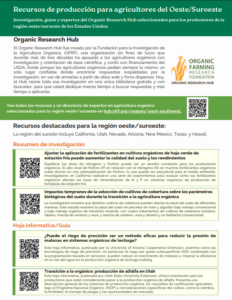
Obtenga la hoja informativa de recursos de oeste/suroeste

Junto con el Hub, hemos preparado una hoja informativa imprimible de una página para el oeste/suroeste. Es una guía de referencia rápida sobre la investigación, las herramientas y los expertos locales seleccionados específicamente para su zona, además de un código QR que lleva directamente a la página de su región en el Hub. 

Descargue la hoja informativa del oeste/suroeste:
Explore lo que se construyó para usted

La investigación, las herramientas y las personas que usted necesita para producir de manera orgánica con confianza ya están reunidas en un solo lugar: el Organic Research Hub, creado para su región, ahora en español y de uso gratuito.

¿Quiere más recursos de agricultura orgánica para su región? Regístrese aquí y se los enviaremos por correo electrónico conforme estén disponibles.

¿Tiene un recurso que debería incluirse o una pregunta sobre lo que encontró? Comuníquese con nuestro equipo; siempre estamos agregando contenido al Hub.

By |2026-10-02T11:56:28-04:00September 25th, 2026|News|

Seeds of Success Events

Beginning in 2023, the Organic Farming Research Foundation (OFRF) has worked in partnership to bring a series of interactive, virtual farmer-to-farmer networking sessions to growers across the country. Partners on these “Seeds of Success” sessions include Organic Farmers Association (OFA), the National Organic Coalition (NOC), the Transition to Organic Partnership Program, Oregon Tilth, Western Sustainable Agriculture Research and Education, and dozens of organic farmers, extension agents and researchers.

These “Seeds of Success” events are designed to empower organic producers and transitioning farmers with engaging peer-to-peer conversation. Each session will act as an interactive, informal space for farmers to share their challenges and successes and will give farmers an opportunity to have open conversations on topics most relevant to them.

Below you’ll find recordings for past events. The most recent events are added at the bottom of this list.

Strategies for Identifying and Navigating Organic Markets

Hosted by OFRF on November 10, 2023.

In this virtual networking session, we address the number one non-production challenge identified by organic producers: finding and developing markets for organic products.

This session featured three women farmers who have creatively grown their markets for organic products: Amy Van Scoik of Frog Song Organics in Florida, Pam Mack of L Marie LTD in Ohio, and Anna Jones-Crabtree of Vilicus Farms in Montana.

Watch Recording:

Demystifying the National Organic Standards Board: What It Is, How It Works, and How It Impacts Your Farm

Hosted by NOC on January 30, 2024

Organic producers and processors must follow strict standards to become organically certified. Who decides what is and is not allowed on organic farms and in organic processing facilities? Not your certifier! Rather, it’s the USDA National Organic Program, in consultation with the National Organic Standards Board (NOSB).

On Tuesday, January 30, 2024, the NOC hosted a virtual meeting for organic and transitioning farmers, where a panel of farmers and advocates demystified the NOSB. Panelists explained the role of the NOSB in shaping organic standards and allowed materials, the process the Board uses to make decisions, and explained how written and oral comments can make a difference in Board decisions.

Panelists included Steve Ela, Former NOSB Chair, NOC NOSB Specialist, and Organic Producer at Ela Family Farms in Colorado; Harriet Behar, Former NOSB Chair, NOC Advisor, OFA Farmer Services Consultant, and Organic Producer at Sweet Springs Farm in Wisconsin; and Amy Bruch, Current NOSB Vice Chair and Organic Producer at Cyclone Farms in Nebraska.

Learn more about this session and your role in providing input to the Board and lifting up farmer voices in the NOSB process on NOC’s website.

Watch Recording Here

Crop Insurance for Organic Farmers: What’s Working, What’s Not, and How We Can Make it Work for Us

Hosted on OFA on April 16, 2024.

In a changing climate, crop insurance can make or break a farmer’s ability to keep farming the next year. But this federally-subsidized program, intended as a safety net for farmers, serves some producers growing a few specific crops better than others. The program, as currently designed, feeds into the consolidation of land and resources in agriculture, with crop insurance being the only subsidized farm program with no upper limit on the funds that a farmer can receive from the federal government, a practice that reinforces existing power structures and leads to fewer, bigger, and less diverse farms.

Organic and transitioning farmers, specifically, find themselves misunderstood and underserved in the crop insurance system, as their practices, rotations, transition, and certification processes are not widely understood by the agents serving them and can be in conflict with Risk Management Agency requirements.

Noah Wendt of A&W Farms in Iowa and Seth Kroeck of Crystal Spring Farm in Maine share their experiences with crop insurance.

Watch Recording:

NRCS Organic Practice 823: Strategies and Best Practices

Hosted by OFA on July 24, 2024.

The National Resources Conservation Service (NRCS) has many programs to help farmers convert to organic farming operations. The Environmental Quality Incentives Program (EQIP) is a conservation program that helps farmers, ranchers, and forest landowners integrate conservation into working lands. Under EQIP, Organic Transition Initiative 823 (OTI) is specifically meant to help those transitioning to organic operations, by cost-sharing and providing technical support on practices organic and transitioning farmers want to implement on their farms. This program is relatively new, and a little different than other NRCS practices. Hear directly from ag professionals and farmers about their experiences with 823 and their ideas regarding how to best utilize this valuable conservation planning tool.

This session was presented by OFA’s Farmer Services Consultant Harriet Behar, Marbleseed’s Climate and Conservation Director/Organic Conservation Specialist Thomas Manley, and Lehman Farms Ltd.’s Aaron Lehman.

Watch Recording:

Adding the “O”: Farmer Perspectives and Experiences Transitioning to Organic

Hosted by OFRF on November 10, 2024.

This webinar features two farmers that share their experiences and thoughts for demystifying some of the challenges they faced while developing, conducting and evaluating research projects on their farms through OFRF’s Farmer-Led Trials project.

Watch Recording:

Lessons from OFRF’s Organic Seed Usage Farmer Listening Session

Hosted by OFRF on March 5, 2025.

In the sixth Seeds of Success networking session, over 40 participants gathered (virtually) to share their thoughts and firsthand experiences using and producing organic seed. The session was not recorded to allow participants to share more freely. Read OFRF’s summary of key takeaways from seed growers, organic producers, researchers, and technical service providers.

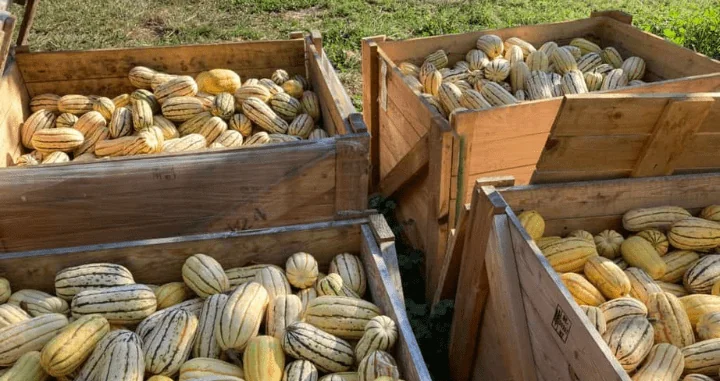
A Delicata squash seed crop cures in bins at White Oak Farm and Education Center, Oregon.

Crop-Livestock Integration

Hosted by OFRF on June 26, 2025.

Are you an organic farmer that is interested in using your livestock in your crop rotation? Are you wondering how others have overcome some of the complexities of integrating your farm system? Would you like to hear directly from farmers who have experience in this topic? If so, then this webinar is for you.

This Seeds of Success farmer-to-farmer networking session was an engaging opportunity where farmers came together to ask questions and share their lived experience in integrating crops and livestock in their production systems. This session we will features three farmers that have built resilience and a dynamic organic system:

Ben Coerper, Wild Harmony Farm

Tomia MacQueen, Wildflower Farm 

Raymond Hain, recently retired from Grain Place Foundation 

Watch Recording:


Farmer Perspectives on Transitioning to Organic in the Northwest

Hosted by OFRF December, 2025.

Farmers transitioning to organic production face unique challenges that require technical assistance on a wide range of production and non-production issues. During the transition period farmers must consider financially viable strategies for the three-year transition period, how to restore soil health while learning to manage weeds without herbicides, acquiring new equipment and infrastructure needed for organic production, and navigating NOP-related paperwork during the last year of transition and first year of certification. This webinar features three farmers that have worked through these issues, who share their experiences and thoughts for demystifying some of the challenges they faced in the process. In this session we feature three farmers in the Northwest that have built resilience and a dynamic organic system: Lynn Schaal, Life Springs Farm – Idaho Tracey Dion, Yellowstone River Farms – Montana Aaron Flansburg, Flansburg Farm – Washington. Read a recap of the session here.

Watch Recording:

Accessing USDA Farmer Resources on the Ground: NRCS and FSA

Hosted by the Organic Farmers Association on January 27, 2026.

Recent changes to USDA offices have real impacts for organic farmers. Join the Organic Farmers Association, OFRF, and the National Organic Coalition (NOC) for this Seeds of Success session: Accessing USDA Farmer Resources on the Ground: NRCS and FSA – Seeds of Success. This session can help farmers understand how they can navigate these changes with insights straight from USDA staff. Participants take the opportunity to engage directly with representatives from the Natural Resource Conservation Service (NRCS) and Farm Service Agency (FSA). During the hour, we delve into the specific changes in the structure, staffing, and location of NRCS and FSA offices. Farmers can learn the most effective ways to access essential resources. The session also provides guidance and updates on available loans, programs, and technical assistance to support farm and business goals.

Watch Recording:

Organic 101 for Extension Agents: Understanding Certification, Standards, and Producer Journeys

Hosted by OFRF January, 2026.

This webinar is for extension agents, technical service providers, or anyone who wants to understand organic certification and help growers make the transition to organic farming. In the first half of this informative session, you will learn the basic principles of organic certification, and become familiar with organic standards. During the second half, you will have the opportunity to interact with farmer panelists as they share their experiences in becoming certified organic producers. Panelists include April Thatcher of April Joy Farm in Washington, Beth Hoinacki of Goodfoot Farm in Oregon, and Diane Green of Greentree Naturals in Idaho. This webinar is brought to you by the Organic Farming Research Foundation, Oregon Tilth, and Western SARE.

Watch Recording:

Hosted by OFRF March, 2026.

This webinar is for extension agents, technical service providers, or anyone who wants to understand organic certification and help growers make the transition to organic farming in the south! Brought to you by the OFRF, Florida Organic Growers, and Southern SARE, the first half of this informative session covers the basic principles of organic certification and organic standards. During the second half, participants bring questions to a panel of experts, including organic farmers and specialists in Extension and organic certification: Eva Worden (Worden Farms), Danielle Treadwell (University of Florida), and Juan Carlos Rodriguez (Florida Organic Growers).

Watch Recording:

Hosted by OFRF May, 2026.

In this session, presenters walk through the most common insects, diseases, and weeds found across the SSARE region — from armyworm and root-knot nematode to pigweed and nutsedge — and connect that regional context to the pest management requirements outlined in the National Organic Program. Drawing on research conducted in the South, the session focuses on practical, science-backed strategies that extension agents and TSPs can bring directly to the farmers they serve, covering approaches to weed management, insect and disease control, and the “many little hammers” IPM framework that underpins organic production.

Watch Recording:

Hosted by OFRF August, 2026.

Managing pests and disease organically isn’t easy. The Northwest throws a lot at growers, from crop-specific insect pressure to diseases that can wreck a harvest fast. Having the right tools and knowledge on hand can make all the difference. The session opens with an overview of OFRF’s organic farming resources, followed by a panel discussion featuring experienced organic farmers and researchers: Ellie Costello, Trust Land Farm (MT) Sarahlee Lawrence, Rainshadow Organics (OR) Robert Orpet, OSU Assistant Professor of Entomology.

Watch Recording:

Cover Cropping Strategies for Organic Systems in the West

Hosted by OFRF September, 2026.

Cover crops are one of the most powerful tools available to organic and transitioning farmers, but getting them right in western growing conditions takes knowledge and experience. This webinar brings together researchers and practitioners to share what the science says and what is working on the ground. OFRF Conservation Scientist Rebecca Champagne, PhD, presents current research on cover crops for western organic systems, covering soil health, nutrient and weed management, pollinator support, and grazing integration. Shannon Cappellazzi, PhD, Soil Health Extension Specialist with Oregon State University, and Anthony Reyes, Director of Agriculture at Oxbow Farm and Conservation Center, join the panel to offer research and on-farm perspectives from real-world experience in the region.

Watch Recording:

Stay tuned for our next farmer-to-farmer networking session. You can view all upcoming OFRF-related events at ofrf.org/events/ and by subscribing to our newsletter here.

The Seeds of Success project is supported through the United States Department of Agriculture (USDA) Transition to Organic Partnership Program (TOPP). TOPP is a program of the USDA Organic Transition Initiative and is administered by the USDA Agricultural Marketing Service (AMS) National Organic Program (NOP).  

By |2026-09-16T12:23:51-04:00November 10th, 2023|News|
Go to Top