
A personal note as I step away from OFRF
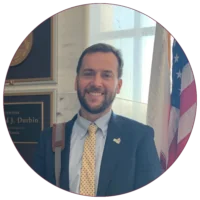
By Gordon Merrick, OFRF Policy Program Director
This will be the last edition of Gordon’s Policy Corner that I will write. As I type that I certainly feel a mix of gratitude, pride, and a fair amount of dust in my eye. After nearly four years at the Organic Farming Research Foundation, I’ll soon be stepping away from an organization that has shaped how I think about food, farming, and what it means to do policy work that serves the people who are integral to our food system: farmers, farm workers, researchers, and those that translate the scientific research into practical tools.
When I joined OFRF, I was given an opportunity to rethink how we, a research organization, engage with policy research and advocacy that is rooted in the people we serve. Over the last four years, I’ve had the privilege of helping grow that work in ways that feel tangible and lasting: launching our Communicating with Legislators course which aims to demystify the policy process for researchers and farmers; helping craft and introduce the Organic Science and Research Investment Act in the House and the Senate; working to build stronger connections between researchers, producers, and the policymakers that serve them; developing practical, farmer-facing toolkits on USDA programs through our TOPP-W/SW work; and partnering with NRCS to strengthen research-backed tools and expertise relevant to organic within the agency.

Fellowship of the Rings photo credit: New Line Cinema
But, those are all things you can put in a report or sometimes feel in your hand. What doesn’t show up as easily on paper is the community. I’m especially proud of the role I was able to play in the TOPP network, a constellation of farmers, certifiers, researchers, nonprofits, and agency staff who are doing the unglamorous, essential work of helping organic systems, from the small urban farm to the complex distributors, exist and thrive. Forgive my nerdiness, but that larger network feels like a Tolkien-esque fellowship: a group up against the odds but deeply committed to carrying something important forward, together.
Looking ahead, I am confident that OFRF is set up to keep having an outsized impact on the adoption of organic agriculture systems. That’s because of the people that make up this organization, the relationships those people hold and nurture, and the way this organization operates: constantly grounding priorities and our work in farmer’s lived experiences. OFRF will continue to work to ensure that research is action-oriented, and refuse to accept that organic should be treated as a side quest instead of a core part of U.S. agriculture. The work we’ve built is bigger than any one person, and that is exactly how it should be.
One of the biggest lessons I’m carrying forward with me is both the need, and the effectiveness, of shifting our collective mindset from scarcity to abundance. From either/or to yes/and. From us-versus-them to whole systemic perspectives. Organic agriculture has always pointed in that direction: organic, at its core, is about working alongside natural systems to foster a naturally abundant system that already exists. Soil health doesn’t compete with profitability, farmer wellbeing isn’t matched against stewardship; they reinforce each other.
That being said, it feels important to name the moment we are in. We are living in a time when science is being questioned, expertise is being flattened to opinion, and fear is easier to sell than nuance. I hold real compassion for people who have been misled or who are reacting from a place of uncertainty or loss. At the same time, I believe strongly that compassion cannot mean silence in the face of real harm. We need to consistently provide both: patience to meet people where they are, and firm, principled opposition to actions that undermine farmers, research, and the systems that sustain us all.
I’m deeply grateful for the farmers, researchers, partners, and colleagues who trusted me, argued with me, taught me, and built things alongside me. OFRF will keep doing work that matters. But starting later this month, I’ll be cheering it on loudly from the sidelines.
I’m not disappearing, and I genuinely hope to stay in touch. If you want to keep talking about organic agriculture, the relationship between research and policy, how to build something better than what we’ve inherited, or to share your favorite bread recipe, please reach out. I’d love that.
Eat well and breathe deeply,
Gordon