
Mid Atlantic/Northeast

Growing Organic Grains and Pulses in the Northeast: What Does the Research Say?

By Brian Geier, OFRF Communications Manager. This article was originally published in the winter 2026 issue of The Natural Farmer

Organic grain farmers depend on complex relationships amongst several moving parts of niche organic systems: from our soils, climate, microbes, insects, and diseases to specialty seed sourcing, post-harvest processing, and unique market needs. 

In our quest for good info, we might wonder what research has been done on organic grains, and if any results might be helpful. But getting these answers can be overwhelming. Research findings can be difficult to decode, organic solutions might be few or far between, and specificity for our crop or region might be missing. 

Through work with the Organic Farming Research Foundation (OFRF), I’ve seen a few programs and resources that I think could help organic grain and pulse growers in the Northeast, and across the country. Here is a roundup:

Introducing the Organic Research Hub

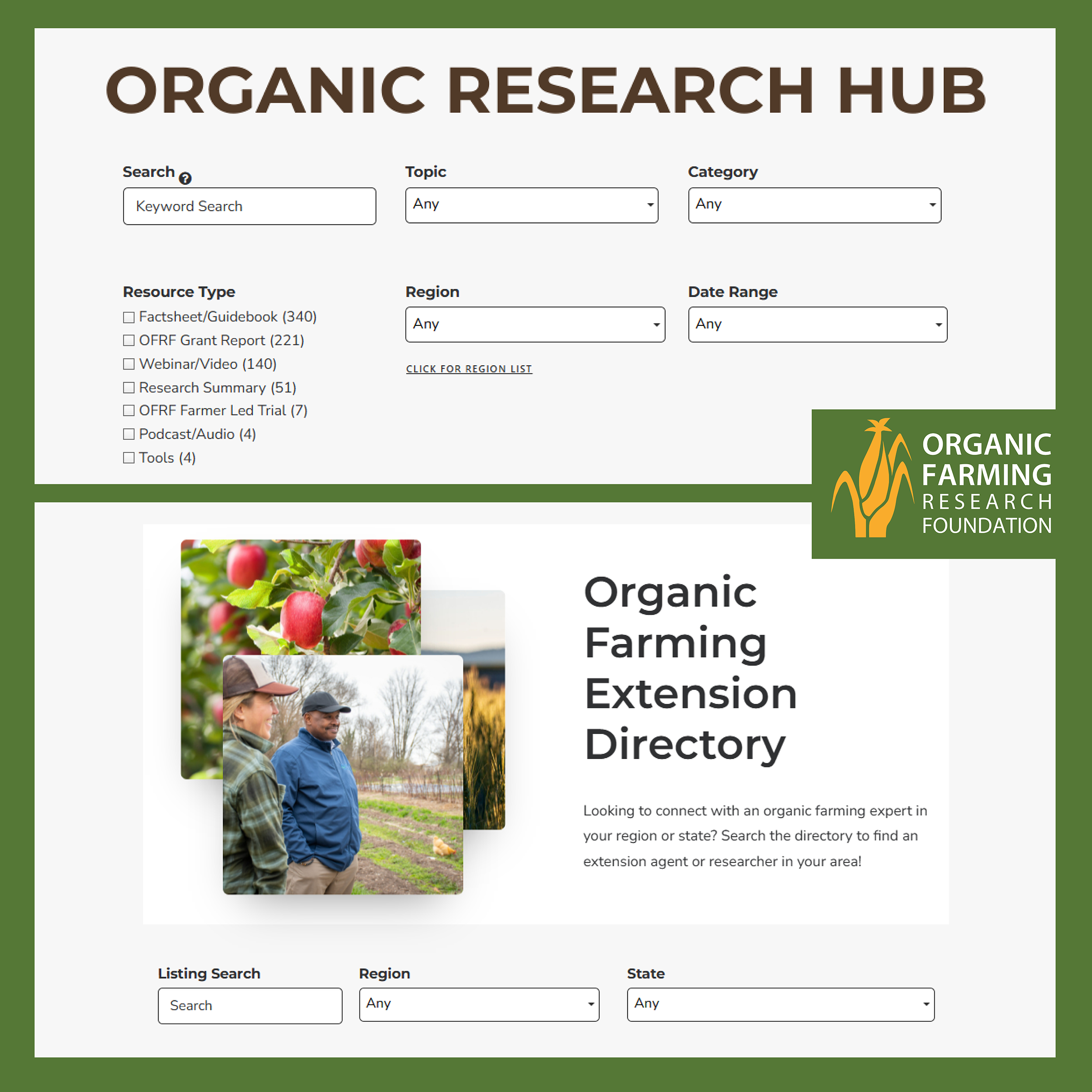
The new Organic Research Hub (“The Hub”) is a curated, searchable collection of science-backed resources for organic production. It can be searched by keyword, topic, region, or production category. For example, here are a couple noteworthy highlights from a search for grain and field crops in the northeast:

The main challenges of grain production in the northeast are outlined in an eOrganic webinar featuring work led by Dr. David Benscher (Cornell University). They are:

  • finding crop rotations, 
  • sourcing seed,
  • identifying seeding rates, 
  • weed management, 
  • grain drying, 
  • insect and rodent control during storage, and 
  • qualities for niche markets. 

The webinar delves into each challenge and presents unique considerations for crops and regions. Buyers for niche markets prefer different grain qualities. Buyers of grain for bread prefer a higher protein content. Malters are more concerned about germination. Distillers may prefer a lower protein content. Knowing your niche market is key. As the “Ten Keys to successful malting barley production in New York” publication from Cornell states, “Have a marketing plan before you plant.”
There are unique challenges with fertilization of overwintering organic grains. Research by Dr. Ellen Mallory at the University of Maine (UMO), addresses ‘Topdressing Organic Hard Winter Wheat to Enhance Grain Protein.’ Meeting the fertility needs of overwintering grains with pre-planting applications risks winter leaching. Spring applications of manure can be tricky given the 90 days-to-harvest rule for organic. Research shows that later applications of nitrogen lead to higher protein levels in grains. This resource helps growers understand the when, what, and how much to topdress for best results.

Organic grain growers in the northeast are experiencing increases in weed pressure under organic management over time. This sobering reality is addressed in a video on Weed Control in Organic Spring Cereals, also from UMO, which highlights the unique and significant weed management challenges for organic grain producers. Aside from strategies before or during planting like crop rotations or high density plantings to help organic grains out-compete weeds, growers have few options other than mechanical cultivation after the crop germinates. Grain growers can look to tine-weeding to control very young weeds, but one wet spell at the wrong time in spring and growers may miss their window. This resource focuses on in-row weeding setups, one example being the Schmotzer EPP cultivator that is controlled by hydraulic-assisted manual steering. These types of setups can be more effective at disrupting weeds that have passed the early “thread” stage than tine-weeders, and cheaper than high density planting.

Farmer-Led Resources

Organic farmers’ #1 source of information is other farmers (source: National Organic Research Agenda). Farmer-friendly resources from OFRF that grain growers may find useful include a suite of resources and a webinar on crop-livestock integration (CLI), farmer-led trials, and organic researcher spotlights. Here are a few takeaways:

In the CLI webinar, farmer Raymond Hain discusses grazing pigs at the Grain Place Foundation in the last year of pasture in their 9-year crop rotation, before opening up fields for grain and soy. The pigs, moved in 10 acre paddocks, help prepare the ground for planting. And they are left for longer periods in some places to help eradicate bindweed. 

In other CLI resources, farmer Mike Bronkema reports that protein content of grains following crop-livestock integration at Shady Side Farm is double that of conventional grains. Reduced need for mechanical cultivation and increased nutrient densities are two of several benefits of CLI that all organic farmers on the CLI project spoke to OFRF about.

In other CLI resources, farmer Mike Bronkema reports that protein content of grains following crop-livestock integration at Shady Side Farm is double that of conventional grains. Reduced need for mechanical cultivation and increased nutrient densities are two of several benefits of CLI that all organic farmers on the CLI project spoke to OFRF about.In farmer-led trials, important work is being done with sourcing seed, variety trials, and evaluating grain qualities for niche markets. With assistance from OFRF, organic farmer Kristin Swoszowski-Tran at Ledoux Grange is testing a new crop (teff) using commercially available seed and seed-bank accessions, while Bob Quinn of the Quinn Institute tests wheat on their farm alongside a baker who evaluates for preferred qualities. 

It is also worth mentioning Dr. Dil Thavarajah (Clemson University), an organic researcher who OFRF recently highlighted. While not in the northeast, her work presents advancements in grain and pulse breeding for organic systems. Her work brings seed from all over the world to test on farms in her region. The international aspect is critical for organic systems, she says, because conventional lines of pulse crops in breeding programs in the US are highly inbred and not very diverse. Her project creates breeding pipelines to speed the development of new pulse crops that are:

  1. Suitable for organic crop rotations with existing cash crops,
  2. Have high protein content and quality,
  3. Are resilient to climate extremes in her area.
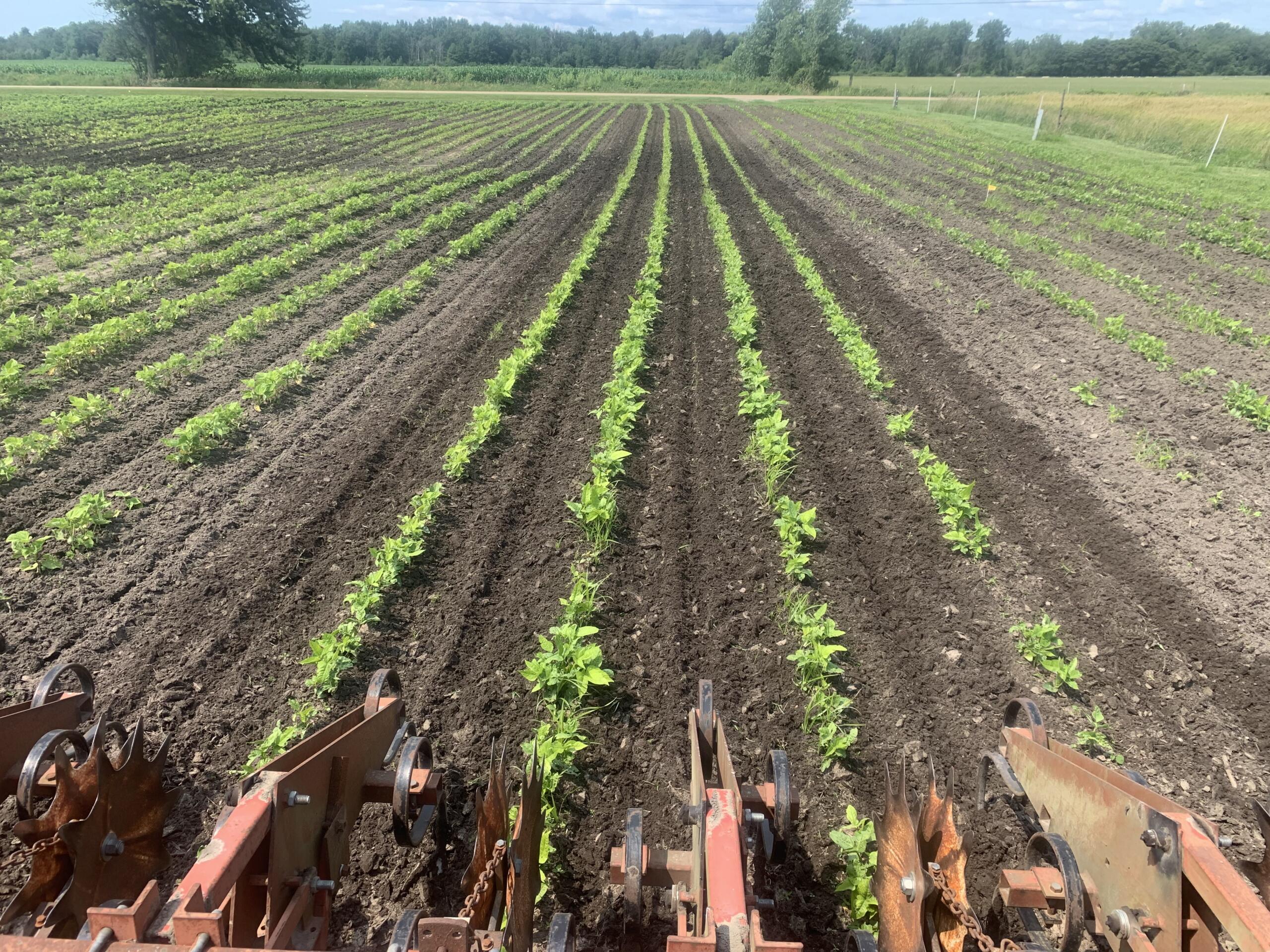
Organic farmers report decreased needs for mechanical cultivation following crop-livestock integration. Photo: Mike Bronkema.

Moving Forward and Making Connections

This article is far from comprehensive but I hope these resources and The Hub can be useful for growers to find the specific information most useful to you. At The Hub, there is also an Organic Farming Extension Directory to help connect growers and organic experts for future research needs. The Hub and the Directory are living resources open to additions. Feedback or suggestions for additions can be submitted via a form on OFRF’s website or by contacting OFRF staff. If farmers, ranchers, researchers, extension agents, or anyone has suggestions for additions to these resources, OFRF welcomes your input.

By |2026-03-19T12:30:06-04:00March 17th, 2026|News|

What’s Happening with Organic Farming Research in Pennsylvania

Written by Brian Geier, OFRF Communications Manger. This article was originally published in Pennsylvania Certified Organic’s (PCO) Organic Matters publication. See the article in PCO’s Winter/Spring 2025 edition.

Before diving into the importance and impact of organic research in Pennsylvania, let’s start with some national context. Nationwide, certified organic produce now makes up more than 15% of total produce sales in the United States. Organic dairy and eggs now constitute more than 11% of the total market. And overall, organic sales have doubled over the last 10 years and in 2024 made up about 6% of the total US food market. By most measurements, organic food is trending upward. Most notably, the growth of organic sales is consistently outpacing the growth of the overall food market. To say it another way, we might be heading into a future that is more and more organic! 

But will we get there? 

Despite the growth of the organic sector, organic agriculture research funding makes up less than 2% of the total research at the USDA, and less than 1% at the Agricultural Research Service (ARS). Additionally, much of the research focused on conventional agriculture relates to chemical applications or genetic traits—technologies that organic producers do not, and if certified, can not, use. To put it another way, organic research benefits all farmers, including conventional ones, but not the other way around.

In order to sustain the growth in organic acreage, producers, and products, it is crucial that more USDA funding be organic and applicable to all farmers. National policy priorities identified by the Organic Farming Research Foundation (OFRF) include:

  • Increasing USDA’s research funding for organic research through both competitive grant programs at the National Institute of Food and Agriculture (NIFA) and intramural research at ARS to reflect its market share and growth trajectory.
  • Fully funding the Organic Data Initiative to provide the necessary market analysis of a rapidly sophisticating sector. 
  • Expanding the accessibility and applicability of technical and financial assistance programs for organic farmers. 

To learn more about this policy work that supports organic nationwide and in Pennsylvania, visit OFRF’s advocacy page.

Organic Research in the Keystone State

Pennsylvania is a powerhouse of organic agriculture. It ranked 4th in the nation with over 100,000 certified acres and 1,200+ farms generating $1 billion in sales in 2021, according to the latest organic survey by the National Agricultural Statistics Service.

The USDA’s NIFA has awarded over $28 million in grants to the state’s research institutions for organic research. Penn State University has played a crucial role, investing $12 million. The ARS has historically funded 17 projects in the state researching organic topics, but currently has no active projects. 

Organic farmers in the state and region have identified three key research concerns (according to the 2022 National Organic Research Agenda): 

  • Climate adaptation and resilience. 
  • Pest management.
  • Soil health.

Active Research Projects in Pennsylvania

Recent NIFA investments, through programs like the Organic Research and Extension Initiative (OREI) and the Organic Transitions Program (ORG), have provided nearly $12 million over the past four years to ongoing projects with an organic focus in Pennsylvania. Key projects at Penn State focus on intensifying production and improving resilience of organic grains, developing a nitrogen decision support tool, testing anaerobic soil disinfection (ASD) in fields and in high tunnels, tracking foraging patterns of organic bees, evaluating perennial crop rotations, and developing parasite resistance in dairy cattle. Another project looking at immersive experiential education of urban educators is underway at Drexel University.

Front cover of OFRF's Organic state Factsheet for the state of Pennsylvania

OFRF’s State-By-State leave-behinds provide data on the organic industry and organic research in states, and can be used to help farmers, researchers, and advocates when articulating needs for proposals or advocating for policy.

OREI-funded research on organic grain production (led by Dr. John Wallace) builds on previous research on reduced and no-til strategies, including planting into high-residue cover crops. Credit: Penn State Weed Science.

Besides providing new knowledge to organic growers, each of these research projects have other direct and indirect benefits worth noting. The Economic Research Service estimates that every $1 spent on agricultural research generates an additional $20 in benefits to the economy. In Pennsylvania, that means the $28 million for organic research translates to $560 million in economic activity. This effect can be seen given the growth of the value in Pennsylvania’s organic production between 2019 and 2021. In 2019, Pennsylvania had 1,039 organic farms with over $740 million in farmgate sales. In 2021, those numbers grew to 1,123 organic farms generating over $1 billion. Research provides real economic opportunities to farms looking to maximize both their economic return and their ecological impact.

Additionally, organic research provides professional training opportunities for undergraduates, graduates, and postdoctoral fellows on organic systems, and promotes symbiosis between up-and-coming researchers and the organic community. As Dr. Ajay Nair, newly appointed as the Department of Horticulture Chair at Iowa State University explained in a recent interview with OFRF, OREI “is the foundation for several of the organic projects that happen across the country. It serves as a good platform for us to reach out to organic growers and for organic growers to reach out to us and say, ‘Hey, can we address this particular issue that is coming up?’ These OREI grants,” he explains, are “actually helping to build our network…to help us build teams across the country.” 

How Pennsylvania Research Benefits Growers Across the Eastern US

Just as organic research can be applicable to all farmers, multi-state projects led in Pennsylvania are bringing new findings to organic farmers facing similar challenges across regions. For example, the OREI-funded project assessing ASD in field, led by Dr. Gioia at Penn State, includes similar research plots led by Dr. Xin Zhao at University of Florida. Results from Pennsylvania may provide insights for growers in the Northeast who face challenges managing soil borne diseases, while the plots in Florida reflect conditions faced by organic growers in the Southeast, but results from each region might inform growers who face similar challenges to similar cropping systems. Growers interested in managing soil health with ASD in the Upper Midwest or the Southeast might find the eOrganic webinar from Dr. Zhao valuable. The webinar focuses on selecting the right carbon source for the organic practice of ASD, which includes insights from the trials on Pennsylvania farms. All growers who want to use ASD to support their transition period to organic farming may be interested in the additional grant awarded to Dr. Gioia and his team to assess the economic viability of using ASD during the transition to organic to control pests and weeds. Additionally, any grower using or considering using ASD can share their story and contribute to the project. “The survey,” Dr. Gioia explains “is part of the bottom-up approach our team have been using to improve the ASD application method and make sure that our research is relevant to growers and meets their needs.”

Source: Francesco Di Gioia/Penn State

Research at Penn State evaluates the impacts of cover crop residues combined or not with wheat bran and molasses as a carbon source for ASD applications on lettuce. The project supports similar research being conducted at the University of Florida. Credit: Francesco Di Gioia/Penn State.

Completed Projects Provide New Resources for Organic Growers

Aside from the active projects above, several NIFA-funded organic research projects have been completed in Pennsylvania. While they may be concluded, the benefits of these organic projects continue. The results of these studies are not limited to publication in academic scientific journals or relevant only to scientists. Researchers, farmers, and extension specialists often collaborate to share the results of studies in ways that are meaningful and applicable to farmers. 

Take soil microbial management, for example. An OREI-funded study led by Dr. Jason Kaye at Penn State involved adding different sources of microbes (composts, forest soils, and other sources) to soils and measuring microbial populations. The project partnered with Pasa Sustainable Agriculture to collaborate with working farmers to conduct studies on working farms. While measurements of soil microbes may not be enough to provide specific recommendations to growers, the knowledge of how microbe populations change under management conditions and how they interact with plant crops can help farmers make better decisions.

Assuming soil microbes are fascinating to everyone with an interest in organic matters, let’s digress here for a moment. There are a myriad of ways that microbes can help or hinder organic systems: Microbes called biostimulants can release hormones into the soil that can help increase plant growth, while others can degrade the stress chemicals that plants produce during drought, helping plants become more resilient. Some microbes called biofertilizers can unlock nutrients in soils that plants cannot access themselves, helping where there may be excess nutrients, while other biofertilizers exchange nutrients directly with the plants in exchange for carbon. And get this—some perform better than others. That is, some biofertilizers that exchange phosphorus for carbon, called arbuscular mycorrhizal fungi (AMF), offer plants more phosphorus in exchange for the same amount of carbon when compared with other AMFs. 

When research-generated insights like these are made available and then accessed, farmers can make better-informed decisions for years to come. All of this fascinating information and more is available to farmers on eOrganic (see Management of Soil Microbes on Organic Farms and Soil Microbes in Organic Cropping Systems 101). Launched in 2009, eOrganic is a national, internet-based, interactive, user-driven, organic agriculture information system for farmers and agricultural professionals.

Want To keep Up With Organic Research in Your State or Nationally?

Aside from using eOrganic, growers and researchers can look forward to a new Organic Content Hub being developed by the OFRF, coming in early 2025. The Content Hub will be searchable by topic, crop, and region, and will provide users with the most current research relevant to organic farming. (Follow OFRF on social media and sign up for our newsletter to get updates on the Content Hub, organic research updates, new organic resources, and more.)

A figure developed by a graduate student (Laura Kaminsky) working on an OREI-funded project during 2019-23 at Penn State, illustrates examples of beneficial microbes. The left diagram shows nitrogen-fixing bacteria, housed either in nodules on legume roots or free-living in the soil. The right diagram illustrates arbuscular mycorrhizal fungi (AMF) (pink) associated with plant roots. See Soil Microbes in Organic Cropping Systems 101.

Moving Forward With Organic Research 

Organic farming research is generating economic activity in Pennsylvania, providing professional development to researchers and students across the east, forming regional networks between researchers and growers, and producing publications being used by organic growers across the country. One might say that the current state of research in Pennsylvania is healthy and humming! 

Looking to the future, it is critical that federal funding keeps up with the growth of the organic movement nationally and in the state. OFRF and partners work daily to bolster and protect this funding, and we are always looking for farmer and researcher partners in this work. If you are an organic farmer or researcher and are willing to share your story, your experiences can be some of the best fodder for advocating for or directing future organic research in Pennsylvania.

By |2025-12-09T17:39:38-05:00March 20th, 2025|Cover Crops & Crop Rotation, Insects & Diseases, News, Soil Health, Weeds|

Farmer-Led Trials Program Spotlight: Kennebec Valley Farm

Written by Mary Hathaway, OFRF’s Research & Education Program Manager

Up on a ridge in rural Maine is Kennebec Valley Farm, a 22-acre historic farm. Owner Jennifer Barrientos was able to purchase the farm three years ago to become steward of the property, which is a mix of woodland and pastureland. Jennifer grows on just about one acre, including greenhouses. She is certified organic and uses no-till and biodynamic methods to grow her produce. You’ll also find chickens and alpacas on her pastureland, and she makes good use of their manure in her soil fertility regimen. 

Jennifer had a long journey to get to her current farm. She grew up in Hawaii, where she helped grow food and care for chickens, goats, and rabbits on her family’s farm. Many years later, after moving back to the mainland and working as a teacher for more than 25 years, Jennifer began working on organic and biodynamic farms on both the West and East Coasts. Now, settled in at Kennebec Valley Farm, Jennifer grows food for her community, offering seasonal produce at their farm store, through a CSA and local farmers markets. 

Rebecca Champagne, OFRF’s Conservation Scientist, visited Kennebec Valley Farm in October to see Jennifer’s operation and chat about her involvement in the FLT program. They chatted about why Jennifer decided to apply for the program, why she chose the specific research question, and discussed how the trial was going. Jennifer is in the beginning phases of being in no-till production, and after visiting some long-term no-till farms in Maine, she knew she wanted to investigate what would create the healthiest soil at her farm. She is interested in finding the right balance in practices financially, labor-wise, and what will build soil health and microbial activity.

Comparing farm-made compost and commercial fertilizer

In her transition to a no-till system, Jennifer has begun to incorporate Dutch white clover as a cover crop to add fertility to her beds and suppress other weeds. As she’s developing and stabilizing her permanent bed system, Jennifer wanted to make use of more cover crops and farm-generated inputs to feed her soil. However, as a market farmer, Jennifer did not want her change in amendments to decrease her yields. Jennifer decided it was a good idea to compare her farm-made compost with the commercially available fertilizer that she had used in previous seasons. 

Farm trial plan

plot map for field trial at Kennebec Valley Farm, part of the Farmer Led Trials Program at OFRFWith technical support from OFRF, Jennifer built out her trial, asking, “Will purchased soil amendments result in higher yield and soil health when compared to farm-made compost in brassica crops?”

OFRF staff helped Jennifer set up a randomized block design to compare the yields of Brussel sprouts growing with her farm-made compost and a commercial fertilizer that consists of blood meal and potassium sulfate. Jennifer is also taking soil tests of plots before and after harvest to see what impact the treatments are having on the soil, as well as the current crop.

Trial updates

The Brussel sprout harvest will be complete in December, with just over half the crop harvested so far. Jennifer continues to track the yield data as the plants are ready for harvest. To capture a full picture of the impact that the cover crop and amendment treatments have on the soil, she will take soil samples after the ground thaws in spring.

rows of organic veggies in a high tunnel at Kennebec Valley Farm, part of the Farmer Led Trial Program with OFRF

“By embracing a holistic approach to farming, I not only contribute to sustainable agricultural practices but also inspire others to recognize the health benefits of consuming locally grown, nutrient-rich produce. As stewards of the land, this research can cultivate a culture that honors the environment, nourishes communities, and builds a better future.”

– Jennifer Barrientos, Kennebec Valley Farm

the farm store at Kennebec Valley Farm, selling local organic fruits and veggies

This story is part of a series profiling farmers who are taking part in OFRF’s Farmer-Led Trials (FLT) program. Farmers receive technical support from OFRF to address their challenges through structured on-farm trials. To learn more about OFRF Farmer-Led Trials Program, visit our website page at https://ofrf.org/research/farmer-led-research-trials/

To learn more about soil fertility rates and various amendments, check out these links:

To learn more about Kennebec Valley Farm visit https://www.kennebecvalleyfarm.com/

By |2025-12-17T17:37:36-05:00December 10th, 2024|Farmer Stories, News, On-Farm Research, Soil Health|
Go to Top