
OFRF Leads Organic Soil Heath Workshop at TOFGA
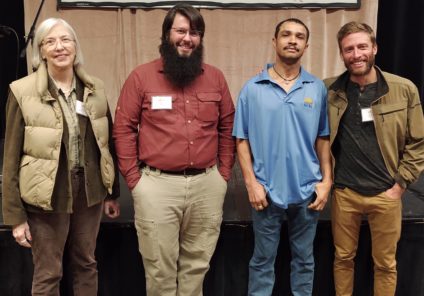
L-R: Diana Jerkins, Scott Snodgrass, Justin Duncan, Tommy Garcia-Prats
January 28, 2020 – OFRF was a sponsor of the Texas Organic Farmers & Gardeners ( TOFGA) annual conference held in Temple, Texas conference from January 16-18. OFRF and TOFGA and OFRF jointly held a panel workshop on soil health, as well as a farmer listening session. Diana Jerkins, OFRF Senior Scientist, led both sessions with 60 participants for the workshop and over 40 for the listening session. Dr. Jerkins is a co-author of OFRF’s educational series on Soil Health and Organic Farming, which includes nine guidebooks and webinars, all of which are available to download/view for free.
TOFGA is a statewide non-profit organization focused on education and advocacy for Texas farmers, ranchers, and gardeners who practice organic and sustainable methods. Attendees came from across Texas for three days of in-depth workshops and learning sessions, plus multiple off-site intensives and farm tours.
Dr. Jerkins provided information on OFRF research and educational projects addressing soil health and moderated a panel on small- and large-scale farmer solutions to improving soil health with examples from research and on-farm sites. Tommy Garcia-Prats, founder and general manager of Small Places LLC of the Finca Tres Robles, an urban farm in downtown Houston discussed integrating soil health-building practices such as making and applying mulch and compost on vegetables, fruit, and herbs. Tommy is “always looking to expand his edges and those of his community through agriculture.” Scott Snodgrass, a fourth-generation Texan and founding partner of The Edible Group, spoke on larger scale production systems, including regenerative practices for vegetable production at scale. Justin Duncan, a researcher and Sustainable Agriculture Specialist with the National Center for Appropriate Technology, gave an overview on the use and selection of cover crops for soil improvement. Attendees especially liked the real farm examples, like building compost and adding biomass to the soil, and the use of specific cover crops for Texas conditions.
The listening session provided an opportunity for organic farmers and ranchers to discuss their production concerns, successes, and priorities for future research investments. Participants expressed concerns over the future of “small” farms and the preservation of farmland due to aging farmer populations and fewer new farmers entering the field. Participants expressed a desire for more funding for organic research, both federal and community grants, with a focus on regionally specific information. Other topics included cover crops; starting winter crops in greenhouses; tools for tracking soil carbon to a create carbon-farm plan; appropriate soil testing for organic production; use of seasonal IPM bug calendars; resource information for current research; on-farm research as “centers for university research;” urban community assessments related to agriculture use; how to connect farmers with researchers; physical and mental impacts of farmworkers; building, training, and maintaining labor force; policy and legislative issues – soil health, water catchment, suburban growth impact on farmland; planning/development land use.
Dr. Jerkins’ presentation is available to view here.
All of OFRF’s research results and educational resources are available to download for free.
Learn more about OFRF’s National Organic Survey here.
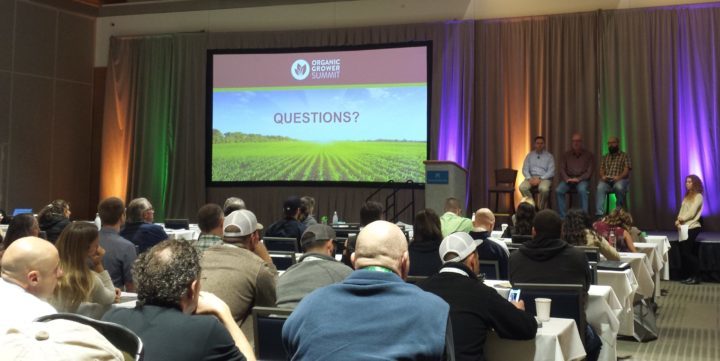 December 9, 2019 – When over 100 people arrived at our workshop on reducing risk through organic soil health practices at this year’s Organic Growers Summit in Monterey, CA, I knew it would be an impactful morning.
  December 4, 2019 – Now through December 31st, all donations made to OFRF will be matched dollar-for-dollar by Patgonia Works!
 November 14, 2019 – OFRF has been using research-based analysis to inform public policy for nearly three decades. Recently, we contributed to a new report from the National Sustainable Organic Agriculture Coalition (NSAC) titled
  November 8, 2019 – Eleven years ago, I started my farm from scratch.
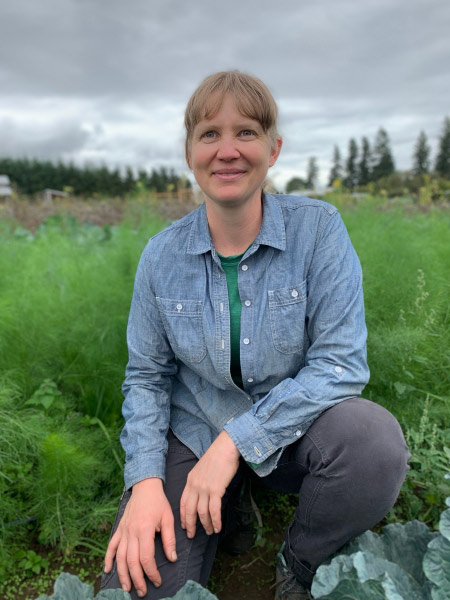 The diversified, organic farming practices I still use today are crucial to the feasibility of my operation, and although soil quality may not have a specified line-item on my balance sheet, it is absolutely the foundation of my work. I have learned how to assess the biological health of my soil, manage nutrient loads, and reduce my dependence on off-farm inputs—all while continuing to reduce the carbon footprint of my operation.
 October 25, 2019 – In 2018, OFRF provided a

 October 18, 2019 – The House Agriculture Committee’s Biotechnology, Horticulture, and Research Subcommittee held a hearing on October 17th to review the implementation of USDA Farm Bill research programs. The hearing centered on discussion of the agency’s move to Kansas City and the deep loss of expertise and experience that is resulting from the relocation.