
News

OFRF and FFAR Announce Research Grant on Organic Farming Approaches to Coffee Leaf Rust Disease

FOR IMMEDIATE RELEASE

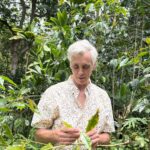
(June 9, 2022) – The Organic Farming Research Foundation (OFRF) and the Foundation for Food & Agriculture Research (FFAR) are pleased to announce its first award for the 2021/22 OFRF organic research grant cycle. Colehour Bondera of Kanalani Ohana Farm was awarded $19,900 to research organic farming systems options for controlling Coffee Leaf Rust (CLR) on five organic farms in Kona, Hawaii.

This farmer-led research project takes a whole-systems approach to evaluate plant health-based options for managing coffee leaf rust (CLR), a potentially devastating disease for all coffee growers but especially organic farmers. Long-term organic growers have seen limited efforts in the state to explore or disseminate information about organic approaches to dealing with this new coffee disease.

“Funding from this OFRF grant provides an opportunity to help working farmers address the arrival of a new pest via farmer-directed research,” says Bondera. “By seeking community involvement and buy-in, this project supports the work of five participating organic farms to learn and work with Hawaii-produced coffee tree inputs to seek impacts at controlling the pest, coffee leaf rust – CLR, which currently has no known long-term solution in the global coffee industry.”

The project will research coffee leaf rust management by increasing biodiversity, using on-farm and island-made inputs and sequestering more carbon through increased soil organic matter. The impacts of additional fertilizer and indigenous micro-organisms (IMO) sprays on reducing CLR will be monitored and tested, with University of Hawaii organic system faculty assisting with analyses. Farmers will oversee research, data analysis and dissemination through already established networks in the community.

“We are thrilled to be able to invest in this research that supports the success of a key organic crop in Hawaii,” said Brise Tencer, OFRF Executive Director.

This year’s program prioritized farmers, early career researchers and Black, Indigenous and People of Color (BIPOC) applicants. Six projects focused on climate mitigation and building on-farm resilience have been awarded a grand total of $119,817 in funding. The 2021/22 cycle was made possible by a $66,000 grant from FFAR and matching funds from OFRF and its research partners.

“FFAR is thrilled to support six organic research grants through this collaboration with the Organic Farming Research Foundation,” said Dr. LaKisha Odom, FFAR scientific program director. “These research grants are funding audacious soil management techniques that enhance crop productivity, improve environmental health and support increased farmer resiliency to severe weather events.”

To date, OFRF has invested over $3 million in 361 grants across North America to advance scientific knowledge and improve the ecological sustainability and economic prosperity of organic farming systems. All OFRF-funded research must involve farmers or ranchers in project design and implementation, take place on certified organic land, and include strong education and outreach components. All research results are freely available in OFRF’s online database.

###

Foundation for Food & Agriculture Research
The Foundation for Food & Agriculture Research (FFAR) builds public-private partnerships to fund bold research addressing big food and agriculture challenges. FFAR was established in the 2014 Farm Bill to increase public agriculture research investments, fill knowledge gaps and complement USDA’s research agenda. FFAR’s model matches federal funding from Congress with private funding, delivering a powerful return on taxpayer investment. Through collaboration and partnerships, FFAR advances actionable science benefiting farmers, consumers and the environment.
https://foundationfar.org/ 

Organic Farming Research Foundation
The Organic Farming Research Foundation (OFRF) is a non-profit foundation that works to foster the improvement and widespread adoption of organic farming systems. OFRF cultivates organic research, education, and federal policies that bring more farmers and acreage into organic production. Project results are shared freely at ofrf.org. OFRF also provides free access to all of its educational materials and resources.
https://ofrf.org

Media Contact
communications@ofrf.org
By |2023-12-12T17:10:47-05:00June 9th, 2022|News, Press Release|

Weed Management for Nutsedge

2022 National Organic Research Agenda CoverThe Organic Farming Research Foundation 2022 National Organic Research Agenda (NORA) is a report informed by surveys and focus groups conducted in 2020 with over 1,100 certified organic farmers and ranchers across North America.
What Farmers Said

  • In the NORA report, two-thirds of survey respondents (67%) cited weed management as a substantial production challenge.
  • Specific feedback from organic farmers also underscores the need for additional research on controlling weeds such as nutsedge.

Knowing Your Weeds
Farmers and researchers alike acknowledge that weeds pose the greatest barrier to building healthy soils in organic cropping systems. Management of weeds in an organic cropping system involves integration of many separate management tactics. Which tactics you use will depend on the weed species present, the crop, the time of year the crop is planted, the type of equipment you have available, other crops in the rotation, and other site and operation-specific factors.

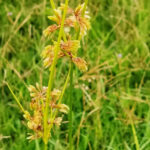
Closeup photo of yellow nutsedgeField of purple nutsedgeManaging Nutsedge
Nutsedge is a highly competitive and persistent weed in a wide range of crops and extreme measures are often taken to manage it. In conventional and organic systems alike, the most common method for controlling yellow and purple nutsedge is to desiccate the tubers by timely, repeated tilling. Farmers working toward sustainable conservation tillage systems may first need to take steps to control a current infestation of weeds before returning to reduced tillage practices.

To reduce the impact of nutsedges on production, farmers can:

  • Mechanically control weeds by repeated cultivation every 2-3 weeks
  • Cultivate an infested area and then withhold all moisture to allow the sun to dry tubers (note: this drying approach only works on purple nutsedge, not yellow nutsedge)
  • Implement shading techniques
  • Consider crop rotations and cover cropping
  • Cautiously consider solarization or occultation
  • Implement rotational grazing

Once control of nutsedge is achieved, efforts should return to restoring soil health. The following steps are key to soil health:

  • Keep the soil covered
  • Maximize living roots in thesis profile
  • Minimize soil disturbance
  • Energize the system with biodiversity

For more on weed management and applicable solutions that control this common weed, farmers can download OFRF’s Weed Management Guide and Weed Profile on Nutsedge.

By |2022-06-06T16:12:30-04:00June 6th, 2022|News|

Organic Farmer Shares Her Story

Help OFRF Support Organic Farmers

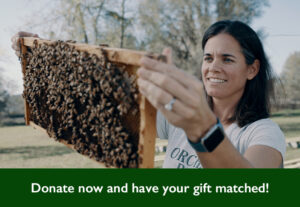
Mary Phipps with beehive - Donate Now

For many organic producers, organic is a way of life and they can’t imagine farming any other way. Mary Phipps is one of those farmers. She joined the OFRF board in 2021, but has been using OFRF resources for nearly 15 years. “I first heard about OFRF from another organic farmer in our area in 2008 and started using OFRF information on our farm to help us solve the many challenges we were facing. I immediately signed up for the newsletter and have been following along and benefiting from OFRF ever since.”

Mary’s farm, Orchard Pond, is a diversified organic farm in the Red Hills Region of Tallahassee, Florida. They grow produce and honey, and create a number of value added products through their on-farm commercial kitchen. But it isn’t always easy. “There are so many challenges that organic farmers face, so we need as much research and new ideas as possible to help us be successful,” Mary explained.

While she first found OFRF through our education and research materials, OFRF’s federal advocacy is what is most important to her lately. “I’ve been filling out our organic certification cost-share paperwork, so it’s on my mind. USDA’s cost-share program is so critical to our ability to continue and OFRF is working to improve and expand programs – like cost-share – that help farmers succeed.”

Mary’s story is quite common: Farmers need practical information that can help solve on-farm challenges, and increased support from the USDA and Congress. Organic farmers can’t do this alone and OFRF works behind the scenes to help organic farmers thrive.

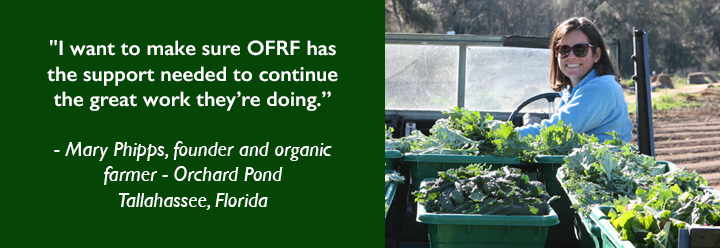
Mary Phipps on tractor

Mary joined the board because she believes in OFRF’s research, education and advocacy work. Follow Mary’s lead and contribute today! Your gift will be matched dollar for dollar, increasing the impact of your donation. And don’t forget, there are many ways to support OFRF.

By |2022-06-03T23:07:35-04:00June 3rd, 2022|News|

USDA Announces Up to $300 Million Investment for Transition to Organic Initiative

FOR IMMEDIATE RELEASE

Organic Transition Initiative Announced, Organic Production as Climate Strategy

(June 1, 2022) – Today, the U.S. Department of Agriculture (USDA) announced a Food System Transformation framework that includes up to $300 million in a new Organic Transition Initiative to provide comprehensive support for farmers to transition to organic production. The new initiative acknowledges that organic production has climate and environmental benefits, allows producers to demand a premium in the marketplace, “and thus take home a greater share of the food dollar,” according to an official USDA statement.

The Organic Transition Initiative will deploy technical assistance, farmer-to-farmer mentoring, direct support through conservation financial assistance and additional crop insurance assistance, and market development support in targeted markets. “All the provisions of the organic transition activities that USDA announced are ones that Organic Farming Research Foundation (OFRF) has historically advocated for,” said Brise Tencer, OFRF Executive Director. “In the past year, OFRF has had numerous meetings with USDA officials and provided in-depth written comments on how the agency can best support farmers and ranchers transitioning to organic production systems.”

The USDA’s new initiative supports research findings cited in the OFRF 2022 National Organic Research Agenda (NORA) that “farmer-to-farmer networks and mentoring are by far the most effective ways to obtain and share information.” Additionally, finding and developing markets for organic products was a leading non-production challenge among organic farmers surveyed in the 2022 NORA report.

“This is a meaningful first step to truly working towards a just and equitable food system,” said Gordon Merrick, OFRF Policy & Programs Manager. “We at OFRF are excited to see the details of this historic investment into the National Organic Program, and will continue to work with staff from across the USDA to ensure that the research needs of organic producers are met to make this vision a reality.”

More than half of NORA organic survey respondents stated “adaptation to climate change” as a topic of concern in organic agriculture. Approximately 78% of surveyed transitioning farmers cited enhanced resilience to climate change through organic practices as a motivating factor for transitioning to organic certification. “It is extremely encouraging to hear Secretary Vilsack recognize organic systems of production will be a vital piece in our collective effort addressing the climate crisis,” said Merrick.

The Organic Transition Initiative builds on the USDA’s previously announced programs, the Organic Certification and Transition Cost Share program and the Farm and Food Worker Relief Grant Program, both which provided farmer and producer assistance during the pandemic.

###

About Organic Farming Research Foundation
Organic Farming Research Foundation works to foster the improvement and widespread adoption of organic farming systems. OFRF cultivates organic research, education, and federal policies that bring more farmers and acreage into organic production.
https://www.ofrf.org/

Policy Contact
Gordon Merrick, OFRF Policy & Programs Manager, gordon@ofrf.org

Media Contact
communications@ofrf.org

By |2023-12-12T17:11:25-05:00June 3rd, 2022|News, Press Release|

Organic Farming Research Foundation Releases Latest California Organic Research Agenda

FOR IMMEDIATE RELEASE

Needs Assessment Examines Organic Farmer Challenges in Nation’s Most Agriculturally Productive State

(May 31, 2022) – Organic Farming Research Foundation (OFRF) has published the new California Organic Research Agenda (CORA), a comprehensive report that examines current needs and challenges of organic farmers and ranchers across California and provides policy and research recommendations to address producer-identified issues. The CORA report is a companion to OFRF’s 2022 National Organic Research Agenda. The national organic survey data boasts responses from over 1,100 producers and 16 listening sessions held across the U.S. Using the California subset of the national survey data, the CORA report highlights the top production and non-production challenges cited by California’s organic farmers and ranchers.

“Organic farming has been historically under-invested in, in terms of research, education and extension,” says OFRF Executive Director Brise Tencer. “Both the new California Organic Research Agenda and the 2022 National Organic Research Agenda present incredible feedback directly from organic farmers and provide a compelling roadmap for how to best support the growth of this important sector of agriculture.”

Report findings indicate that managing production costs is a substantial challenge for 71% of producers surveyed, and accessing labor proved to be the leading non-production challenge. An overwhelming number of state producers (76%) expressed substantial need for technical assistance with the organic management of weeds, pests, and disease. In addition to detailing farmer challenges on and off the field, OFRF’s CORA report provides a comparison analysis of farmer responses based on commodity and farming experience. National and state comparisons are also included in the report.

Production of the CORA report was supported in part by the University of California Organic Agriculture Institute (UC OAI), a new statewide program within the UC Division of Agriculture and Natural Resources (UC ANR), as well as the UC Santa Cruz Center for Agroecology.

“One of our primary activities is to generate new research and extension programs focused on organic agriculture,” says Houston Wilson, director of the UC OAI. “The CORA report provides an excellent roadmap to guide and prioritize our efforts, we’re really excited to turn this information into action.”

According to the California Department of Food & Agriculture, state farmers and ranchers were responsible for 40% of all organic agricultural product sales in the country. Data from a 2019 USDA organic survey concludes California has 965,257 acres in organic production, which is approximately 17.5% of all organic acreage in the country. OFRF’s California Organic Research Agenda examines grower needs in the nation’s top-producing state of organic agricultural commodities and specialty crops, paving the way for future research and investment.

“This report will benefit organic growers in California by playing a role as a critical reference to increase public support and develop research projects targeting specific needs that diverse organic growers in the state are facing,” says Joji Muramoto, Ph.D., Assistant Cooperative Extension Organic Production Specialist, University of California.

Each report is available online (www.ofrf.org/research/nora/) free of charge to farmers, policymakers, ag suppliers, seed companies, and the general public.

###

About Organic Farming Research Foundation
Organic Farming Research Foundation works to foster the improvement and widespread adoption of organic farming systems. OFRF cultivates organic research, education, and federal policies that bring more farmers and acreage into organic production.
https://www.ofrf.org/

Media Contact
communications@ofrf.org

By |2023-12-12T17:02:07-05:00June 2nd, 2022|News, Press Release|

Weed Management for Canada Thistle

2022 National Organic Research Agenda CoverThe Organic Farming Research Foundation 2022 National Organic Research Agenda (NORA) is a report informed by surveys and focus groups conducted in 2020 with over 1,100 certified organic farmers and ranchers across North America.
What Farmers Said

  • In the NORA report, two-thirds of survey respondents (67%) cited weed management as a substantial production challenge.
  • Specific feedback from organic farmers also underscores the need for additional research on controlling weeds such as Canadian thistle.

Knowing Your Weeds
Farmers and researchers alike acknowledge that weeds pose the greatest barrier to building healthy soils in organic cropping systems. Management of weeds in an organic cropping system involves integration of many separate management tactics. Which tactics you use will depend on the weed species present, the crop, the time of year the crop is planted, the type of equipment you have available, other crops in the rotation, and other site and operation-specific factors.

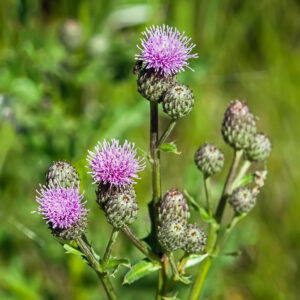
Cropped photo of flowering Canada thistle weedManaging Canada Thistle
Because Canada thistle has a deep root system, the only approach for controlling this weed is to exhaust the storage roots and prevent further weed seed contamination. Food reserves in the roots reach a minimum near the onset of hot weather when the shoots reach about 12” tall and then increase as energy flows from the shoots to the storage roots.

The following steps are key to soil health:

  • Keep the soil covered
  • Maximize living roots in thesis profile
  • Minimize soil disturbance
  • Energize the system with biodiversity

To reduce the impact of Canada thistle on production, farmers can:

  • Remove shoots by late spring
  • Consider cover cropping and institute crop rotations
  • Consider occultation
  • Implement rotational grazing

For more on weed management and applicable solutions that control this common weed, farmers can download OFRF’s Weed Management Guide and Weed Profile on Canada Thistle.

By |2022-06-06T16:13:25-04:00May 25th, 2022|News|

Applications Now Open for Two USDA Programs Geared Toward Organic and Transitioning Producers

FOR IMMEDIATE RELEASE

(May 17, 2022) – Certified organic and transitioning to organic agricultural producers and handlers can now apply for the Organic and Transitional Education and Certification Program (OTECP) and the Organic Certification Cost Share Program (OCCSP). These United States Department of Agriculture (USDA) programs help producers and handlers cover organic certification cost and other related expenses. Applications are open now and due October 31, 2022.

The two USDA programs cover costs incurred from October 1, 2021, to September 30, 2022. Organic and transitioning agricultural producers should contact their local Farm Service Agency (FSA) office and/or participating State agency to apply. “The FSA, and the USDA broadly, are committed to making sure our Nation’s organic producers and handlers have the tools they need to continue positively shaping our local and regional food systems,” said FSA Administrator Zach Ducheneaux.

According to OFRF’s 2022 National Organic Research Agenda (NORA) report, cost of organic certification ranked third as a top non-production challenges among more than 1,100 organic producers surveyed. “By helping with organic certification costs – long identified as a barrier to certification – USDA has helped producers participate in new markets while investing in the long-term health of their operations,” said Ducheneaux.

The Organic and Transitional Education and Certification Program and the Organic Certification Cost Share Program are important to many organic and transitioning producers. OFRF has put significant effort into advocacy to ensure funding for these programs, such as championing organic provisions included in the 2018 Farm Bill. Most recently, OFRF and allied organizations authored a group letter of support to extend last year’s OTECP application due date which was successfully implemented.

“If someone is considering getting certified, they should definitely look into the program as it can reduce some of the financial burden,” says organic farmer and OFRF Board Chair Bryan Hager. Hager has previously participated in the cost share program to certify his farm, Crager Hager Farm.

More information is available on the OTECP and OCCSP webpages.

###

About Organic Farming Research Foundation

Organic Farming Research Foundation works to foster the improvement and widespread adoption of organic farming systems. OFRF cultivates organic research, education, and federal policies that bring more farmers and acreage into organic production.

https://www.ofrf.org/

Policy Contact

Gordon Merrick, gordon@ofrf.org

Media Contact

communications@ofrf.org

By |2023-12-12T17:13:54-05:00May 17th, 2022|News, Press Release|

OFRF Awards 2021/22 Grant to Research Climate Resilience for Coffee Producers Using Organic Practices

Organic Farming Research Foundation (OFRF), in partnership with the Foundation for Food and Agriculture (FFAR), is pleased to award a 2021-22 Organic Research grant to Alejandra Guzman-Luna, affiliated with Universidad Veracruzana and in collaboration with the Agroecology and Livelihoods Collaborative at the University of Vermont. Guzman-Luna has nearly 15 years of experience working with farmers and Indigenous communities in Mexico.

OFRF’s grant program funds research on organic production systems and the dissemination of these research results to organic farmers and agricultural research communities. The 2021/22 grant cycle prioritized early career researchers and Black, Indigenous and People of Color (BIPOC) applicants, and awarded on-farm projects focused on climate mitigation and resilience.

The awarded team will research climate change resilience with coffee smallholder producers by extending organic practices to staple crops in Mexico. They have three objectives to address the perceived lack of viable organic alternatives in staple crop production: conduct a participatory diagnosis of the challenges of growing staple crops organically; co-design and establish four experimental and educational plots; and systematize the results and widely disseminate them. 

As a result of OFRF’s research, education, and outreach efforts, thousands of farmers have received pertinent research and training information. Results from all OFRF-funded projects are available to access for free in an online database.

Thank you to FFAR and our research partners for making the 2021/22 organic research grant program possible.

OFRF Research Grant Partners


By |2022-06-17T21:43:52-04:00May 11th, 2022|News|

OFRF Awards 2021/22 Grant to Research Organic Farming System Options Addressing Coffee Leaf Rust

Organic Farming Research Foundation (OFRF), in partnership with the Foundation for Food and Agriculture Research (FFAR), is pleased to award Kanalani Ohana Farm a 2021-22 Organic Research grant. OFRF’s grant program funds research on organic production systems and disseminates these research results to organic farmers and agricultural research communities. The 2021/22 grant cycle prioritized farmers, early career researchers and Black, Indigenous and People of Color (BIPOC) applicants, and awarded research projects focused on climate mitigation and building on-farm resilience.

Kanalani Ohana Farm will research organic farming system options for control of Coffee Leaf Rust on five organic farms in Kona, Hawaii. Colehour Bondera (MS and MEd) is a second generation farmer and will serve as research project lead. Their research team will test a systems-level approach to Coffee Leaf Rust management by increasing microbial biodiversity, using on-farm and island-made inputs, and sequestering more carbon through increased soil organic matter. This project was conceived, developed, and will be carried out by organic farmers. University of Hawaii organic system faculty will assist with analyses. 

As a result of OFRF’s research, education, and outreach efforts, thousands of farmers have received pertinent research and training information. Results from all OFRF-funded projects are available to access for free in an online database.

Thank you to FFAR and our research partners for making the 2021/22 organic research grant program possible.OFRF Research Grant Partners

By |2022-05-11T19:18:31-04:00May 11th, 2022|News|

Now is the Moment to Help OFRF Support Organic Farmers

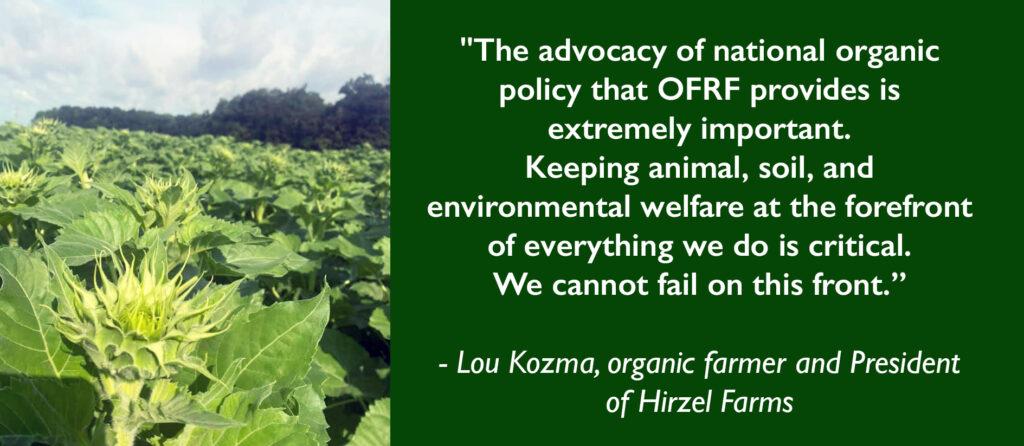
Sunflowers at Hirzel FarmsEvery five years a U.S. Farm Bill is voted into law by Congress, directing hundreds of billions of dollars to flow into the food and agriculture systems.
The 2023 Farm Bill is right around the corner and now is the moment to act.

Help support farmers and advance organic agriculture in the 2023 Farm Bill. Thanks to a generous donor, contributions made today will be matched dollar for dollar up to $5,000!

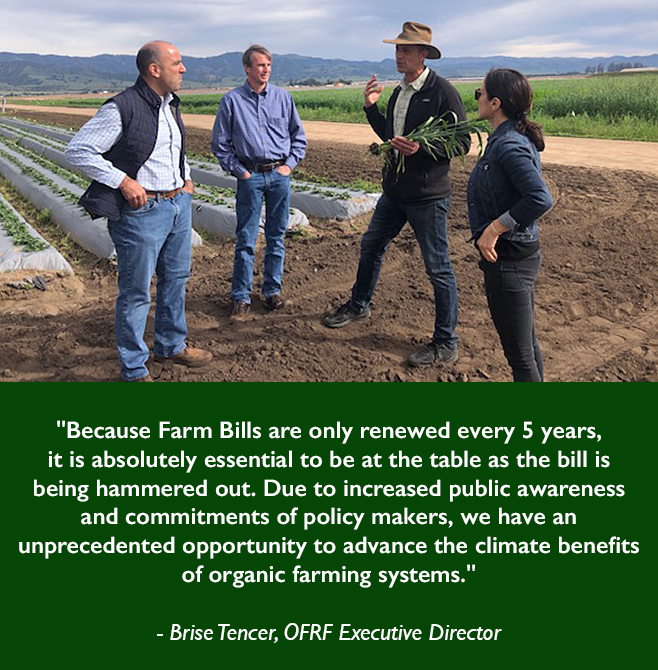
OFRF heard loud and clear from organic and transitioning farmers and ranchers about their needs in the 2022 National Organic Research Agenda and OFRF touring ARS fields with member of Congresswill be focusing our 2023 Farm Bill efforts on the following to address the challenges they are facing:

  • Increase the amount of funds dedicated to organic research at the USDA.
  • Push organic agriculture as a climate solution across USDA agencies and ensure organic and transitioning farmers receive resources they need to be successful.
  • Support the expansion of organic farming systems.

Together we can ensure organic farmers are properly supported for the following five years. And remember, the work to affect policy change isn’t just needed in the six months before a Farm Bill, but instead it requires constant pressure, collaboration, education, commenting, and relationship-building all year long.

There are many ways to give to OFRF. And don’t forget: donate today and your gift will be matched dollar for dollar, thanks to a generous donor.

By |2022-05-10T22:13:48-04:00May 10th, 2022|News|
Go to Top