

Water Management & Irrigation

Infrastructure and Crop-Livestock Integration

In OFRF’s 2022 National Organic Research Agenda (NORA), organic farmers and ranchers across North America shared a common concern about the lack of technical assistance and educational resources available for Integrated Crop-Livestock Systems (ICLS). Integrating crops and livestock results in numerous benefits, however the process can also lead to increased complexity, especially for farmers who must adhere to National Organic Program rules and regulations.

This series of resources focused on Crop-Livestock Integration is informed by interviews with four highly-experienced organic producers that shared their challenges, successes, and advice for others interested in integrating livestock and crops on their organic farms.

Infrastructure for integrating animal and crop systems includes animal housing, watering systems, and fencing. Learn how farmers develop infrastructure that match the type and age of animal, are highly movable, and are adapted to soil and climate conditions.

Infrastructure for Crop Livestock Integration report cover

Farmer-Led Trials Program Spotlight: Parker Farms

Managing Moisture in Organic Tomatoes on an Urban Farm

Written by Mary Hathaway, OFRF’s Research & Education Program Manager, and Markisha Parker, FLT Program participant

Parker Farms, located in Warren, Ohio, is a small farm with a big heart, committed to serving their community with sustainable, urban agriculture. The farm provides fresh, locally grown produce through wholesale partnerships with food banks and community programs, supporting local food security. Markisha Parker, owner and founder, specializes in sustainable urban farming and organic production and is in her second year of transitioning to certified organic (a process that typically takes three years). With a background in urban agriculture, education, and research, she offers hands-on experience and community education on soil management, crop rotation, and organic pest control.

Her urban farm spans multiple sites totaling approximately one acre with areas dedicated to cultivating native plants, vegetables, and fruits, allowing Parker Farms to grow their impact and bridge the gap between urban gardening and farming. Markisha’s primary crop is tomatoes, but the farm’s mission extends much further: to empower others in agriculture by offering resources and support to help gardeners build successful commercial farming enterprises. While Markisha has done field trials in the past, she was looking for an opportunity to have support in improving her processes and systems on the farm. After this trial, Parker Farms hopes to integrate educational elements by inviting local farmers, aspiring growers, and community members to observe and learn from their research.

Puddling Problems: Managing Moisture in Tomatoes

With limited space in an urban environment, Parker Farms wants to improve their yield and systems in the area that they have. This means making every square foot count. In previous seasons, Markisha had issues with excess moisture and puddling in the fields. One of her biggest challenges was in her most valuable crop: tomatoes. Episodes of excess rain left much of her crop with splitting or blight.

In order to address these issues, she wanted to trial different materials that were readily available as a mulch material to help her tomatoes get to market. In her area, Markisha knew that woodchips, grass clippings, and straw were readily available. So she asked: does a mulching material help mitigate soil moisture for greater tomato yield?

Farm Trial Plan

With technical support from OFRF, Markisha has set up a trial to compare how straw, grass clippings, or woodchips, impact the yield and marketability of slicer tomatoes, and compare it to a control group with no mulch. The design of the trial includes 4 treatments and 4 replications, in a 16-plot layout. Each plot will have 5 tomato plants.

Trial updates

The tomatoes were transplanted on May 22nd, and the mulch types were laid down just after transplanting. The mulch varieties of aged wood chips, straw from a neighboring farm, and fresh grass clippings from areas around her farm, were applied at an approximate 2” depth. The control plot had no mulch added, and was left as bare soil. An initial harvest is expected at the beginning of August. For data collection, Markisha will take both the total weight of tomatoes and the marketable weight of tomatoes. These measurements will help the farm understand if the different mulching materials impact yield, and especially the marketable yield of tomatoes that don’t have damage related to uneven moisture.

Stay tuned for trial updates and a final report at the end of the season!

Farmer-researcher Markisha Parker

“Participating in the Farmer Led Trials has given me the structure and support to test practices that could improve both the health of my crops and the sustainability of my urban plots.”

– Markisha Parker, Parker Farms

Parker Farms.

This is part of a series of blogs highlighting farmers who are participating in OFRF’s Farmer-Led Trials program. Farmers receive technical support to address their production challenges through structured on-farm trials. To learn more about OFRF Farmer-Led Trials Program, visit our website page at https://ofrf.org/research/farmer-led-research-trials/ 

By |2025-12-17T17:32:05-05:00July 28th, 2025|Farmer Stories, News, On-Farm Research, Water Management & Irrigation|

Farmer-Led Trials Program Spotlight: Jorge Reyes

Written by Jose Perez, OFRF’s Research & Education Engagement Coordinator

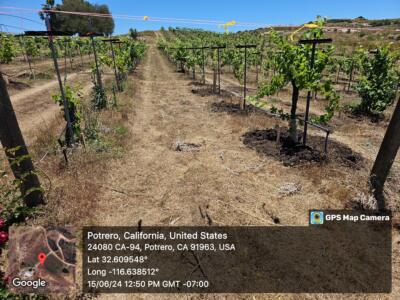
Image: Jorge Reyes in the vineyard.

Jorge proudly comes from a Mexican migrant farmworker family who had a dream of owning a farm one day. After retiring from the Navy, he was able to purchase a 3-acre vineyard located in Potrero, California. Jorge’s young vineyard produces organic grapes, and it is in the process of obtaining organic certification. Jorge plans to produce organic wine.

Finding the Right On-Farm Challenge to Focus On

Jorge was initially interested in conducting a farm trial to find solutions for suppressing gophers. These little creatures are a constant challenge at the vineyard because they burrow in the soil and chew on the roots, severely damaging or killing the vines. He was also interested in testing different practices to manage wasps during grape maturation and harvest. OFRF staff discussed with Jorge the difficulty of designing a farm trial based on these two challenges, given practical limitations, such as the size of the farm and the length of time needed.

The challenges on a young vineyard are not in short supply, so Jorge pivoted to focus on the use of mulch for soil moisture retention, weed management and grape quality. Improving soil moisture is critical to Jorge’s operation, as the irrigation depends on a solar-powered pump. The local climate conditions are generally very dry, with 9 to 11 inches of rain during the winter season. Wildfires are a frequent risk during the dry season, making soil moisture a critical factor and cost to Jorge’s operation.

On-Farm Trial Updates

With OFRF technical support, Jorge is now conducting a paired comparison where 10 grapevines with mulch will be compared with 10 vines with no mulch. Jorge applied 3 inches high of mulch around the vine (about a 4-foot area for each vine) in late May. He marked the trial area with stakes to identify each plant. 

To compare the moisture levels of the two treatments, Jorge purchased a soil moisture sensor. To date, he has conducted two measurements, one in late June and one in mid-July. Based on those readings, Jorge already sees a clear winner: The soil around the mulched grapevines has consistently been showing good moisture levels, while the readings around the un-mulched plants show dry conditions. Jorge’s own observations confirm this: “The mulch is like a double win, the mulch holds the moisture for longer and it suppresses the weeds as well… There are also a lot of creatures and biological activity in the mulched areas, while just putting the soil probe into the un-mulched areas was a challenge, as the soil was hard,” Jorge said.
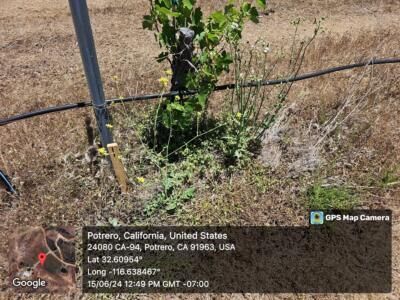
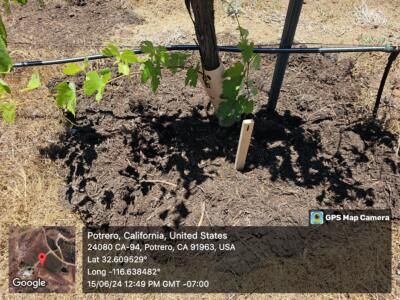
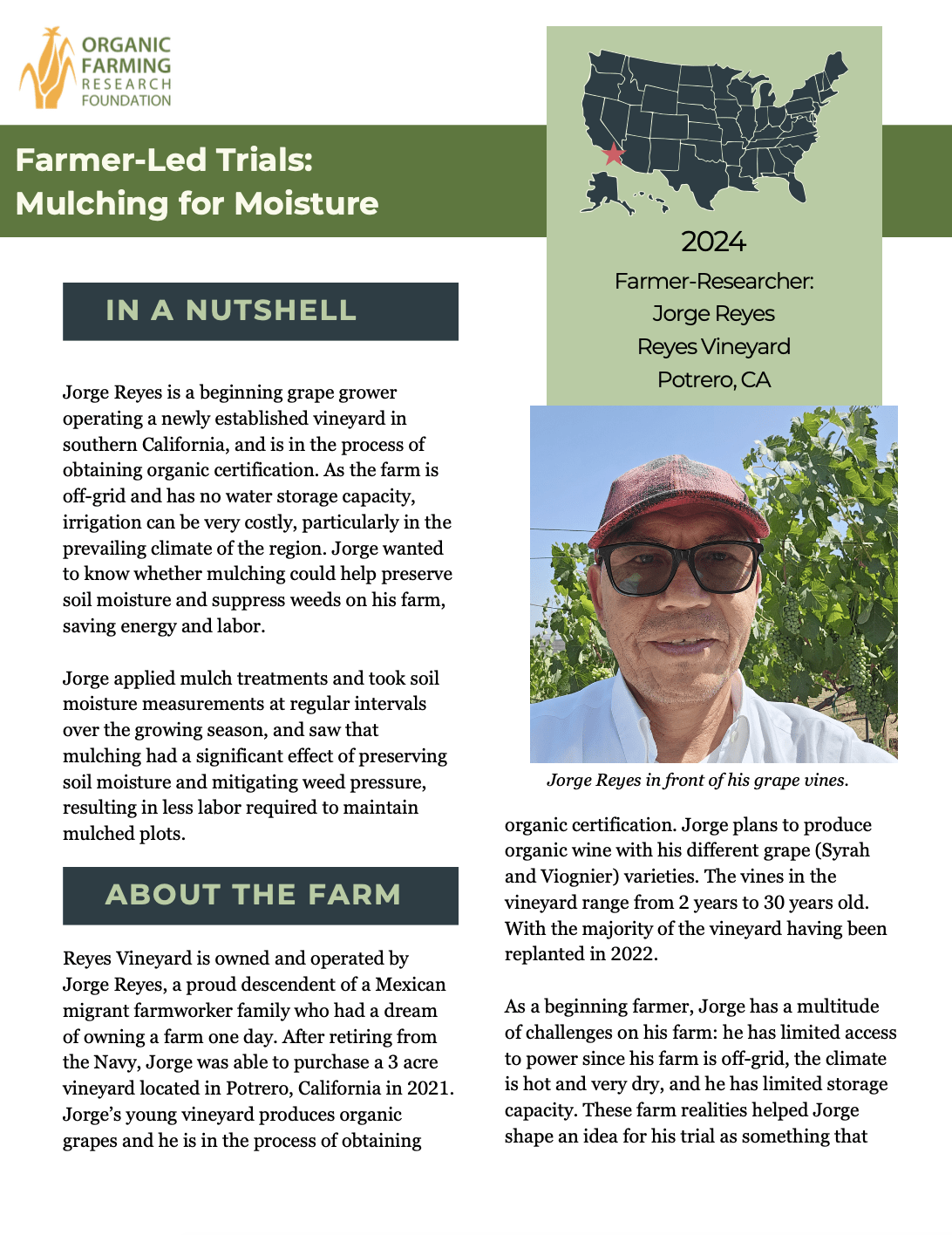
Image: Side-by-side trials of mulched and un-mulched grape vines.

Jorge has not cut back on irrigation, but after seeing the immediate effects of mulch, he is considering doing so, which would represent some energy and cost savings. In terms of weed suppression, the pictures Jorge took of the plants in late June are striking (see attached pictures). The mulch successfully suppressed weed growth and can represent some labor savings in the long term. Finally, Jorge is curious to know if the mulch will affect the grapes’ sugar content levels. He is planning to conduct these measurements at harvest through a Brix meter.

Below images: un-mulched grape vines on left and mulched grape vines on right. 

“The mulch provides a beneficial ecosystem that is thriving with beneficial organisms like rollie-pollies and pinchers which help increase the soil health. I plan to double my effort to increase the mulch application. This will lead to water conservation, increase soil health, increase my crop yield and reduce my labor requirement. This is a win-win for the environment and myself.” – Jorge Reyes

Research Results

Jorge Reyes’ farmer-led trial examined the effects of mulching on soil moisture retention, weed suppression, and labor reduction in his organic vineyard. Over the course of the growing season, Jorge applied a 3-5” layer of organic mulch around selected grapevines and monitored soil moisture levels, weed presence, and grape sugar content (Brix levels).

Key Findings:

  • Increased Soil Moisture: In both Syrah and Viognier grape varieties, mulched plots consistently retained higher moisture levels compared to unmulched plots. This effect was statistically significant in Syrah at all sampling dates and in Viognier at two out of three sampling dates.
  • Reduced Weed Pressure & Labor Needs: Jorge observed fewer weeds in the mulched plots, leading to reduced labor for trimming and vineyard maintenance.
  • Potential Impact on Grape Quality: While not formally evaluated, preliminary Brix readings suggest mulched vines had slightly higher sugar content (22 vs. 20) than unmulched vines, indicating potential effects on fruit ripening.

Encouraged by these results, Jorge plans to integrate mulching as a long-term vineyard management strategy. He is particularly interested in further exploring its impact on grape yield, soil biodiversity, and irrigation efficiency in future seasons.

For full details on the study’s methodology and results, read the final report.

At OFRF we are excited to partner with Jorge in his quest to produce a high quality organic wine, while sharing with other small scale grapevine producers the effects of mulching.

“I am 100% sold on organic, protecting our environment and learning to cohabitate with nature. Organic should be the only option, we need to consume healthy food that is not going to poison us.” – Jorge Reyes 

This story is part of a series profiling farmers who are taking part in OFRF’s Farmer-Led Trials (FLT) program. Farmers receive technical support from OFRF to address their challenges through structured on-farm trials. To learn more about OFRF’s Farmer-Led Trials Program, visit our website page at https://ofrf.org/research/farmer-led-research-trials/

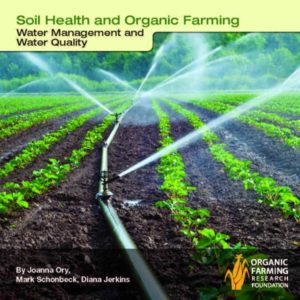
Water Management and Water Quality

Efficient utilization of irrigation water is essential for production, economic, and environmental reasons, especially in regions with limited annual rainfall. Managing water resources effectively during both water scarcity and periods of water excess is critical for successful farming.

Prefer to listen?

Go to Top