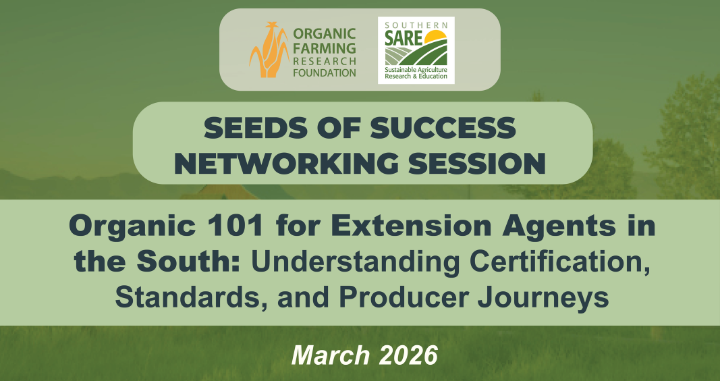
This webinar is for extension agents, technical service providers, or anyone who wants to understand organic certification and help growers make the transition to organic farming in the south!
Brought to you by OFRF, Florida Organic Growers, and Southern SARE, the first half of this informative session covers the basic principles of organic certification and organic standards. During the second half, participants bring questions to a panel of experts, including organic farmers and specialists in Extension and organic certification:
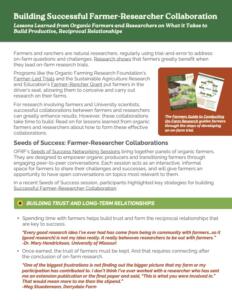
Farmers and ranchers are natural researchers, regularly using trial-and-error to address on-farm questions and challenges. Research shows that farmers greatly benefit when they lead on-farm research trials.
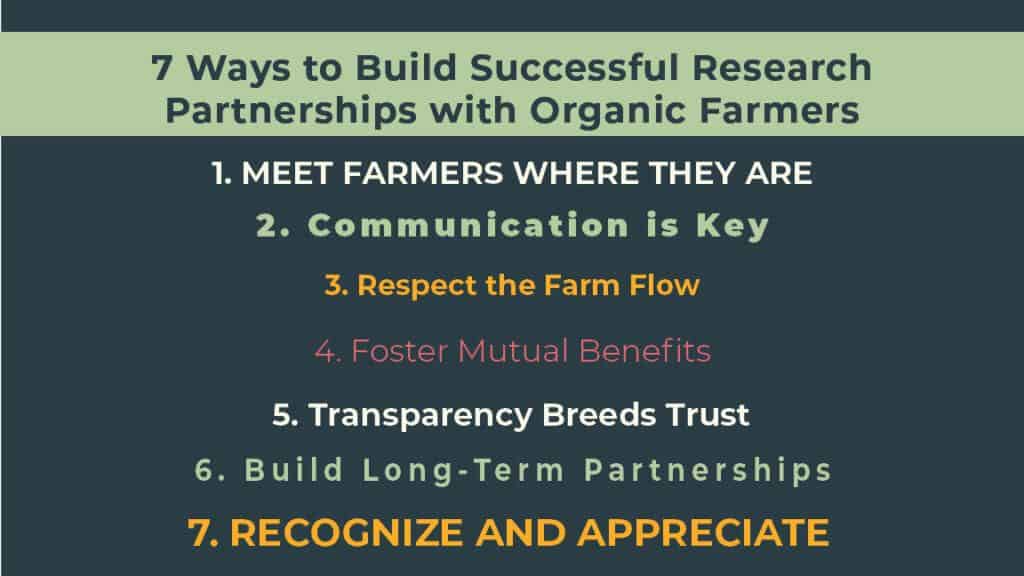
For research involving farmers and University scientists, successful collaborations between farmers and researchers can greatly enhance results. However, these collaborations take time to build. Read our report on for lessons learned from organic farmers and researchers about how to form these effective collaborations.
Are you an organic farmer that is interested in using your livestock in your crop rotation? Are you wondering how others have overcome some of the complexities of integrating your farm system? Would you like to hear directly from farmers who have experience in this topic? If so, then this webinar is for you.
This Seeds of Success farmer-to-farmer networking session was an engaging opportunity where farmers came together to ask questions and share their lived experience in integrating crops and livestock in their production systems.
This session features three farmers that have built resilience and a dynamic organic system:
OFRF has partnered with the Organic Farmers Association (OFA) and National Organic Coalition (NOC) to lead a series of virtual farmer-to-farmer networking sessions. These facilitated events will be engaging opportunities for farmers to share their challenges and successes, and will be accompanied with relevant resources you can use.
Funding for this series is provided by a cooperative agreement between OFRF and USDA- NIFA to highlight research investments made through both OREI and ORG grant programs.
The USDA’s National Organic Program (NOP) requires the use of organic seed unless the seeds farmers need, including equivalent varieties, aren’t commercially available, per the Seeds and planting stock planting standard (7 CFR 205.204).
The purpose of the current organic seed exemption is to provide a transition time for the seed industry to catch up to demand and to allow organic growers to find suitable varieties to transition to, with the goal of eventually achieving 100 percent organic seed sourcing. The allowance for non-organic seed is important for growers who lack access to appropriate organic seed for their operations. While it is no one’s intention to force organic growers to use organic seed that may not be optimal for their operations, continuous improvement in organic seed sourcing is essential to incentivizing growth in the organic seed supply and strengthening organic integrity.
The dialogue from participants in this networking session is summarized below and will help guide advocacy for balanced solutions that strengthen organic integrity and the seed supply.
The State of Organic Seed report from the Organic Seed Alliance provides insights on organic seed usage and an action plan to increase organic seed supply while fostering decentralized organic seed grower networks.
Key Insights from the Listening Session
Seed Grower and Researcher Perspectives
Organic seed availability: Availability varies by crop and scale. Small-scale farmers can often source organic seeds, but large-scale operations struggle, especially for grains, cover crops, and certain vegetables.
Challenges in organic seed supply: Limited year-round availability, lack of regionally adapted varieties, and difficulties in securing non-proprietary and open-pollinated (OP) seeds.
Improving NOP seed regulations: Calls for 100% organic seed requirements, incentives for seed stewardship, cost reductions for certification, and stricter enforcement of organic seed sourcing.
Handlers & certifiers’ role: Processors often dictate seed choices, limiting organic adoption. NOP could regulate processor demands and improve certifier tools for verifying organic seed availability.
Organic seed database: A centralized database could help track seed availability and genetics, but concerns exist over maintenance, participation, and potential large-scale buyouts by industrial players.
Organic seed value: Many farmers see organic seed as important for soil health, resilience, and expanding organic acreage. However, cost and availability remain major concerns.
Barriers to organic seed use: High costs, limited availability, and documentation challenges make it difficult for some farmers to use exclusively organic seed.
Recordkeeping & compliance: Some producers find documentation burdensome, while others see it as manageable or even beneficial for farm planning.
Suggestions for NOP: Farmers suggest stricter organic seed regulations, incentives for seed saving, and better coordination with seed breeders to address regional challenges.
Seed breeding needs: More transparency, regional adaptability, and climate-resilient varieties are key priorities for growers. Many emphasize the importance of seed saving and collaboration.
Voices from Technical Service Providers, Policymakers, and Educators
Organic seed challenges: Farmers struggle with sourcing organic seed due to cost, limited availability, and contract restrictions. Wholesalers often don’t prioritize organic-specific varieties.
Mentorship & seed production: Limited mentorship opportunities for organic seed growers. Some interest exists, but infrastructure and certification barriers remain.
Certifier & inspector role: Inspectors find it difficult to enforce commercial availability rules and assess variety choices. A shift to acreage-based benchmarks for organic seed use may be more feasible.
Database for organic seed: Need for a centralized, up-to-date seed availability database, but challenges exist in funding, maintenance, and neutrality. Potential for regional databases or collaboration with certifiers.
NOP & seed policy: Calls for stronger organic seed regulations, incentives for growers, and addressing handler influence on seed selection.
Looking Ahead
We are incredibly grateful to our co-hosts for this session — NOC, OSA, OFA, and OEFFA — whose collaboration, recruitment, and facilitation support made the conversation possible.
We are looking forward to disseminating these findings with the National Organic Standards Board, the National Organic Program, and the entirety of the organic seed industry spectrum (from growers, to seed breeders, retailers, and researchers). Based on the interest of participants and registrants, we are looking at hosting similar iterations of the conversation, making space for more voices and perspectives.
OFRF has partnered with the Organic Farmers Association (OFA) and National Organic Coalition (NOC) to lead a series of virtual farmer-to-farmer networking sessions. These facilitated events will be engaging opportunities for farmers to share their challenges and successes, and will be accompanied with relevant resources you can use.
Funding for this series is provided by a cooperative agreement between OFRF and USDA- NIFA to highlight research investments made through both OREI and ORG grant programs.
Snacks, refreshments, and a circle of chairs were ready as a group of organic dairy farmers gathered together in southeast Minnesota for a listening session hosted by organic dairy researcher Dr. Brad Heins. Based in the west-central part of the state, Heins wanted to know more about what organic dairy farmers were facing in the southeast. For most of the event, he listened and allowed the producers to speak amongst themselves about the challenges they were facing. Meg Stuedemann of Derrydale Farm recalls Dr. Heins treated it like an informal focus group. “He’d ask a question and sit back and listen to who had been exploring what, who was interested in what, and how many people were dealing with the same issue.”
Meg recently joined an OFRF panel of farmers and researchers to discuss successful farmer-researcher collaborations for organic agriculture. The panel took place in January of 2025, and is one of OFRF’s Seeds of Success Networking Sessions, a project funded by a cooperative agreement with USDA-NIFA. Other panelists included Dr. Mary Hendrickson, Professor in Rural Sociology at the University of Missouri, Dr. Kerry Clark, Research Professor and Soybean breeder at the University of Missouri and farmer Liz Graznak of Happy Hollow Farm in Jamestown, Missouri. A link to the full recording of the panel is available at the end of this post.
Spending time with farmers helps build trust reciprocal relationships that are key to successful farmer-researcher collaboration. “We (farmers) are most interested to participate in projects when it is a question that we are interested in,” said Meg, recalling the positive experience she had collaborating with Dr. Heins following the listening session.
Dr. Mary Hendrickson agreed that being in community with farmers is key to successful research. From her perspective, a lot of the early research work in the 1990’s around grazing dairy and grazing herds in Missouri can be traced back to two researchers who attended “grazing clusters”, monthly peer-to-peer meetups of farmers who met at each other’s farms. Attending the farmers’ conversations allowed the researchers to find researchable questions and resulted in what Dr. Hendrickson called “extremely successful collaborating between grazing, forage researchers (and) beef producers.”
“Every good research idea I’ve ever had has come from being in community and working with farmers…so it [good research] is not my idea really. It really behooves researchers to be out with farmers.” -Dr. Mary Hendrickson
Even if researchers do not have a lot of opportunities to listen directly to farmers, Meg pointed out that they can get a sense of what research farmers are interested in by searching the SARE database, OFRF’s grant database, or state-level programs for on-farm research in their area. “I would be thrilled if someone called me and said, ‘I read about your paper and want to collaborate,’” Meg explained.
Farmer Involvement in Organic Research
While networking can ensure farmers can help generate ideas for new research, involving farmers in research projects can be a whole other challenge.
Even after a good research idea has been identified, researchers may have to wait months for funders’ Request for Applications (RFA’s) to be released before they know the specifics for proposals and timelines. These can have very regimented procedures that researchers have to stick to throughout the project period (several years). And it can take months to write a proposal and then several more months before researchers find out if they got the funding.
To ensure farmer involvement in a given project, knowing several farmers within the industry can help. “Sometimes you end up doing on-farm research with a different farmer than the one that helped generate the idea,” Dr. Clark explained.
For collaboration to work, it is important for researchers to understand that farmers have different priorities. “The farm will always come first,” explained Mary, and Liz agreed. Clear agreements can lead to better outcomes. Meg suggested that more in-person involvement on the farm throughout the project period may help. “Researchers cannot expect farmers to be technicians,” she said. More in-person involvement from the research team, especially at data collection, can help uphold the integrity of the research.
Even with the best of planning, “Sometimes it just doesn’t work out,” Dr. Clark cautions. She recounted one grazing experiment where the cows kept getting out despite the farmer’s best efforts, and that the research on that farm was ruined for that year. “Don’t feel bad,” Clark advises, “keep trying.”
Compensation for Farmers
While everyone on the panel agreed that farmers’ time is valuable and should be compensated for, amounts are not standardized and can vary greatly from project to project depending on the level of involvement and on what was originally written into a grant. Farmer involvement can even be a requirement in some RFA’s but specifics on those amounts are rarely, if ever, provided.
Even if a research project is only utilizing land on a working farm, and not requiring a farmer to do any work or data collection, a stipend is expected. But panelists reported offering very different amounts ranging from a few hundred dollars to $2,000. While the researchers on the panel compared the different amounts they’d offered to farmers for their projects, one attendee of the session chimed in the chat to remind everyone that if farmers had been involved at the beginning of those projects, they could have helped set those payment amounts.
For any use of a farmer’s time, it was recommended that they be treated as professional consultants or specialized contractors, and given a comparable rate.
Farmers Value Long-Term Relationships
One key to the success of farmer-researcher collaboration came up amongst the farmers on the panel, and it echoes what OFRF heard at a panel discussion in early 2024 with Project Directors and collaborating farmers working on USDA-funded organic research projects: long-term relationships build trust.
That process can start well before a project, with researchers spending time with farmers, or with farmers reaching out to researchers. There are a lot more farmers than there are researchers, so it may be easier for farmers to reach out to researchers than the other way around. “Don’t be afraid to call the University in your state,” said Clark.
The Follow-Up: An Overlooked Key to Ongoing Success
Once earned, the trust of farmers must be kept. And that, according to farmers on the panel, requires connecting after the conclusion of on-farm research. Farmers report that seeing the end result of research that they contributed to was one of, if not the most important thing to feeling like it was worthwhile.
“One of the biggest frustrations is not finding out the bigger picture that my farm or my participation has contributed to. I don’t think I’ve ever worked with a researcher who has sent me the final paper or sent me an extension publication or the final paper and said, “This is what you were involved in.” That would mean more to me than the stipend.” -Meg Stuedemann, Derrydale Farm
“I agree that acknowledging that farmers are professionals and that compensation is appreciated,” Meg said. “But it’s not why I say yes. It is not a revenue stream for my farm. But knowing what happened would be really wonderful.” According to the farmers on the panel, that could look like simply getting a call or better yet getting sent complementary copies of published papers or extension resources.
Watch the full Seeds of Success networking session:
About the Seeds of Success Series
OFRF has partnered with the Organic Farmers Association (OFA) and National Organic Coalition (NOC) to lead a series of virtual farmer-to-farmer networking sessions. These facilitated events will be engaging opportunities for farmers to share their challenges and successes, and will be accompanied with relevant resources you can use.
Funding for this series is provided by a cooperative agreement between OFRF and USDA- NIFA to highlight research investments made through both OREI and ORG grant programs.
Are you beginning the process of transitioning your farm to certified organic? Are you wondering how others have overcome the hurdles of certification? Would you like to hear directly from farmers who have successfully made their transition to organic?
This webinar features two farmers that share their experiences and thoughts for demystifying some of the challenges they faced in the process.
Our Farmer Panelists:
Mike Bronkema of Shady Side Farm in Michigan began his journey in 1992 with a conventional layer operation. With the help of his wife, Mike has now transitioned 150 acres into a diversified farm of 20 different varieties of edible dry beans as well as heritage small grains, such as einkorn and spelt, and open-pollinated corn. https://shadysidefarm.com/
Dakota Moore of Moore Family Farm in Michigan began the transition in 2019. Dakota was raised on the historic Moore Family Farm in Warsaw, North Carolina, which has been around since 1833. He and his father work together on the farm where they specialize in the production of Watermelon, Cantaloupe, Cauliflower, Collard Greens, Cabbage, Butterhead and Romaine Lettuce.
The Seeds of Success series brings farmers together for peer-to-peer networking and discussion. In this session, three women organic farmers share their experiences growing markets for organic products, followed by Q&A and breakout sessions to exchange ideas.
Topics covered include identifying market opportunities, developing strategies for organic products, and overcoming common challenges. This webinar provides actionable insights from real-world farm experiences.
In a changing climate, crop insurance can make or break a farmer’s ability to keep farming the next year. But this federally subsidized program, intended as a safety net for farmers, serves some producers, growing a few specific crops, better than others. The program, as currently designed, feeds into consolidation of land and resources in agriculture, with crop insurance being the only subsidized farm program with no upper limit on the funds that a farmer can receive from the federal government, a practice that reinforces existing power structures and leads to fewer, bigger, and less diverse farms.
Organic and transitioning farmers, specifically, find themselves misunderstood and underserved in the crop insurance system, as their practices, rotations, transition, and certification processes are not widely understood by the agents serving them, and can be in conflict with Risk Management Agency requirements.
Noah Wendt of A&W Farms in Iowa and Seth Kroeck of Crystal Spring Farm in Maine share their experiences with crop insurance.
Seeds of Success Webinar | The Organic Farming Research Foundation (OFRF), is partnering with the Organic Farmers Association (OFA), and National Organic Coalition (NOC) to host a series of virtual farmer-to-farmer networking sessions, Seeds of Success. These facilitated events will be interactive, informal spaces for farmers to share their challenges and successes, and will give farmers an opportunity to have open conversations on topics most relevant to them.
For more information about the Organic Farmers Association and its programs, resources, and events, please visit: https://organicfarmersassociation.org
This work was supported through the United States Department of Agriculture (USDA) Transition to Organic Partnership Program (TOPP). TOPP is a program of the USDA Organic Transition Initiative and is administered by the USDA Agricultural Marketing Service (AMS) National Organic Program (NOP). For more information about TOPP or transitioning to organic, please visit: http://www.organictransition.org
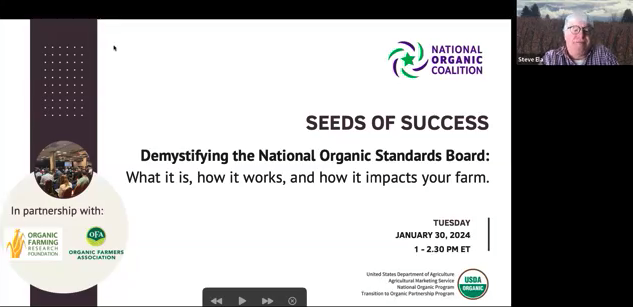
Organic producers and processors must follow strict standards to become certified—but who decides what is and isn’t allowed on organic farms? Not your certifier! The USDA National Organic Program (NOP), in consultation with the National Organic Standards Board (NOSB), sets these rules.
In 2024, the National Organic Coalition (NOC) hosted a Seeds of Success virtual session for organic and transitioning farmers, where a panel of farmers and advocates demystified the NOSB. Panelists explained the Board’s role in shaping organic standards, how decisions are made, and how written and oral comments can influence outcomes.
These “Seeds of Success” events are designed to empower organic producers and transitioning farmers with engaging peer-to-peer conversation. Each session will act as an interactive, informal space for farmers to share their challenges and successes and will give farmers an opportunity to have open conversations on topics most relevant to them.
Below you’ll find recordings for past events. The most recent events are added at the bottom of this list.
Strategies for Identifying and Navigating Organic Markets
Hosted by OFRF on November 10, 2023.
In this virtual networking session, we address the number one non-production challenge identified by organic producers: finding and developing markets for organic products.
This session featured three women farmers who have creatively grown their markets for organic products: Amy Van Scoik of Frog Song Organics in Florida, Pam Mack of L Marie LTD in Ohio, and Anna Jones-Crabtree of Vilicus Farms in Montana.
Watch Recording:
Demystifying the National Organic Standards Board: What It Is, How It Works, and How It Impacts Your Farm
Hosted by NOC on January 30, 2024
Organic producers and processors must follow strict standards to become organically certified. Who decides what is and is not allowed on organic farms and in organic processing facilities? Not your certifier! Rather, it’s the USDA National Organic Program, in consultation with the National Organic Standards Board (NOSB).
On Tuesday, January 30, 2024, the NOC hosted a virtual meeting for organic and transitioning farmers, where a panel of farmers and advocates demystified the NOSB. Panelists explained the role of the NOSB in shaping organic standards and allowed materials, the process the Board uses to make decisions, and explained how written and oral comments can make a difference in Board decisions.
Panelists included Steve Ela, Former NOSB Chair, NOC NOSB Specialist, and Organic Producer at Ela Family Farms in Colorado; Harriet Behar, Former NOSB Chair, NOC Advisor, OFA Farmer Services Consultant, and Organic Producer at Sweet Springs Farm in Wisconsin; and Amy Bruch, Current NOSB Vice Chair and Organic Producer at Cyclone Farms in Nebraska.
Learn more about this session and your role in providing input to the Board and lifting up farmer voices in the NOSB process on NOC’s website.
Crop Insurance for Organic Farmers: What’s Working, What’s Not, and How We Can Make it Work for Us
Hosted on OFA on April 16, 2024.
In a changing climate, crop insurance can make or break a farmer’s ability to keep farming the next year. But this federally-subsidized program, intended as a safety net for farmers, serves some producers growing a few specific crops better than others. The program, as currently designed, feeds into the consolidation of land and resources in agriculture, with crop insurance being the only subsidized farm program with no upper limit on the funds that a farmer can receive from the federal government, a practice that reinforces existing power structures and leads to fewer, bigger, and less diverse farms.
Organic and transitioning farmers, specifically, find themselves misunderstood and underserved in the crop insurance system, as their practices, rotations, transition, and certification processes are not widely understood by the agents serving them and can be in conflict with Risk Management Agency requirements.
Noah Wendt of A&W Farms in Iowa and Seth Kroeck of Crystal Spring Farm in Maine share their experiences with crop insurance.
Watch Recording:
NRCS Organic Practice 823: Strategies and Best Practices
Hosted by OFA on July 24, 2024.
The National Resources Conservation Service (NRCS) has many programs to help farmers convert to organic farming operations. The Environmental Quality Incentives Program (EQIP) is a conservation program that helps farmers, ranchers, and forest landowners integrate conservation into working lands. Under EQIP, Organic Transition Initiative 823 (OTI) is specifically meant to help those transitioning to organic operations, by cost-sharing and providing technical support on practices organic and transitioning farmers want to implement on their farms. This program is relatively new, and a little different than other NRCS practices. Hear directly from ag professionals and farmers about their experiences with 823 and their ideas regarding how to best utilize this valuable conservation planning tool.
This session was presented by OFA’s Farmer Services Consultant Harriet Behar, Marbleseed’s Climate and Conservation Director/Organic Conservation Specialist Thomas Manley, and Lehman Farms Ltd.’s Aaron Lehman.
Watch Recording:
Adding the “O”: Farmer Perspectives and Experiences Transitioning to Organic
Hosted by OFRF on November 10, 2024.
This webinar features two farmers that share their experiences and thoughts for demystifying some of the challenges they faced while developing, conducting and evaluating research projects on their farms through OFRF’s Farmer-Led Trials project.
Watch Recording:
Lessons from OFRF’s Organic Seed Usage Farmer Listening Session
Hosted by OFRF on March 5, 2025.
In the sixth Seeds of Success networking session, over 40 participants gathered (virtually) to share their thoughts and firsthand experiences using and producing organic seed. The session was not recorded to allow participants to share more freely. ReadOFRF’s summary of key takeaways from seed growers, organic producers, researchers, and technical service providers.
Are you an organic farmer that is interested in using your livestock in your crop rotation? Are you wondering how others have overcome some of the complexities of integrating your farm system? Would you like to hear directly from farmers who have experience in this topic? If so, then this webinar is for you.
This Seeds of Success farmer-to-farmer networking session was an engaging opportunity where farmers came together to ask questions and share their lived experience in integrating crops and livestock in their production systems. This session we will features three farmers that have built resilience and a dynamic organic system:
Farmer Perspectives on Transitioning to Organic in the Northwest
Hosted by OFRF December, 2025.
Farmers transitioning to organic production face unique challenges that require technical assistance on a wide range of production and non-production issues. During the transition period farmers must consider financially viable strategies for the three-year transition period, how to restore soil health while learning to manage weeds without herbicides, acquiring new equipment and infrastructure needed for organic production, and navigating NOP-related paperwork during the last year of transition and first year of certification. This webinar features three farmers that have worked through these issues, who share their experiences and thoughts for demystifying some of the challenges they faced in the process. In this session we feature three farmers in the Northwest that have built resilience and a dynamic organic system: Lynn Schaal, Life Springs Farm – Idaho Tracey Dion, Yellowstone River Farms – Montana Aaron Flansburg, Flansburg Farm – Washington. Read a recap of the session here.
Watch Recording:
Accessing USDA Farmer Resources on the Ground: NRCS and FSA
Hosted by the Organic Farmers Association on January 27, 2026.
Recent changes to USDA offices have real impacts for organic farmers. Join the Organic Farmers Association, OFRF, and the National Organic Coalition (NOC) for this Seeds of Success session: Accessing USDA Farmer Resources on the Ground: NRCS and FSA – Seeds of Success. This session can help farmers understand how they can navigate these changes with insights straight from USDA staff. Participants take the opportunity to engage directly with representatives from the Natural Resource Conservation Service (NRCS) and Farm Service Agency (FSA). During the hour, we delve into the specific changes in the structure, staffing, and location of NRCS and FSA offices. Farmers can learn the most effective ways to access essential resources. The session also provides guidance and updates on available loans, programs, and technical assistance to support farm and business goals.
Watch Recording:
Organic 101 for Extension Agents: Understanding Certification, Standards, and Producer Journeys
Hosted by OFRF January, 2025.
This webinar is for extension agents, technical service providers, or anyone who wants to understand organic certification and help growers make the transition to organic farming. In the first half of this informative session, you will learn the basic principles of organic certification, and become familiar with organic standards. During the second half, you will have the opportunity to interact with farmer panelists as they share their experiences in becoming certified organic producers. Panelists include April Thatcher of April Joy Farm in Washington, Beth Hoinacki of Goodfoot Farm in Oregon, and Diane Green of Greentree Naturals in Idaho. This webinar is brought to you by the Organic Farming Research Foundation, Oregon Tilth, and Western SARE.
Watch Recording:
Stay tuned for our next farmer-to-farmer networking session. You can view all upcoming OFRF-related events at ofrf.org/events/ and by subscribing to our newsletter here.
The Seeds of Success project is supported through the United States Department of Agriculture (USDA) Transition to Organic Partnership Program (TOPP). TOPP is a program of the USDA Organic Transition Initiative and is administered by the USDA Agricultural Marketing Service (AMS) National Organic Program (NOP).