Federal Assistance

Organic Certification Cost Share Program (OCCSP)

Farmers across the U.S. may now receive up to $750 per scope for organic certification costs

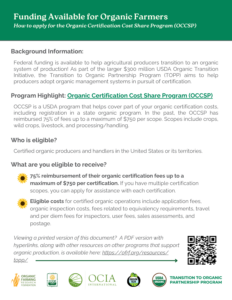
As a farmer or a technical service provider to farms, you understand the importance of organic certification. It not only adds value to your products but also opens doors to a growing market of health-conscious consumers. However, the process of obtaining and maintaining organic certification can be costly. Financial assistance was last available in 2024, through the Organic Certification Cost Share Program (OCCSP) to help ease this burden. In this blog post, we’ll walk you through the basic steps to access up to $750 in financial assistance for each organic certification scope if this program funding is available.

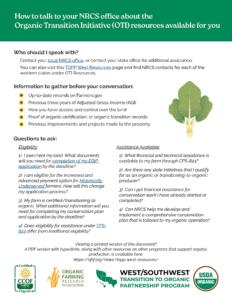
Note: all of this information is summarized in printable, downloadable PDF’s, available in English and Spanish, at the bottom of this blogpost.

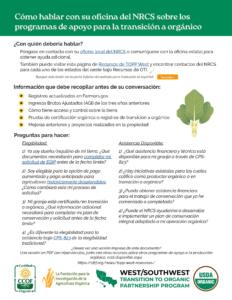
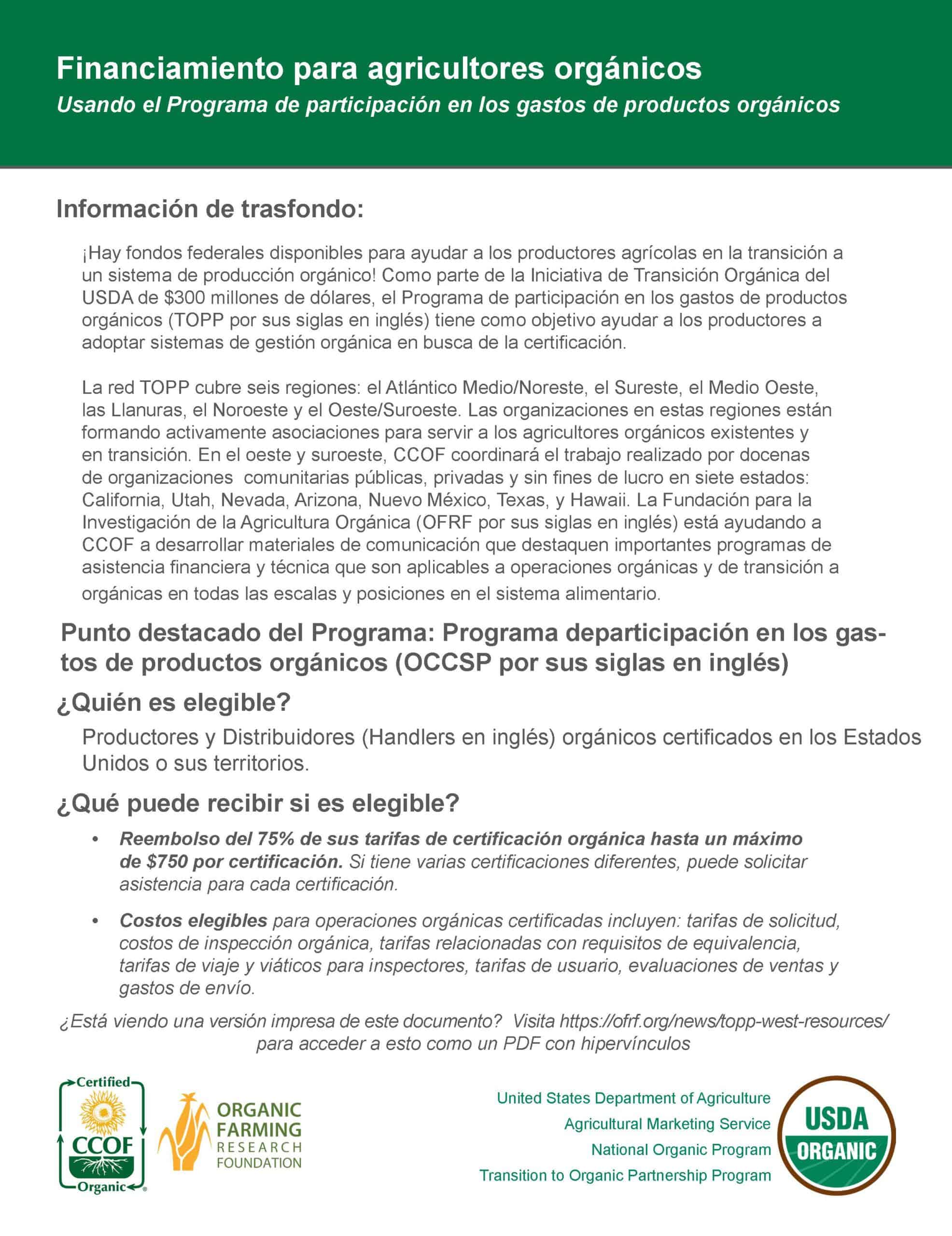
Nota: toda esta información se resume en archivos PDF imprimibles y descargables, disponibles en inglés y español, al final de esta publicación de blog.

1. Start with Research

Before diving into the application process, it’s wise to build up some knowledge of the program and who you will apply to. The OCCSP is administered by the USDA, and their website provides a wealth of general information. Additionally, some states have their own supplements to the program. If you’re in Arizona, California, or Texas, consider checking your state’s agriculture agency website for state-specific resources.

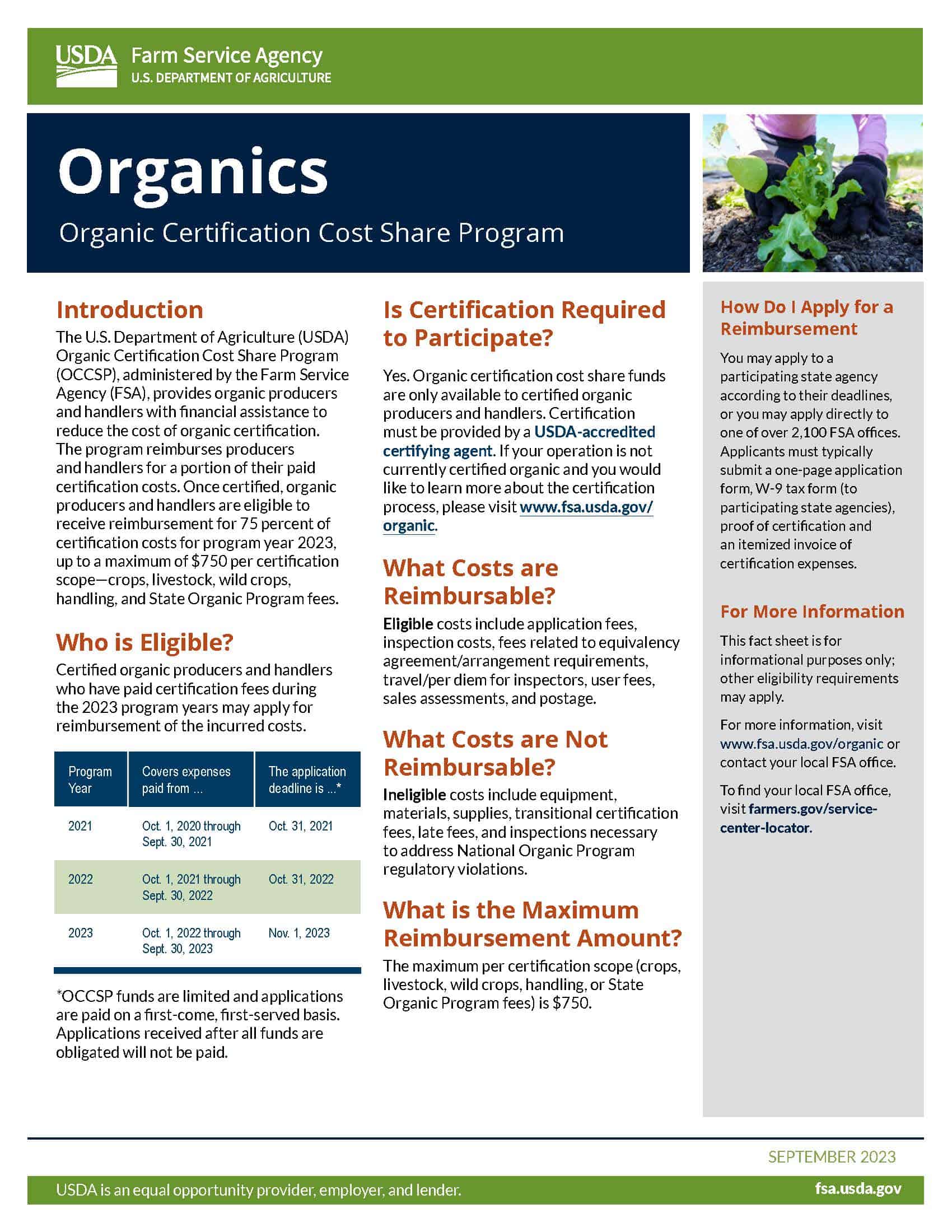
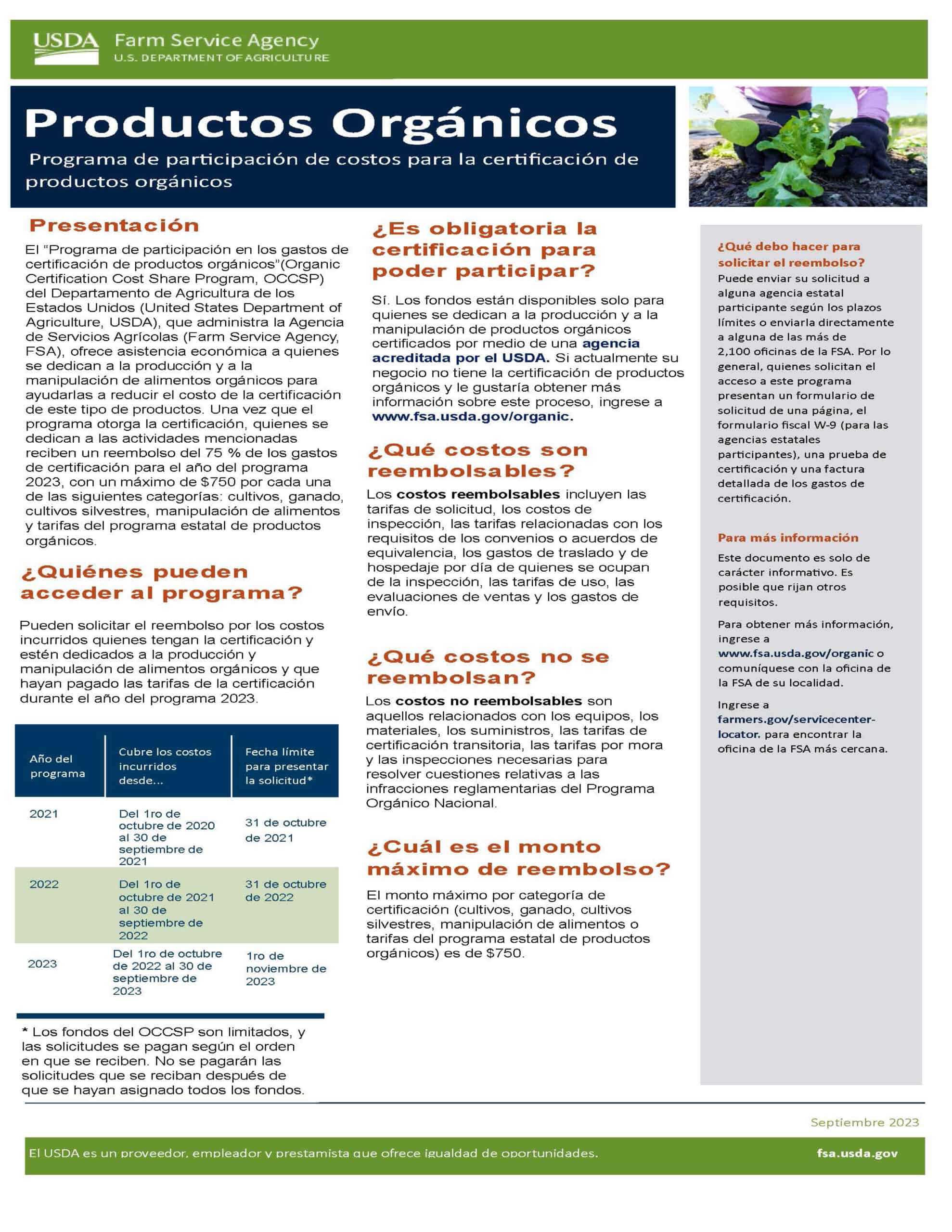
Below are factsheets from the USDA about the OCCSP, one in English and one in Spanish.

2. Finding the Right Application 

Certified organic operations can apply for OCCSP assistance through their local Farm Service Agency (FSA) office or, in some cases, through a participating State Agency. Here’s how to proceed:

Through FSA: If you choose to apply through the FSA, you’ll need to use their specific OCCSP application form and follow the instructions provided. This ensures that your application is processed smoothly and efficiently.

Through a State Agency: If your state participates in the OCCSP, you likely have the option to apply through your state agency. In this case, use the application form provided by your state’s program. States like Arizona and California have their own forms, while Texas offers an online application platform along with a Request for Assistance (RFA) providing information.

3. Gathering Financial Information

To access government payments through OCCSP, you’ll need to provide certain financial information. The information must be provided in the correct format, depending on how you are applying. Here’s a brief explanation of the options in the Southwest: 

FSA: If you’re applying through the FSA, they typically require an IRS W-9 form as part of your application.

California: In California, you’ll need to complete a Payee Data Record Form as part of your application.

Arizona: In Arizona, they require an AZ W-9 form to be submitted along with your application.

Texas: If you’re applying through Texas’ online platform, you’ll need to provide a Tax ID to operate on their system, obtain one here.

4. Compiling Required Documents

Alongside your application and financial information, you’ll also need to include certain documents:

  • A copy of your organic certification.
  • Proof of payment for your certification fees.
  • Itemized receipts for any other covered expenses related to organic certification that you’re seeking reimbursement for.

Covered expenses under the OCCSP include application fees, inspection costs, fees related to equivalency agreement/arrangement requirements, travel/per diem for inspectors, user fees, sales assessments, and postage. However, covered expenses do not include equipment, materials, supplies, transitional certification fees, late fees, and inspections necessary to address National Organic Program regulatory violations.

5. Submission

Once you’ve gathered all the required information and documents, it’s time to submit your OCCSP application. Double-check your application to ensure everything is complete and accurate. Ensure you send this information to the appropriate state or federal agency office based on your chosen application method.

The OCCSP can be a valuable resource for farmers and technical service providers seeking financial assistance for their organic certifications. By following these steps and meeting the program’s requirements, you can access up to $750 to support your commitment to organic farming practices.

For more detailed information and access to specific application forms, be sure to visit the OCCSP USDA website or consult your state’s agriculture agency website if they operate their own OCCSP program (Arizona, California, Texas). Your organic journey just got a little more affordable.

Apply for OCCSP assistance now, and reap the benefits of a more affordable path to organic certification. Your commitment to organic farming deserves the support it needs.

All of this information is summarized in a printable, downloadable PDF below, available in English and Spanish.

Wilson Organic Farms, Chris Wilson

The Organic Farming Research Foundation is honored to share this farmer story, featuring Chris Wilson, business manager and farmer at Wilson Organic Farms. The following article is based off of an interview with Chris that was conducted earlier this year. You can press play below to listen to an edited version of the interview, click this link to download it and listen later, or click the green button below to watch a recording of Chris telling his story!

Written by Elizabeth Tobey

Chris Wilson remembers the day that the first load of milk from his family’s farm was picked up by the Organic Valley cooperative. The Wilson farm, which has been in the family for seven generations, began the transition to organic in the mid 90s, inspired by a neighbor who was making the switch as well. The certification process takes three years on land that has been receiving inputs that are prohibited under the organic program, and the Wilson family farm also needed to transition their herd of dairy cows. They started the process in 1996 and by 1999 all their crop land was certified organic. January 2nd, 2000 the Organic Valley truck pulled away from the farm for the first time, full of certified organic milk.

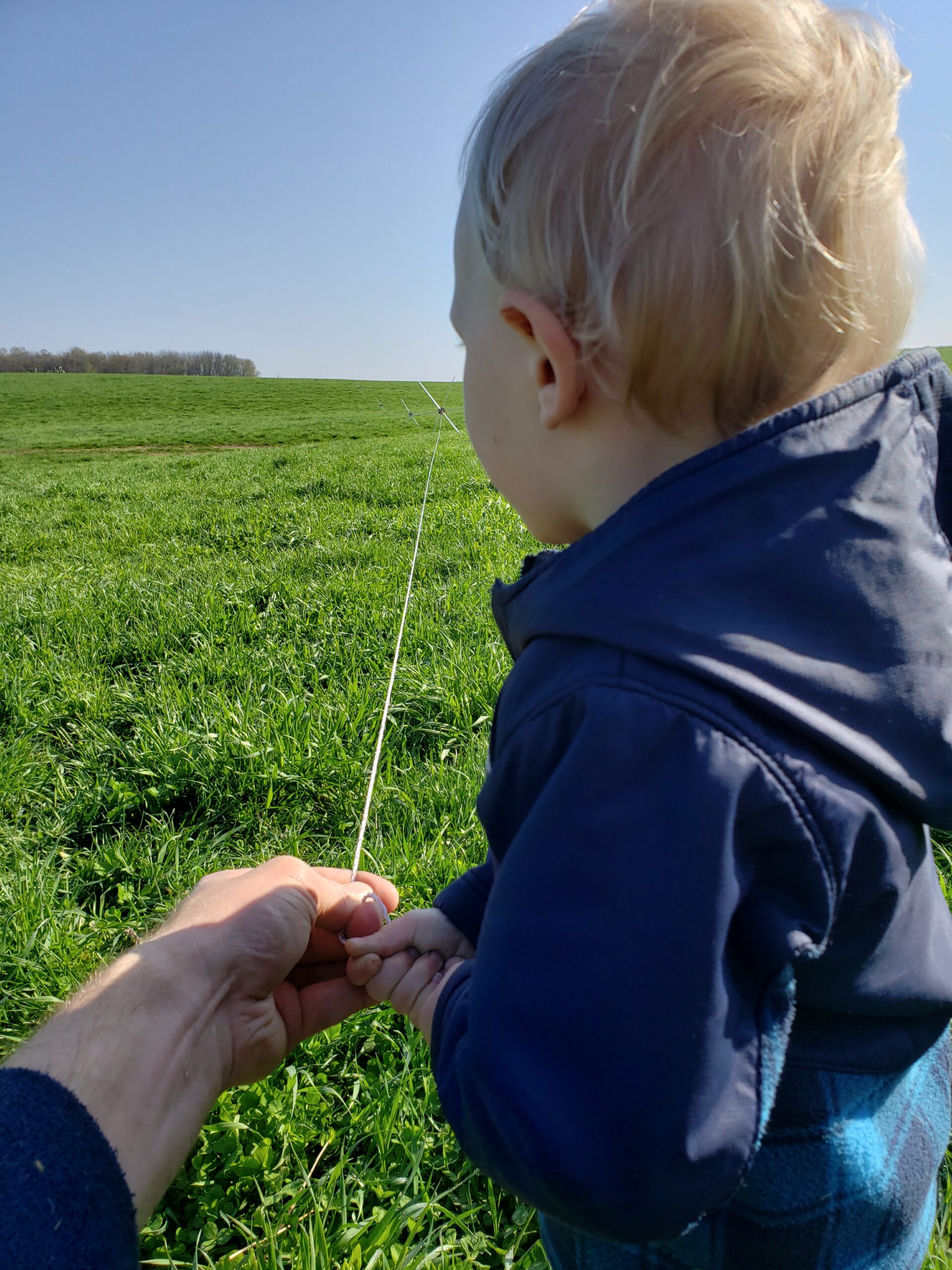
Chris Wilson and his partner walk the farm with their child.

Chris Wilson is the business manager, and seasonal labor. The farm, which is located in the driftless region of Wisconsin, has been passed down in his father’s side of the family since it was first homesteaded in 1848. Now it is managed by a network of extended family including several of Chris’s cousins, with seven different families participating in total. Although transitioning the farmland through the generations hasn’t always been easy, it’s something that the Wilson’s don’t take for granted. In a world where access to farmland is one of the biggest barriers of entry into agriculture, inheriting a family farm is a huge advantage. They have worked hard to find ways to ensure that anyone in the next generation who wants to be involved will be able to participate in the farm business, and that older family members who are retiring are also provided for.

Transitioning to Organic

The family originally had some hesitations about making the change to organic production. They started with just a small portion of their farm the first year, but soon went all in, transitioning the full 1000 acres that they were farming at the time. “We had concerns about losing some tools for antibiotics in the livestock,” Chris explains. “But that ultimately ended up being a non-issue as we got into (it), and really the animals, they build up better immune systems and we have less problems today than we ever did when we had those tools.”

“We had concerns about losing some tools for antibiotics in the livestock, but that ultimately ended up being a non-issue as we got into [it], and really the animals, they build up better immune systems and we have less problems today than we ever did when we had those tools.”

Wilson Organic Farms now manages 3500 acres total. Of that, about 2600 acres are in crops, with a mix of alfalfa, forage mixes, corn for silage and snaplage, and grain, wheat, barley, soybeans, yellow peas and occasional other food grade crops. The remaining 900 acres is in pasture, 250 of which supports their dairy herd, and the remainder which is used for heifers and beef cattle.
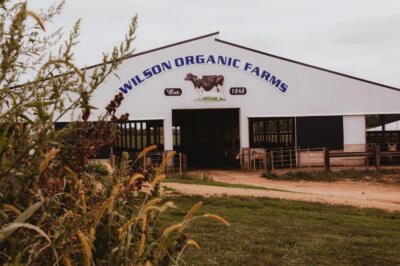
Wilson Organic Farms began their transition to organics in the mid 90s.

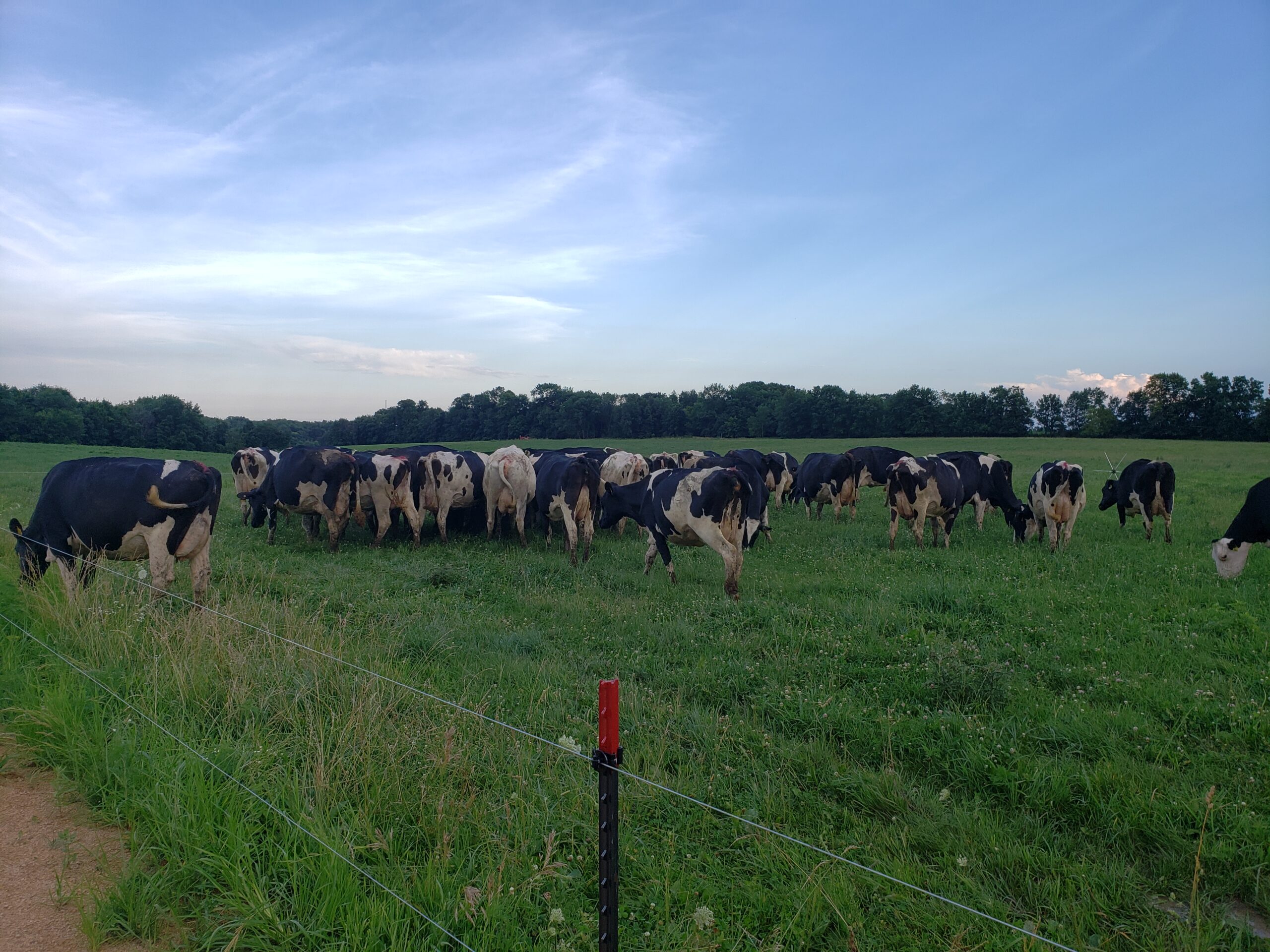
Looking at their farming practices now, Chris says that organic standards reflect the way that they approach farming with the inclusion of livestock. They utilize resources in a “circular motion,” as he says. Livestock fertilize the ground, crops grown in the ground feed the livestock, and all of it contributes to feeding life in the soil. They intensively graze the milk cows, which means they move them daily during the grazing season. As they eat, they leave behind their manure and also trample the ground, the combination of which provides tremendous eco benefits to the soil.

Organic farming principles “lined up with things we were already doing and things that we already believed in,” Chris says. “…and that made it a really easy transition for us, philosophically.” And he adds, “We got the premium for the crop, so we were rewarded for that effort.”

NRCS Partnerships

The Wilson farm has also partnered with their local USDA Natural Resources Conservation Service (NRCS) to design and implement a variety of conservation practices and to support their transition to organic. They have received support for farm infrastructure and implementation of different farming practices through NRCS’s Environmental Quality Incentives Program (EQIP) and Conservation Stewardship Program (CSP). Projects that the Wilson farm has implemented have ranged from implementing cover cropping and intensive rotational grazing, installing improved fencing and watering systems, livestock corridors, and creating season-long forage for pollinators. Chris was quick to point out that in addition to the financial support, another aspect of what NRCS has to offer “is the expertise that’s brought to the table.”

“The other aspect of this that doesn’t show up in the dollars and cents is just the expertise that was brought to the table on laying that stuff out and thinking about it holistically. Our NRCS rep happened to be an expert in setting up water infrastructure, so he was able to think about some of the detailed engineering questions.”

Pasture Infrastructure Programs
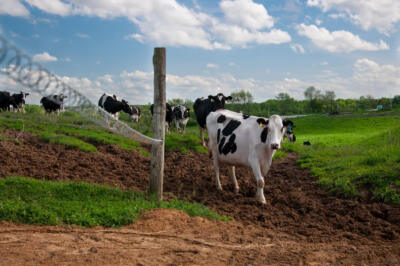
NRCS cost-share programs assisted Wilson Organics with improved pasture infrastructure.

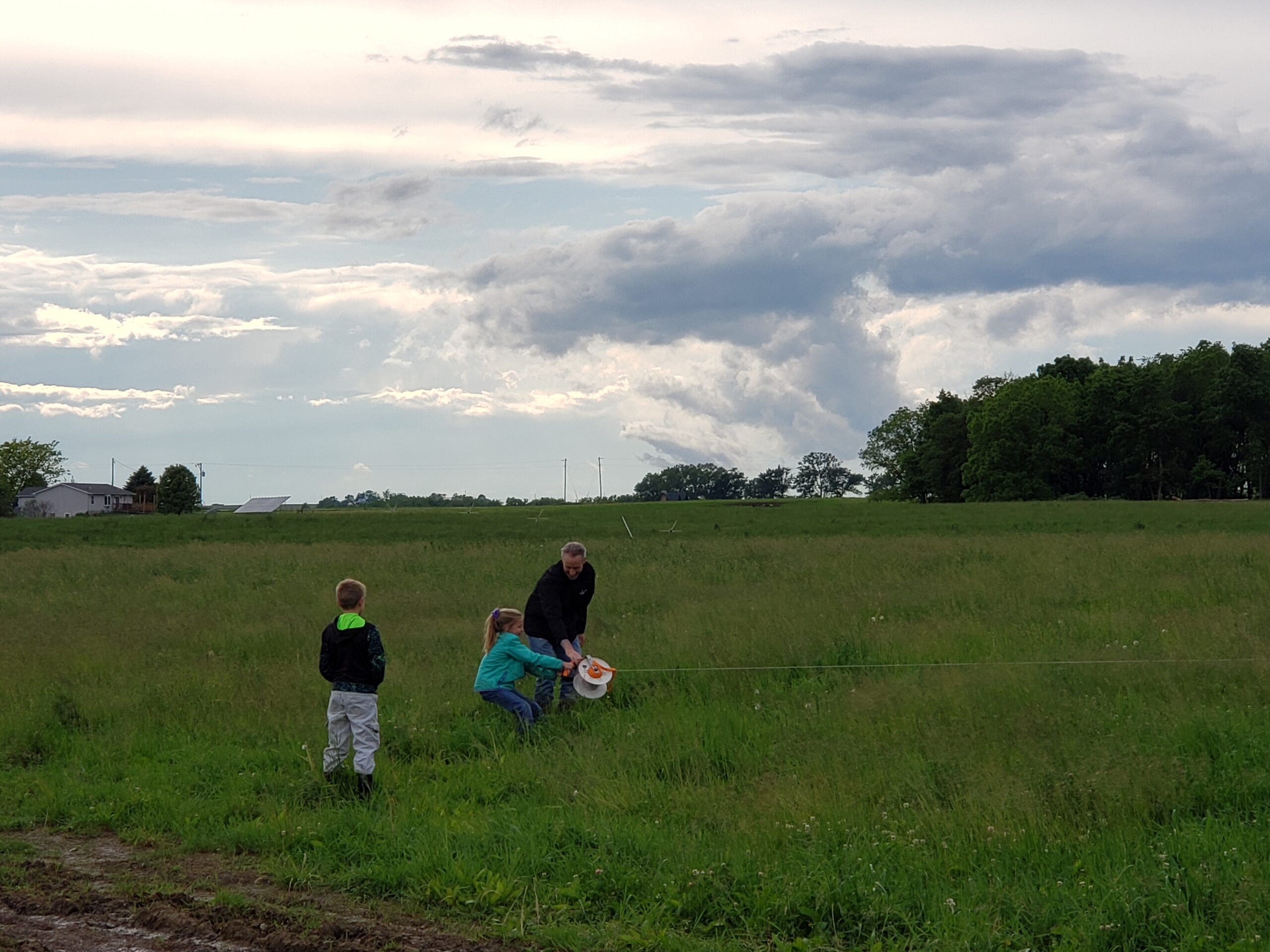
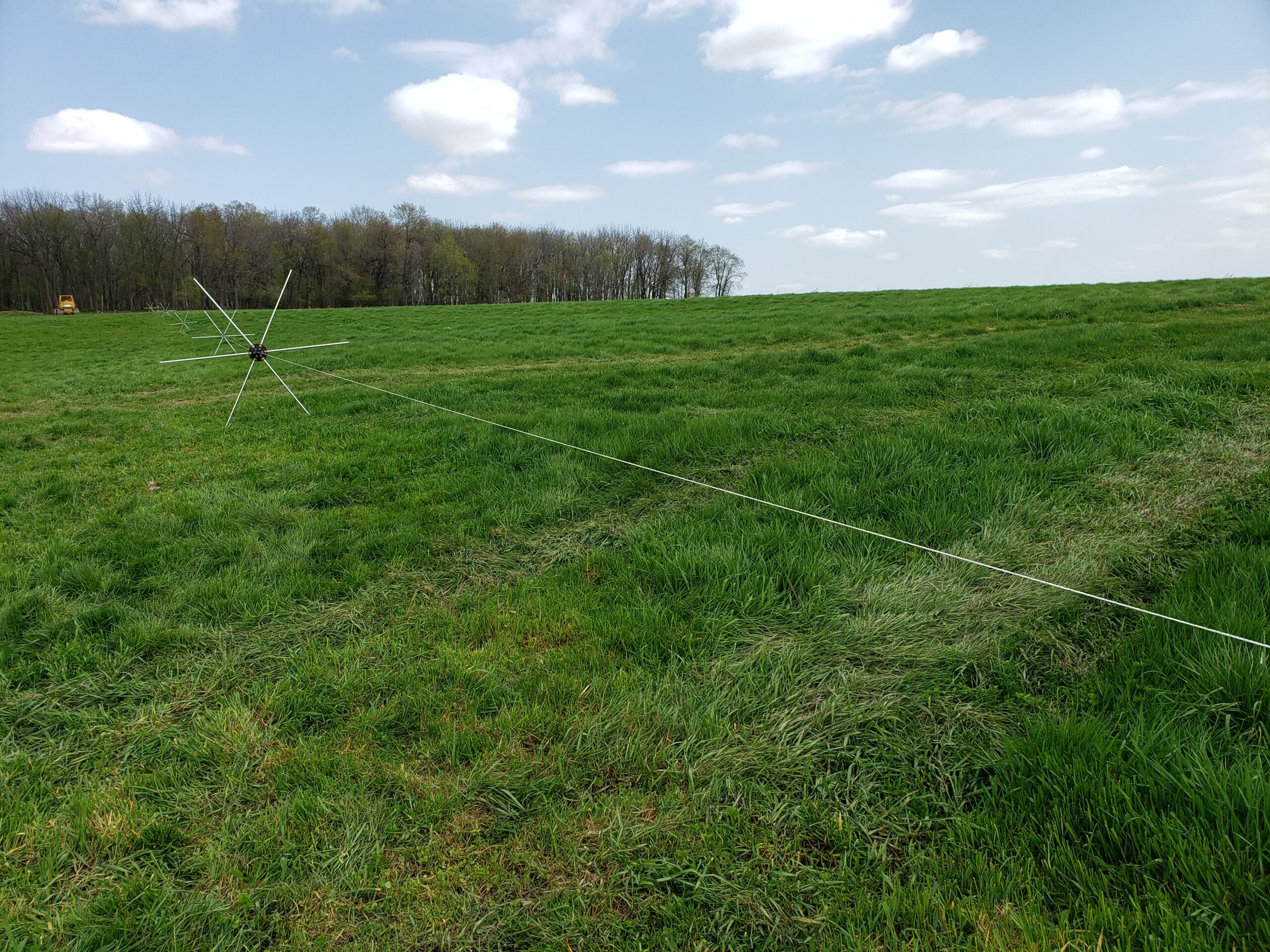
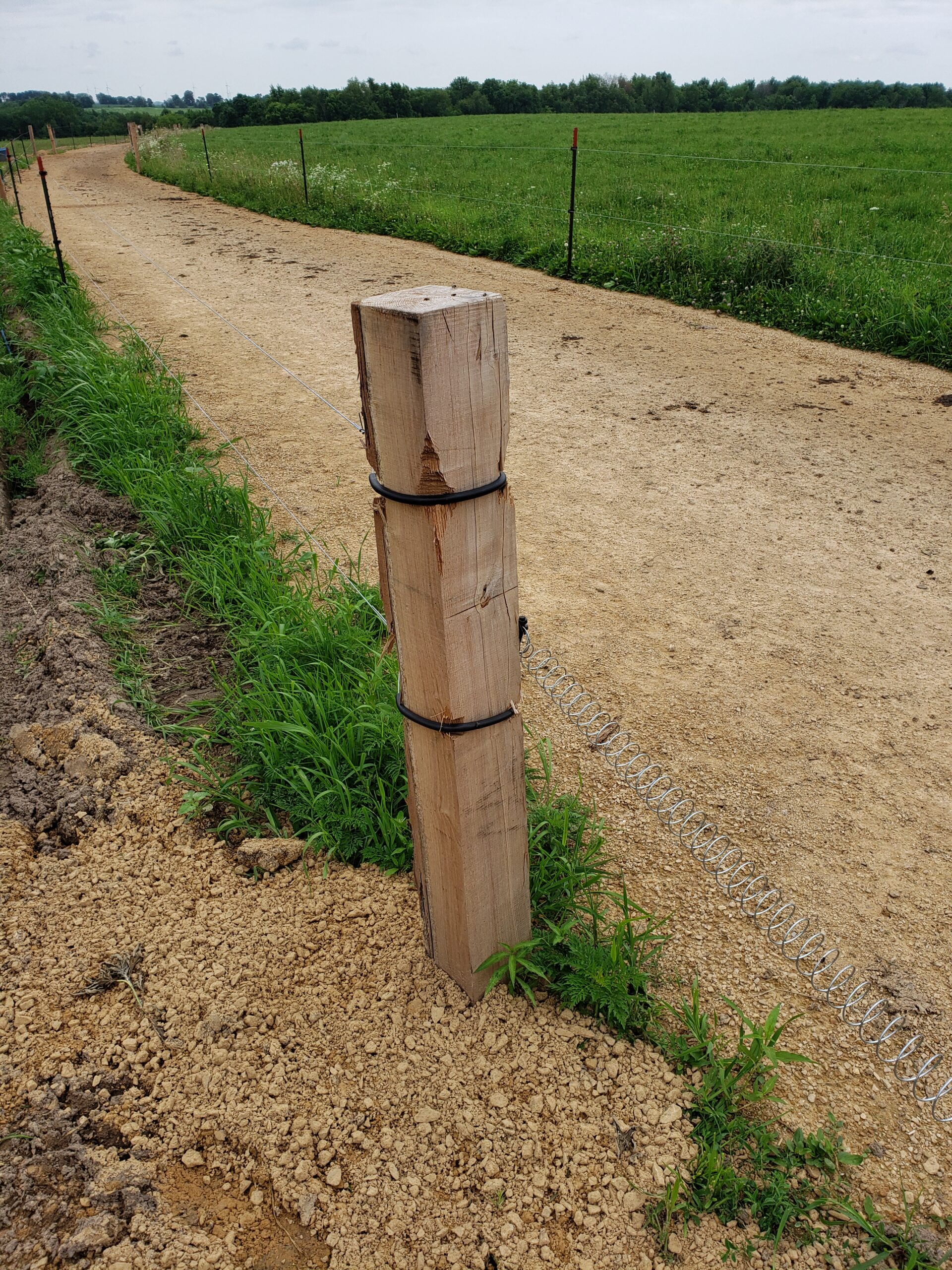
Through a cost share program, Wilson Organic Farms received financial support for improved pasture  infrastructure and installation costs. They installed a six-strand barbed wire fence around the whole perimeter, and hired someone to install it. Chris points out that they had the option to install it themselves, which could save labor costs. They also installed underground water lines throughout the pasture. The NRCS program offered a cost share per linear foot, which Chris says “covered 50-60% of total cost.” This was similar to the support they received for the cow lanes they installed, where the cost share was based on square feet of cow lane. Their local agent was able to help them think through the details and layout of the systems they wanted to install. This financial and logistical support helped the farm transition from large paddocks to a rotational system that improves pasture and soil health.
Cow lanes in action at Wilson Organic Farms.

Cover Cropping

Another project that Wilson Organic Farms implemented with NRCS support was integrating cover cropping into their crop plan. Chris explains that “you sign up the number of acres you want to cover crop” and then there’s a list of cover crops you can use. “It’s been super successful,” he adds. They now have a system in place that includes cover cropping at three different times in the year. The cost share support for this project spans five years.

Wisconsin Honey Bee Pollinator Initiative

The farm also hosts Field Days with their partners, such as NRCS and Organic Valley, to share what they are doing with others.

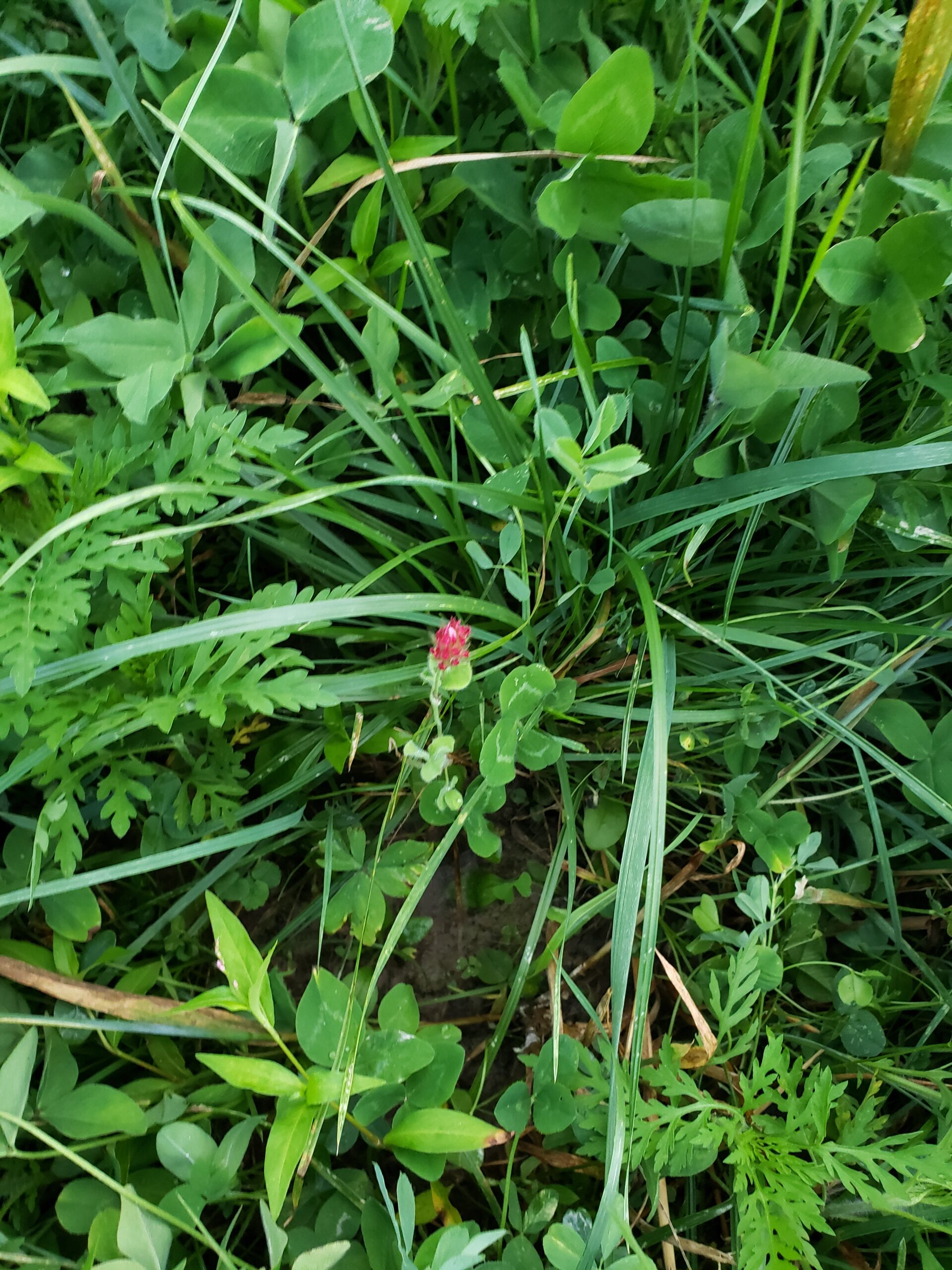
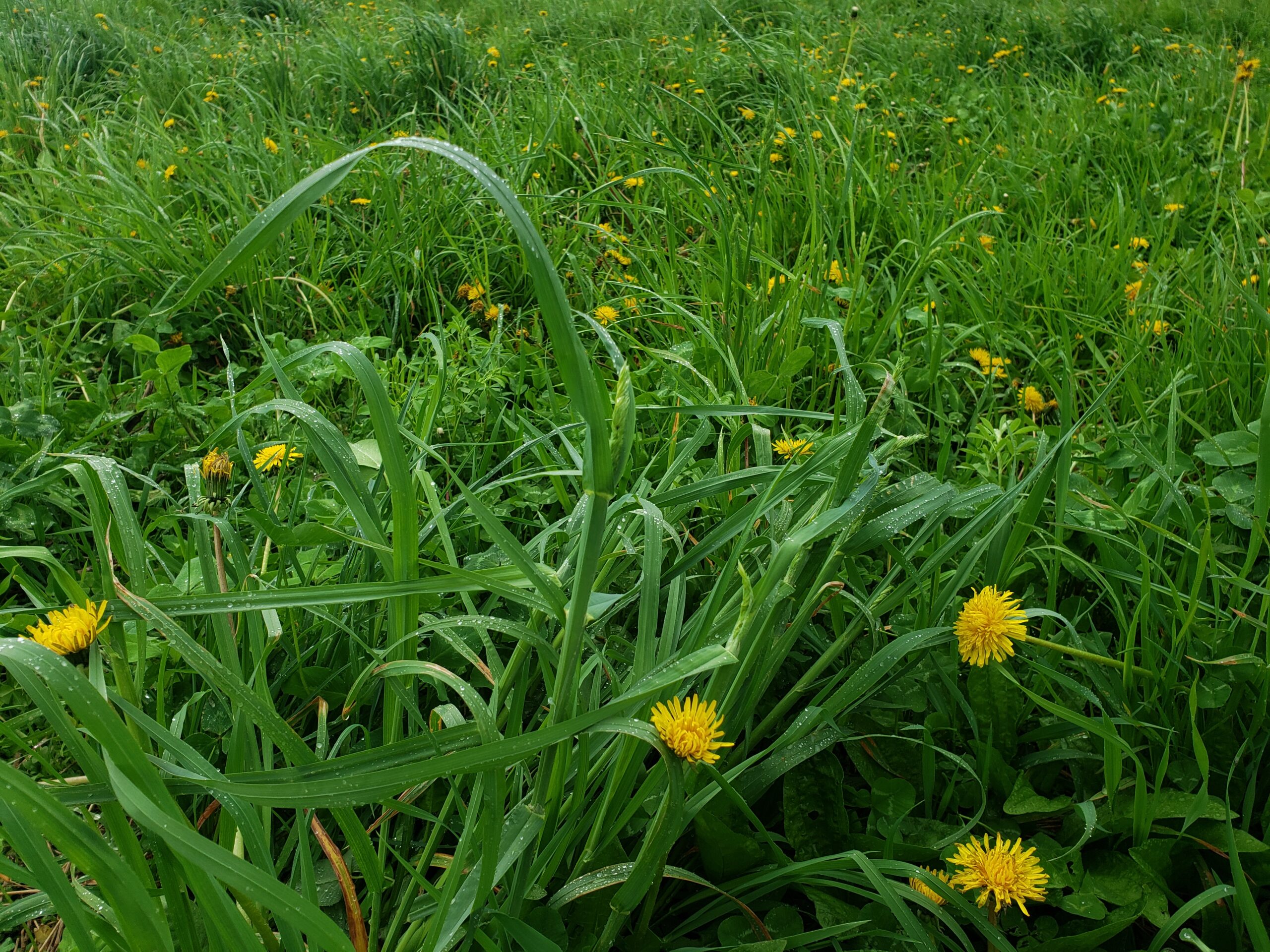
Wilson Organic Farms has also participated in the Wisconsin Honey Bee Pollinator Initiative, a statewide project to increase pollinator habitat in the grazing landscape. By incorporating a variety of different plants, and shifting the grazing schedule, the farm is able to create an environment where pollinators had continuous access to flowering plants. The seed mix includes lots of clovers and other plants that result in a long season of blooms. This program also required that they only graze each section of pasture every 30 days. That is a core principle of intensive grazing anyway, which was already something that Wilson Organic Farms was practicing. They often wait 40-45 days to rotate cattle back onto the same pasture during the driest parts of the season. This allows the pasture to regrow between grazing. “It’s pretty incredible to see,” Chris says. “I come out to the farm in late April, early May when the dandelions are blooming all the way into the fall when the burdock plants are starting to bloom. And there’s flowers, you can find tons of flowers any day of the year, and there’s tons of bees, tons of pollinators.”

As well as implementing these programs, the farm strives to share what they’re doing and what they’ve learned with others. They typically host at least one field day each year, either in partnership with the NRCS, their local Extension Service, or Organic Valley. Their focus is often on natural resource management on farms. For instance they recently hosted a field day on organic cropping systems and water resource management for farms. Last year their topic was grazing systems. These events invite farmers in the region to come tour Wilson Organic Farms and learn more about the farm programs that are available. For farmers who are curious about what’s available, Chris’s advice is to “meet with your local NRCS agent and start a conversation.” Then, he adds, “Start small. Maybe cover crop a few acres, see how it goes. You can expand if you want or try something else if it’s not for you.”

Distribution

Organic Valley is a farmer-owned cooperative that aggregates and distributes milk products from coast to coast.

Wilson Organic Farms milk continues to be sold to Organic Valley and made into cheese and butter for distribution nationwide. Their milk is also used in many Stonyfield products as well as other store brand products. Organic Valley is a farmer owned cooperative with around 1600 participating farms located across the country. “It is unique,” Chris says, “because it evolved from a group of farmers who wanted to farm using organic principles and reach a consumer who valued those things.” To this day the cooperative is committed to supporting small farms, and member farmers have a strong voice in decision-making.

In addition to the dairy products, Wilson Organic Farms also grows hard red winter wheat, which is sold to a mill 10 miles away. It is ground into flour for Meadowlark Organics, and distributed nationally. They also sell corn and soybeans to local farmers who are raising livestock. And they sell beef cattle off the farm, most of which is processed locally and sold in the local or regional area.

Farming in a Changing Climate

A young calf will grow up on pasture in an organic, rotational grazing system at Wilson Organic Farms.

Like many farmers, the Wilson family has not been immune to the effects of intensified weather patterns. In 2018 and 2019 the region they’re in received unusually high rainfall, sometimes getting several inches in a day, for weeks on end. This kind of weather pattern can make a farm particularly susceptible to runoff and erosion, especially in a region with more sloping terrain like where the Wilson farm is located. Now they’ve had two years of drier than normal weather in 2021 and 2022. Chris describes the recent rain pattern as “scarce but timely,” with the area receiving rain only about once every three weeks. Chris attributes the resiliency of their farm in the face of both extreme rain and drought to the diversity of crops and to the prevalence of perennials in their farm system. They strive to have a living root in the ground as many days of the year as possible. They are able to do this using long and diversified crop rotations, including perennial crop production like alfalfa and grass mixtures. Their crop rotation and cover cropping means that they always follow a crop immediately after it comes out of the field, either with the next cash crop or a cover crop.

You have eco benefits, where you have perennials and cover crops and different things that are grabbing rainfall and filtering it. It’s incredible to see the differences in how that soil can absorb rainfall when it does come and then also weather long periods without rainfall and still stay productive.

The nearly year-round soil cover, and the soil-holding and water-holding capacity of the root systems protects against erosion and helps the soil to absorb water when it does come and then withstand the periods of dryness without losing productivity. Also, because the farm has several different enterprises they are not relying on the success of just one or two crops in order for the farm to have a successful year. This doesn’t make it easy, but it does mean that they’ve been able to watch their fields maintain productivity during adverse weather events.

Here are a sampling of photos from Wilson Organic Farms of the work they have done in partnership with NRCS.

By |2025-12-17T18:24:35-05:00April 4th, 2023|Farmer Stories, Federal Assistance, Livestock, News|

Introduction to Crop Insurance for Organic and Transitioning Producers

Crop insurance can help protect your farm from weather- and market-related losses. This guidebook provides an overview of crop insurance options, coverage, record-keeping, and working with insurance agents, with a focus on organic and transitioning producers.

You’ll also find practical worksheets for field locations, crop rotations, sales records, and income and expense tracking—all designed to support organic certification requirements. By integrating crop insurance into your farm’s risk management plan, you can increase resilience and protect your operation. Download the full guide to explore all coverage options, worksheets, and strategies for organic and transitional farms.

By |2026-03-02T11:50:52-05:00September 23rd, 2019|Federal Assistance, Resource|
Go to Top