
Farmer-Led Trials Program Spotlight: Chestnut Acres Farm
Navigating Parasite Management on an Organic Sheep Operation
Written by Mary Hathaway, OFRF’s Research & Education Program Manager, and Amy and Madeline Lucas, FLT Program participants
This on-farm trial at Chestnut Acres Farm will test the effectiveness of using an organic oral drench of black walnut powder, garlic powder, and molasses to reduce internal parasite-load in sheep. Results from this study will help organic farmers manage parasites while adhering to organic certification requirements.
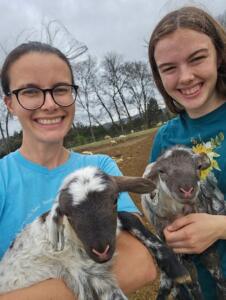 Source: Chestnut Acres Farm
Amy Lucas and her daughter Madeline with the lambs of Chestnut Acres Farms.
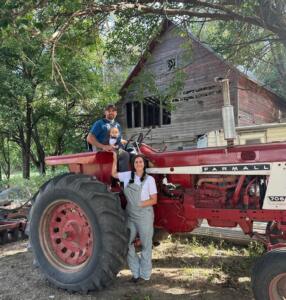
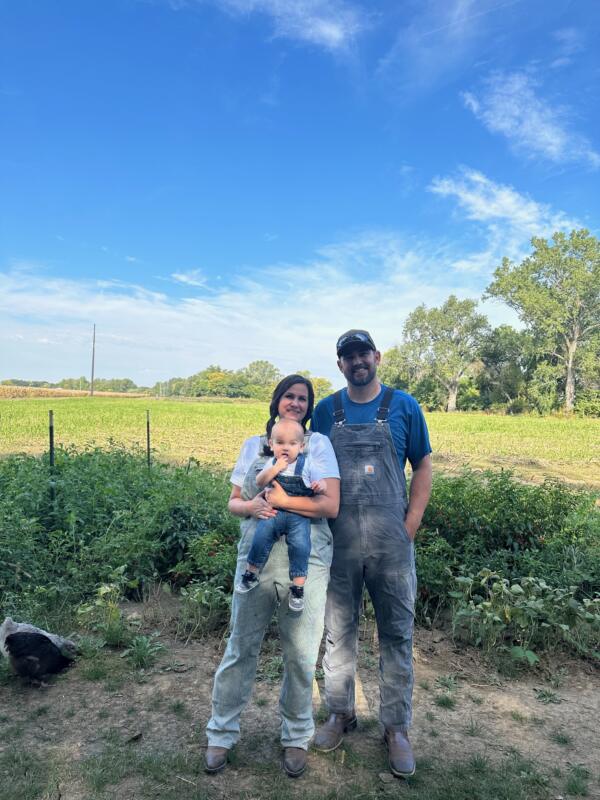
Nestled in the Tennessee Valley, in Kelso, Tennessee, Chestnut Acres Farm is a small, diversified family operation. Managed by the Lucas family, they specialize in three main areas: seasonal produce, pastured lamb, and free-range eggs. Central to their farm is a commitment to sustainable practices, including the cultivation of an organic orchard. They began the process of transitioning the land to organic in 2023; in early 2026 the farm completed organic certification inspection and now offers certified organic produce, eggs, and lamb to their community.
Organic Solutions to Parasite Challenges
One of the most persistent challenges facing small-scale organic sheep producers is managing internal parasites, particularly barber pole worm (Haemonchus contortus), without relying on conventional chemical dewormers. For the Lucas Family, this challenge became especially acute as they worked toward organic certification. Organic certifiers require that any product used on livestock be specifically labeled for use in that species, a restriction that eliminates many of the herbal and botanical products commonly discussed in the small-ruminant farming community.
Over the years, the Lucas Family have employed rotational grazing across 18 acres of pasture, moving the flock every three days in summer, and weekly in winter, as a key strategy to interrupt parasite life cycles. While this practice helps reduce pasture contamination, parasite pressure in young lambs remains a significant concern. Lambs begin consuming grass at just a few weeks of age, rapidly exposing them to infective larvae on the pasture. Finding an effective, certifier-approved intervention to reduce parasite loads during this vulnerable early period has been a persistent need on the farm.
After researching botanical options and consulting with their organic certifier, Madeline Lucas, with the help of her parents, identified an oral drench using a combination of black walnut powder, organic garlic powder, and organic molasses as a promising approach that could be approved for use on her certified operation.
On-Farm Trial Plan
With technical support from OFRF, Madeline and her parents designed a controlled on-farm trial to evaluate the effect of a black walnut/garlic/molasses drench on intestinal parasite load in lambs. The trial uses approximately 18 lambs born during the farm’s 2026 lambing season, organized into three groups (replications) based on birth date. Within each group of six lambs, three are randomly assigned to receive the herbal drench and three serve as untreated controls. Each lamb is individually tagged for identification, and birth weight, birth date, dam, and litter type (single or twin) are recorded.
Administration of the oral drench begins when each group reaches an average age of three weeks, a proactive starting point, before significant parasite burdens are expected, and is repeated on a four-week cycle for a total of three applications. Two weeks after each drench application, fecal egg counts (FECs) and FAMACHA scores are collected for every animal to measure treatment efficacy. To make regular fecal testing feasible and cost-effective, the farm has invested in equipment for in-house fecal analysis.
Oral Drench
Given at 2-4 weeks, 7-9 weeks, and 13-15 weeks. 13mL of solution per 10kg lamb weight.
Process:
Heat 900 mL of water to a boil.
Add 100 grams of garlic powder and 100 grams of black walnut, stir.
Add 300 mL of molasses, stir.
Yields 1300 mL of solution.
Trial Updates
The 2026 lambing season got underway in early March, and, as of summer 2026, the trial is now well into its final stretch. Data collection has proceeded across three groups of lambs, with the first two groups completing all three treatment and measurement cycles. Along the way, the team encountered several real-world complexities common to on-farm research: early fecal counts revealed the presence of multiple parasite egg types, including smaller eggs not typical of barber pole worm, prompting careful review of the data with OFRF staff. One lamb was lost due to complications following a routine veterinary procedure, and a late-season coccidia outbreak in the final group required treatment to protect animal health. Final data collection for the third group is expected to wrap up in August, with a full data review and analysis planned for early September.
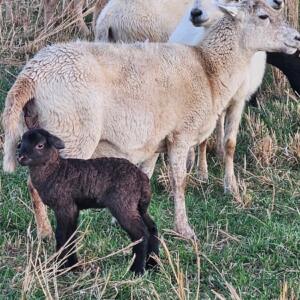 Source: Chestnut Acres Farm
18 lambs were born during the 2026 lambing season.
“We are very thankful to the OFRF organization and staff for this opportunity. We learned a lot about fecal counting and the different organic parasite treatments we trialed. We have already identified some things we might do differently next year. It was overall a great experience!”
– Madeline Lucas, FLT Program Participant
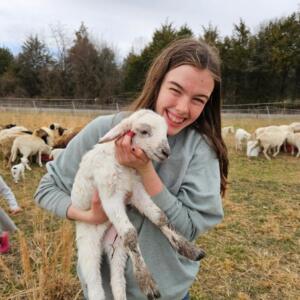 Source: Chestnut Acres Farm
Farmer Madeline Lucas with a lamb that participated in the trial.
This is part of a series of blogs highlighting farmers who are participating in OFRF’s Farmer-Led Trials program. Farmers receive technical support to address their production challenges through structured on-farm trials. To learn more about OFRF’s Farmer-Led Trials Program, visit our website page at https://ofrf.org/research/farmer-led-research-trials/
To learn more about Chestnut Acres Farm, visit their website or follow them on Facebook.