Advocacy

Impacts of OFRF Berry Research

This report offers a detailed review and impact assessment of OFRF-funded research on organic
berry production, with a focus on strawberries. These research projects address the most pressing
issues in the industry and this evaluation clearly indicates that OFRF investments have resulted
in important advances in organic berry production knowledge and practices, especially in
California. Overall, OFRF grant funding has advanced scientific knowledge and improved the
practices, ecological sustainability, and economic prosperity of organic berry farming. This
report recommends continued research support for organic insect, disease, and weed
management research efforts in berry production.

By |2025-12-10T15:22:42-05:00December 10th, 2025|Advocacy, Insects & Diseases, On-Farm Research, Resource|

2021 CALIFORNIA ORGANIC RESEARCH AGENDA

California is the nation’s top producer of organic agricultural commodities and specialty crops. Thus, it
is imperative to understand the unique needs of the organic growers in the nation’s most agriculturally
productive state. The 2021 CORA report provides up-to-date information on the stewardship practices
used by organic producers across the state and identifies the most pressing production and non-production
challenges faced by organic California growers. The findings presented in this report: 1) highlight the soil
health management practices that organic producers in California are currently implementing, 2) outlines the most pressing challenges and needs of certified organic producers in California, and 3) outlines priorities and recommendations to address those needs through public policy, research, and Extension programs.

2021 California Organic Research Agenda report
By |2025-12-10T15:16:29-05:00December 10th, 2025|Advocacy, Insects & Diseases, On-Farm Research, Resource|

Why Technical Note 12 Is Such a Big Deal

By Gordon Merrick, OFRF’s Senior Policy & Programs Manager

Versión en español a continuación.

The Need that Technical Note 12 Meets

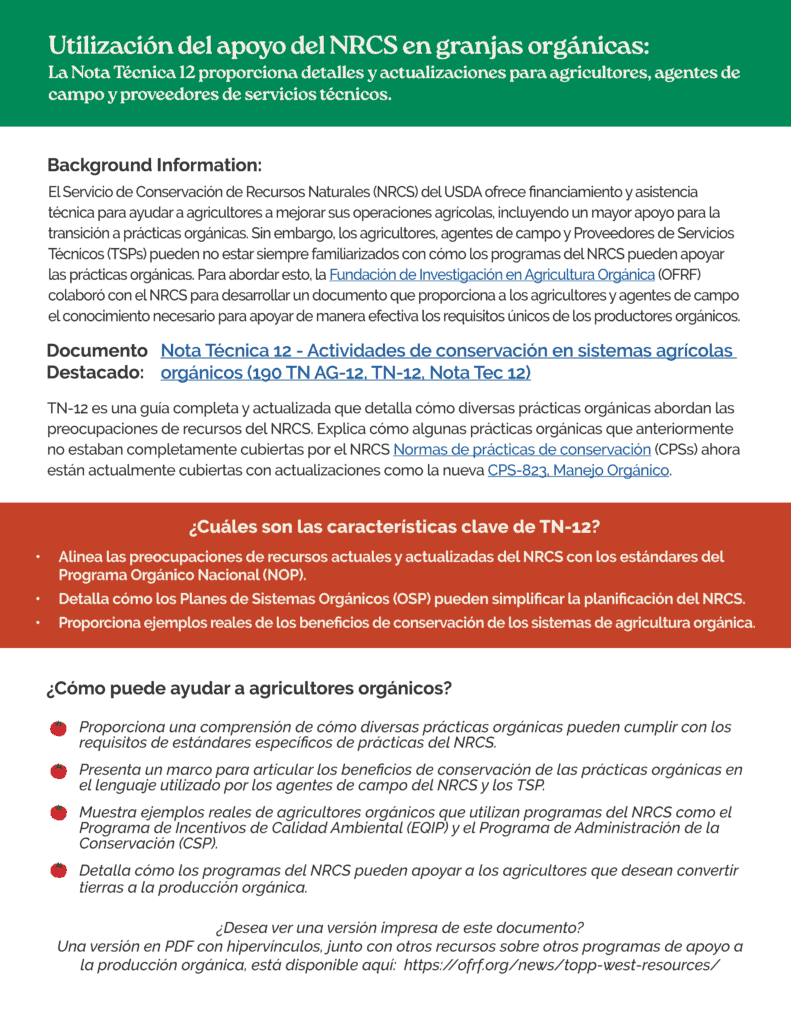
The Natural Resources Conservation Service of the United States Department of Agriculture (USDA-NRCS, NRCS) has been one of the most impactful modern agencies in the adoption of conservation practices and systems in the United States. Only recently did the NRCS publish a technical note that will aid Field Agents and other Technical Service Providers (TSPs) administer these programs on organic operations. Technical Note 12 – Conservation Activities in Organic Farming Systems (Tech Note 12) provides a wealth of knowledge needed to effectively support the unique requirements of organic producers. Recently, as part of our work for the Transition to Organic Partnership Program (TOPP) in the West/Southwest region, we have developed a toolkit designed to raise awareness among farmers of this resource, which is now in the hands of NRCS staff and TSPs. In this blog post, we’ll briefly discuss what Tech Note 12 is, how it benefits farmers, and how it helps NRCS staff and TSPs.

What Is Tech Note 12?

A technical note, as defined by the NRCS, is an authoritative document designed to provide detailed guidance on specific technical subjects relevant to conservation planning and implementation. These documents serve as essential resources for NRCS field staff, TSPs, and producers, offering in-depth information and practical instructions to support the effective management of natural resources and address resource concerns. Technical notes are developed to address a wide range of topics, including soil health, water quality, wildlife habitat, and agricultural practices. They offer step-by-step procedures, best management practices, and innovative solutions to common challenges faced in the field. By standardizing and disseminating this knowledge, technical notes help ensure consistency and quality in applying NRCS conservation programs and practices.

Tech Note 12 is intended to provide all this information—as it relates to organic agricultural production. It offers detailed guidance on conservation activities that are compatible with organic standards and provides real-world examples that illustrate how conservation activities have been implemented.  

How Tech Note 12 Helps Farmers

Tech Note 12 helps organic producers articulate the conservation benefits of their practices in the language used by NRCS field agents and TSPs. This clarity is crucial for accessing NRCS programs such as the Environmental Quality Incentives Program (EQIP) and the Conservation Stewardship Program (CSP), which provide financial and technical assistance to improve farm operations.

How Tech Note 12 Helps NRCS Staff and TSPs

For NRCS field agents and TSPs, Technical Note 12 is an invaluable tool for conducting thorough assessments of organic farming operations. By referencing the document, agents can identify appropriate conservation practices that address resource concerns while complying with organic standards. This approach ensures that the proposed solutions are both effective and aligned with the unique traits of organic farming, such as soil fertility, water management, pest control, and habitat conservation.

How to Access and Use Tech Note 12

To effectively use Tech Note 12 for your organic farming practices, start by contacting your regional Natural Resource Conservation Service (NRCS) office. Your NRCS field agent can provide helpful guidance on applying the recommendations in Tech Note 12 to your conservation planning while meeting organic standards.

For additional information and resources, download our Tech Note 12 flyer here. The flyer includes a summary of Tech Note 12, practical tips for using it, and suggested questions to ask your NRCS agent. This will help you get the most out of your NRCS support and prepare for your discussion.

Don’t miss out on valuable resources like this one—subscribe to our newsletter for groundbreaking organic farming research, educational guides, and critical funding and policy updates.

Brochure of how to utilize NRCS support on organic farms (includes background information, link to Tech Note 12, features, resources).

¿Por qué es tan importante la Nota Técnica 12?

La Necesidad que Satisface la Nota Técnica 12

El Servicio de Conservación de Recursos Naturales del Departamento de Agricultura de los Estados Unidos (USDA-NRCS, NRCS) ha sido una de las agencias más influyentes en la adopción de prácticas y sistemas de conservación en Estados Unidos. Recientemente, el NRCS publicó una nota técnica que ayudará a los Agentes de Campo y otros Proveedores de Servicios Técnicos (TSP) a administrar estos programas en operaciones orgánicas. Nota Técnica 12 – Actividades de conservación en sistemas agrícolas orgánicos (Nota técnica 12) proporciona una gran cantidad de conocimientos necesarios para apoyar de manera efectiva los requisitos únicos de los productores orgánicos. Recientemente, como parte de nuestro trabajo para el Programa de Asociación para la Transición a la Agricultura Orgánica (TOPP) en la región Oeste/Suroeste, hemos desarrollado un kit de herramientas diseñado para concienciar a los agricultores sobre este recurso, que ahora está en manos del personal del NRCS y los TSP. En esta publicación del blog, discutiremos brevemente qué es la Nota Técnica 12, cómo beneficia a los agricultores y cómo ayuda al personal del NRCS y a los TSP.

¿Qué es la Nota Técnica 12?

Una nota técnica, según lo define el NRCS, es un documento autoritativo diseñado para proporcionar orientación detallada sobre temas técnicos específicos relevantes para la planificación e implementación de conservación. Estos documentos sirven como recursos esenciales para el personal de campo del NRCS, los TSP y productores, ofreciendo información detallada e instrucciones prácticas para apoyar la gestión efectiva de los recursos naturales y abordar las preocupaciones de recursos. Las notas técnicas se desarrollan para tratar una amplia gama de temas, incluyendo la salud del suelo, calidad del agua, hábitat de la vida silvestre y prácticas agrícolas. Ofrecen procedimientos paso a paso, mejores prácticas de gestión y soluciones innovadoras a desafíos comunes enfrentados en el campo. Al estandarizar y difundir este conocimiento, las notas técnicas ayudan a garantizar la consistencia y la calidad en la aplicación de los programas y prácticas de conservación del NRCS.

La Nota Técnica 12 está destinada a proporcionar toda esta información, en lo que respecta a la producción agrícola orgánica. Ofrece orientación detallada sobre las actividades de conservación que son compatibles con los estándares orgánicos y proporciona ejemplos reales que ilustran cómo se han implementado las actividades de conservación.

Como la Nota Técnica 12 ayuda a los agricultores

La Nota Técnica 12 ayuda a los productores orgánicos a articular los beneficios de conservación de sus prácticas en el lenguaje utilizado por los agentes de campo y los proveedores de servicios de conservación del NRCS. Esta claridad es crucial para acceder a programas del NRCS como el Programa de Incentivos a la Calidad Ambiental (EQIP) y el Programa de Administración de Conservación (CSP), que de asistencia financiera y técnica para mejorar las operaciones agrícolas.

¿Cómo Ayuda la Nota Técnica 12 al Personal del NRCS y a los TSP?

Para los agentes de campo del NRCS y los TSP, la Nota Técnica 12 es una herramienta invaluable para realizar evaluaciones exhaustivas de las operaciones de agricultura orgánica. Al consultar el documento, los agentes pueden identificar las prácticas de conservación apropiadas que aborden las preocupaciones de recursos mientras cumplen con los estándares orgánicos. Este enfoque asegura que las soluciones propuestas sean tanto efectivas como alineadas con las características únicas de la, (agricultura orgánica) tales como fertilidad del suelo, manejo del agua, control de plagas y conservación del hábitat.

Cómo Acceder y Utilizar la Nota Técnica 12

Para utilizar eficazmente la Nota Técnica 12 en sus prácticas de agricultura orgánica, comience contactando a su oficina regional del Servicio de Conservación de Recursos Naturales (NRCS) (Oficina del Servicio Regional de Conservación de Recursos Naturales (NRCS) Su agente de campo del NRCS puede ofrecerte orientación útil sobre cómo aplicar las recomendaciones de la Nota Técnica 12 en su planificación de conservación mientras cumple con los estándares orgánicos.

Para más información y recursos, descargue nuestro folleto sobre la Nota Técnica 12 aquí. El folleto incluye un resumen de la Nota Técnica 12, consejos prácticos para su uso y preguntas sugeridas para hacerle a su agente del NRCS. Esto le ayudará a aprovechar al máximo el apoyo del NRCS y prepararse para su conversación.

No se pierda recursos valiosos como este: (Suscríbase a nuestro boletín) para recibir investigaciones innovadoras en agricultura orgánica, guías educativas y actualizaciones importantes sobre financiamiento y políticas.

By |2025-12-09T17:49:10-05:00September 13th, 2024|Advocacy, Federal Assistance, News, Spanish Resources, TOPP West|

2022 National Organic Research Agenda and 2022 State of Organic Seed Reports Released

FOR IMMEDIATE RELEASE

As the Organic Industry Booms, Grower Challenges and Seed Needs Loom Large
Two new assessments underscore the need for targeted investments in organic research

(SANTA CRUZ, Calif., March 15, 2022) — Organic Farming Research Foundation (OFRF) and Organic Seed Alliance (OSA) are proud to announce the release of the National Organic Research Agenda (NORA) and State of Organic Seed (SOS). The two reports are published every five years to examine organic farming challenges across the U.S., identify research needs, and better understand the organic seed needs of producers.

The organic food market experienced incredible growth in 2020, with sales surpassing $56 billion, a 12 percent increase from 2019. The organic seed market has also grown in recent years due to this demand for organic food as well as a dramatic rise in gardening during the COVID-19 pandemic.

The reports released today provide comprehensive assessments and recommendations for ensuring the ongoing growth and success of organic farming in the U.S. Specifically, NORA details organic research needs with the goal of informing future investments that support the success of organic farmers and ranchers and those transitioning to organic production. SOS details trends in organic seed sourcing, challenges faced by organic seed producers, public investments in organic plant breeding, and more.

In 2019, OFRF and OSA were jointly awarded funding from the U.S. Department of Agriculture’s (USDA) National Institute of Food and Agriculture’s (NIFA) Organic Research and Extension Initiative (OREI) for the NORA and SOS projects. The following year, OFRF and OSA launched a national survey of organic farmers and ranchers, in addition to a survey targeting transitioning-to-organic operations, to better understand these producers’ challenges, needs, and perspectives. More than 1,100 producers responded to the survey and an additional 100 producers attended 16 listening sessions across the country. Overall, farmer participation reflected the same demographics of those in the U.S. farming sector as documented in the USDA’s National Agricultural Statistics Services 2019 Organic Survey.

Highlights from the National Organic Research Agenda

“Organic farming has been historically under-invested in, in terms of research, education and extension,” says OFRF Executive Director Brise Tencer. “The 2022 National Organic Research Agenda presents incredible feedback directly from organic farmers and provides a compelling roadmap for how to best support the growth of this important sector of agriculture.”

Survey respondents provided input and perspectives on their current organic production systems, including the use of regenerative soil health management practices, water conservation, organic inputs, and organic seed. Findings confirm that organic producers lead the nation in adoption of soil health management and climate-friendly practices. The 2022 NORA also examines current farmer concerns in organic agriculture, farmers’ preferred sources and modes for information-sharing, and summarizes the impacts of COVID on organic producers.

Respondents also shared their production and non-production challenges, which OFRF then analyzed by region, farming experience, and race/ethnicity. This particular NORA compares the experiences of both Black, Indigenous, and People of Color (BIPOC) and White farmers, and reveals BIPOC producers are experiencing many organic production challenges and at a higher rate than their White counterparts.

In addition to identifying gaps in current organic and transitioning-to-organic production challenges, NORA highlights farmer-identified solutions and strategies shared during its focus group discussions. NORA also provides comprehensive recommendations to guide OFRF’s research and policy initiatives. Proposed investments and focus areas include, but are not limited to, technical assistance, organic research, and racial equity programming.

Highlights from State of Organic Seed

The State of Organic Seed report is part of an ongoing project to monitor organic seed systems in the U.S. More than ever, organic seed is viewed as the foundation of organic integrity and an essential component to furthering the principles underpinning the organic movement. Every five years, SOS serves as a progress report and action plan for increasing the organic seed supply while fostering seed grower networks and policies that aim to decentralize power and ownership in seed systems.

The update released today includes substantially more data than the 2016 report, including a deeper examination of organic seed producer/company challenges and their networks. This and other data can be explored through an interactive website where users can sort five data sets by region, crop type, and other identifiers (see: https://organicseed.shinyapps.io/SOSData/).

Organic farmers produce food differently, and that means they need different seed for the crops they grow – seed developed to thrive without synthetic chemical fertilizers and pesticides, and adapted to their local climate and soil conditions. Organic seed is also a regulatory requirement. The USDA’s National Organic Program requires the use of organic seed when commercially available.

Unfortunately, OSA’s recent findings show no meaningful improvement in organic producers using more organic seed compared to five years ago. This lack of progress puts at risk the viability of the organic seed industry and the integrity of the organic label. In particular, the largest organic operations still use relatively little organic seed, and data suggests that organic certifiers’ enforcement of the organic seed requirement could be strengthened.

However, OSA’s data points to progress in other areas, including public investments going toward organic plant breeding and other organic seed research initiatives. More than $39 billion have been invested in these types of projects in the last five years alone. This represents the largest public investment in organic seed systems that OSA has ever recorded. More organic plant breeders are having success releasing new varieties as well.

“The findings are clear, and they underscore the urgent need to modernize organic seed policy, support the success of existing and new seed producers, and confront the dire risks climate change poses to our seed supply,” says OSA’s Kiki Hubbard, lead author of the report.

Each report is available online at www.ofrf.org/research/nora/ and www.stateoforganicseed.org/.

###

Download this Press Release (214 KB, PDF)

Media Contacts
Organic Farming Research Foundation, communications@ofrf.org
Kiki Hubbard, Organic Seed Alliance, kiki@seedalliance.org, (406) 544-8946

About Organic Farming Research Foundation
Organic Farming Research Foundation (OFRF) works to foster the improvement and widespread adoption of organic farming systems. OFRF cultivates organic research, education, and federal policies that bring more farmers and acreage into organic production.

https://www.ofrf.org/

About Organic Seed Alliance

Organic Seed Alliance (OSA) works nationally to advance ethical seed solutions to meet food and farming needs in a changing world. Through research, education, and advocacy, OSA fosters organic seed systems that are democratic and just, support human and environmental health, and deliver genetically diverse and regionally adapted seed to farmers.

https://seedalliance.org/
By |2025-12-10T15:10:56-05:00March 15th, 2022|Advocacy, News, On-Farm Research, Press Release|

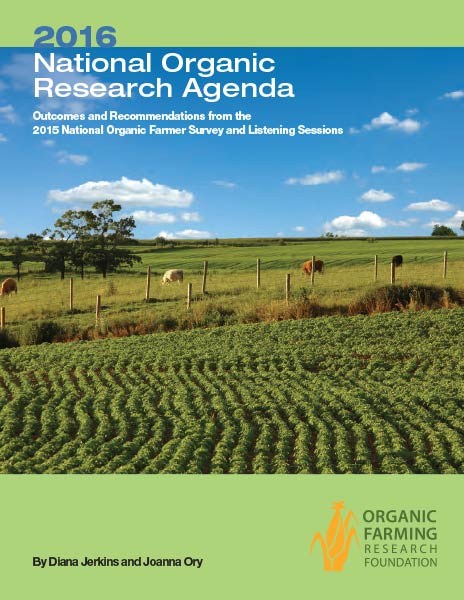
2016 National Organic Research Agenda (NORA)

This 2016 National Organic Research Agenda (NORA) report provides comprehensive recommendations for future investment in organic agricultural research. These recommendations are based on the Organic Farming Research Foundation’s 2015 survey of organic farmers, nationwide listening sessions with organic farmers, and a review of key documents and recommendations from other organizations, including the National Organic Standards Board (NOSB). The 2015 Organic Farmer Survey was conducted online and completed by over 1,000 organic farmers. Their responses directly inform our top recommendations for organic research.

Photo of cover of the National Organic Research Agenda 2016 report
By |2025-12-10T15:26:57-05:00September 23rd, 2019|Advocacy, On-Farm Research, Uncategorized|
Go to Top