
Ensuring a Sustainable Future With My Legacy to OFRF

Ensuring a Sustainable Future With My Legacy to OFRF

By |2025-06-13T17:41:29-04:00June 13th, 2025|News|

Written by Katrina Heinze, OFRF Board Member from 2014-2023

A planned gift is a gift to the future. I support organic farming and OFRF because I care about the future health of our planet and its people. A planned gift to OFRF is a tangible way for me to pay it forward.

My mom fed me organic milk before “organic” was even a label. I grew up cooking and connecting with people through food. Later in my career, these interests led me to work in organic foods and organic policy. What a gift! Through my work, I learned about the care, hard work, and amazing knowledge that organic farmers bring to growing our food, as well as the challenges that make farming organically and bringing a farm’s goods to market difficult. 

In 2014, I joined OFRF’s board. Our farmer board members and farmer listening sessions taught me that organic farmers are experimenters and that we still have much to learn about the best production practices to nurture our environment, deal with and address the impacts of climate change, and provide healthy food for all—all while ensuring sustainable economics for farmers and farming communities.

OFRF’s mission is to foster the improvement and widespread adoption of organic farming systems. I love OFRF’s farmer-centered, science-based approach. Our work is long-term and requires long-term funding. For example, OFRF publishes the National Organic Research Agenda (NORA) every 5-6 years. The NORA Report is used to ask for Congressional funding for organic research, influence USDA’s grant funding, and help those of us in the organic food industry rally to support our farmers’ most important production (and non-production) needs. All of this contributes to new knowledge and support for organic farmers.

My husband and I have included OFRF in our will in addition to our regular OFRF donations. We did this to model our values for our family, demonstrate how we align our resources to those values, and be clear about the legacy we want to leave behind.

Estate planning can be easy to put off or avoid. However, we found that having conversations with our family about our wishes enriched our relationships. By discussing what mattered most to us and how we could best use our resources now and in the future, we’ve become better stewards of our resources today. We are glad we did this now instead of waiting or missing the opportunity altogether.

Planned giving can take place during your lifetime or at death, and it is a crucial part of your overall financial and estate plan. Typically larger than donations from ordinary income, planned gifts can provide income, financial security, and tax savings to you and your family, depending on how they are structured. In our case, our planned gift includes a multi-year commitment to OFRF now and a designation of a percentage of any remaining estate at our deaths.  

Planned giving is crucial for non-profits like OFRF, who depend largely on annual giving to “keep the lights on.” Although OFRF receives grants for key program initiatives, these grants don’t often pay for staff development, accounting, and the time-consuming work of helping policymakers understand the needs of farmers. Planned gifts build year-to-year stability for now and create a “savings account” for later.

I have seen the impact of planned gifts on OFRF. When I was on the Board of Directors, we received a planned gift. This single donation enabled us to hire a paid intern to support our research program. It also demonstrated to a future grant maker the value of our work, which has now resulted in a multi-year grant. Better still, the donor was unknown to us, and learning about why OFRF was important to them brought us joy and a renewed commitment to our mission.

A planned gift does not have to be complicated. Including OFRF as a beneficiary in your will or naming OFRF as a full or partial beneficiary of a life insurance policy or retirement account is a simple way to make a planned gift. Consulting with your financial and legal advisors can help you determine what is best for your situation and values. Once you have put a gift plan in place, let the beneficiary non-profit know. They will benefit from understanding what motivated you, and you will get to enjoy the impact of your thoughtful gift.

Together, let’s ensure the widespread adoption of organic farming practices. Our earth and farming communities depend on it. Please join me in planting a seed for the future by making a planned gift to OFRF today.

Sincerely,

Katrina

Keeping it Real: How OFRF Groundtruths Our Policy Priorities, and Why That Matters

By |2025-08-28T13:09:27-04:00June 3rd, 2025|Gordon's Policy Corner, News|

By Gordon Merrick, OFRF Senior Policy & Programs Manager

In today’s political environment, defined by complexity, shifting political winds, and consistently competing interests, clarity and consistency matter more than ever. That’s why it is all the more important that OFRF stays grounded by always adhering to one simple principle: our work must be rooted in the real needs of the organic farming and research community. Whether we’re advocating for research funding in the halls of Congress, submitting comments to the USDA, or analyzing the impacts of federal programs and decisions, we’re guided by what we hear directly from farmers, researchers, and partners across the United States.

OFRF Policy Priorities

OFRF’s policy work centers around three core goals:

  1. Invest in Organic Research that supports all farmers in building ecologically resilient, economically viable farming operations
  2. Expand access to technical assistance and financial tools that empower producers to implement research-backed, systems-based practices
  3. Grow organic as an economic engine, especially in rural communities, by ensuring federal policy recognizes and supports organic production systems as a public good

These priorities aren’t abstract, they’re rooted in field experience, producer feedback, and a clear-eyed assessment of what it takes to make organic agriculture succeed on the ground and in communities across the United States.

Our commitment to our community’s needs

OFRF does not set our policy agenda from an ivory tower or an echo chamber. We’ve committed to revisiting and updating our priorities annually in direct response to feedback from the communities we serve. We take seriously our responsibility to represent the diverse perspectives within the organic sector. That means staying connected to the farmers navigating certification, the researchers searching for funding that will facilitate their work, and the businesses and communities that depend on organic production.

That’s why we brought these priorities to our recent Organic Stewardship Council meeting. Producers like Anna Jones-Crabtree of Vilicus Farms reminded us that while organic systems offer tremendous benefits, too many federal programs still fail to recognize or accommodate how organic works. This on-the-ground story mirrors national research findings: current USDA programs are not designed with organic and agroecological systems in mind. This results in lost support, unfair pricing assumptions, and policies that treat organic like an outlier, rather than a proven system that feeds people and restores land (for reference, about 15% of our produce is organic by volume, but organically managed land represents less than 1% of all farmland).

The real experiences and stories shared in this discussion weren’t one-offs. They are part of the intentional work we do at OFRF in every conversation, farm visit, and research partnership. We aim to update our priorities annually in collaboration with farmers, researchers, and movement leaders. Through OFRF’s work with grass-tops organizations and directly with farms across the country, we work to build spaces for people to tell us their stories about what is changing on the ground. Whether it’s ensuring USDA’s technical and financial assistance programs are applicable to organic farms or fighting for parity in research investments, OFRF’s priorities are shaped by what people tell us they need, not what sounds good in D.C.

What you can do

There’s a reason this work feels more urgent right now. As several farmers noted in our recent conversations, organic is at an inflection point. Market premiums are narrowing. Other labels and claims are muddying consumer understanding. And more than 15,000 USDA staff are leaving the agency, threatening institutional memory and slowing urgently needed reforms.

OFRF doesn’t have all the answers; but we do have a clear mission: to cultivate organic research, education, and federal policies that bring more farmers and acreage into organic production.

If you are a farmer with organic acreage, a researcher studying organic agriculture topics, or just someone who has a story to share on the importance of organic agriculture, we are here to listen. If you want to make sense of the current policy landscape, we are here to help: our new, free, self-paced Communicating with Legislators email course is designed to support you in telling your story loudly and clearly. Farmers are doing the work. Our job is to make sure policy catches up. 

We’re here to make sure your voice is not only heard, but acted on.

Eat well and breathe deeply,

Gordon

P.S. You can catch up on recent editions of Gordon’s Policy Corner here.

Matt Jones (he/him)

By |2025-09-11T17:21:03-04:00June 1st, 2025|Staff|

Research and Education Program Fellow

email: matt[at]ofrf.org

Matt Jones (he/him) joins OFRF as the Research and Education Program Fellow after 15 years working with farmers on sustainable agriculture research. In this role he will be working on a national needs assessment to inform a National Organic Research Agenda report.

Throughout his career, Matt has worked with farmers across diverse agroecosystems, from organic lowbush blueberry growers in Maine to transitioning vegetable farmers in California. Most recently he’s been working as an independent consultant assisting growers, businesses and nonprofits in finding biologically-based farm management solutions. Previously he worked as Research Assistant Professor at Washington State University’s Tree Fruit Research and Extension Center. Earlier roles included a Fulbright Research Fellowship in New Zealand and a research technician for the USDA.

Matt has a Ph.D. in Entomology from Washington State University and an M.S. in Ecology and Environmental Science from the University of Maine. He and his wife live on a small farm in the Chumstick Valley of central Washington. When he’s not at work, you can find him digging in the dirt, pruning fruit trees, or climbing and skiing in the backyard mountains.

Farmer-Led Trials Program Spotlight: Farmacea

By |2025-12-17T17:37:24-05:00May 29th, 2025|Farmer Stories, News, On-Farm Research, Weeds|

Farmacea Strawberry Trial Explores Sustainable Mulching

Written by Mary Hathaway, OFRF’s Research & Education Program Manager

In the heart of Munith, Michigan, Farmacea is undertaking an exciting experiment to help enhance their farm systems and design. Run by Mike Lucas and Rollin Baker, the farm’s 31 acres had previously been dedicated to conventional corn production for many decades. Over the past two years, Mike and Rollin have been diligently working to convert about 2 acres into arable, quality land by incorporating leaf mold and other organic materials. As they work to transition their land to certified organic, they are excited and energized to grow healthy, sustainable fruits and vegetables for their community. Mike and Rollin are committed to bringing the land back to life and hope to honor the tradition of Food as First Medicine.

The Strawberry Trial: Plastic vs. Clover

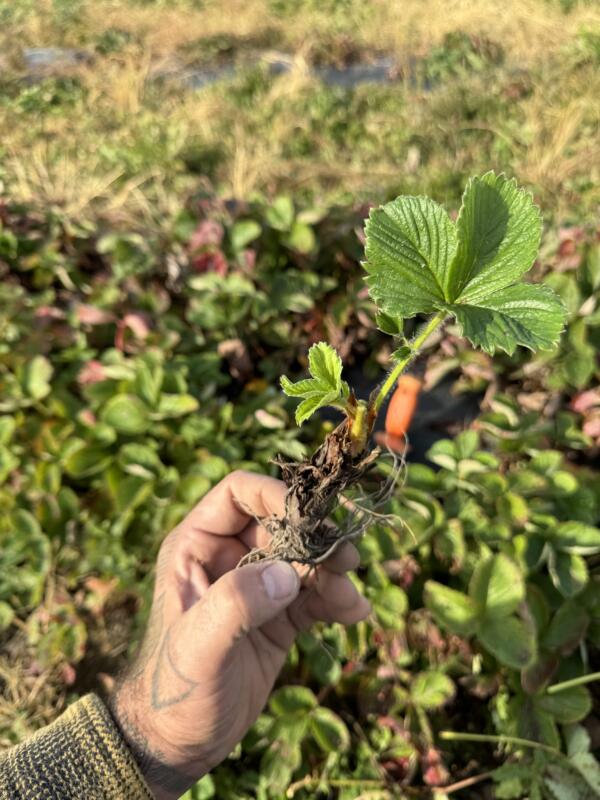
On-farm research trial at Farmacea comparing clover living mulch with conventional plastic mulch in organic strawberry crops.Farmacea’s project is a strawberry trial comparing traditional plastic mulch to a living mulch of white Dutch clover. Their research question is simple but will help Farmacea determine which strawberry planting system will work best for them in the coming years: “Does a living clover mulch produce higher strawberry yields than a plastic mulch?”.

To answer this, they’ve set up six beds. Three beds use the conventional plastic mulch, while the other three are planted with New Zealand White Clover (Trifolium repens) to serve as a living mulch. Both sets of beds include a mix of strawberry cultivars: Earliglow, Chandler, Allstar, and San Andreas, ensuring consistency in strawberry varieties across the trial.

Careful initial planning was essential, focusing on a consistent number and mix of strawberry plants in each bed. Mike and Rollin standardized the beds and timed clover planting, which faced weather-related delays and farm facility damage. Additionally, deer intrusions necessitated the construction of higher fences to protect the crops.

What They’re Measuring

Farmacea will be tracking several key metrics to determine the success of each mulching method:

  • Yield: Weight of harvested berries, percent marketable yield, and pint counts.
  • Brix: A measure of sugar content in the berries.
  • Weed Pressure: Observations and frequency of weeding interventions.
  • Photo Documentation: Keeping a visual record of the trial’s progress.
  • Soil Testing: Collecting samples to analyze soil health.

Data is being collected consistently over the season, with harvests twice weekly. They plan to document everything from the number of pints of berries to the weight of both marketable and unmarketable yields. Brix levels are being measured to gauge the sweetness of the berries and will ideally be taken at three intervals during the strawberry season.

Why This Matters

Farmacea’s trial is about more than just growing strawberries. It’s about finding sustainable options for weed suppression and improving soil health through practices like cover cropping. They are also interested in decreasing their reliance on nonrenewable resources and preventing microplastic contamination in their soil. Implementing a living mulch strategy is intended to lessen the need for manual weeding, enhance soil structure, and foster an environment that naturally inhibits weeds.

“For too long, the bulk of attention, funding, and resources in the agricultural research world have gone toward so-called ‘conventional’ farming methods. As a result, advances in organic farming practices have stalled and many today consider it an inefficient, outdated, and impractical way to produce food. We couldn’t disagree more. We see participating in a research trial on organic farming to be an important step in turning this tide, and hope that it will lead to better understanding and acceptance of these essential practices.”

– Rollin & Mike, Farmacea

Looking Ahead

As the trial progresses, Farmacea will continue to monitor and collect data. Soil tests will be conducted, and observations on weed pressure will be recorded. At the end of the trial, they will analyze the results to determine which mulching method provides the best yields, berry quality, and weed control.

This trial at Farmacea is a perfect example of how farmer-led research can lead to valuable insights and sustainable agricultural practices. By sharing their findings, Farmacea contributes to a broader community of farmers and researchers working towards a healthier, more resilient food system.

Stay tuned:

  • Follow Farmacea on Instagram @farma.cea to see photos and updates as Farmacea’s strawberry trial unfolds!
  • Check back here for future blog posts on the trial’s progress.

This story is part of a series profiling farmers who are taking part in OFRF’s Farmer-Led Trials (FLT) program. Farmers receive technical support from OFRF to address their challenges through structured on-farm trials. To learn more about OFRF Farmer-Led Trials Program, visit our website page at https://ofrf.org/research/farmer-led-research-trials/

Bringing Organic to the Hill: How OFRF is Making Waves in D.C.

By |2025-05-20T16:41:06-04:00May 20th, 2025|News|

Written by Vinnie Trometter

When people think of organic food these days, they might picture a well-stocked grocery store, a local farmers’ market, or their favorite organic snack. What most people don’t picture? A day of meetings on Capitol Hill.

But that’s precisely where you’ll find us.

With the future of agricultural policy in flux and renewed attention on domestic food security, climate resilience, and sustainable farming practices, it’s more important than ever that organic farmers—and the science that supports them—have a seat at the table.

OFRF has been working hard to increase our presence in Washington, D.C., to make sure organic farmers have a voice in the decisions shaping agriculture policy. And what’s been especially encouraging lately is this: organic farming is something both sides of the aisle can get behind.

As OFRF’s point person in D.C., I spend my days walking the halls of Congress, meeting with lawmakers and their staff, and talking about the value of organic farming research. We work closely with coalition partners and farmer representatives to ensure organic perspectives are heard and reflected in policy decisions. What’s striking is that whether I’m in a Democrat’s office or a Republican’s, the conversations almost always land in the same place: organic farming research matters.

With some offices, the conversation might start with a concern about the trade deficit, increasing domestic food production, or improving public health. For others, conversation may focus on sustainability, conservation, and environmental health. But in the end, the key point is the same—investing in organic research benefits farmers in all parts of the country.

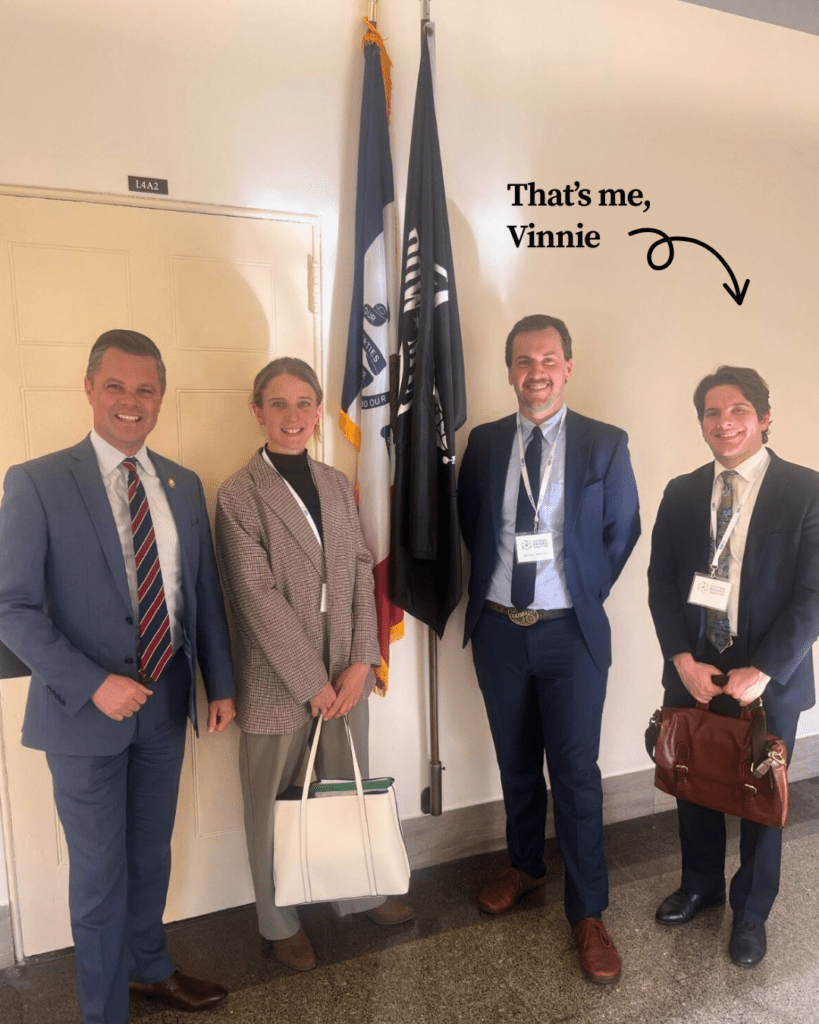
Rep. Nunn (IA-3, R), Alice Runde (NOC), Gordon Merrick (OFRF Sr. Policy & Programs Manager), Vinnie Trometter (OFRF Policy Fellow) during the 2025 NOC Fly-In

Left to right: Rep. Nunn (IA-3, R), Alice Runde (NOC), Gordon Merrick (OFRF Sr. Policy & Programs Manager), Vinnie Trometter (OFRF Policy Fellow) during the 2025 NOC Fly-In

I usually begin with a simple fact: the USDA’s Economic Research Service (ERS) has said that innovation and technology are the main contributors to economic growth in U.S. agriculture. Then, I connect the dots. For example, investing in organic research helps reduce the organic trade deficit, supports American farmers, and ensures consumers get access to food that’s both nutritious and responsibly grown.

From there, we talk specifics. At OFRF, we’re focused on a handful of key programs in this year’s federal budget:

We shape our advocacy based on what farmers tell us they need—through direct conversations, guidance from our Organic Stewardship Council, and insights from thousands of survey responses in the National Organic Research Agenda (NORA).

Each one plays a unique role in boosting productivity, supporting farmer-led innovation, and helping small and mid-sized organic producers thrive. And when we show congressional offices how these programs are already helping researchers and farmers in their own states? That’s when the conversation really clicks.

We’ve found that staying rooted in the facts builds trust. We keep our messaging focused on economic impact, real-world results, and the growing demand for organic food, which now tops $71 billion annually. That resonates whether someone’s priority is market competitiveness or environmental stewardship.

And yes, we’re hearing the concerns about tight budgets. But we also hear this: “These are small investments with big returns.”

The truth is, organic agriculture doesn’t belong to one political party. It’s about innovation, health, economic opportunity, and smart stewardship of our land. And that’s something everyone can get behind.

As OFRF continues to expand our presence in D.C., we’re proud to be a bridge between science, policy, and the people who grow our food. We know this work matters—and we’re grateful to be carrying it forward, one conversation at a time.

From DC, 

Vinnie

circular headshot of Vinnie Trometter

Vinnie Trometter (he/him/his)

By |2025-10-14T14:22:22-04:00May 18th, 2025|Staff|

Policy Manager

email: vinnie[at]ofrf.org

Vinnie Trometter (he/him/his) joins the OFRF team after being involved in a number of agriculture policy campaigns on Capitol Hill relating to anti-trust, pesticide preemptions, climate-smart agriculture, country of origin labeling, the Commodity and Crop Insurance titles of the Farm Bill, and animal welfare laws involving the egg and pork industries.

He also is experienced in international trade issues, having worked at Enterprise Ireland, Ireland’s export promotion agency, and publishing op-eds about tariffs and foreign direct investment in outlets such as the Boston Herald, Chicago Tribune, and the Pittsburgh Post-Gazette.

Vinnie’s passion for organic agriculture stems from his mother growing up on a subsistence organic farm outside of Philadelphia. The family mainly grew specialty crops and would drive into the city on a “huckster truck” to sell fruit and vegetables. Later in life, she became a professor of culinary arts at the Pennsylvania College of Technology for 35 years.

As such, Vinnie grew up heavily influenced by concepts of healthy eating and knowing where your food comes from. He views the promotion of organic agriculture as a way for farmers to mitigate supply chain risks and become better stewards of the land.

Vinnie did his undergraduate studies at Penn State University and earned a master’s degree at Trinity College of Dublin, Ireland. When he is not working, he spends time with family back in Williamsport, PA, and cheers for his Nittany Lions and Pittsburgh Steelers.

Lessons from Organic Seed Usage Farmer Listening Session

By |2025-12-09T17:41:12-05:00May 15th, 2025|News, Plant Breeding & Variety Selection|

Certified organic producers share their challenges and opportunities in organic seed use

Written by Brian Geier

In the sixth Seeds of Success: Farmer to Farmer Networking Session, held on March 5, 2025, nearly 40 participants gathered virtually to share their thoughts and firsthand experiences using and producing organic seed. The session was co-hosted by the National Organic Coalition (NOC), Organic Seed Alliance (OSA), Organic Farming Research Foundation (OFRF), Organic Farmers Association (OFA), and the Ohio Ecological Food and Farming Association (OEFFA). Like all Seeds of Success sessions, this was a facilitated, farmer-to-farmer conversation designed to support farmer-driven solutions, information sharing, and the identification of areas for future research and support.

Understanding the Organic Seed Requirement

The USDA’s National Organic Program (NOP) requires the use of organic seed unless the seeds farmers need, including equivalent varieties, aren’t commercially available, per the Seeds and planting stock planting standard (7 CFR 205.204).

The purpose of the current organic seed exemption is to provide a transition time for the seed industry to catch up to demand and to allow organic growers to find suitable varieties to transition to, with the goal of eventually achieving 100 percent organic seed sourcing. The allowance for non-organic seed is important for growers who lack access to appropriate organic seed for their operations. While it is no one’s intention to force organic growers to use organic seed that may not be optimal for their operations, continuous improvement in organic seed sourcing is essential to incentivizing growth in the organic seed supply and strengthening organic integrity. 

The dialogue from participants in this networking session is summarized below and will help guide advocacy for balanced solutions that strengthen organic integrity and the seed supply.

The State of Organic Seed report from the Organic Seed Alliance provides insights on organic seed usage and an action plan to increase organic seed supply while fostering decentralized organic seed grower networks.

Key Insights from the Listening Session

Seed Grower and Researcher Perspectives 

  • Organic seed availability: Availability varies by crop and scale. Small-scale farmers can often source organic seeds, but large-scale operations struggle, especially for grains, cover crops, and certain vegetables.
  • Challenges in organic seed supply: Limited year-round availability, lack of regionally adapted varieties, and difficulties in securing non-proprietary and open-pollinated (OP) seeds.
  • Improving NOP seed regulations: Calls for 100% organic seed requirements, incentives for seed stewardship, cost reductions for certification, and stricter enforcement of organic seed sourcing.
  • Handlers & certifiers’ role: Processors often dictate seed choices, limiting organic adoption. NOP could regulate processor demands and improve certifier tools for verifying organic seed availability.
  • Organic seed database: A centralized database could help track seed availability and genetics, but concerns exist over maintenance, participation, and potential large-scale buyouts by industrial players.

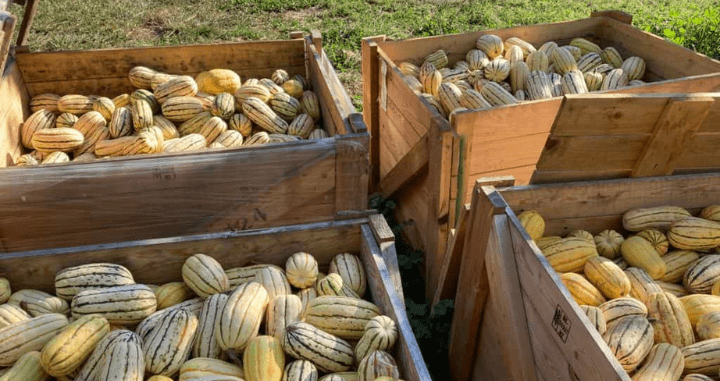
A Delicata squash seed crop cures in bins at White Oak Farm and Education Center, Oregon.

Producer Insights 

  • Organic seed value: Many farmers see organic seed as important for soil health, resilience, and expanding organic acreage. However, cost and availability remain major concerns.
  • Barriers to organic seed use: High costs, limited availability, and documentation challenges make it difficult for some farmers to use exclusively organic seed.
  • Recordkeeping & compliance: Some producers find documentation burdensome, while others see it as manageable or even beneficial for farm planning.
  • Suggestions for NOP: Farmers suggest stricter organic seed regulations, incentives for seed saving, and better coordination with seed breeders to address regional challenges.
  • Seed breeding needs: More transparency, regional adaptability, and climate-resilient varieties are key priorities for growers. Many emphasize the importance of seed saving and collaboration.

Voices from Technical Service Providers, Policymakers, and Educators

  • Organic seed challenges: Farmers struggle with sourcing organic seed due to cost, limited availability, and contract restrictions. Wholesalers often don’t prioritize organic-specific varieties.
  • Mentorship & seed production: Limited mentorship opportunities for organic seed growers. Some interest exists, but infrastructure and certification barriers remain.
  • Certifier & inspector role: Inspectors find it difficult to enforce commercial availability rules and assess variety choices. A shift to acreage-based benchmarks for organic seed use may be more feasible.
  • Database for organic seed: Need for a centralized, up-to-date seed availability database, but challenges exist in funding, maintenance, and neutrality. Potential for regional databases or collaboration with certifiers.
  • NOP & seed policy: Calls for stronger organic seed regulations, incentives for growers, and addressing handler influence on seed selection.

Looking Ahead

We are incredibly grateful to our co-hosts for this session — NOC, OSA, OFA, and OEFFA — whose collaboration, recruitment, and facilitation support made the conversation possible.

We are looking forward to disseminating these findings with the National Organic Standards Board, the National Organic Program, and the entirety of the organic seed industry spectrum (from growers, to seed breeders, retailers, and researchers). Based on the interest of participants and registrants, we are looking at hosting similar iterations of the conversation, making space for more voices and perspectives.

For another perspective and complementary summary, we recommend reading this recap of the listening session from the National Organic Coalition, which includes additional context and reflections.

About the Seeds of Success Series

OFRF has partnered with the Organic Farmers Association (OFA) and National Organic Coalition (NOC) to lead a series of virtual farmer-to-farmer networking sessions. These facilitated events will be engaging opportunities for farmers to share their challenges and successes, and will be accompanied with relevant resources you can use.

To learn more about these and other events from OFRF visit: https://ofrf.org/events/

Funding for this series is provided by a cooperative agreement between OFRF and USDA- NIFA to highlight research investments made through both OREI and ORG grant programs.

Learn more about the Organic Agriculture program at USDA-NIFA at:  https://www.nifa.usda.gov/grants/programs/organic-agriculture-program

Spring Storms in Policymaking: How Organic Research is Affected by Reconciliation

By |2025-05-08T13:56:48-04:00May 8th, 2025|Gordon's Policy Corner, News|

Written by Gordon Merrick and Vinnie Trometter

If you have been following the twists and turns of the recent policy developments in Washington, D.C., you may have heard about something called “reconciliation.” It’s a powerful tool used by Congress to “reconcile” current revenue & spending priorities with past revenue & spending allocations. Reconciliation is a process that is largely out of the public’s eye, primarily due to the rushed nature in which this tool is usually employed. For advocates of organic farming and publicly-funded agricultural research, reconciliation can have profound implications on the future of important programs.

What is Reconciliation? What’s going on right now?

Reconciliation is a fast-track budget process that allows Congress to adjust spending, revenue, and debt limits with a simple majority vote, bypassing the usual 60-vote threshold for policy changes in the Senate. While reconciliation bills are limited to budget matters (generating revenue, adjusting spending, or amending the debt limit), they can have sweeping policy implications by changing the structure or availability of funding that critical programs and agencies rely on.

Right now, House and Senate leaders are exploring reconciliation as a vehicle for securing spending cuts and tax reforms before the end of the fiscal year. Speaker Johnson and conservative members of the House have pushed for a total cut of $1.5 trillion across federal spending, with the House Agriculture Committee tasked with up to $230 billion of that total. That places major Farm Bill programs, especially those tied to nutrition, commodities, conservation, and research, squarely at issue in this process.

To make this all more urgent, the goal of this process is to get legislation on the President’s desk by Memorial Day, May 26. That is an astoundingly fast timeline with long-lasting implications.

What’s at Stake for Organic Research?

Like most of American agriculture, the Farm Bill authorizes most of the research, extension, and data work that supports organic agriculture. This includes funding for the Organic Agriculture Research and Extension Initiative (OREI), the Organic Markets and Data Initiative (ODI), and broader programs that also fund organic agriculture projects like the Agriculture and Food Research Initiative (AFRI) and the Specialty Crop Research Initiative (SCRI).

All of these programs ensure that organic and transitioning to organic producers have access to regionally-relevant science, economic tools, and opportunities for system-level innovation. They fund partnerships between farmers, researchers, Land-Grant Universities, and nongovernment organizations to answer practical questions and improve long-term viability of the U.S. organic sector. But, if the longstanding Farm Bill coalition is fractured by including some controversial funding changes without bipartisan buy-in, then any incentive to pass a robust, bipartisan Farm Bill in the 119th Congress could evaporate. That would leave these essential research programs running on authorities from 2018 legislation written for a radically different moment in time.

An Already Strained System

The Research, Education, and Economics (REE) agencies are already strained: over 15,000 USDA employees are accepting the USDA’s second Deferred Resignation Program. This includes over 1,600 in the REE agencies, representing a massive loss of institutional knowledge and capacity, particularly in agencies already short-staffed like Agricultural Research Service (ARS) and the National Institute of Food and Agriculture (NIFA).

At the same time, organic research funding is already disproportionately low. Organic products account for over 6% of U.S. food sales and more than 15% of produce sales, yet less than 2% of USDA’s research budget and less than 1% of ARS’ funding goes to organic topics. That gap has helped fuel a surge in organic imports, while U.S. acreage and exports stagnate. New data from the USDA’s 2025 Organic Situation Report reinforces that, without major investments, the U.S. will fall further behind in meeting growing domestic and export demand with homegrown production.

Organic farmers and the researchers and extension professionals they rely on deserve better than a legislative game of chicken. Reconciliation wasn’t designed to replace the Farm Bill, and without a new Farm Bill that responds to today’s challenges, we risk the opportunity to meet the needs of today’s farmers to overcome tomorrow’s challenges.

Call to Action

We don’t need to shoehorn Farm Bill legislating into reconciliation cost-saving. We need a Farm Bill built on bipartisan cooperation, one that reinvests in rural communities, public research, and organic agriculture systems.

The coming weeks are going to be critical. As committees move toward decisions, it is essential that members of Congress hear from constituents who care about the future of organic agriculture. Public investments in organic research are not a luxury, they are a backbone of a resilient, regionally-adapted, and economically-vibrant food system.

Call your Representative and Senators. Show up at district events. Tell your story. A far-reaching and forward-looking Farm Bill is still possible; but only if we demand it.

Eat well and breathe deeply,

Gordon & Vinnie

OFRF-Funded Organic Strawberry Researcher Receives Prestigious Sustainability Leadership Award

By |2025-05-06T19:51:50-04:00May 6th, 2025|News|

Written by Elizabeth Tobey, OFRF Communications Manager

In 2019, Dr. Joji Muramoto became the first Cooperative Extension Specialist in the University of California (UC) system dedicated specifically to organic agriculture. This week, he will receive an award from the Agricultural Sustainability Institute (ASI) at UC Davis for his contribution to organic agriculture research.

The 2025 Eric Bradford and Charlie Rominger Agricultural Sustainability Leadership Award recognizes and honors the legacy of Eric Bradford and Charlie Rominger by celebrating the leadership of an individual who has worked to promote agricultural sustainability.

Some of the most significant scientific advancements in strawberry research have been made by Dr. Muramoto and Dr. Carol Shennan at UC Santa Cruz, where they have pioneered alternatives to methyl bromide in commercial strawberry production. The practices of anaerobic soil disinfestation (ASD), an alternative to soil fumigation for the control of soil pathogens and nematodes, developed by Dr. Muramoto and colleagues, have been widely adopted among organic and conventional strawberry growers in California.

From an early age in suburban Tokyo, Japan, Dr. Muramoto was interested in the organic movement. “Organic farmers there told me repeatedly, ‘Soil is the foundation of farming.’ That’s when I got interested in soil science,” he says. As he advanced in his career, he found that helping growers was especially rewarding. “My passion is to help organic and conventional farmers make their farms more sustainable: ecologically sound, economically viable, and socially just.”

Dr. Muramoto’s influential research focuses on enhancing soil health and promoting the sustainability of organic agriculture in California through transdisciplinary agroecological approaches. Since 1996, he has conducted research and extension on fertility and soil-borne disease management in organic strawberry and vegetable production and fumigant alternatives in conventional strawberry production in coastal California.

The Organic Farming Research Foundation (OFRF) began following Dr. Muramoto’s research in 1997 when we helped to initiate the work with a research grant. OFRF awarded additional grants in 2003 and 2010, which have since been leveraged to secure more than $5 million in funding from state and federal agencies to support this pivotal work. “I thank OFRF for its support from the beginning of my career at Santa Cruz,” Dr. Muramoto said when we reached out to congratulate him on this award. We applaud researchers like Dr. Muramoto, whose work exemplifies the ways that organic research can lead to innovative solutions that benefit the whole farming community, conventional and organic alike.

With organic agriculture as the fastest-growing sector in the United States’ food market, accounting for over 6% of total food sales and 15% of all produce sales, we believe it should receive a proportionate amount of research funding. However, organic research currently receives less than 2% of USDA’s research funding, and less than 1% of the Agricultural Research Service’s (ARS) research budget. Additionally, the research agencies at the USDA have not been spared from the current administration’s budget cuts and widespread firings.

Agricultural research is the backbone of the technical and financial assistance programs operated by the USDA that ensure food security, food safety, environmental sustainability, and economic vitality for the United States. We are committed to continuing to advocate for the funding that organic agriculture research deserves, enabling scientists like Dr. Muramoto to continue to pave the way towards sustainable solutions for all farmers.

Read more about our Policy Priorities here, and explore additional research in our new searchable resource database, The Organic Research Hub.

This story was adapted from a press release by UC Davis and a previous story OFRF released about Dr. Muramoto’s work.

Marina Santos (they/them)

By |2025-09-25T08:59:29-04:00May 6th, 2025|Uncategorized|

Policy & Communication Intern, Spring-Summer 2025

Marina Santos (they/them) was the 2025 Spring-Summer Policy & Communications intern with OFRF. With their background in Animal Science, they have spent the last five years working in the biomedical science field, with a recent focus on drug addiction. They are currently pursuing a Master’s degree in Food and Agriculture Law and Policy through Vermont Law and Graduate School. School nutrition and food security are areas that Marina believes can be strengthened through community outreach.

Go to Top