
Resource

2025 Research Summary on Conservation Benefits of Organic Management

This document provides a summary of the latest organic agriculture research across a variety of topics, meant to provide NRCS staff, organic producers, and other interested parties with in-depth educational information on the conservation benefits of organic management.
This research summary was produced with support from the United States Department of Agriculture’s Natural Resources Conservation Service (USDA-NRCS) under Cooperative Agreement No. FBC24CPT0013867. The contents are solely the responsibility of the authors and do not necessarily reflect the views of USDA-NRCS.

By |2026-01-15T13:49:25-05:00January 15th, 2026|Advocacy, Resource|

Adding the “O”: Farmer Perspectives and Experiences Transitioning to Organic in the Northwest

Farmers transitioning to organic production face unique challenges that require technical assistance on a wide range of production and non-production issues. During the transition period farmers must consider financially viable strategies for the three-year transition period, how to restore soil health while learning to manage weeds without herbicides, acquiring new equipment and infrastructure needed for organic production, and navigating NOP-related paperwork during the last year of transition and first year of certification. This webinar features three farmers that have worked through these issues, who share their experiences and thoughts for demystifying some of the challenges they faced in the process. In this session we feature three farmers in the Northwest that have built resilience and a dynamic organic system:

Lynn Schaal, Life Springs Farm – Idaho Tracey Dion,

Yellowstone River Farms – Montana Aaron Flansburg,

Flansburg Farm – Washington

About the Seeds of Success Series OFRF has partnered with the Organic Farmers Association (OFA) and National Organic Coalition (NOC) to lead a series of virtual farmer-to-farmer networking sessions. These facilitated events will be engaging opportunities for farmers to share their challenges and successes, and will be accompanied with relevant resources you can use.

To learn more about these and other events from OFRF visit: https://ofrf.org/events/ Funding for this series is provided by a cooperative agreement between OFRF and USDA- NIFA to highlight research investments made through both OREI and ORG grant programs.

By |2026-01-16T11:13:31-05:00January 15th, 2026|Certification & Compliance, Resource|

Strategies for Successful Researcher Farmer Collaboration

Have you ever wondered how to connect with a farmer or researcher to conduct on-farm research? This Researcher- Farmer Virtual Networking event highlights the successes and challenges of engaging in farmer-researcher partnerships and focuses on building positive outcomes for farmer and researcher collaboration in organic agriculture. OFRF are joined by four speakers that have participated in successful organic research projects funded by USDA NIFA. Two researchers: Julie Grossman and Eric Gallandt, and their farmer collaborators, Seth Kroeck and KaZoua Berry, share details on their experience and the process of engaging in on-farm research. The session begins with a brief introduction on USDA-NIFA organic programs and featured facilitated conversations on the topic of collaborative farmer-researcher projects that will support information sharing and identify possibilities for future research partnerships. This is the first in the Seeds of Success Networking Sessions from OFRF, from October 2023. To learn more about these and other events from OFRF visit: https://ofrf.org/events/ Funding for this series is provided by a cooperative agreement between OFRF and USDA- NIFA to highlight research investments made through both OREI and ORG grant programs.

By |2026-01-16T11:14:54-05:00January 15th, 2026|On-Farm Research, Resource|

Building Successful Farmer-Researcher Collaboration

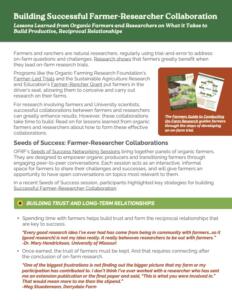
Farmers and ranchers are natural researchers, regularly using trial-and-error to address on-farm questions and challenges. Research shows that farmers greatly benefit when they lead on-farm research trials.

Programs like the OFRF’s Farmer-Led Trials and the Sustainable Agriculture Research and Education’s Farmer-Rancher Grant put farmers in the driver’s seat, allowing them to conceive and carry out research on their farms.

For research involving farmers and University scientists, successful collaborations between farmers and researchers can greatly enhance results. However, these collaborations take time to build. Read our report on for lessons learned from organic farmers and researchers about how to form these effective collaborations.

Front cover of seeds of success resource
By |2025-12-19T12:51:02-05:00December 19th, 2025|On-Farm Research, Resource|

An Organic Approach to Increasing Resilience

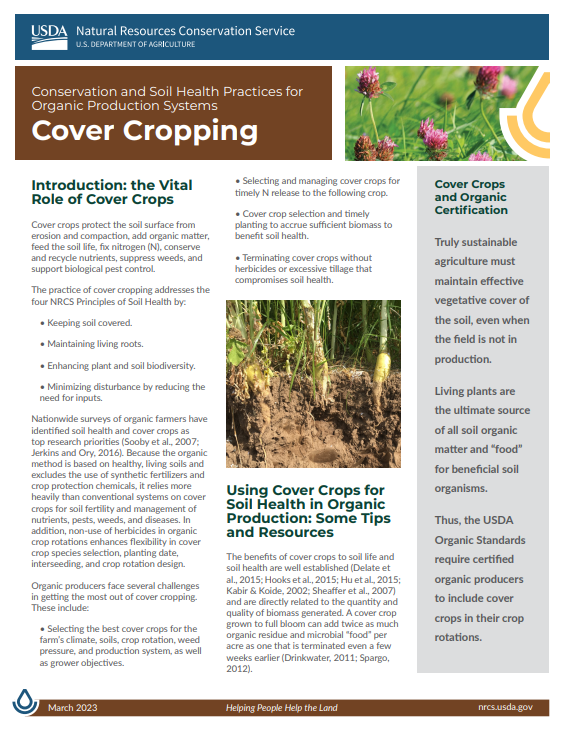
Few farmers need official reports to tell them that “increasing weather volatility” and climate change threaten their livelihoods and the resilience of their farming and ranching operations. With historic droughts, wildfires, flooding, and hurricanes in recent years, more farms are facing variable yields, crop losses, increased weed, pest, and disease pressures, and intensifying soil degradation, erosion, and compaction.

By utilizing organic and sustainable practices to build soil health, farmers and ranchers can improve their resilience and reduce risk as our climate changes. While practices can vary depending on your operation, establishing optimum soil organic matter (SOM) and biological
activity will help your operation through the difficult times to come.

Adding the “O”: Farmer Perspectives and Experiences Transitioning to Organic

Are you beginning the process of transitioning your farm to certified organic? Are you wondering how others have overcome the hurdles of certification? Would you like to hear directly from farmers who have successfully made their transition to organic?

This webinar features two farmers that share their experiences and thoughts for demystifying some of the challenges they faced in the process.

Our Farmer Panelists:

  • Mike Bronkema of Shady Side Farm in Michigan began his journey in 1992 with a conventional layer operation. With the help of his wife, Mike has now transitioned 150 acres into a diversified farm of 20 different varieties of edible dry beans as well as heritage small grains, such as einkorn and spelt, and open-pollinated corn. https://shadysidefarm.com/
  • Dakota Moore of Moore Family Farm in Michigan began the transition in 2019. Dakota was raised on the historic Moore Family Farm in Warsaw, North Carolina, which has been around since 1833. He and his father work together on the farm where they specialize in the production of Watermelon, Cantaloupe, Cauliflower, Collard Greens, Cabbage, Butterhead and Romaine Lettuce.
By |2026-01-16T11:26:10-05:00December 17th, 2025|Certification & Compliance, Resource|

NRCS Organic Practice 823: Strategies and Best Practices

During this session of the Seeds of Success series OFA explores NRCS Organic Practice 823.

The National Resources Conservation Service (NRCS) has many programs to help farmers convert to organic farming operations. The Environmental Quality Incentives Program (EQIP) is a conservation program that helps farmers, ranchers and forest landowners integrate conservation into working lands. Under EQIP, Organic Transition Initiative 823 (OTI) is specifically meant to help those transitioning to organic operations, by cost-sharing and providing technical support on practices organic and transitioning farmers want to implement on their farms.

This program is relatively new, and a little different than other NRCS practices. Hear directly from ag professionals and farmers about their experiences with 823 and their ideas regarding how to best utilize this valuable conservation planning tool.

By |2026-01-16T11:26:02-05:00December 17th, 2025|Certification & Compliance, Federal Assistance, Resource|
Go to Top