
Resource

Infrastructure and Crop-Livestock Integration

In OFRF’s 2022 National Organic Research Agenda (NORA), organic farmers and ranchers across North America shared a common concern about the lack of technical assistance and educational resources available for Integrated Crop-Livestock Systems (ICLS). Integrating crops and livestock results in numerous benefits, however the process can also lead to increased complexity, especially for farmers who must adhere to National Organic Program rules and regulations.

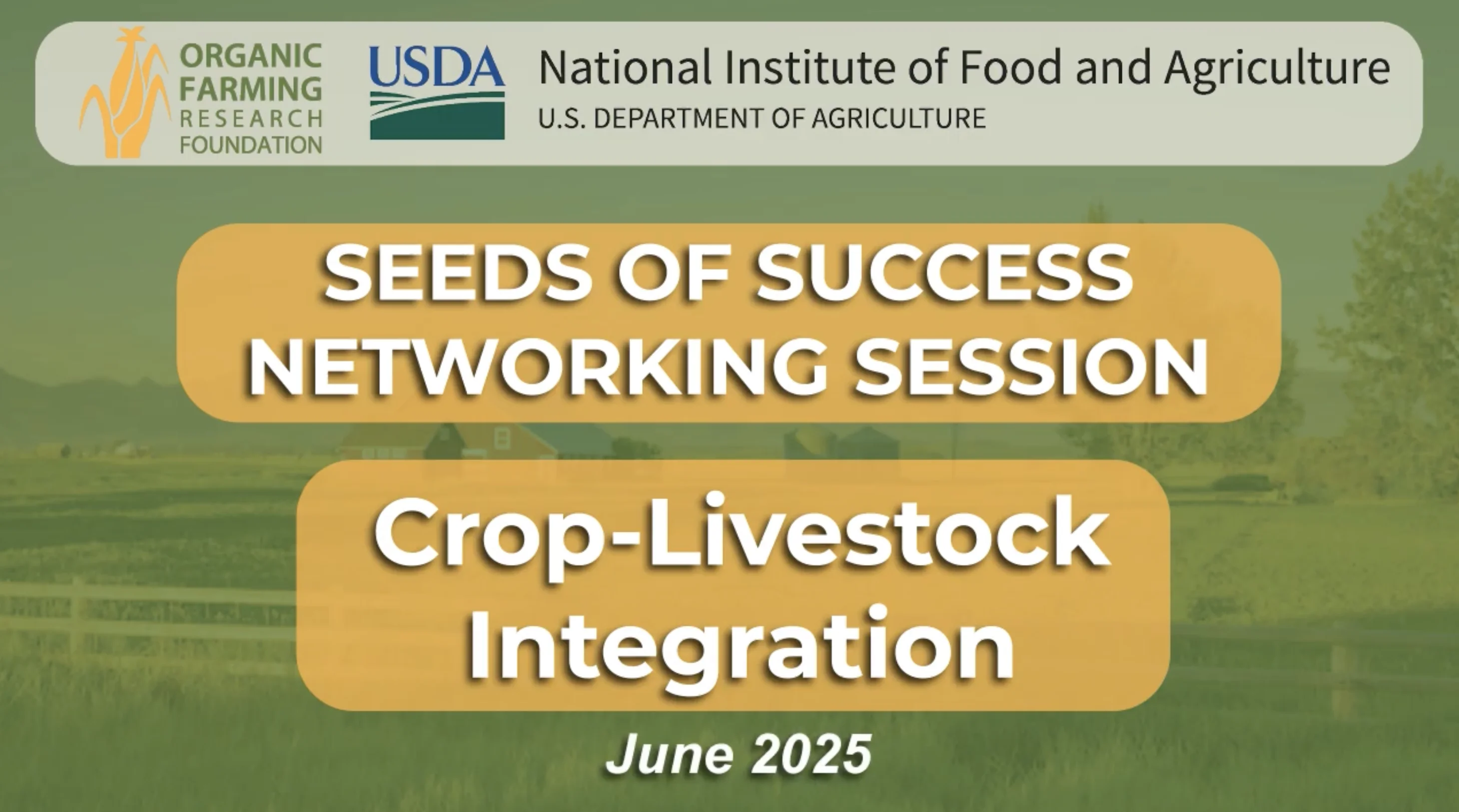
This series of resources focused on Crop-Livestock Integration is informed by interviews with four highly-experienced organic producers that shared their challenges, successes, and advice for others interested in integrating livestock and crops on their organic farms.

Infrastructure for integrating animal and crop systems includes animal housing, watering systems, and fencing. Learn how farmers develop infrastructure that match the type and age of animal, are highly movable, and are adapted to soil and climate conditions.

Infrastructure for Crop Livestock Integration report cover

Adding the “O”: Farmer Perspectives and Experiences Transitioning to Organic

Are you beginning the process of transitioning your farm to certified organic? Are you wondering how others have overcome the hurdles of certification? Would you like to hear directly from farmers who have successfully made their transition to organic?

This webinar features two farmers that share their experiences and thoughts for demystifying some of the challenges they faced in the process.

Our Farmer Panelists:

  • Mike Bronkema of Shady Side Farm in Michigan began his journey in 1992 with a conventional layer operation. With the help of his wife, Mike has now transitioned 150 acres into a diversified farm of 20 different varieties of edible dry beans as well as heritage small grains, such as einkorn and spelt, and open-pollinated corn. https://shadysidefarm.com/
  • Dakota Moore of Moore Family Farm in Michigan began the transition in 2019. Dakota was raised on the historic Moore Family Farm in Warsaw, North Carolina, which has been around since 1833. He and his father work together on the farm where they specialize in the production of Watermelon, Cantaloupe, Cauliflower, Collard Greens, Cabbage, Butterhead and Romaine Lettuce.
By |2026-03-02T11:55:38-05:00November 18th, 2024|Certification & Compliance, Resource|

Farmer-Led Trials Forum 2024

OFRF believes in supporting organic farmers and ranchers in their constant search for innovation and farm profitability. The Farmer-Led Trials (FLT) program puts farmers in the driver’s seat and recognizes their wisdom, experimentation, and problem-solving skills. Built in the spirit of curiosity and collaboration, this program supports farmers and ranchers in conducting impactful research that can address their unique challenges. The FLT provides farmers with technical assistance and a small amount of funding to investigate and learn about solutions to their most pressing production challenges.

In this forum, you will hear from four of the organic farmers in the 2024 FLT cohort:

  • Maggie Dungan (Salad Days Farm, KY),
  • Jorge Reyes (Reyes Vineyard, CA),
  • Nathan Lada (Green Things Farm Collective, MI), and
  • Rhianna Simes (Verdant Phoenix Farm, OR).

OFRF staff will also provide an overview of steps to conduct on-farm research trials, share opportunities to participate in the program, and explain how it can impact your farm operation.

Strategies for Identifying and Navigating Organic Markets

The Seeds of Success series brings farmers together for peer-to-peer networking and discussion. In this session, three women organic farmers share their experiences growing markets for organic products, followed by Q&A and breakout sessions to exchange ideas.

Topics covered include identifying market opportunities, developing strategies for organic products, and overcoming common challenges. This webinar provides actionable insights from real-world farm experiences.

Farmer presenters include:

Watch the full recorded session to hear directly from farmers and gain strategies you can apply to your own operation.

By |2026-03-02T11:52:03-05:00October 20th, 2024|Marketing, Resource|

NRCS Organic Practice 823: Strategies and Best Practices

During this session of the Seeds of Success series OFA explores NRCS Organic Practice 823.

The National Resources Conservation Service (NRCS) has many programs to help farmers convert to organic farming operations. The Environmental Quality Incentives Program (EQIP) is a conservation program that helps farmers, ranchers and forest landowners integrate conservation into working lands. Under EQIP, Organic Transition Initiative 823 (OTI) is specifically meant to help those transitioning to organic operations, by cost-sharing and providing technical support on practices organic and transitioning farmers want to implement on their farms.

This program is relatively new, and a little different than other NRCS practices. Hear directly from ag professionals and farmers about their experiences with 823 and their ideas regarding how to best utilize this valuable conservation planning tool.

By |2026-03-02T11:54:58-05:00July 29th, 2024|Certification & Compliance, Federal Assistance, Resource|

Crop Insurance for Organic Farmers: What’s Working, What’s Not, and How We Can Make it Work for Us

In a changing climate, crop insurance can make or break a farmer’s ability to keep farming the next year. But this federally subsidized program, intended as a safety net for farmers, serves some producers, growing a few specific crops, better than others. The program, as currently designed, feeds into consolidation of land and resources in agriculture, with crop insurance being the only subsidized farm program with no upper limit on the funds that a farmer can receive from the federal government, a practice that reinforces existing power structures and leads to fewer, bigger, and less diverse farms.

Organic and transitioning farmers, specifically, find themselves misunderstood and underserved in the crop insurance system, as their practices, rotations, transition, and certification processes are not widely understood by the agents serving them, and can be in conflict with Risk Management Agency requirements.

Noah Wendt of A&W Farms in Iowa and Seth Kroeck of Crystal Spring Farm in Maine share their experiences with crop insurance.

Seeds of Success Webinar | The Organic Farming Research Foundation (OFRF), is partnering with the Organic Farmers Association (OFA), and National Organic Coalition (NOC) to host a series of virtual farmer-to-farmer networking sessions, Seeds of Success. These facilitated events will be interactive, informal spaces for farmers to share their challenges and successes, and will give farmers an opportunity to have open conversations on topics most relevant to them.

For more information about the Organic Farmers Association and its programs, resources, and events, please visit: https://organicfarmersassociation.org

This work was supported through the United States Department of Agriculture (USDA) Transition to Organic Partnership Program (TOPP). TOPP is a program of the USDA Organic Transition Initiative and is administered by the USDA Agricultural Marketing Service (AMS) National Organic Program (NOP). For more information about TOPP or transitioning to organic, please visit: http://www.organictransition.org

By |2026-03-02T11:54:16-05:00April 17th, 2024|Federal Assistance, Resource|

TOMI: Organic Management and Improvement of Tomatoes

Building on previous research (TOMI Phase I), the Tomato Organic Management and Improvement – TOMI Phase II project integrates soil microbiome research, induced systemic resistance, and farmer-participatory breeding to develop disease-resistant, flavorful tomatoes for organic systems. Microbial biofungicides and organic amendments support healthy soils while reducing pathogen risks. Advanced breeding lines show promise for regional adaptation and market-ready quality. Download the full report to learn more about tomato varieties and soil-based disease management strategies.

By |2026-03-02T12:19:20-05:00February 12th, 2024|On-Farm Research, Plant Breeding & Variety Selection, Resource|

Carrot Improvement for Organic Agriculture: Leveraging On-Farm and Below-Ground Networks

The Carrot Improvement for Organic Agriculture (CIOA) project develops carrot varieties suited to organic systems, using farmer-participatory trials and soil microbiome research. These efforts improve disease resistance, nutrient uptake, flavor, and market traits. Advanced breeding lines include orange, purple, red, and yellow carrots with improved resilience and quality. Download the full report to learn more about these varieties and on-farm research insights.

By |2026-03-02T12:18:10-05:00February 12th, 2024|On-Farm Research, Plant Breeding & Variety Selection, Resource|

Organic Management of Honey Bees

This resource provides a comprehensive factsheet based on Penn State research comparing conventional, chemical-free, and organic honey bee management systems across 288 colonies. It highlights critical findings on colony health, overwintering survival, and the surprising economic superiority of organic methods, which yielded the highest honey production and net profit.

Download the factsheet to discover how organic miticides and mechanical interventions can effectively manage pests like Varroa mites to support resilient, high-yielding apiaries without the use of synthetic chemicals.

image of two-page pdf factsheet on the organic management of honey bees
By |2026-03-02T12:27:24-05:00February 12th, 2024|Insects & Diseases, On-Farm Research, Resource|

Demystifying the National Organic Standards Board (NOSB) for Farmers

Organic producers and processors must follow strict standards to become certified—but who decides what is and isn’t allowed on organic farms? Not your certifier! The USDA National Organic Program (NOP), in consultation with the National Organic Standards Board (NOSB), sets these rules.

In 2024, the National Organic Coalition (NOC) hosted a Seeds of Success virtual session for organic and transitioning farmers, where a panel of farmers and advocates demystified the NOSB. Panelists explained the Board’s role in shaping organic standards, how decisions are made, and how written and oral comments can influence outcomes.

Panelists included Steve Ela (Former NOSB Chair, NOC NOSB Specialist, Ela Family Farms, CO), Harriet Behar (Former NOSB Chair, NOC Advisor, OFA Farmer Services Consultant, Sweet Springs Farm, WI), and Amy Bruch (Current NOSB Vice Chair, Cyclone Farms, NE).

screenshot of mp4 recording of Demystifying the NOSB webninar
By |2026-03-02T11:52:33-05:00January 30th, 2024|Certification & Compliance, Resource|
Go to Top