Resource

Farmers are Researchers: Conducting your own on-farm research

Farmers and ranchers conduct experiments all the time. They constantly test and modify new or improved ways to farm. In this webinar, farmers will learn about adding a few scientific steps to their farm tests that can produce more reliable results that they can trust. OFRF is excited to present this workshop as part of the new OFRF Farmer-led Trials Program (FLT) and the accompanying publication Farmers Guide to On Farm Research.

This webinar recording covers the official launch of OFRF’s Farmer-Led Trials Program, which promotes farmer-led innovations in organic farming. Learn how this program can support farmers and ranchers like you in conducting practical, on-farm research.

By |2026-03-02T12:03:51-05:00November 11th, 2023|Certification & Compliance, On-Farm Research, Resource|

Strategies for Successful Researcher Farmer Collaboration

Have you ever wondered how to connect with a farmer or researcher to conduct on-farm research? This Researcher- Farmer Virtual Networking event highlights the successes and challenges of engaging in farmer-researcher partnerships and focuses on building positive outcomes for farmer and researcher collaboration in organic agriculture. OFRF are joined by four speakers that have participated in successful organic research projects funded by USDA NIFA. Two researchers: Julie Grossman and Eric Gallandt, and their farmer collaborators, Seth Kroeck and KaZoua Berry, share details on their experience and the process of engaging in on-farm research. The session begins with a brief introduction on USDA-NIFA organic programs and featured facilitated conversations on the topic of collaborative farmer-researcher projects that will support information sharing and identify possibilities for future research partnerships. This is the first in the Seeds of Success Networking Sessions from OFRF, from October 2023. To learn more about these and other events from OFRF visit: https://ofrf.org/events/ Funding for this series is provided by a cooperative agreement between OFRF and USDA- NIFA to highlight research investments made through both OREI and ORG grant programs.

By |2026-03-02T12:05:05-05:00November 10th, 2023|On-Farm Research, Resource|

Crop Livestock Integration with John Bitter

In OFRF’s 2022 National Organic Research Agenda (NORA), organic farmers and ranchers across North America shared a common concern about the lack of technical assistance and educational resources available for Integrated Crop-Livestock Systems (ICLS). Integrating crops and livestock results in numerous benefits, however the process can also lead to increased complexity, especially for farmers who must adhere to National Organic Program rules and regulations.

This series of resources focused on Crop-Livestock Integration is informed by interviews with four highly-experienced organic producers that shared their challenges, successes, and advice for others interested in integrating livestock and crops on their organic farms.

This video features John Bitter, Production Manager and co-owner of Frog Song Organics. Frog Song is a diversified organic farm producing vegetables, orchard crops, herbs, flowers, pork, and eggs. Operating on 62 acres in north Florida, Frog Song employs about 30 full-time workers, supplies direct and wholesale markets in several nearby cities, and runs an online, customizable CSA program. In this video, John talks about integration of crop and animal production systems at this thriving organic farm.

Plants sprouting with the Organic Farming Research Foundation Logo

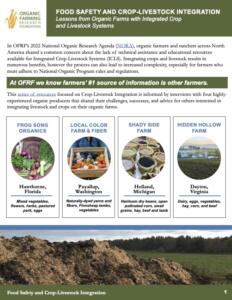
Food Safety and Crop-Livestock Integration

In OFRF’s 2022 National Organic Research Agenda (NORA), organic farmers and ranchers across North America shared a common concern about the lack of technical assistance and educational resources available for Integrated Crop-Livestock Systems (ICLS). Integrating crops and livestock results in numerous benefits, however the process can also lead to increased complexity, especially for farmers who must adhere to National Organic Program rules and regulations.

This series of resources focused on Crop-Livestock Integration is informed by interviews with four highly-experienced organic producers that shared their challenges, successes, and advice for others interested in integrating livestock and crops on their organic farms.

Food safety is a critical concern for any farmer, and those with integrated systems must take extra precautions. Learn how organic farmers identify and mitigate critical points for food safety and where you can find assistance in developing a food safety plan for your farm.

Food Safety and Crop Livestock Integration report cover

Benefits of Crop-Livestock Integration

In OFRF’s 2022 National Organic Research Agenda (NORA), organic farmers and ranchers across North America shared a common concern about the lack of technical assistance and educational resources available for Integrated Crop-Livestock Systems (ICLS). Integrating crops and livestock results in numerous benefits, however the process can also lead to increased complexity, especially for farmers who must adhere to National Organic Program rules and regulations.

This series of resources focused on Crop-Livestock Integration is informed by interviews with four highly-experienced organic producers that shared their challenges, successes, and advice for others interested in integrating livestock and crops on their organic farms.

Learn about the benefits of crop-livestock integration, including reduced inputs, improvements in soil tilth and health, higher nutrient densities in food and forages, pest control in crops and livestock, decreased need for mechanical cultivation, and more.

Benefits of Crop Livestock Integration report cover

Crop Rotations and Crop-Livestock Integration

In OFRF’s 2022 National Organic Research Agenda (NORA), organic farmers and ranchers across North America shared a common concern about the lack of technical assistance and educational resources available for Integrated Crop-Livestock Systems (ICLS). Integrating crops and livestock results in numerous benefits, however the process can also lead to increased complexity, especially for farmers who must adhere to National Organic Program rules and regulations.

This series of resources focused on Crop-Livestock Integration is informed by interviews with four highly-experienced organic producers that shared their challenges, successes, and advice for others interested in integrating livestock and crops on their organic farms.

Farmers with ICLS utilize carefully-planned rotations of  crops and animals that intersect and overlap to provide benefits to soil, crop, and livestock health. Read about and see illustrations of examples of integrated crop and animal rotations developed by organic farmers.

Crop Rotations and Crop-Livestock Integration report cover

Organic Management Guide for Canada Thistle

Effective Canada thistle management centers on exhausting its storage roots and preventing new seed production. This factsheet highlights the critical role of timing, especially removing shoots in late spring, when root reserves are at their lowest. Farmers will find practical organic strategies to disrupt regrowth, reduce thistle vigor, and maintain long-term field health.

By |2026-03-02T11:36:03-05:00November 21st, 2022|Resource, Weeds|

Managing Yellow and Purple Nutsedge in Organic Systems

Controlling weeds is the top challenge for organic farmers, and nutsedges are among the most persistent weeds in organic production, with unique stress tolerances that make them difficult to control. This factsheet explains the biology and environmental preferences of yellow and purple nutsedge, along with organic management tactics tailored to their behavior. It also includes key preventative measures to help limit establishment and reduce long-term impacts on crop and soil health.

By |2026-03-02T11:35:05-05:00November 21st, 2022|Resource, Weeds|

Field Bindweed Management: Organic Weed Control Strategies

Controlling weeds is the top challenge for organic farmers, and field bindweed can be especially persistent. This factsheet provides species-specific strategies for managing and preventing field bindweed in organic cropping systems. It includes practical tactics, tips for integrating them into your operation, and links to additional resources for further guidance.

By |2026-03-02T11:33:00-05:00November 21st, 2022|Resource, Weeds|

Spotted Wing Drosophila: Identification & Management Basics

This factsheet outlines how to recognize Spotted Wing Drosophila (SWD) adults, eggs, and larvae, and explains the insect’s life cycle, timing, and factors driving its abundance. It provides key ecological pest management strategies—monitoring presence, using time and space to your advantage, maintaining clean fields, and supporting beneficial insects. Farmers will gain practical tools to limit SWD infestations and protect fruit crop quality and yield.

By |2026-03-02T11:38:27-05:00October 27th, 2022|Insects & Diseases, Resource|
Go to Top