TOPP Southeast

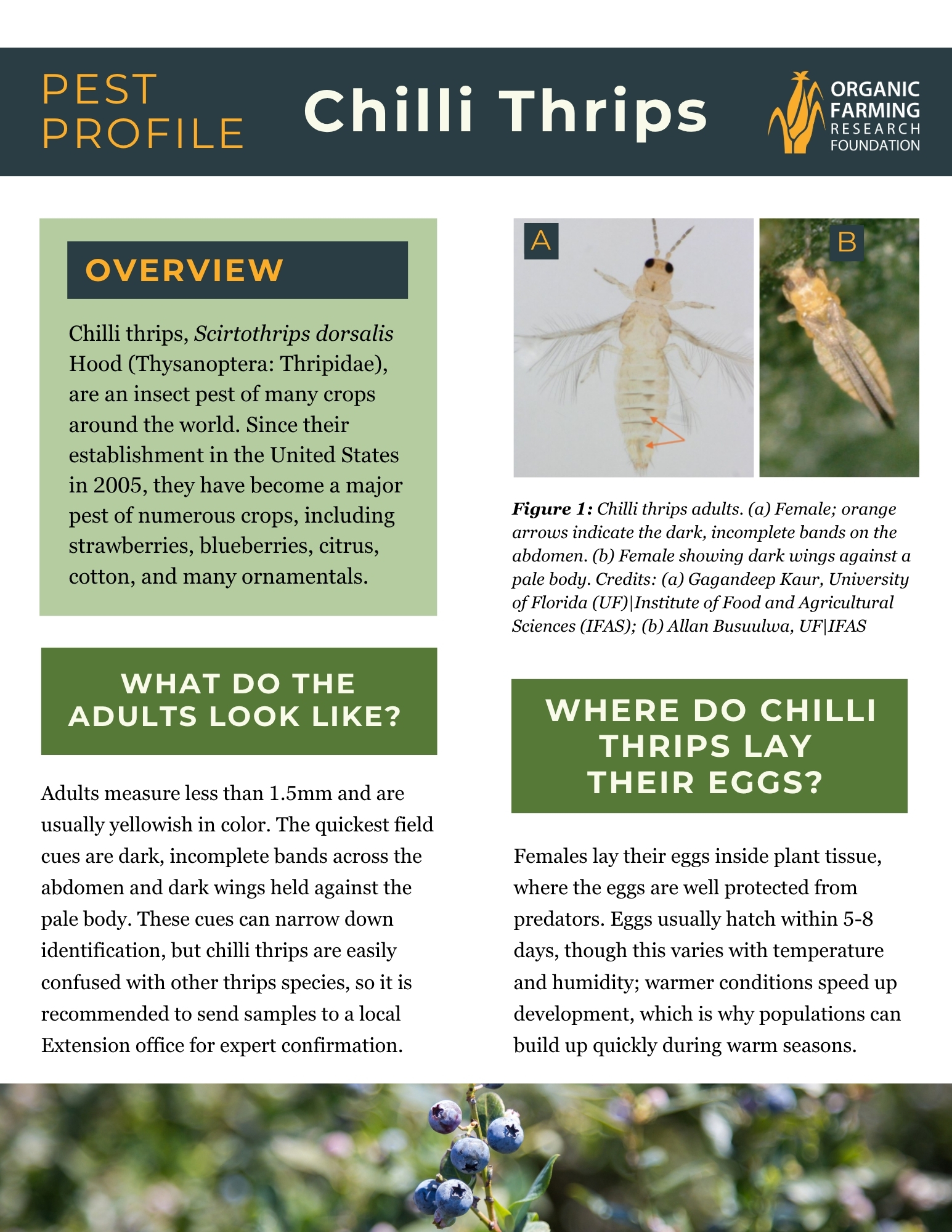
Chilli Thrips Factsheet

Chilli thrips are an insect pest of many crops around the world. Since their establishment in the United States in 2005, they have become a major pest of numerous crops, including strawberries, blueberries, citrus, cotton, and many ornamentals. This resource covers chilli thrip identification and life cycle, and explains how producers can control these pests organically with natural predators.

By |2026-09-30T11:28:41-04:00September 29th, 2026|Insects & Diseases, Resource|

Your Region, Your Research: What’s New on the Organic Research Hub

Written by: Ashley Dulaney, OFRF’s Communications Director

Versión en español a continuación.

If you farm organic, you already know the problem: the research you need is out there, but finding it means digging through university extension sites, government databases, and search results that are built for conventional agriculture—not yours.

That’s exactly why OFRF built the Organic Research Hub and why we’re excited to share what’s new. 

What Is the Organic Research Hub?

OFRF's Organic Research Hub logo with an illustration of a hub-and-spoke visual with different illustrations in each spoke (farmers, cow, barn, wheat, magnifying glass over a leaf, beet in soil) with a map of the US with stars spread across it and a report-looking illustration below it, in the center of the illustration

The Organic Research Hub is a free, USDA-funded, searchable library of research-backed resources built specifically for organic and transitioning producers. Whether you’re navigating a conservation program like the Natural Resources Conservation Service’s Environmental Quality Incentives Program (EQIP) or Conservation Stewardship Program (CSP), working through your organic transition, or troubleshooting a challenge on the farm, the Hub puts practical, science-backed answers in one place, instead of scattered across the internet.

For many of the studies in the Hub, you don’t have to wade through a dense academic paper to get what you need. Our team translates the research into plain-language summaries that lay out the methods and outcomes up front, so you can see what was tested and what it means for your farm in a few minutes. Many resources already have summaries, and for those that don’t, we’re adding more all the time.

We’ve spent over three decades as a trusted source of organic farming research and technical guidance. The Hub makes that trove of knowledge searchable in one place for the first time.

What’s New on the Hub

Over the past few months, we’ve been adding new features based on what organic farmers have told us they need. Here’s what’s new:

Pages built for your region. 

The Hub now has dedicated pages for each of the six TOPP regions—Midwest, Northeast, Northwest, Plains, Southeast, and West/Southwest—bringing together the resources, experts, and grants most relevant to your climate, soil, and growing conditions. No more filtering through results that don’t apply to you. 

A bigger Directory of Experts. 

You can now search over 300 verified Extension agents, researchers, and technical service providers nationwide by name, state, region, or on a clickable map of the U.S. Every person listed is vetted by OFRF and works in organic or organic-adjacent agriculture, so you’re not sorting through contacts who don’t know the difference between organic and conventional practices. If you’d rather talk through a decision with a real person than read another factsheet, this is where to start.

You can now view the Hub in Spanish.

Growers can select their preferred language, English or Spanish, so more research is accessible to more farmers.

A dedicated USDA Organic Research Grant Database. 

Curious what organic research is currently being funded? You can now browse USDA OREI (Organic Agriculture Research & Extension Initiative) and ORG (Organic Transition Program) grant projects and reports directly, searchable by keyword, program, year, or award number.

Alerts that do the searching for you.

Set up a free, personalized alert by topic, region, or keyword, and new matching resources will land in your inbox daily, weekly, monthly, or as soon as they’re posted. Subscribe once, and stop searching the same terms over and over.

Get Your Region’s Resource Factsheet

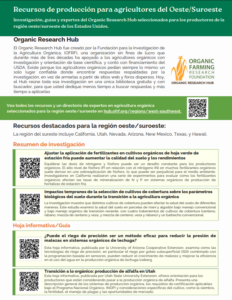
Alongside the Hub itself, we’ve put together a printable, one-page factsheet for each region. It’s a quick reference guide to the research, tools, and local experts curated specifically for your area, plus a QR code straight to your region’s page on the Hub. 

Download your region’s factsheet below as it becomes available:

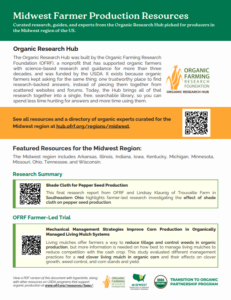
Front page of TOPP Midwest Organic Research Hub Regional factsheet

AR, IL, IN, IA, KY, MI, MN, MS, OH, TN, WI

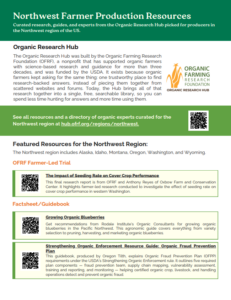
Front page of TOPP Northwest Organic Research Hub Regional factsheet

AK, ID, MT, OR, WA, WY

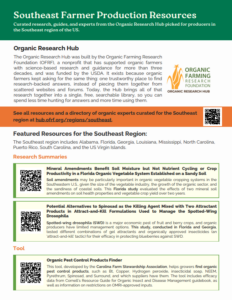
Front page of TOPP SE Organic Research Hub Regional factsheet

AL, FL, GA, LA, MS, NC, PR, SC, USVI

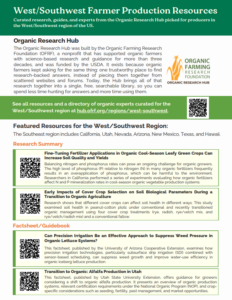
Front page of TOPP West/Southwest Organic Research Hub Regional factsheet

 AZ, CA, HI, NV, NM, TX, UT

Coming Soon!

Plains
(CO, KS, NE, ND, OK, SD)

Northeast/Mid-Atlantic
(CT, DE, ME, MD, MA, NH, NJ, NY, PA, RI, VT, VA, WV)

Want more organic farming resources for your region? Sign up here, and we’ll email them to you as they become available.

Explore What’s Been Built for You

The research, tools, and people you need to farm organically with confidence are already gathered in one place: the Organic Research Hub, built for your region, now in Spanish, and free to use.

Have a resource that should be included, or a question about what you find? Reach out to our team; we’re always adding to the Hub.

Su región, su investigación: lo nuevo en el Organic Research Hub

Si usted produce de manera orgánica, ya conoce el problema: la investigación que necesita existe, pero encontrarla implica rebuscar entre sitios de extensión universitaria, bases de datos gubernamentales y resultados de búsqueda pensados para la agricultura convencional, no para la suya.

Justamente por eso OFRF creó el Organic Research Hub y por eso nos entusiasma compartir las novedades. 

¿Qué es el Organic Research Hub?

OFRF's Organic Research Hub logo with an illustration of a hub-and-spoke visual with different illustrations in each spoke (farmers, cow, barn, wheat, magnifying glass over a leaf, beet in soil) with a map of the US with stars spread across it and a report-looking illustration below it, in the center of the illustration

El Organic Research Hub es una biblioteca gratuita, financiada por el USDA y con buscador, de recursos respaldados por la investigación, creada específicamente para productores orgánicos y en transición. Ya sea que usted esté gestionando un programa de conservación del Natural Resources Conservation Service (Servicio de Conservación de Recursos Naturales, NRCS) como el Environmental Quality Incentives Program (Programa de Incentivos para la Calidad Ambiental, EQIP) o el Conservation Stewardship Program (Programa de Administración de la Conservación, CSP), esté realizando su transición a lo orgánico o esté resolviendo un problema en la finca, el Hub reúne respuestas prácticas y con respaldo científico en un solo lugar, en vez de dispersas por todo el internet.

En muchos de los estudios del Hub, usted no tiene que abrirse paso entre un denso artículo académico para obtener lo que necesita. Nuestro equipo traduce la investigación a resúmenes en lenguaje sencillo que presentan los métodos y los resultados desde el inicio, para que en pocos minutos vea qué se puso a prueba y qué significa para su finca. Muchos recursos ya cuentan con resúmenes y, para los que aún no los tienen, seguimos agregando más todo el tiempo.

Llevamos más de tres décadas siendo una fuente confiable de investigación y orientación técnica sobre agricultura orgánica. El Hub hace que ese acervo de conocimiento sea consultable en un solo lugar por primera vez.

Lo nuevo en el Hub

Durante los últimos meses hemos agregado nuevas funciones a partir de lo que los agricultores orgánicos nos han dicho que necesitan. Esto es lo nuevo:

Páginas hechas para su región. 

El Hub ahora tiene páginas dedicadas a cada una de las seis regiones de TOPP — Medio Oeste, Noreste, Noroeste, Grandes Llanuras, Sureste y Oeste/Suroeste—que reúnen los recursos, expertos y subvenciones más pertinentes para su clima, su suelo y sus condiciones de cultivo. Ya no tendrá que filtrar resultados que no le aplican.

Un directorio de expertos más amplio. 

Ahora puede buscar entre más de 300 agentes de Extensión, investigadores y proveedores de servicios técnicos verificados de todo el país, por nombre, estado, región o en un mapa interactivo de los Estados Unidos. Cada persona incluida ha sido verificada por OFRF y trabaja en agricultura orgánica o afín a lo orgánico, así que usted no estará revisando contactos que no distinguen entre prácticas orgánicas y convencionales. Si prefiere conversar una decisión con una persona real en lugar de leer otra hoja informativa, este es el lugar para empezar.

Ahora puede ver el Hub en español.

Los productores pueden seleccionar su idioma preferido, inglés o español, para que más investigación sea accesible para más granjeros.

A dedicated USDA Organic Research Grant Database. 

Una base de datos dedicada a las subvenciones de investigación orgánica del USDA.
¿Le interesa saber qué investigación orgánica se está financiando actualmente? Ahora puede consultar directamente los proyectos e informes de las subvenciones OREI, Iniciativa de Investigación y Extensión en Agricultura Orgánica y ORG, Programa de Transición Orgánica del USDA con búsqueda por palabra clave, programa, año o número de adjudicación.

Alertas que buscan por usted.

Configure una alerta gratuita y personalizada por tema, región o palabra clave, y los nuevos recursos que coincidan llegarán a su correo a diario, semanalmente, mensualmente o apenas se publiquen. Suscríbase una vez y deje de buscar los mismos términos una y otra vez.

Obtenga la hoja informativa de recursos de oeste/suroeste

Junto con el Hub, hemos preparado una hoja informativa imprimible de una página para el oeste/suroeste. Es una guía de referencia rápida sobre la investigación, las herramientas y los expertos locales seleccionados específicamente para su zona, además de un código QR que lleva directamente a la página de su región en el Hub. 

Descargue la hoja informativa del oeste/suroeste:

Explore lo que se construyó para usted

La investigación, las herramientas y las personas que usted necesita para producir de manera orgánica con confianza ya están reunidas en un solo lugar: el Organic Research Hub, creado para su región, ahora en español y de uso gratuito.

¿Quiere más recursos de agricultura orgánica para su región? Regístrese aquí y se los enviaremos por correo electrónico conforme estén disponibles.

¿Tiene un recurso que debería incluirse o una pregunta sobre lo que encontró? Comuníquese con nuestro equipo; siempre estamos agregando contenido al Hub.

By |2026-10-02T11:56:28-04:00September 25th, 2026|News|

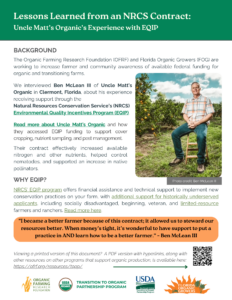
Using Synergy, Conservation Practices, and NRCS Support to Save Citrus with Uncle Matt’s Organic

Written by Mary Elizabeth Kidd, OFRF Communications Associate

OFRF is currently working to increase farmer and community awareness of the federal funding opportunities available to organic and transitioning farms. 

As part of our work with the Southeast region of the USDA’s Transition to Organic Partnership Program (TOPP), we’re spotlighting the experience of Uncle Matt’s Organic and McLean Family Farms in Clermont, Florida, that received funding and support through the Natural Resource Conservation Service’s Environmental Quality Incentives Program (EQIP).

Their story offers a transparent look at what it’s really like to work with NRCS: the benefits, the obstacles, and the lessons they’ve learned. We hope other farmers can use their experience to navigate the process of applying for and implementing contracts more easily.

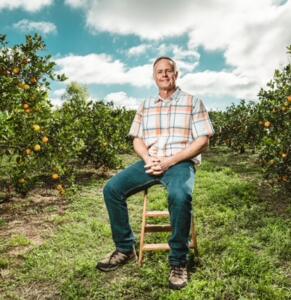
Meet Ben McLean III of Uncle Matt’s Organic and McLean Family Farms

Photo Courtesy of Ben McLean III

Location: Clermont, Florida (Lake County, west of Orlando)

Established: family farm established in the 1880s, Uncle Matt’s Organic established in 1999

Acres: 50

Production: Citrus

Certification: USDA Certified Organic via QCS since 2003

Staff: 15 full-time employees (as of EQIP contract phase)

Markets: Sell directly to grocery outlets including Whole Foods, Target, Publix, and more (20,000+ locations)

As the Head of Research with Uncle Matt’s Organic and a fourth-generation citrus farmer with McLean Family Farms, Ben McLean III is harnessing science, a robust network of experts and support, and family legacy to help safeguard the future of citrus in Florida and around the world.

Members of the OFRF team recently spoke to Ben to learn more about his experience accessing NRCS’ Environmental Quality Incentives Program (EQIP) and how this program and its resulting wins and learnings can help fellow growers. 

>> Learn more: Listen to Ben McLean III on the Food for You and the Planet podcast.

About the Farmers

Angus Benjamin McLean, Ben McLean III’s great-grandfather, began citrus farming on the family’s Bartow, Florida, property in the 1880s. Ben’s grandfather, father, and siblings have continued the family legacy, weathering the uncertainties of ecological and economic change to help keep citrus farming alive in central Florida.

Ben received his master’s degree in Horticulture Science from the University of Florida and consistently works closely with university researchers and members of the USDA’s Agricultural Research Service (ARS) to explore and advance citrus research and conservation efforts. He’s traveled to Mexico, Costa Rica, Brazil and South Africa to learn from citrus growers around the world and to share his knowledge, including learnings from his EQIP contract with NRCS.

His ability to activate a synergistic network of grower organizations, learning opportunities through these organizations and the USDA, and a community of experts, researchers, and farming peers continues to create opportunities for him to grow the family farm business and act as a leader in the citrus and sustainable agriculture spaces.

Context & Challenges

The top concern of Ben, his team, and the researchers they work with is citrus greening disease, also known as Citrus Huanglongbing, or Citrus HLB.  Within the last 30 years, this disease caused by the bacterium (Candidatus Liberibacter asiaticus) and vectored by the Asian citrus psyllid has destroyed over 75% of Florida’s citrus production.

Citrus greening continues to cripple Florida’s citrus production, and Ben is on a mission to facilitate research to protect Florida citrus. His NRCS EQIP contract, discussed below, played a role in the promising research they’re facilitating towards this mission.

The McLean family originally managed over 1,200 acres in organic citrus production in 2008, which dropped to 600 acres in 2015, and now hovers around 50 acres, with 15 acres focused heavily on research to combat the disease. 

This dramatic drop in acreage is also the result of weather events and real estate development. Since 2004, Ben cites five major hurricanes (with landfall), tropical storms, and dramatic variations in temperature and precipitation with wreaking significant damage to their citrus groves. Their humid, subtropical climate means that weeds thrive almost year-round and represent a key challenge and focus point in their organic research and practices.

Real estate development has impacted both land and labor availability. In the past, farmers like the McLeans  could rely on a steady supply of H-2A workers (temporary agricultural labor), particularly during harvest season. However, many of those workers are now drawn to the abundance of higher paying job opportunities associated with urban development.

Why Organic?

In Ben’s almost 30-year career farming organically, he and his family have witnessed the resilience and fortifying biodiversity that organic practices bring to their crops. “Trying to withstand these increased environmental, pest, and other pressures, you have to create resilience. And conservation practices help you create that resilience in your property, your soil, with your own biology.”

Ben credits his grandfather, a vocal proponent of conservation practices like cover cropping, for introducing him to the benefits of organic farming practices. In the era before conventional herbicides and pesticides became the norm, his grandfather was using methods that are now labeled as organic and sustainable, but were then considered reliable, “old way” farming practices. From the focus on hand labor and simple tools to organic fertilizers such as Feather Meal, to natural pesticides such as botanical oils derived from Neem trees to liquid lime sulfur, Ben cites that today “the toolbox for the organic production of citrus is solid.”

Practically speaking, as Ben and his father and brother were establishing Uncle Matt’s Organic Farm Plan and citrus acreage: “we wanted to be price makers, not price takers,” focusing on high quality and nutrient density- and the market for organic fresh fruit and juices supported their decision to certify and remain organic.

Ben first learned about the opportunity to receive reimbursements for organic practices through farming peers in the Florida Organic Growers network who had success with NRCS programs such as EQIP and CSP.

Working with NRCS

Application Process

Ben’s first experience with federal funding for farmers came via Farm Service Agency (FSA) support after a series of hurricanes devastated central Florida in the early 2000s. Registering with the FSA became a catalyst for other emergency relief and would eventually streamline their application process for their EQIP contract around 2009.

Ben shared: “I encourage any grower to go visit your local FSA office, get your property registered, and get on their mailing list. You’ll find out about workshops, visiting researchers, conferences, and programs.” 

One challenge farmers often cite in both the organic certification process and the process of applying for NRCS support is paperwork and recordkeeping. This presented a unique challenge for the McLeans as portions of their farm plan included separate groves that were leased, or were owned by other investors. While the Farm Plan as a whole is managed organically and operates cohesively, the individual leased or separately owned components required more complex recordkeeping, with some properties required to have their own EQIP contracts. Fortunately, their office manager, a trained accountant and bookkeeper, plus a supportive NRCS rep ensured a relatively smooth process.

“Ask your NRCS agent. I asked a lot of questions, and I got a lot of help. We can’t be afraid to ask the questions.”

Implementation

Between 2009 and 2012, Ben and his team implemented an EQIP contract focused on cover cropping (primarily cowpea), nutrient sampling (through soil and leaf analysis), and pest management.

Why cover cropping? “One last challenge we all face is water, right?” Ben shared, “With our location and development along the coastlines, we get saltwater intrusion and limitations on water usage, which is why these conservation efforts, especially cover crops and composting, are so important for water use and drought management.”

While cover cropping was already a familiar practice to the McLeans, getting EQIP compensation for this work helped propel them towards better testing and enabled them to bring on a full-time team member to manage the practices. 

They continue cover cropping and conducting related research to this day, thanks in part to their successful EQIP contract.
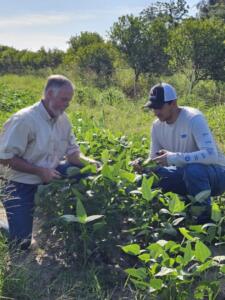
Cowpea cover crop planted working with UF Researcher, Courtesy of Ben McLean III

Outcomes & Challenges

For him, the primary benefit of implementing cover cropping was the increase in available nitrogen and other nutrients; the secondary benefit was root exudates that help in managing  nematodes, and the unexpected benefit was the increase in native pollinators.

Through soil sampling and other analysis, they were able to measure 25% more manganese availability within 90 days of planting. And the resulting biodiversity from cover cropping meant that their orchard, with its 6-foot strips of flowering cowpea and sunn hemp, created wonderful insectaries with honeybees, bumblebees, native pollinators, beetles, and other deterrents to harmful insect pathogens.

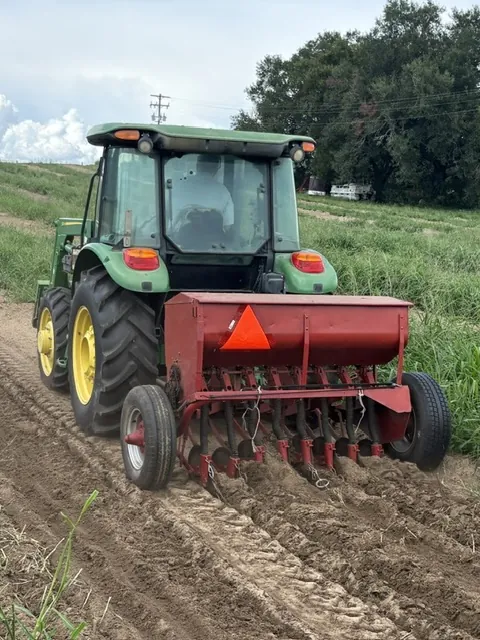
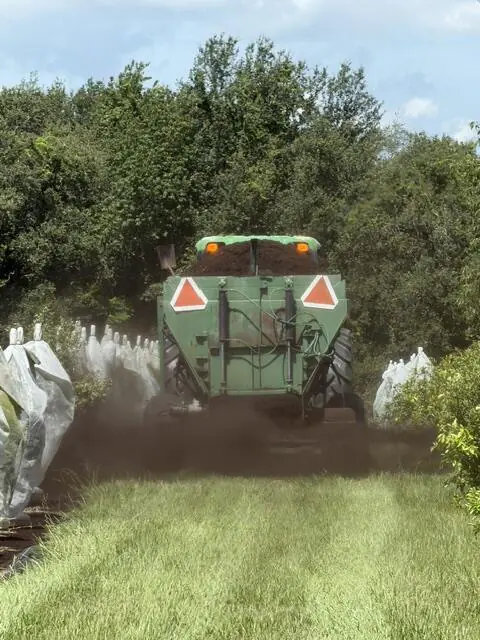
Cover cropping continues in 2026 with University of Florida researchers and Jarred Eddy of Central Florida Ag Services. Pictured above: a Massey Ferguson Grain Drill planting cover crops (left) and compost spreader utilizing Florida-based Veransa compost (right). Photos courtesy of Ben McLean III.

Advice to Farmers

“The good news that I would share with anybody considering either the transition to organic or applying for NRCS support: it can be done.” Ben continues, “It was easier than I thought, and I received excellent help from our local FSA and NRCS staff in both Lake County and Polk County. There is paperwork, but it’s worth doing, and it creates value in your long-term farm plan. It opens doors to you, and you’ll get access to information you may not have had.”

He also cites thorough recordkeeping and the support of staff and recordkeeping accountants as a key factor in the smoothness of the process.

Furthermore, he echoes familiar farmer advice: lean on other farmers and mentors. Networks and neighbors can both serve as tremendous support for growers at any experience level. 

“I encourage farmers to go to your Extension workshops, go to your university workshops, go to USDA workshops or field days.  And get to know your neighbors, get to know other farmers, join your grower organizations. This is where you’ll meet people from NRCS and can ask about their programs. Don’t be afraid to ask a lot of questions.”

Ready to Apply? Here Are a Few Helpful Resources

If you’re a farmer considering applying for EQIP or other NRCS programs, here are some helpful tools to get started:

Additional Resources & Reading:

Organic Farming Research Foundation Resources:

Connect with OFRF:
By |2026-09-30T13:10:37-04:00September 14th, 2026|Farmer Stories, Insects & Diseases, News, On-Farm Research|
Go to Top