
Doing the Unglamorous, Essential Work to Help Organic Agriculture Thrive

Doing the Unglamorous, Essential Work to Help Organic Agriculture Thrive

By |2026-02-04T16:40:07-05:00February 4th, 2026|Gordon's Policy Corner, News|

A personal note as I step away from OFRF

By Gordon Merrick, OFRF Policy Program Director 

This will be the last edition of Gordon’s Policy Corner that I will write. As I type that I certainly feel a mix of gratitude, pride, and a fair amount of dust in my eye. After nearly four years at the Organic Farming Research Foundation, I’ll soon be stepping away from an organization that has shaped how I think about food, farming, and what it means to do policy work that serves the people who are integral to our food system: farmers, farm workers, researchers, and those that translate the scientific research into practical tools.

When I joined OFRF, I was given an opportunity to rethink how we, a research organization, engage with policy research and advocacy that is rooted in the people we serve. Over the last four years, I’ve had the privilege of helping grow that work in ways that feel tangible and lasting: launching our Communicating with Legislators course which aims to demystify the policy process for researchers and farmers; helping craft and introduce the Organic Science and Research Investment Act in the House and the Senate; working to build stronger connections between researchers, producers, and the policymakers that serve them; developing practical, farmer-facing toolkits on USDA programs through our TOPP-W/SW work; and partnering with NRCS to strengthen research-backed tools and expertise relevant to organic within the agency.

Fellowship of the Rings photo credit: New Line Cinema

But, those are all things you can put in a report or sometimes feel in your hand. What doesn’t show up as easily on paper is the community. I’m especially proud of the role I was able to play in the TOPP network, a constellation of farmers, certifiers, researchers, nonprofits, and agency staff who are doing the unglamorous, essential work of helping organic systems, from the small urban farm to the complex distributors, exist and thrive. Forgive my nerdiness, but that larger network feels like a Tolkien-esque fellowship: a group up against the odds but deeply committed to carrying something important forward, together.

Looking ahead, I am confident that OFRF is set up to keep having an outsized impact on the adoption of organic agriculture systems. That’s because of the people that make up this organization, the relationships those people hold and nurture, and the way this organization operates: constantly grounding priorities and our work in farmer’s lived experiences. OFRF will continue to work to ensure that research is action-oriented, and refuse to accept that organic should be treated as a side quest instead of a core part of U.S. agriculture. The work we’ve built is bigger than any one person, and that is exactly how it should be.

One of the biggest lessons I’m carrying forward with me is both the need, and the effectiveness, of shifting our collective mindset from scarcity to abundance. From either/or to yes/and. From us-versus-them to whole systemic perspectives. Organic agriculture has always pointed in that direction: organic, at its core, is about working alongside natural systems to foster a naturally abundant system that already exists. Soil health doesn’t compete with profitability, farmer wellbeing isn’t matched against stewardship; they reinforce each other.

That being said, it feels important to name the moment we are in. We are living in a time when science is being questioned, expertise is being flattened to opinion, and fear is easier to sell than nuance. I hold real compassion for people who have been misled or who are reacting from a place of uncertainty or loss. At the same time, I believe strongly that compassion cannot mean silence in the face of real harm. We need to consistently provide both: patience to meet people where they are, and firm, principled opposition to actions that undermine farmers, research, and the systems that sustain us all.

I’m deeply grateful for the farmers, researchers, partners, and colleagues who trusted me, argued with me, taught me, and built things alongside me. OFRF will keep doing work that matters. But starting later this month, I’ll be cheering it on loudly from the sidelines.

I’m not disappearing, and I genuinely hope to stay in touch. If you want to keep talking about organic agriculture, the relationship between research and policy, how to build something better than what we’ve inherited, or to share your favorite bread recipe, please reach out. I’d love that.

Eat well and breathe deeply,

Gordon

Farmer-Led Trials Program Spotlight: Passion Garden

By |2026-04-09T12:06:34-04:00January 27th, 2026|Farmer Stories, News|

Experimenting with on-farm materials to create organic soil amendments

Written by Mary Hathaway, OFRF’s Research & Education Program Manager, and Kay Bell, FLT Program participant

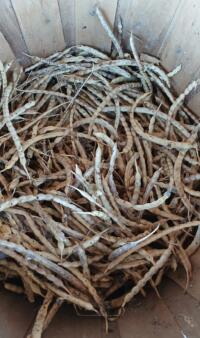
Mesquite bean pods, collected by Kay Bell, to use as a soil amendment at Passion Garden

Kay Bell has been farming for ten years on her three-acre farm in Waco, TX, called Passion Garden. She grows a variety of fruits, vegetables and herbs that she sells as fresh produce and herbal teas at local farmers markets and health food stores. Her farm is currently in the process of transitioning to certified organic, with a focus on building her own on-farm fertility.

Kay has a big focus on using locally available, on farm inputs to help improve her soil health, and has long considered using the pods of the Mesquite Tree Bean in her fertility plan. As a farmer focused on growing the health of her community, she looked into the nutrient content of Mesquite Bean, and realized that it has a high protein content and is rich in many nutrients. Since the tree is prevalent on her property, and the pods are not too difficult to harvest, she believed it could be a useful amendment in building her soil health.

Using Mesquite Beans as a Soil Amendment for Tomatoes

To test her idea, Kay wanted to build an experiment that would assess the impact of mesquite bean meal as a soil amendment on the yield of ‘Celebrity’ tomatoes, one of her favorite tomato varieties. She hopes that the addition of Mesquite Bean Meal (MBM) will result in a measurable increase in total or marketable tomato yield compared to her normal soil amendments in raised beds. To create the MBM, Kay harvested the pods, and used a simple mill to grind them so that they were in an easy to use powder format.

On-Farm Trial Plan

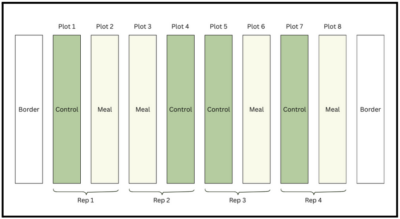
Plot map from Passion Garden’s FLT Program trial

In the beginning of August 2025, with technical support from OFRF’s Farmer-Led Trials Program staff, Kay prepared eight raised beds, each measuring 4 feet wide by 8 feet long, to provide a uniform growing area for the plants. All of the beds were filled with the same base soil mixture and compost. Kay planted 4 tomato plants in each of the beds in September. At the time of transplanting, the four treatment raised beds received ½ cup of the MBM. During the growing season, all of the beds were treated consistently, with the same irrigation schedule, staking, and pest management.

By mid-October, Kay began tracking the yields, her key metric of the trial. This was recorded as total weight and marketable weight, the weight of tomatoes that meet standards for commercial sale (free from major blemishes, cracks, or rot). Kay also took observations of plant health, pest pressure, and any plant losses that might impact the findings for the trial.

Farmer-Led Trial Results: Tomato Production Increased with On-Farm Amendment

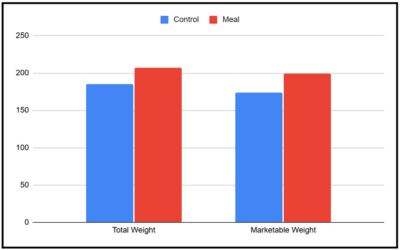
Once all of Kay’s data had been collected, the analysis revealed a significant difference in yield between the control and meal treatments, with the treatment receiving the MBM yielding more per plant and overall than the control treatment.

Anecdotally, Kay observed improved water drainage and thinks that the MBM helped improve the drainage in her clay soils. She also noted increased presence of worms and other soil organisms, and she speculates that the natural sugars in the MBM help attract more soil invertebrates.

Yield results from Passion Garden’s FLT Program trial, showing yield of tomatoes in the control group (blue) vs the group grown using Mesquite Bean Meal (red).

Kay is very motivated by the success of this trial and plans to use MBM as a pre-transplant amendment throughout her farm. She is also excited to spread the word on the many uses of Mesquite Bean – including as a coffee alternative, as a gluten free flour in baking, and a sweet jelly.

Stay tuned for a final report on Kay’s trial coming out later this year.

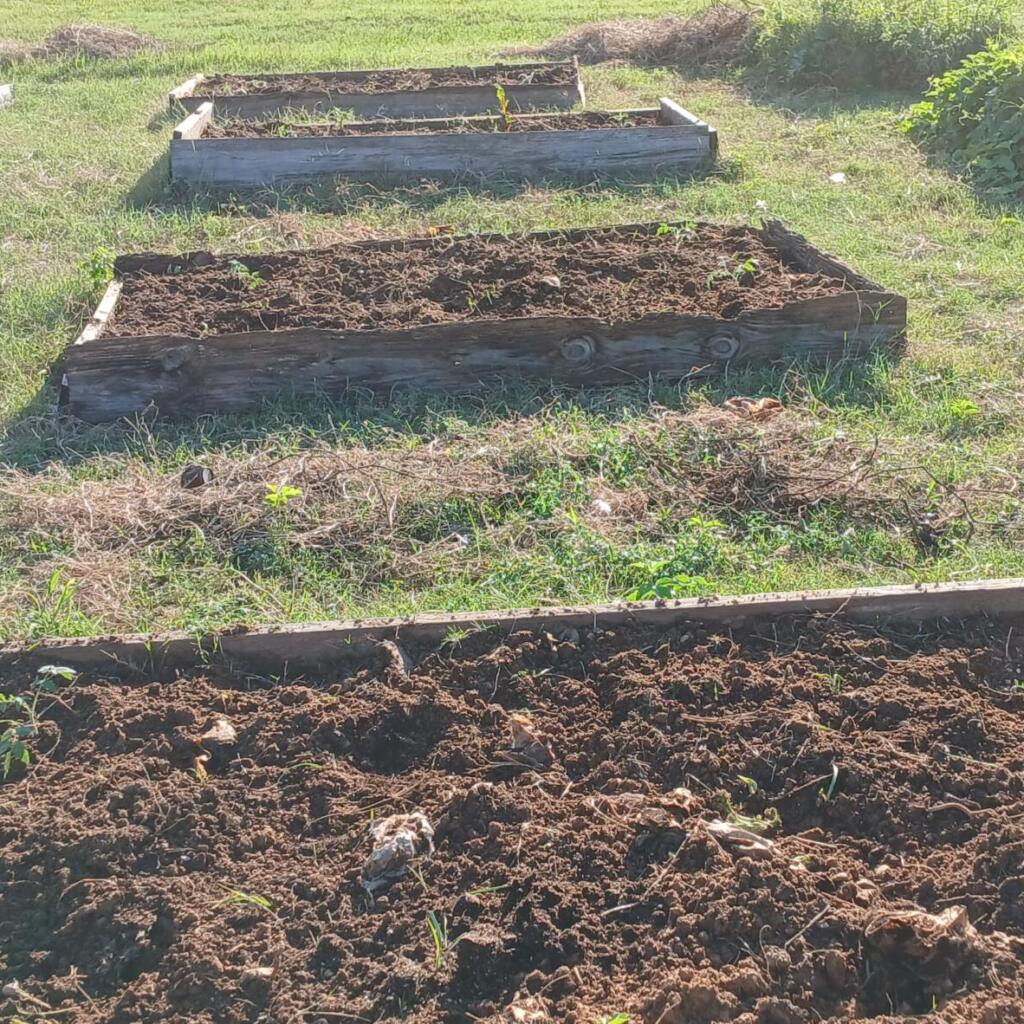
Prepped beds at Passion Garden during the 2025 FLT.

“I know this trial has made me stronger as a farmer. And I just look forward to experimenting with nature to grow things with resources I have on-farm.” 

– Kay Bell, FLT Program Participant

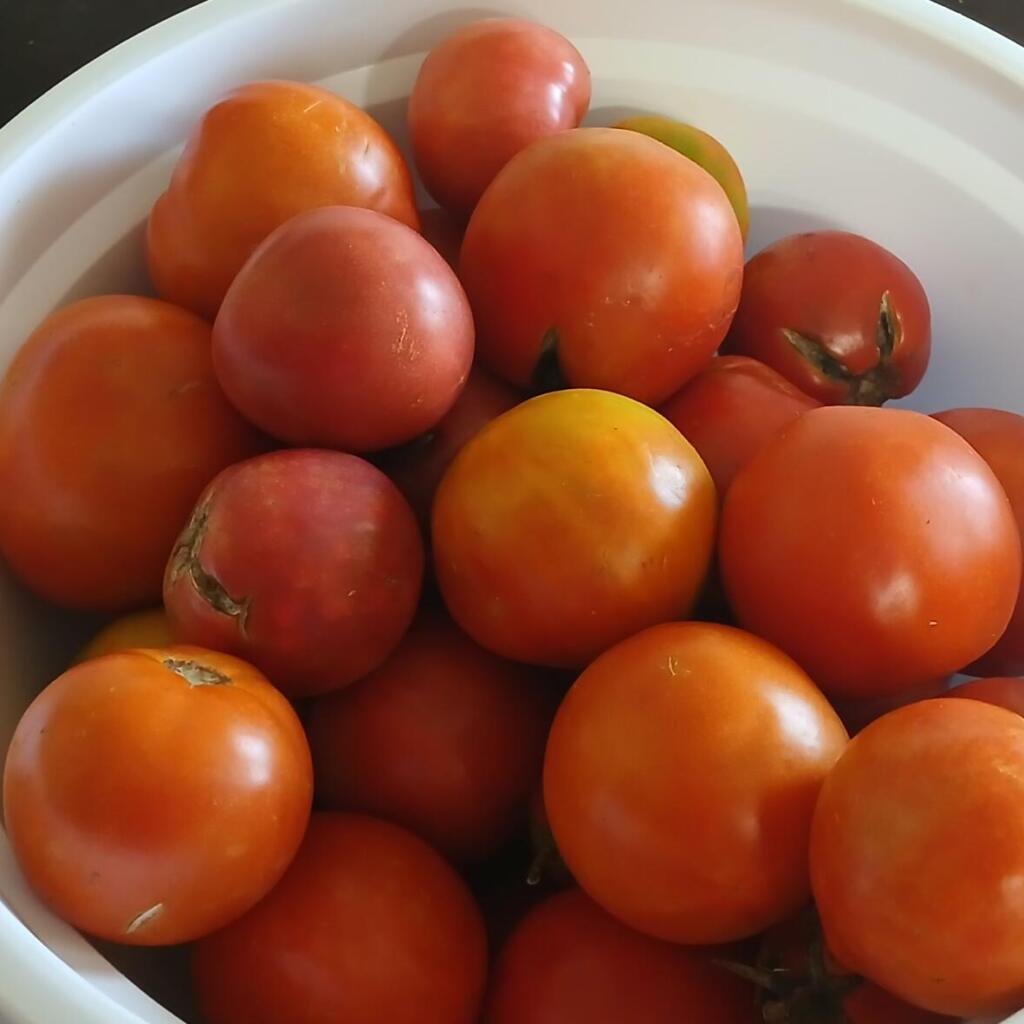
Tomatoes harvest from Passion Garden, during the 2025 trial.

Research Results

This Farmer-Led Trial evaluated the effect of an MBM soil amendment on ‘Celebrity’ tomato yields. Kay prepared eight raised beds, each measuring 4 feet wide by 8 feet long, in keeping with Kay’s space limitations. At the time of transplanting, the four treatment raised beds received ½ cup of the MBM.

Key Findings

  • Sample size in the trial was small, however, the analysis revealed a significant difference in yield between the control and meal treatment, with the treatment receiving the MBM having a positive impact on yield in both the total yield and marketable yield.
  • Kay observed improved water drainage and thinks that the MBM helped improve the drainage in her clay soils. She also noted increased presence of worms and other soil organisms, and she speculates that the natural sugars in the MBM help attract more soil invertebrates.

Kay recorded tomato yields and made observations around plant health, pest pressure, and any plant losses that might impact the findings for the trial. Data suggest that tomato yields were slightly higher in plots receiving the MBM amendment, and that there may be a benefit to utilizing the MBM in tomatoes.

For full details on the study’s methodology and results, read the final report.

This is part of a series of blogs highlighting farmers who are participating in OFRF’s Farmer-Led Trials program. Farmers receive technical support to address their production challenges through structured on-farm trials. To learn more about OFRF’s Farmer-Led Trials Program, visit our website page at https://ofrf.org/research/farmer-led-research-trials/ 

To learn more about Kay Bell and Passion Garden, check out this ATTRA article.

Kay is President of the National Women in Agriculture Association Texas Chapter: https://www.nwiaa.org/texas 

Organic Agriculture Research in Action: High Tunnels and Cover Cropping with Moore Family Farms

By |2026-01-15T09:46:04-05:00January 21st, 2026|Farmer Stories, News|

Written by Rebecca Champagne, PhD, OFRF Conservation Scientist

Meet Moore Family Farms

Robert and Dakota are the father-son team behind Moore Family Farm.

Moore Family Farms is a family-owned and operated farm located in Warsaw, North Carolina. Managed by Robert Moore and his son Dakota, the farm was founded in 1833 based on principles of sustainability. Out of the 260-acre farm, 22 acres are in production—12 conventional and 10 certified organic. On the organic side of the farm, they grow watermelons, collard greens, and cabbage. The non-organic side of the farm produces bell peppers, tomatoes, and cantaloupe.

“Our farm was revived in 2018, focusing on sustainable practices to honor our heritage while also adapting to modern agricultural trends,” Dakota explained.

Their crops are sold mainly wholesale through a regional organic produce distributor called Happy Dirt. They also had a contract with the Second Harvest Food Bank through the Local Food Purchase Assistance program (LFPA), but this contract was unfortunately lost due to federal funding freezes. They are currently exploring additional markets through Feast Down East, a local non-profit organization that connects farmers, restaurants, grocers, and consumers.

Moore Family Farms began the process of transitioning part of their farm to organic production in 2020 and has been certified since late 2023. Dakota mentioned that rising input prices prompted them to seek certification. “Fertilizer prices skyrocketed between 2019 and 2021, and we couldn’t afford to buy them,” he explained. “We did a lot of economic research into organic and decided to jump in.” 

He also pointed out that other key reasons for seeking certification included market demand for organic produce and the family’s passion for environmental stewardship.

The volatility of various markets, like fertilizers, can put significant financial strain on farmers. That’s why federal funding for organic agriculture research is so important and helps family farms hedge against production risks.

The Importance of Organic Agriculture Research

During his college days at North Carolina Agricultural and Technical (A&T) State University, Dakota had the opportunity to work on agricultural research in high tunnel systems. He immediately noticed the difference in crops grown in high tunnels during extreme weather. Dakota and his father knew that with a high tunnel, they could get their watermelons planted earlier in the season and have more control of the growing environment. For farmers who rely on wholesale markets, getting their produce out of the field earlier can mean a longer growing season, protection against extreme weather, and ultimately more revenue.

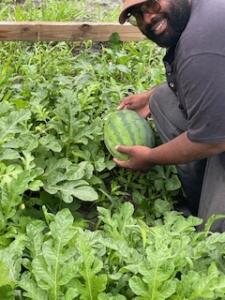
Dakota with watermelon grown on their farm.

“With our high tunnel, we can now harvest watermelons before the Fourth of July,” Dakota said.

Since establishing their high tunnel for organic watermelon production, they’ve seen increased crop protection against extreme heat and cold, which has enhanced the quality of the crop. The high tunnel also extends their growing season, allowing them to plant and harvest crops earlier and later than before.

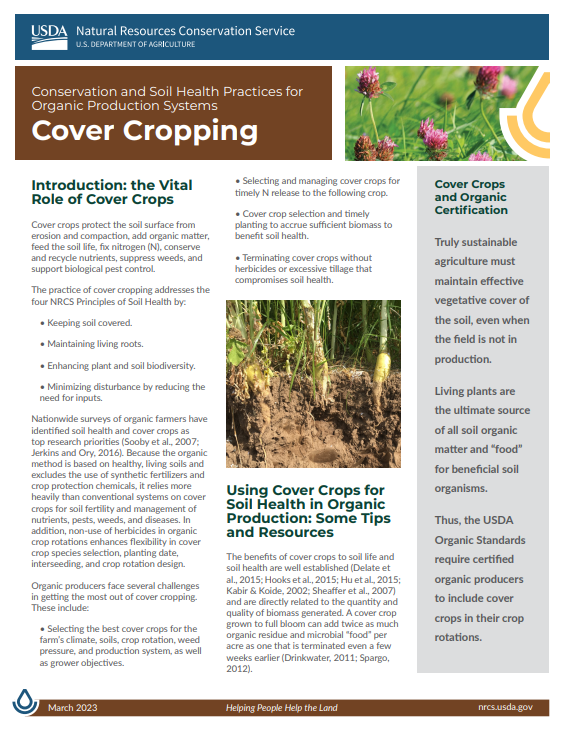
They’ve also been planting cover crops in their organic and conventional cropland, which have provided weed suppression, reduced soil runoff/erosion, and provided water retention benefits. “We were using plastic mulch for water retention to trap soil moisture, but we didn’t want to be throwing it away every season. We started using cover crops and saw that it helped keep more moisture in the soil,” said Dakota. He also saw the soil health benefits. According to soil test results, one of their fields saw an almost 3% increase in soil organic matter (SOM) over a three-year period, from 1.76% to 4.26% after using cover crops consistently.

View soil test results from Moore Family Farms BEFORE and AFTER utilizing cover crops in their cropping rotations ⬇️

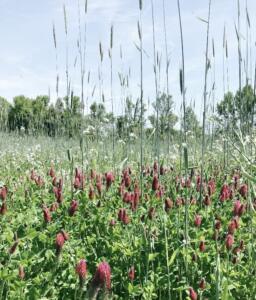
Cover crops growing at Moore Family Farm.

The benefits of cover cropping on soil health and soil organic matter show that investments in organic agriculture research can benefit all farms looking to adopt conservation practices, not just organic farms. Moore Family Farms, operating as a split operation with both conventional and certified organic land, can utilize methods that are foundational to organic production across their entire farm. There has been abundant research on cover cropping across the country to provide organic and conventional farmers with the latest practices to help increase soil fertility and organic matter levels without costly synthetic fertilizers.

Without public research funding on these and other agronomic topics, the risk associated with agricultural experimentation would be placed more on farmers themselves, leading to slower development of beneficial innovations and less widespread adoption of practices that can result in greater conservation of natural resources. Investments in organic agriculture research advance environmental stewardship on more than just certified organic land as the findings from this research can give all farm types the knowledge and resources they need to make their operations more resilient. And the benefits of research extend beyond the farm, too. According to an analysis done by the USDA Economic Research Service (ERS), every $1 invested into agricultural research triggers a $20 economic benefit. This provides long-term benefits in addressing agronomic issues, increases farm productivity and profitability, and ultimately benefits the economies and resiliency of communities.

You can support farms like Moore Family and help strengthen the agricultural research all farmers depend on by:

  • Letting us know about the impact agricultural research has had on your farm (contact communications[at]ofrf.org!).
  • Enrolling in our free Communicating with Legislators email-based course and sharing your story with elected officials.
  • Writing a letter to the editor or an opinion piece in your local newspaper, talking about how research projects/programs have benefited your farm.

Dakota Moore in front of a high tunnel on their farm.

Conservation Stewardship Program (CSP)

By |2026-05-20T21:21:45-04:00January 15th, 2026|Federal Assistance, News, Spanish Resources, TOPP West|

Farmers across the U.S. are eligible for significant technical and financial assistance from the Natural Resources Conservation Service (NRCS).

Versión en español a continuación.

If you are engaging in environmental stewardship and conservation efforts on your farm, the Conservation Stewardship Program (CSP) can help support your progress. CSP compensates agricultural producers who agree to increase conservation on their farm by adopting additional conservation activities or improving upon existing practices. With technical assistance from a conservation planner, farmers will work to increase conservation through practices best suited to their operation, like cover cropping, integrated grazing, or building wildlife habitats.

Obtain additional translated materials, or schedule interpretation services for phone calls or in-person visits, at farmers.gov/translations, or request personalized Spanish language support for any USDA resource, at farmers.gov/translations#spanish-request.

Important Points:

  • CSP provides annual payments for farmers, with the annual minimum being $4,000, for a 5-year contract for installing, maintaining, and improving existing conservation on a farm.
  • CSP payments are reported to the IRS and should be treated as taxable income.
  • Unlike the Environmental Quality Incentives Program (EQIP), there are no minimum acreage requirements, but the program requires whole-farm enrollment. The applicant’s farm must be in existing production; the program generally will not support land being cleared or prepared for future production.
  • Contacting your local NRCS office is a key step in determining your eligibility and beginning your application process.
  • Applications are accepted on a rolling basis and will be reviewed on the next ranking date for your state. Begin your application process as soon as possible to ensure completion by the next deadline! Applications are prioritized by local resource concerns and the applicant’s level of need.
    • The 2026 batching deadline was January 15, 2026, for all states. 
  • You will need to create a free online account at Farmers.gov and ensure that it is up to date.
  • If you do not own your land, you will need to submit written permission from the owner with your application.
  • New this year: the Regenerative Agriculture Initiative may be an opportunity for organic and transitioning-to-organic producers to leverage their operational status for qualifying for contracts.

Step 1. Research Your Options.

CSP offers support for a broad scope of conservation activities and projects to producers, including both financial and technical support. CSP contracts last 5 years, with the option for renewal. Read up on the program to determine your eligibility and brainstorm how you already are, or would like to, increase conservation on your farm. For some possible project inspiration, check out NCRS’s Conservation at Work video series.

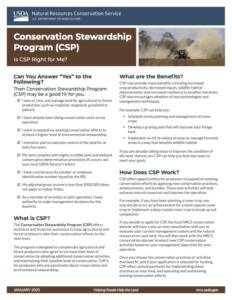
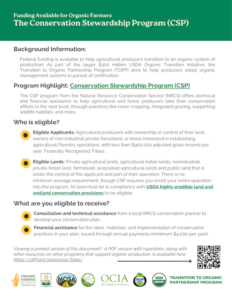
Front page of a CSP factsheet in English
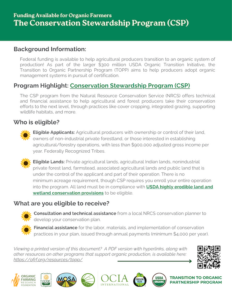
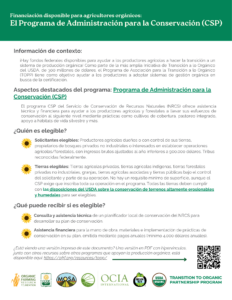
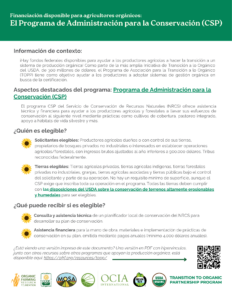
Front page of a CSP factsheet in Spanish

Step 2. Connect with USDA.

Create or update your account at Farmers.gov, and contact your local NRCS office to get started. Your conservation specialist will confirm your eligibility and help you determine your farm’s current stewardship thresholds. A stewardship threshold is NRCS’s benchmark for whether a CSP applicant is meeting or exceeding the level of conservation for a specific natural resource concern. To qualify, applicants must meet the threshold for at least two priority resource concerns across all land uses in their operation and commit to meeting or exceeding at least one additional concern by the end of their contract.

Guiding questions for initial contact with NRCS:

  • “I’m interested in  _conservation project(s) of interest_. What do you need from me to get started on my application?”
  • “What additional funding opportunities are available to my farm?”
  • “When is the deadline for the next CSP ranking period?”
  • “I _(own/rent)_ my land. What documents will you need for completion of my CSP application by the deadline?”
  • “My farm is _certified/transitioning_ to organic. What additional will you need for completion of my conservation plan and application by the deadline?”

Step 3. Gather your application documents.

You’ll need your:

  • Official tax ID (Social Security Number or Employer Identification Number)
  • Adjusted gross income certification (Form CCC-941), which requires your Taxpayer ID Number and AGI from the previous 3 tax years.
  • Deed, or property lease agreement, and written authorization from the landowner to install structural or vegetative practices.
  • A map showing all land uses and acres in the operation, and a map or other documentation identifying any known ineligible land and associated acreage amounts (NRCS staff will help you obtain this information if you don’t already have it).
  • Farm tract number (obtained from Farmers.gov or FSA membership).
  • Documentation of organic certification (if applicable).
  • Documentation of your land’s irrigation history (if applicable to project).

Step 4. Complete your application & submit!

Your NRCS conservation specialist will complete and submit your application form (CPA 1200) based on your established conservation plan.

Step 5. Implement your plan.

If your application is selected, NRCS will offer a contract outlining the approved conservation activities, payment rates, and other terms. CSP contracts last five years and begin only after both the farmer and NRCS sign the agreement. NRCS provides technical assistance, verifies completion of contract activities, and issues annual payments after October 1 each year.

Apply for CSP now to take conservation efforts on your farm to the next level! 

All of this information is summarized in a printable, downloadable PDF below in English and Spanish.

Los agricultores de todo Estados Unidos son elegibles para recibir asistencia técnica y financiera del Servicio de Conservación de Recursos Naturales (NRCS).

Si usted participa en esfuerzos de gestión ambiental y conservación en su granja, El Programa de Administración para la Conservación (CSP) puede ayudarle a apoyar su progreso. El CSP compensa a los productores agrícolas que aceptan aumentar la conservación en su granja adoptando actividades adicionales de conservación o mejorando prácticas existentes. Con la asistencia técnica de un planificador de conservación, los agricultores trabajarán para aumentar la conservación mediante prácticas más adecuadas a su explotación, como la construcción de cultivos de cobertura, el pastoreo integrado o la construcción de hábitats para la vida silvestre.

Obtenga materiales traducidos adicionales, programa servicios de interpretación para llamadas telefónicas o visitas presenciales, en farmers.gov/translations, o solicite apoyo personalizado en español para cualquier recurso del USDA, en farmers.gov/translations#spanish-request.

Puntos importantes:

  • CSP da pagos anuales a los agricultores, con un mínimo anual de 4.000 dólares, por un contrato de 5 años por instalar, mantener y mejorar la conservación existente en la granja.
  • Los pagos del CSP se reportan al IRS y deben considerarse ingreso sujeto a impuestos.
  • A diferencia del Programa de Incentivos para la Calidad Ambiental (EQIP), no existen requisitos mínimos de superficie, pero el programa exige la inscripción de toda la granja. La granja del solicitante debe estar en producción existente; El programa generalmente no apoya la limpieza o preparación de terrenos para futuras producciones.
  • Contactar con la oficina local del NRCS es un paso clave para determinar su elegibilidad y comenzar el proceso de solicitud.
  • Las solicitudes se aceptan de forma continua y se revisarán en la siguiente fecha de clasificación para su estado. ¡Comience su proceso de solicitud lo antes posible para asegurarse de finalizar antes de la próxima fecha límite! Las solicitudes se priorizan según los recursos locales y el nivel de necesidad del solicitante.
    • La fecha límite para 2026 fue el 15 de enero de 2026 para todos los estados. 
  • Tendrá que crear una cuenta online gratuita en Farmers.gov y asegurarse de que está actualizada.
  • Si no es propietario de su terreno, tendrá que presentar un permiso por escrito del propietario con su solicitud.
  • Novedad de este año: la Iniciativa de Agricultura Regenerativa podría ser una oportunidad para que los productores orgánicos y en transición a orgánicos aprovechen su estatus operativo para calificar para contratos.

Paso 1. Investigue sus opciones.

El CSP ofrece apoyo para un amplio alcance de actividades y proyectos de conservación a los productores, incluyendo apoyo financiero y técnico. Los contratos CSP duran 5 años, con opción de renovación. Infórmese sobre el programa para determinar su elegibilidad y haga una lluvia de ideas sobre cómo ya está, o le gustaría, aumentar la conservación en su granja. Para alguna posible inspiración en proyectos, revise la serie de videos sobre Conservación en el Trabajo de NCRS.

Front page of a CSP factsheet in Spanish
Front page of a CSP factsheet in English

Paso 2. Contacte con USDA.

Cree o actualice su cuenta en Farmers.gov y contacte con la oficina local del NRCS para empezar. Su especialista en conservación confirmará su elegibilidad y le ayudará a determinar los límites actuales de gestión de su granja. Un umbral de manejo responsable es el referente de la NRCS para determinar si un solicitante de CSP cumple o supera el nivel requerido de conservación para una inquietud específica de recursos naturales. Para calificar, los solicitantes deben cumplir el umbral para al menos dos inquietudes prioritarias de recursos naturales en todos los usos del suelo en su operación y comprometerse a cumplir o superar al menos una inquietud adicional antes de finalizar su contrato.

Preguntas orientadoras para el contacto inicial con el NRCS:

  • “Me interesa el/los _proyecto(s) de conservación(es) que le interese. ¿Qué necesitan de mí para empezar con mi solicitud?”
  • “¿Qué oportunidades adicionales de financiación hay disponibles para mi granja?”
  • “¿Cuándo es la fecha límite para el próximo periodo de clasificación CSP?”
  • “Yo _(poseo/alquilo)_ mi tierra. ¿Qué documentos necesitarán para completar mi solicitud CSP antes de la fecha límite?”

Paso 3. Reúna sus documentos de solicitud.

Necesitará su:

  • Identificación fiscal oficial (Número de Seguro Social o de Identificación del Empleador)
  • Certificación de ingreso bruto ajustado (Formulario CCC-941), que requiere su número de identificación de contribuyente y AGI de los 3 años fiscales anteriores.
  • Escritura, o contrato de arrendamiento de propiedad, y autorización por escrito del propietario para instalar prácticas estructurales o vegetativas.
  • Un mapa que muestre todos los usos del suelo y acres en la operación, y un mapa u otra documentación que identifique cualquier terreno no elegible conocido y las extensiones asociadas (el personal de NRCS le ayudará a obtener esta información si aún no la tiene).
  • Número de parcela de la granja (obtenido de Farmers.gov o de la membresía FSA).
  • Documentación de certificación orgánica (si procede).
  • Documentación del historial de riego de su terreno (si es aplicable al proyecto).

Paso 4. ¡Complete su solicitud y envíela!

Su especialista en conservación del NRCS completará y enviará su formulario de solicitud (CPA 1200) en base a su plan de conservación establecido.

Paso 5. Implemente su plan.

Si su solicitud es seleccionada, el NRCS ofrecerá un contrato que detalle las actividades de conservación aprobadas, las tarifas de pago y otros términos. Los contratos CSP duran cinco años y solo comienzan después de que tanto el agricultor como el NRCS firmen el acuerdo. El NRCS proporciona asistencia técnica, verifica la finalización de las actividades contractuales y emite pagos anuales después del 1 de octubre de cada año.

¡Solicite CSP ahora para llevar los esfuerzos de conservación en su granja al siguiente nivel! 

Toda esta información se resume en un PDF imprimible y descargable a continuación, disponible en inglés y español.

2024 Research Summary on Conservation Benefits of Organic Management

By |2026-03-02T12:16:34-05:00January 15th, 2026|Climate Change, Resource|

This document provides a summary of the latest organic agriculture research across a variety of topics, meant to provide NRCS staff, organic producers, and other interested parties with in-depth educational information on the conservation benefits of organic management.

This research summary was produced with support from the United States Department of Agriculture’s Natural Resources Conservation Service (USDA-NRCS) under Cooperative Agreement No. FBC24CPT0013867. The contents are solely the responsibility of the authors and do not necessarily reflect the views of USDA-NRCS.

2025 Research Summary on Conservation Benefits of Organic Management

By |2026-03-02T12:16:49-05:00January 15th, 2026|Climate Change, Resource|

This report provides a summary of the latest organic agriculture research (as of 2025) across a variety of topics, meant to provide NRCS staff, organic producers, and other interested parties with in-depth educational information on the conservation benefits of organic management.

This research summary was produced with support from the United States Department of Agriculture’s Natural Resources Conservation Service (USDA-NRCS) under Cooperative Agreement No. FBC24CPT0013867. The contents are solely the responsibility of the authors and do not necessarily reflect the views of USDA-NRCS.

Adding the “O”: Farmer Perspectives and Experiences Transitioning to Organic in the Northwest

By |2026-03-02T12:28:14-05:00January 15th, 2026|Certification & Compliance, Resource|

Farmers transitioning to organic production face unique challenges that require technical assistance on a wide range of production and non-production issues. During the transition period, farmers must consider financially viable strategies for the three-year transition period, how to restore soil health while learning to manage weeds without herbicides, acquiring new equipment and infrastructure needed for organic production, and navigating NOP-related paperwork during the last year of transition and first year of certification. This webinar features three farmers who have worked through these issues and share their experiences and thoughts for demystifying some of the challenges they faced in the process. In this session, we feature three farmers in the Northwest who have built resilience and a dynamic organic system:

  • Lynn Schaal, Life Springs Farm in Idaho
  • Tracey Dion, Yellowstone River Farms in Montana
  • Aaron Flansburg, Flansburg Farm in Washington

About the Seeds of Success Series

OFRF has partnered with the Organic Farmers Association (OFA) and National Organic Coalition (NOC) to lead a series of virtual farmer-to-farmer networking sessions. These facilitated events will be engaging opportunities for farmers to share their challenges and successes, and will be accompanied with relevant resources you can use.

To learn more about these and other events from OFRF, visit: https://ofrf.org/events/. Funding for this series is provided by a cooperative agreement between OFRF and USDA-NIFA to highlight research investments made through both the OREI and ORG grant programs.

New Year, Same Farm Bill… Again.

By |2026-01-08T08:15:23-05:00January 8th, 2026|Gordon's Policy Corner, News|

By Gordon Merrick, OFRF Policy Program Director 

If it feels like we’ve been talking about the Farm Bill forever, you’re not wrong. As we turn the calendar to a new year, we are still operating under an extended version of the 2018 Farm Bill, once again kicking the can down the road on a comprehensive, bipartisan update to one of the most consequential pieces of legislation for U.S. agriculture.

Here’s a quick reset on where things stand, what key players are signaling, and how OFRF is approaching the year ahead.

A Quick Catch-Up: How We Got Here

Last year was defined less by progress and more by procedural survival. Congress passed multiple short-term extensions to avoid a lapse in Farm Bill authorities, ultimately extending the 2018 Farm Bill into the new year. While this kept critical programs operating, it also delayed meaningful updates to research, conservation, and rural development policy, areas that increasingly need modernization.

At the same time, Farm Bill negotiations were repeatedly sidelined by larger political dynamics: leadership changes, appropriations brinkmanship, reconciliation debates, and an overall lack of floor time. The result was a familiar outcome: temporary certainty paired with long-term stagnation.

For organic farmers and researchers, this has real consequences. Programs authorized by the Farm Bill can’t evolve, funding levels can’t be right-sized, and emerging challenges—climate volatility, supply chain disruptions, market consolidation—remain inadequately addressed.

What Key Players Are Saying About the Farm Bill This Year

As Congress returns, there’s no shortage of rhetoric about getting a Farm Bill “done this year.” Committee leadership in both chambers continues to express support for a bipartisan process, and USDA officials have reiterated the importance of predictability for farmers and rural communities.

That said, the signals are mixed. Some members are focused on a “skinny” Farm Bill approach. Others are openly questioning whether the traditional Farm Bill coalition can hold together. Meanwhile, broader debates over federal spending and agency structure continue to loom over the process.

What’s clear is this: nothing will move on autopilot. A successful Farm Bill this year will require sustained engagement, coalition-building, and pressure from outside Washington to remind lawmakers what’s at stake.

What OFRF Is Doing This Year for Organic Agriculture Policy

OFRF is approaching this Farm Bill cycle with clarity and intention. Our priorities remain consistent: ensuring that organic agriculture is fully recognized as a research-driven, conservation-forward, and economically significant part of U.S. agriculture.

This year, that means:

  • Advocating for robust investments in organic research, including OREI, ORG/RTOP, and USDA intramural research.
  • Working to ensure that technical and financial assistance programs actually function for organic and transitioning-to-organic producers, not just on paper.
  • Elevating the role of organic agriculture as an economic engine, particularly in rural communities.
  • Supporting bipartisan policy solutions, like the Organic Science and Research Investment (OSRI) Act, that can be integrated into a final Farm Bill.

Just as importantly, we’re continuing to ground-truth these priorities through direct conversations with farmers, researchers, and partners across the country. Policy that isn’t informed by lived experience doesn’t hold up, and we’re committed to making sure that doesn’t happen.

How You Can Get Involved

If there’s one lesson from the last year, it’s that silence doesn’t move policy. Whether this Farm Bill becomes another extension or a meaningful reset depends in part on how clearly lawmakers hear from the communities they serve.

You can:

  • Talk with your members of Congress about why organic research and conservation matter in your district.
  • Share your experiences navigating USDA programs: what works, what doesn’t, and what needs to change.
  • Engage with OFRF’s and our partner’s policy updates, sign-on letters, and action alerts as opportunities arise.
  • Encourage colleagues, partners, and neighbors to stay engaged, even when the process feels slow or opaque.

A new year doesn’t automatically bring a new Farm Bill. But sustained, informed engagement can.

We’ll keep doing our part to make sure organic agriculture is not an afterthought in this process. We hope you’ll stay in it with us.

Eat well and breathe deeply,

Gordon

Organic Agriculture Research in Action: Navigating Urban Farming with Little Lighthouse Farm

By |2026-01-06T13:04:46-05:00January 6th, 2026|Farmer Stories, News|

Written by Rebecca Champagne, PhD, OFRF Conservation Scientist

Meet Little Lighthouse Farm

Little Lighthouse Farm is a half-acre, certified-organic urban farm founded in 2022. Located in central Phoenix, Arizona, Rachel Opio runs the farm at the house she was born and raised in. She aims to grow everything that’s in season: produce, leafy greens like collards, dandelion greens, and swiss chard, as well as herbs, pasture-raised chickens for egg production, and a beehive for honey. She also cultivates native plants that many people don’t realize they can eat, like purslane.

Rachel sells her produce and other products at the local farmer’s market, at the farm stand right on the farm, and at the food bank. She accepts SNAP, WIC, and the Senior Nutrition Program, and she’s one of only a few places in the area to do so.

“As a black female farmer, I want to ensure my neighbors of all races, backgrounds, and ethnicities have nutrient-rich foods,” Rachel said. “I also offer garden consulting for my neighbors who want to learn how to grow their own edible landscapes.”

Little Lighthouse Farm gained USDA organic certification in February 2025. It is currently the only black-owned, certified organic urban farm in Arizona. Given the history of discrimination in federal lending programs against black farmers by the USDA, it was important to Rachel to seek certification and build trust in what she produces.

(Recommended reading → USDA issues payments to address discrimination against Black farmers; Racial Equity in Organic)

Although Little Lighthouse Farm is only half an acre in size, producing crops on even a small scale comes with its challenges. Additionally, there are unique challenges to urban farming. That’s why federal funding for organic agriculture research is so important and helps producers of all sizes.

The Importance of Organic Agriculture Research

Rachel was motivated to implement conservation practices to reduce the risks associated with irrigation costs, one of the biggest concerns on her farm. During the very hot Arizona summers, Rachel can spend up to four hours a day hand-watering her crops. Not only is this time-consuming, but because she operates an urban farm that’s reliant on city water, it can be expensive. She is also passionate about soil health and providing habitat for beneficial insects, like pollinators.

Rachel is already seeing the benefits of implementing conservation practices. She began using cover crops and set up a pollinator garden when she started the farm three years ago. Cover cropping, in particular, has helped alleviate compaction that is typical of the soil in Phoenix.

“If I hadn’t used cover crops, I would have never been able to grow anything in this soil. The first day I put a trowel in the soil after amending it for over a year, the trowel just slid in like a glove. And then I saw the worms. I was crying. Soil life is amazing.”

Investments in organic agriculture research can help farmers of all backgrounds and farms of all sizes. Urban farms face unique challenges of their own but can implement conservation practices just like larger-scale farms, which means they benefit from research findings, too. Organic research projects focused on urban agriculture have published studies that can help with conservation goals such as guides about water management and access and strategies for hydroponic strawberry production.

At Little Lighthouse Farm, soil health was restored because of the years of research on the benefits of cover cropping. Better soil health allows Rachel to grow better crops, which provide nutritious products to community members. Research funding makes this all possible and demonstrates that innovations in organic agriculture research can result in widespread adoption of beneficial practices, helping farms of all sizes and production types meet conservation goals. And the benefits of research extend beyond the farm, too. According to an analysis done by the USDA Economic Research Service (ERS), every $1 invested into agricultural research triggers a $20 economic benefit. This provides long-term benefits in addressing agronomic issues, increases farm productivity and profitability, and ultimately benefits the economies and resiliency of communities.

You can support farmers like Rachel and help strengthen the agricultural research all farmers depend on by:

  • Letting us know about the impact agricultural research has had on your farm (contact communications[at]ofrf.org!).
  • Enrolling in our free Communicating with Legislators email-based course and sharing your story with elected officials.
  • Writing a letter to the editor or an opinion piece in your local newspaper, talking about how research projects/programs have benefited your farm.
Go to Top