Chilli Thrips Factsheet

Chilli Thrips Factsheet

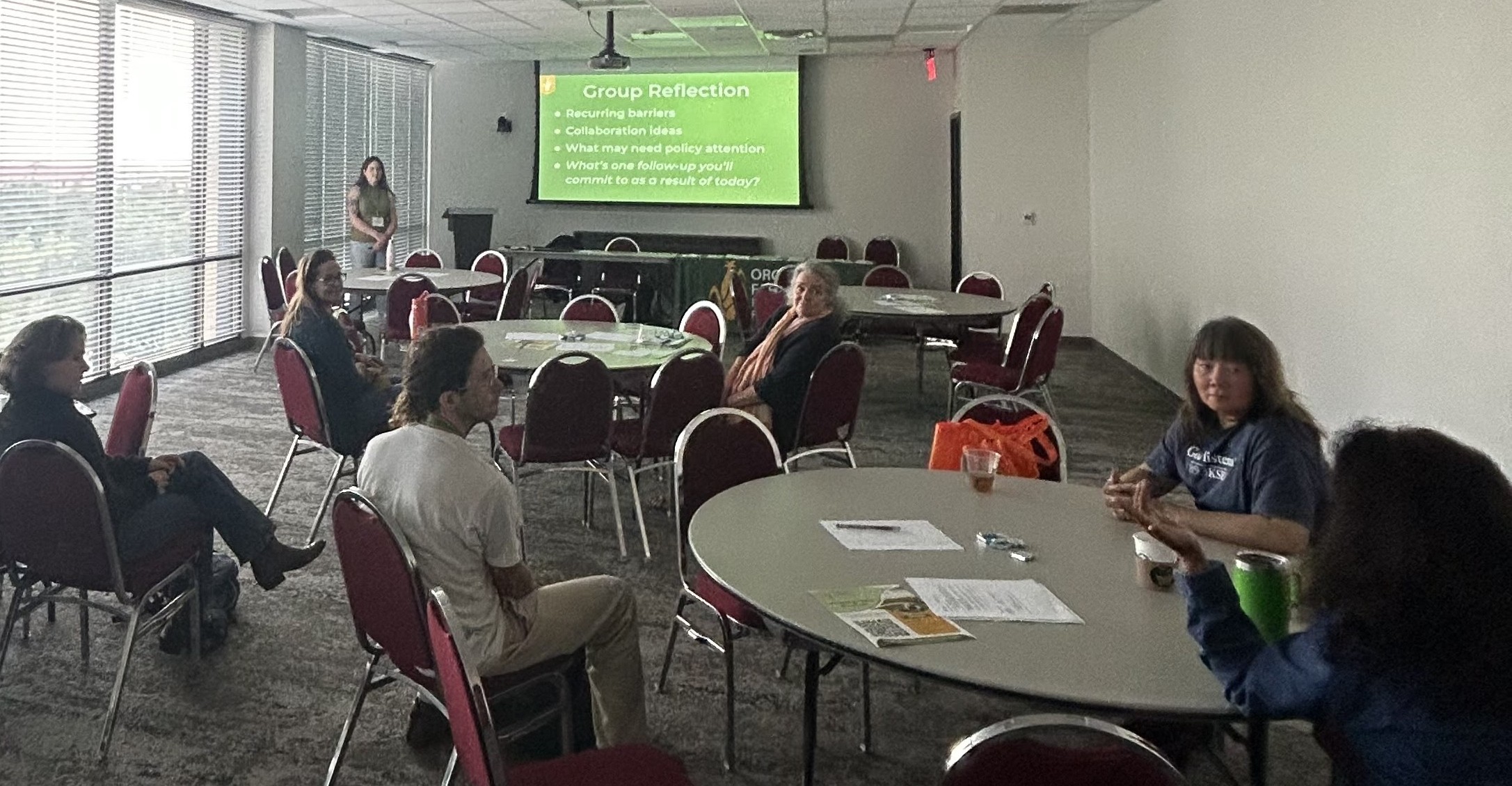
By |2026-09-30T11:28:41-04:00September 29th, 2026|Insects & Diseases, Resource|

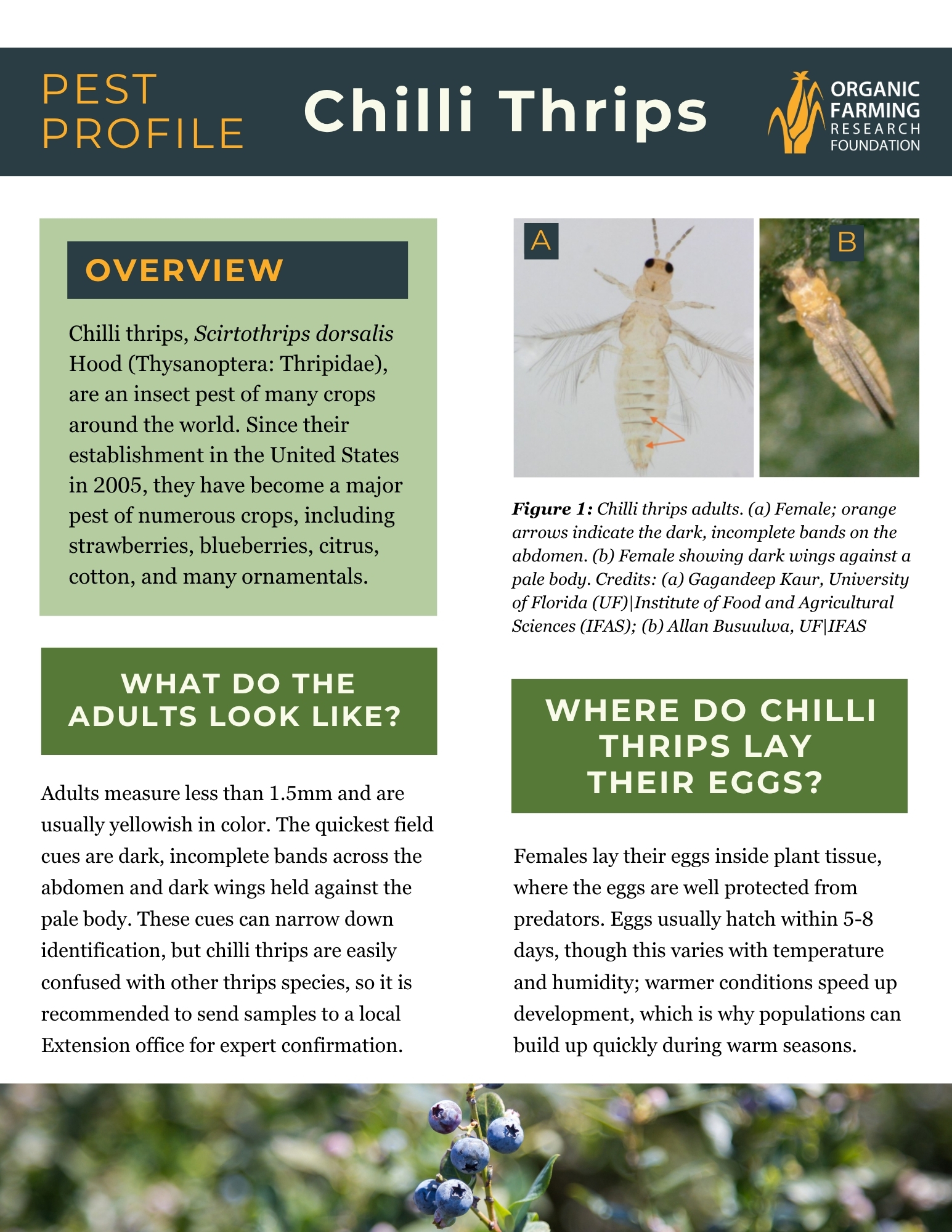
Chilli thrips are an insect pest of many crops around the world. Since their establishment in the United States in 2005, they have become a major pest of numerous crops, including strawberries, blueberries, citrus, cotton, and many ornamentals. This resource covers chilli thrip identification and life cycle, and explains how producers can control these pests organically with natural predators.

Your Region, Your Research: What’s New on the Organic Research Hub

By |2026-10-28T07:36:55-04:00September 25th, 2026|News|

Written by: Ashley Dulaney, OFRF’s Communications Director

Versión en español a continuación.

If you farm organic, you already know the problem: the research you need is out there, but finding it means digging through university extension sites, government databases, and search results that are built for conventional agriculture—not yours.

That’s exactly why OFRF built the Organic Research Hub and why we’re excited to share what’s new. 

What Is the Organic Research Hub?

OFRF's Organic Research Hub logo with an illustration of a hub-and-spoke visual with different illustrations in each spoke (farmers, cow, barn, wheat, magnifying glass over a leaf, beet in soil) with a map of the US with stars spread across it and a report-looking illustration below it, in the center of the illustration

The Organic Research Hub is a free, USDA-funded, searchable library of research-backed resources built specifically for organic and transitioning producers. Whether you’re navigating a conservation program like the Natural Resources Conservation Service’s Environmental Quality Incentives Program (EQIP) or Conservation Stewardship Program (CSP), working through your organic transition, or troubleshooting a challenge on the farm, the Hub puts practical, science-backed answers in one place, instead of scattered across the internet.

For many of the studies in the Hub, you don’t have to wade through a dense academic paper to get what you need. Our team translates the research into plain-language summaries that lay out the methods and outcomes up front, so you can see what was tested and what it means for your farm in a few minutes. Many resources already have summaries, and for those that don’t, we’re adding more all the time.

We’ve spent over three decades as a trusted source of organic farming research and technical guidance. The Hub makes that trove of knowledge searchable in one place for the first time.

What’s New on the Hub

Over the past few months, we’ve been adding new features based on what organic farmers have told us they need. Here’s what’s new:

Pages built for your region. 

The Hub now has dedicated pages for each of the six TOPP regions—Midwest, Northeast, Northwest, Plains, Southeast, and West/Southwest—bringing together the resources, experts, and grants most relevant to your climate, soil, and growing conditions. No more filtering through results that don’t apply to you. 

A bigger Directory of Experts. 

You can now search over 300 verified Extension agents, researchers, and technical service providers nationwide by name, state, region, or on a clickable map of the U.S. Every person listed is vetted by OFRF and works in organic or organic-adjacent agriculture, so you’re not sorting through contacts who don’t know the difference between organic and conventional practices. If you’d rather talk through a decision with a real person than read another factsheet, this is where to start.

You can now view the Hub in Spanish.

Growers can select their preferred language, English or Spanish, so more research is accessible to more farmers.

A dedicated USDA Organic Research Grant Database. 

Curious what organic research is currently being funded? You can now browse USDA OREI (Organic Agriculture Research & Extension Initiative) and ORG (Organic Transition Program) grant projects and reports directly, searchable by keyword, program, year, or award number.

Alerts that do the searching for you.

Set up a free, personalized alert by topic, region, or keyword, and new matching resources will land in your inbox daily, weekly, monthly, or as soon as they’re posted. Subscribe once, and stop searching the same terms over and over.

Get Your Region’s Resource Factsheet

Alongside the Hub itself, we’ve put together a printable, one-page factsheet for each region. It’s a quick reference guide to the research, tools, and local experts curated specifically for your area, plus a QR code straight to your region’s page on the Hub. 

Download your region’s factsheet below as it becomes available:

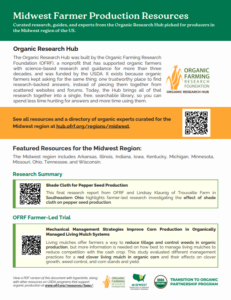
Front page of TOPP Midwest Organic Research Hub Regional factsheet

AR, IL, IN, IA, KY, MI, MN, MS, OH, TN, WI

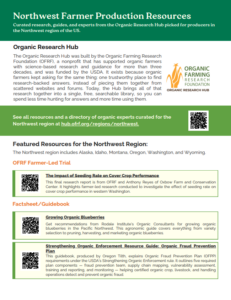
Front page of TOPP Northwest Organic Research Hub Regional factsheet

AK, ID, MT, OR, WA, WY

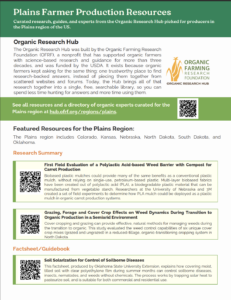
Front page of TOPP Plains Organic Research Hub Regional factsheet

CO, KS, NE, ND, OK, SD

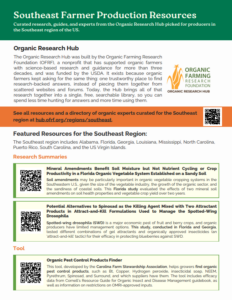
Front page of TOPP SE Organic Research Hub Regional factsheet

AL, FL, GA, LA, MS, NC, PR, SC, USVI

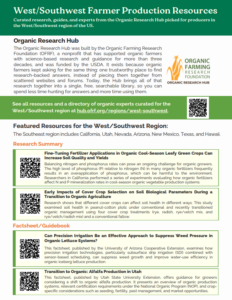
Front page of TOPP West/Southwest Organic Research Hub Regional factsheet

 AZ, CA, HI, NV, NM, TX, UT

Coming Soon!

Northeast/Mid-Atlantic
(CT, DE, ME, MD, MA, NH, NJ, NY, PA, RI, VT, VA, WV)

Want more organic farming resources for your region? Sign up here, and we’ll email them to you as they become available.

Explore What’s Been Built for You

The research, tools, and people you need to farm organically with confidence are already gathered in one place: the Organic Research Hub, built for your region, now in Spanish, and free to use.

Have a resource that should be included, or a question about what you find? Reach out to our team; we’re always adding to the Hub.

Su región, su investigación: lo nuevo en el Organic Research Hub

Si usted produce de manera orgánica, ya conoce el problema: la investigación que necesita existe, pero encontrarla implica rebuscar entre sitios de extensión universitaria, bases de datos gubernamentales y resultados de búsqueda pensados para la agricultura convencional, no para la suya.

Justamente por eso OFRF creó el Organic Research Hub y por eso nos entusiasma compartir las novedades. 

¿Qué es el Organic Research Hub?

OFRF's Organic Research Hub logo with an illustration of a hub-and-spoke visual with different illustrations in each spoke (farmers, cow, barn, wheat, magnifying glass over a leaf, beet in soil) with a map of the US with stars spread across it and a report-looking illustration below it, in the center of the illustration

El Organic Research Hub es una biblioteca gratuita, financiada por el USDA y con buscador, de recursos respaldados por la investigación, creada específicamente para productores orgánicos y en transición. Ya sea que usted esté gestionando un programa de conservación del Natural Resources Conservation Service (Servicio de Conservación de Recursos Naturales, NRCS) como el Environmental Quality Incentives Program (Programa de Incentivos para la Calidad Ambiental, EQIP) o el Conservation Stewardship Program (Programa de Administración de la Conservación, CSP), esté realizando su transición a lo orgánico o esté resolviendo un problema en la finca, el Hub reúne respuestas prácticas y con respaldo científico en un solo lugar, en vez de dispersas por todo el internet.

En muchos de los estudios del Hub, usted no tiene que abrirse paso entre un denso artículo académico para obtener lo que necesita. Nuestro equipo traduce la investigación a resúmenes en lenguaje sencillo que presentan los métodos y los resultados desde el inicio, para que en pocos minutos vea qué se puso a prueba y qué significa para su finca. Muchos recursos ya cuentan con resúmenes y, para los que aún no los tienen, seguimos agregando más todo el tiempo.

Llevamos más de tres décadas siendo una fuente confiable de investigación y orientación técnica sobre agricultura orgánica. El Hub hace que ese acervo de conocimiento sea consultable en un solo lugar por primera vez.

Lo nuevo en el Hub

Durante los últimos meses hemos agregado nuevas funciones a partir de lo que los agricultores orgánicos nos han dicho que necesitan. Esto es lo nuevo:

Páginas hechas para su región. 

El Hub ahora tiene páginas dedicadas a cada una de las seis regiones de TOPP — Medio Oeste, Noreste, Noroeste, Grandes Llanuras, Sureste y Oeste/Suroeste—que reúnen los recursos, expertos y subvenciones más pertinentes para su clima, su suelo y sus condiciones de cultivo. Ya no tendrá que filtrar resultados que no le aplican.

Un directorio de expertos más amplio. 

Ahora puede buscar entre más de 300 agentes de Extensión, investigadores y proveedores de servicios técnicos verificados de todo el país, por nombre, estado, región o en un mapa interactivo de los Estados Unidos. Cada persona incluida ha sido verificada por OFRF y trabaja en agricultura orgánica o afín a lo orgánico, así que usted no estará revisando contactos que no distinguen entre prácticas orgánicas y convencionales. Si prefiere conversar una decisión con una persona real en lugar de leer otra hoja informativa, este es el lugar para empezar.

Ahora puede ver el Hub en español.

Los productores pueden seleccionar su idioma preferido, inglés o español, para que más investigación sea accesible para más granjeros.

A dedicated USDA Organic Research Grant Database. 

Una base de datos dedicada a las subvenciones de investigación orgánica del USDA.
¿Le interesa saber qué investigación orgánica se está financiando actualmente? Ahora puede consultar directamente los proyectos e informes de las subvenciones OREI, Iniciativa de Investigación y Extensión en Agricultura Orgánica y ORG, Programa de Transición Orgánica del USDA con búsqueda por palabra clave, programa, año o número de adjudicación.

Alertas que buscan por usted.

Configure una alerta gratuita y personalizada por tema, región o palabra clave, y los nuevos recursos que coincidan llegarán a su correo a diario, semanalmente, mensualmente o apenas se publiquen. Suscríbase una vez y deje de buscar los mismos términos una y otra vez.

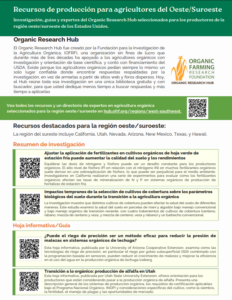
Obtenga la hoja informativa de recursos de oeste/suroeste

Junto con el Hub, hemos preparado una hoja informativa imprimible de una página para el oeste/suroeste. Es una guía de referencia rápida sobre la investigación, las herramientas y los expertos locales seleccionados específicamente para su zona, además de un código QR que lleva directamente a la página de su región en el Hub. 

Descargue la hoja informativa del oeste/suroeste:

Explore lo que se construyó para usted

La investigación, las herramientas y las personas que usted necesita para producir de manera orgánica con confianza ya están reunidas en un solo lugar: el Organic Research Hub, creado para su región, ahora en español y de uso gratuito.

¿Quiere más recursos de agricultura orgánica para su región? Regístrese aquí y se los enviaremos por correo electrónico conforme estén disponibles.

¿Tiene un recurso que debería incluirse o una pregunta sobre lo que encontró? Comuníquese con nuestro equipo; siempre estamos agregando contenido al Hub.

Cover Cropping Strategies for Organic Systems in the West

By |2026-10-27T14:13:36-04:00September 16th, 2026|Cover Crops & Crop Rotation, Resource|

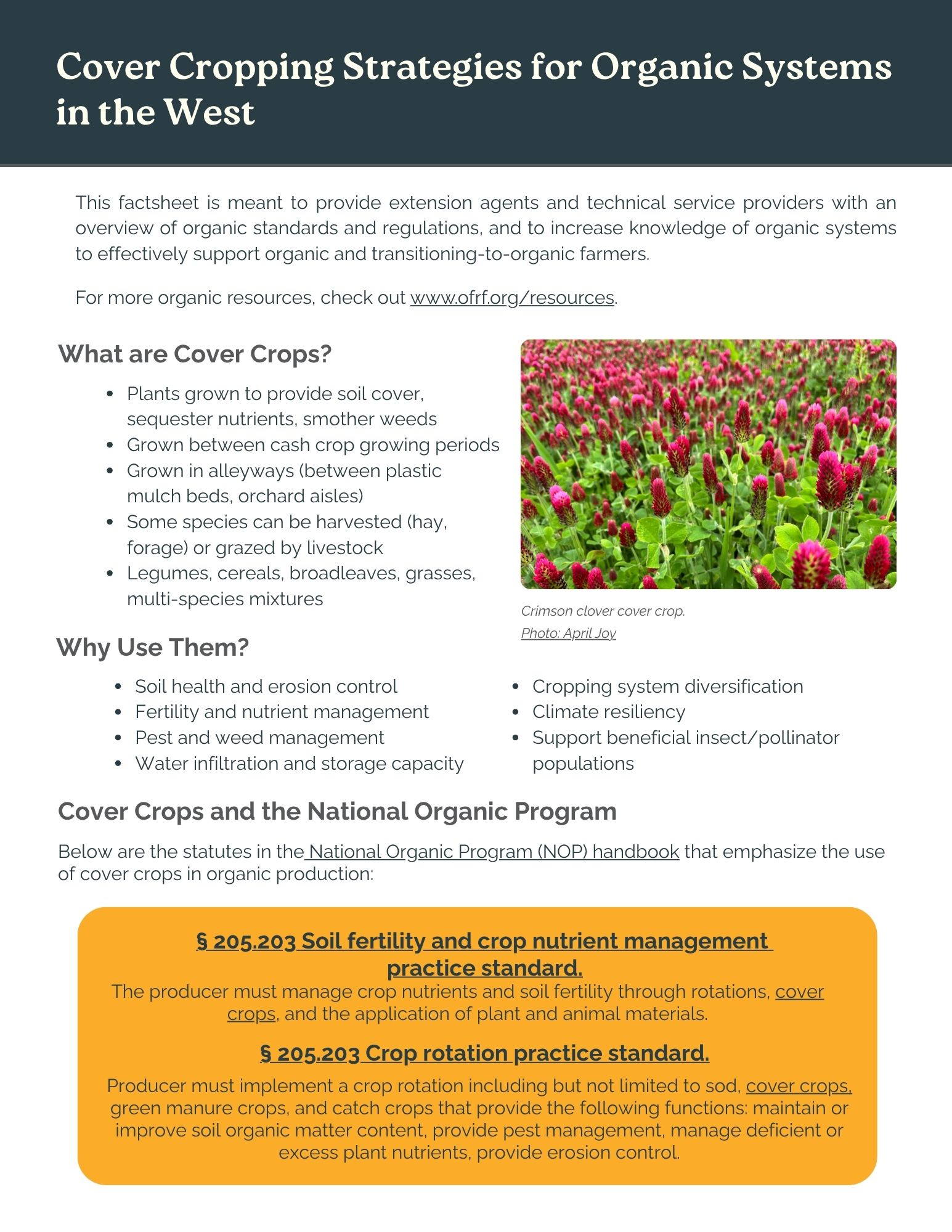
An Organic Cover Cropping Guide for Extension Agents and Technical Service Providers (TSPs) in the West.

This factsheet is meant to provide extension agents and technical service providers with an overview of cover cropping, to present the organic standards that relate to cover crops and soil health, and to increase knowledge of organic systems to effectively support organic and transitioning-to-organic farmers.

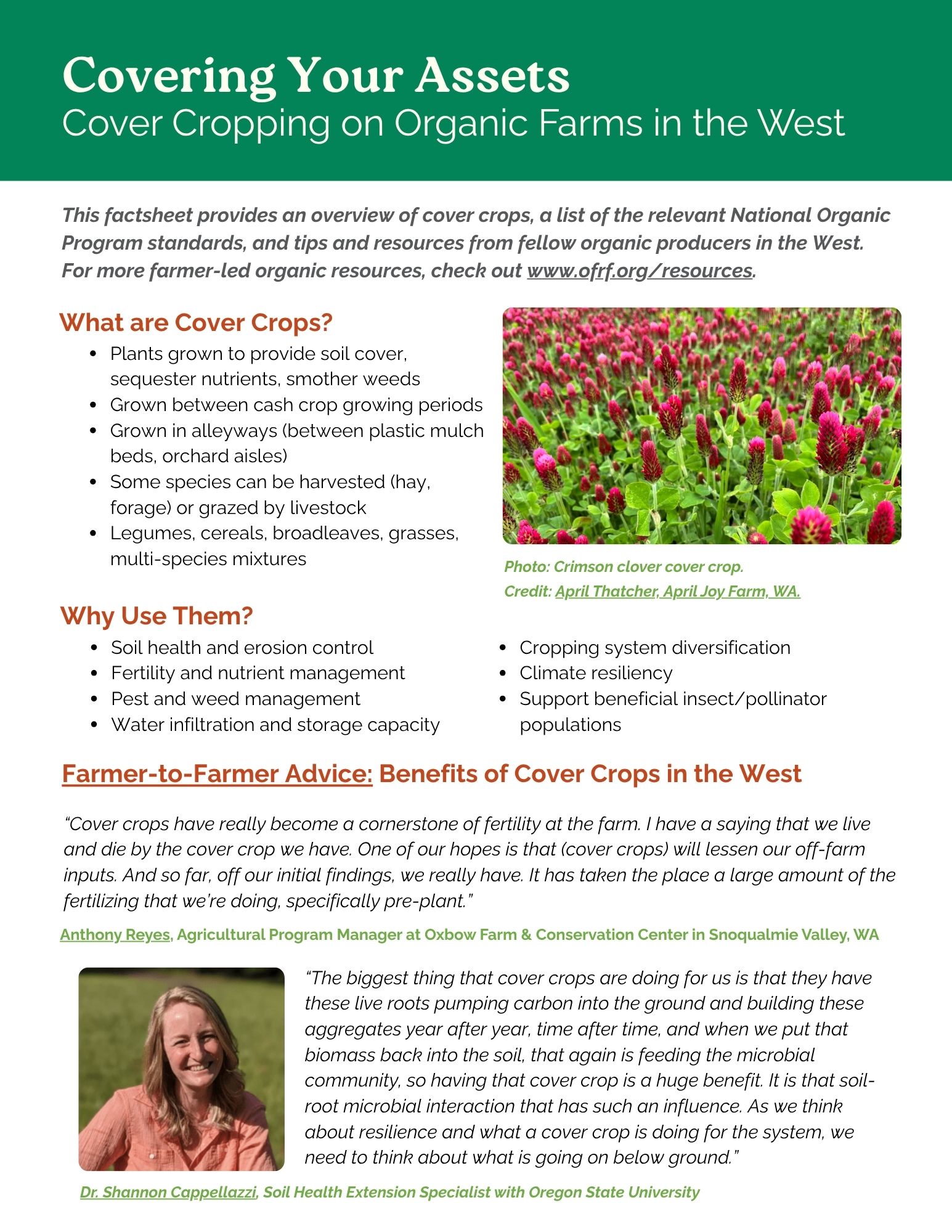
An Organic Cover Cropping Guide for Farmers in the West.

This factsheet provides the overview of cover crops, the list of the relevant National Organic Program standards, and more tips and resources from organic producers and experts in the West. This version is written for farmers and ranchers in the West.

Prefer to listen? Watch our Cover Cropping Strategies for Organic Systems in the West webinar.

Cover crops are one of the most powerful tools available to organic and transitioning farmers, but getting them right in western growing conditions takes knowledge and experience. This webinar brings together researchers and practitioners to share what the science says and what is working on the ground. OFRF Conservation Scientist Rebecca Champagne, PhD, presents current research on cover crops for western organic systems, covering soil health, nutrient and weed management, pollinator support, and grazing integration. Shannon Cappellazzi, PhD, Soil Health Extension Specialist with Oregon State University, and Anthony Reyes, Director of Agriculture at Oxbow Farm and Conservation Center, join the panel to offer research and on-farm perspectives from real-world experience in the region.

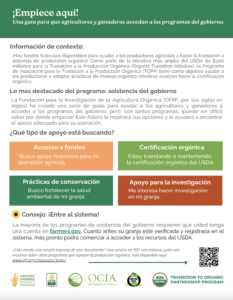
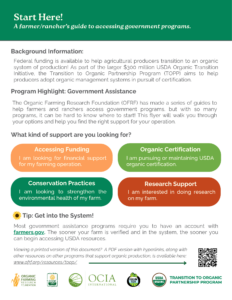
Start Here! An Organic Farmer/Rancher’s Guide to Government Programs

By |2026-10-02T10:18:08-04:00September 16th, 2026|Federal Assistance, News, Spanish Resources|

Versión en español a continuación.

The United States Department of Agriculture (USDA) offers myriad programs to farmers and ranchers seeking financial and technical assistance support. But with so many options, it can be hard to know where to start! OFRF has made a series of guides to demystify government programs, with easy, step-by-step application support. Use this guide to find the specific help you’re looking for, so you can get off your computer and back into the field!

What type of support do you need?

Tip: Get into the System Early! Most government assistance programs require you to have an account with farmers.gov. The sooner your farm is verified and in the system, the sooner you can begin accessing USDA resources.

Funding and Financial Resources

Accessing funding is a vital part of every farm’s journey. Whether you are looking to purchase land, insure your crops, fund a new conservation or research projects, or just cover day to day operation costs, financial resources are available to you!

Farm Service Agency (FSA) Loans

Accessing funding is a vital part of every farm’s journey. Whether you are looking to purchase land, insure your crops, fund a new conservation or research projects, or just cover day to day operation costs, financial resources are available to you!

The Farm Service Agency (FSA) is a crucial financing resource for farmers. It can help guarantee loans made by commercial lenders or issue direct loans to farmers when they cannot access credit or favorable terms and rates from a bank. The FSA can also be the “Lender of First Opportunity” for beginning farmers.

Eligible Applicants: Family-size farmers/ranchers who cannot obtain commercial credit from a bank, Farm Credit System institution, or other lender.

Funding Available: Direct and guaranteed farm ownership (FO) and operating loans (OL).

Projects Funded: FSA offers a variety of loan types including but not limited to: farm ownership and operating, beginning farmers, emergencies, and more.

Application Deadline: Applications are accepted on a rolling basis.

Whole Farm Revenue Program (WFRP)

The Whole-Farm Revenue Protection (WFRP) policy is a crop insurance option developed by the Risk Management Agency (RMA) and administered by the Federal Crop Insurance Corporation (FCIC). Through WFRP, farmers can get a single crop insurance policy for their entire farm, making it a great option for organic and diversified farms.

Eligible Applicants: Farmers/Ranchers in the U.S. or territories. It is best suited to farms with a range of commodities that sell to wholesale markets.

Insurance Coverage: WFRP protects against revenue loss due to natural disasters or market shifts, up to $17 million. Actual coverage amount will depend on the specific farm. Use our WFRP calculator to get an estimate!

Application Deadline: Dates will vary by crop and location, with the first filing date usually occurring in Spring.

More Financial Opportunities

If you are looking for financial support for organic certification, see OCCSP.

If you are looking for financial support for implementing conservation practices on your farm, see EQIP or CSP.

If you are looking for financial support for research projects on your farm, see SARE.

USDA Organic Certification

The USDA’s National Organic Program (NOP) is a federal regulatory program that enforces standards for organic products sold in the U.S. Farmers pursue organic certification for various reasons, including improving soil health, reducing reliance on synthetic inputs, enhancing biodiversity, contributing to a more sustainable food system, and taking advantage of the economic opportunities it presents, such as accessing new organic markets and higher price premiums. Certification requires additional recordkeeping, and may include a transitional period before certification can be administered. If you’ve decided that certification is the right path for your farm, we have resources to guide you through.

Organic Certification Cost Share Program (OCCSP)

The Organic Certification Cost Share Program (OCCSP) is a USDA program that helps cover part of your organic certification costs, including registration in a state organic program. In the past, the OCCSP has reimbursed 75% of fees up to a maximum of $750 per scope. Scopes include crops, wild crops, livestock, and processing/handling.

Eligible Applicants: Certified organic producers and handlers in the United States or its territories.

Funding Available: 75% reimbursement of their organic certification fees up to a maximum of $750 per certification. If you have multiple certification scopes, you can apply for assistance with each certification.

Covered Costs: Application fees, organic inspection costs, fees related to equivalency requirements, travel and per diem fees for inspectors, user fees, sales assessments, and postage.

Application Deadline: Applications are generally due at the end of the calendar year.

The Organic Transition Initiative (OTI)

The Organic Transition Initiative (OTI) is a USDA agency that works to help transitioning farmers. Before becoming certified organic, farmers must complete a 36-month period managing their land without prohibited inputs. This time period can present challenges for growers, as their land adapts to organic management and they are not yet benefiting from the higher price premium from the organic label. Explore OTI’s resources to aid with the transitional period.

Transition to Organic Partnership Program (TOPP)

The Transition to Organic Partnership Program (TOPP) is a collaborative partnership created to guide transitioning farmers. Through the program, producers can be matched with a mentor to guide them through becoming certified organic and offer ongoing support.

Natural Resources Conservation Service (NRCS) Support

NRCS offers help to producers implementing conservation activities required for certification, receiving expert technical support, and recovering foregone income due to reduced yields during the organic transition period through OTI. Read our guide to learn how to communicate with your NRCS agent about accessing support for your organic transition.

If you are looking for support on implementing conservation practices on your farm, see Increasing Conservation.

Learn more about USDA Organic Certification

The organic transition period and USDA requirements present a learning curve for farmers. Luckily, we have advice from farmers who have done it before!

Increasing Conservation

The Natural Resources Conservation Service (NRCS) is a federal agency that supports the adoption of conservation practices by providing farmers, ranchers, foresters, and landowners with technical and financial assistance. They work to address resource concerns related to soil, water, plants, animals, air, and energy; help producers and landowners achieve conservation goals; and enhance the long-term sustainability of US agriculture. If you are interested in increasing conservation practices on your land, your local NRCS office is a good place to start!

NRCS Farmer Stories:

Environmental Quality Incentives Program (EQIP)

The Environmental Quality Incentives Program (EQIP) from NRCS offers a variety of technical and financial assistance opportunities for farmers and ranchers, including the High Tunnel Initiative, the On Farm Energy Initiative, and the Organic Initiative.

Eligible Applicants: Agricultural producers; non-industrial private forest-owners; federally recognized tribes; water management entities.

Funding Available: Cost-share covering building, resource, and labor costs. Amount of funding varies on availability.

Projects Funded: New projects or infrastructure addressing a natural resource concern. Ex. building a high tunnel, establishing a cover cropping system, fencing for rotational grazing.

Project Length: 1-10 years.

Application Deadline: Applications are accepted on a rolling basis throughout the year, with the first batching deadline generally falling in early January.

Conservation Stewardship Program (CSP)

The Conservation Stewardship Program (CSP) from NRCS offers technical and financial assistance to help agricultural and forest producers take their conservation efforts to the next level, through practices like cover cropping, integrated grazing, supporting wildlife habitats, and more.

Eligible Applicants: Agricultural producers; non-industrial private forest-owners; federally recognized tribes.

Funding Available: Annual minimum payments of $4,000.

Projects Funded: Projects that maintain or enhance conservation efforts, e.g., trialing new cover crop mixes, planting agroforestry projects, increasing pollinator habitats.

Project Length: 5 years, with renewal available.

Application Deadline: Applications are accepted on a rolling basis throughout the year, with the first batching deadline generally falling in early January.

CSP Farmer Stories

EQIP and CSP: What’s the Difference? Both programs provide funding opportunities for conservation efforts, and many farmers use both on their farm. EQIP is a cost-share program for projects that address a specific natural resource concern and establish a new conservation practice (like establishing a cover cropping system or planting natives to reduce erosion). CSP provides annual payments to help farmers maintain or enhance existing conservation strategies on their farm (like trialing new cover crop mixes or planting natives to increase pollinator habitats). EQIP contracts are a specified length (1-10 years), while CSP contracts are 5 years and can be renewed. Farmers often start with an EQIP contract to address a specific issue, and then maintain the practice through an ongoing CSP contract.

Conservation Programs and Organic Certification

Despite both being administered by USDA, NRCS conservation practices and USDA certification requirements may not perfectly align. NRCS’s Technical Note 12 strives to bridge that gap, outlining the overlap between NRCS resource concerns and NOP organic standards.

Conducting Research

Organic farmers and ranchers often test and experiment with new ideas to improve their farming operations. If you are looking to turn your informal farm research into more structured research projects, OFRF has the tools to get you started!

Sustainable Agriculture Research and Education (SARE)

The Sustainable Agriculture Research and Education (SARE) Farmer/Rancher Grant Program is a competitive grant program that provides funding to producers who have designed their own research projects and teams. This program aims to award funding to projects that address real-world, on-farm challenges and include both research and outreach components.

Eligible Applicants: Commercial farmers and ranchers with an income of at least $1,000 annually.

Funding Available: Financial assistance for the entirety of your proposed project, up $15,000-35,000; varies regionally.

Projects Funded: SARE provides grants for the entirety of a research project, from designing the trial to sharing the results. Ex. Trialing organic pest or weed management strategies, comparing cover crop mixes or rotations, testing compost or organic fertilizer effects.

Project Length: Between 1-3 years, depending on region.

Application Deadline: Applications vary by region between early fall and late winter.

Find your SARE Region: There are four SARE regions and requirements and funding availability may vary based on location.

Northeast SARE: Connecticut, Delaware, Maine, Maryland, Massachusetts, New Hampshire, New Jersey, New York, Pennsylvania, Rhode Island, Vermont, West Virginia.

North Central SARE: Illinois, Indiana, Iowa, Kansas, Michigan, Minnesota, Missouri, Nebraska, North Dakota, Ohio, South Dakota, Wisconsin.

Southern SARE: Alabama, Arkansas, Florida, Georgia, Kentucky, Louisiana, Mississippi, North Carolina, Oklahoma, Puerto Rico, South Carolina, Tennessee, Texas, U.S. Virgin Islands, Virginia.

Western SARE: Alaska, American Samoa, Arizona, California, Colorado, CNMI, FSM, Guam, Hawaii, Idaho, Montana, Nevada, New Mexico, Oregon, Utah, Washington, Wyoming.

Getting Started with On-Farm Research

SARE favors farmers who have a developed research proposal and have made connections with research professionals. If you are looking to dip your toe into more structured research before submitting a SARE proposal, explore our resources!

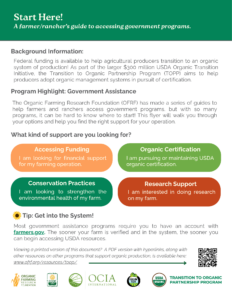
All of this information is summarized in a printable, downloadable PDF below, available in English and Spanish.

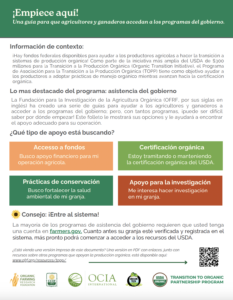
¡Empiece aquí! Guía de programas del gobierno para agricultores y ganaderos orgánicos

El Departamento de Agricultura de los Estados Unidos (USDA, por sus siglas en inglés) ofrece innumerables programas para agricultores y ganaderos que buscan apoyo con asistencia financiera y técnica. Pero, con tantas opciones, ¡puede ser difícil saber por dónde empezar! OFRF ha creado una serie de guías para quitar los mitos acerca de los programas del gobierno, con apoyo sencillo y paso a paso para aplicar. Use esta guía para encontrar la ayuda específica que está buscando, ¡para que pueda dejar la computadora y volver al campo!

¿Qué tipo de apoyo necesita?

Consejo: ¡entre al sistema con anticipación! La mayoría de los programas de asistencia del gobierno requieren que usted tenga una cuenta en farmers.gov. Cuanto antes su granja esté verificada y registrada en el sistema, más pronto podrá comenzar a acceder a los recursos del USDA.

Fondos y recursos financieros

El acceso a fondos es una parte vital del camino de toda granja. Ya sea que usted busque comprar tierras, asegurar sus cultivos, financiar un nuevo proyecto de conservación o de investigación, o simplemente cubrir los costos de operación del día a día, ¡hay recursos financieros disponibles para usted!

Préstamos de la Agencia de Servicios Agrícolas (FSA)

La Agencia de Servicios Agrícolas (FSA, por sus siglas en inglés) es un recurso de financiamiento crucial para los agricultores. Puede ayudar a garantizar préstamos otorgados por prestamistas comerciales o emitir préstamos directos a los agricultores cuando estos no pueden acceder a crédito o a condiciones y tasas favorables en un banco. La FSA también puede ser el “prestamista de primera oportunidad” para agricultores que están iniciando.

Solicitantes elegibles: Agricultores y ganaderos de escala familiar que no pueden obtener crédito comercial de un banco, de una institución del Farm Credit System o de otro prestamista.

Fondos disponibles: Préstamos directos y garantizados para propiedad agrícola (FO, por sus siglas en inglés) y de operación (OL, por sus siglas en inglés).

Proyectos financiados: La FSA ofrece una variedad de tipos de préstamos que incluyen, entre otros: propiedad y operación agrícola, agricultores que están iniciando, emergencias y más.

Fecha límite de solicitud: Las solicitudes se aceptan de forma continua.

Programa de Protección de Ingresos para Toda la Granja (WFRP)

La póliza de Protección de Ingresos para Toda la Granja (WFRP, por sus siglas en inglés) es una opción de seguro de cultivos desarrollada por la Agencia de Manejo de Riesgos (RMA, por sus siglas en inglés) y administrada por la Corporación Federal de Seguros de Cosechas (FCIC, por sus siglas en inglés). A través del WFRP, los agricultores pueden obtener una sola póliza de seguro de cultivos para toda su granja, lo que la convierte en una gran opción para granjas orgánicas y diversificadas.

Solicitantes elegibles: Agricultores y ganaderos en los Estados Unidos o sus territorios. Es más adecuada para granjas con una variedad de productos que venden a mercados mayoristas.

Cobertura del seguro: El WFRP protege contra la pérdida de ingresos debida a desastres naturales o cambios en el mercado, hasta $17 millones. El monto real de la cobertura dependerá de cada granja. ¡Use nuestra calculadora del WFRP para obtener un estimado!

Fecha límite de solicitud: Las fechas varían según el cultivo y la ubicación; la primera fecha de presentación suele ocurrir en la primavera.

Más oportunidades financieras

Si busca apoyo financiero para la certificación orgánica, consulte el OCCSP.

Si busca apoyo financiero para implementar prácticas de conservación en su granja, consulte el EQIP o el CSP.

Si busca apoyo financiero para proyectos de investigación en su granja, consulte SARE.

Certificación orgánica del USDA

El Programa Nacional Orgánico (NOP, por sus siglas en inglés) del USDA es un programa regulatorio federal que hace cumplir las normas para los productos orgánicos que se venden en los Estados Unidos. Los agricultores buscan la certificación orgánica por diversas razones, entre ellas: mejorar la salud del suelo, reducir la dependencia de insumos sintéticos, aumentar la biodiversidad, contribuir a un sistema alimentario más sostenible y aprovechar las oportunidades económicas que esta presenta, como el acceso a nuevos mercados orgánicos y a precios más altos. La certificación requiere llevar registros adicionales y puede incluir un período de transición antes de que la certificación pueda otorgarse. Si usted ha decidido que la certificación es el camino correcto para su granja, tenemos recursos para guiarle en el proceso.

Programa de Costos Compartidos para la Certificación Orgánica (OCCSP)

El Programa de Costos Compartidos para la Certificación Orgánica (OCCSP, por sus siglas en inglés) es un programa del USDA que ayuda a cubrir parte de sus costos de certificación orgánica, incluida la inscripción en un programa orgánico estatal. En el pasado, el OCCSP ha reembolsado el 75% de las tarifas, hasta un máximo de $750 por alcance. Los alcances incluyen cultivos, cultivos silvestres, ganado y procesamiento/manejo.

Solicitantes elegibles: Productores y manejadores orgánicos certificados en los Estados Unidos o sus territorios.

Fondos disponibles: Reembolso del 75% de las tarifas de certificación orgánica, hasta un máximo de $750 por certificación. Si usted tiene múltiples alcances de certificación, puede solicitar asistencia para cada certificación.

Costos cubiertos: Tarifas de aplicación, costos de inspección orgánica, tarifas relacionadas con requisitos de equivalencia, viáticos de los inspectores, tarifas de usuario, contribuciones sobre ventas y franqueo postal.

Fecha límite de solicitud: Las solicitudes generalmente vencen al final del año calendario.

La Iniciativa de Transición Orgánica (OTI)

La Iniciativa de Transición Orgánica (OTI, por sus siglas en inglés) es una iniciativa del USDA que trabaja para ayudar a los agricultores en transición. Antes de obtener la certificación orgánica, los agricultores deben completar un período de 36 meses manejando sus tierras sin insumos prohibidos. Este período puede presentar desafíos para los productores, mientras sus tierras se adaptan al manejo orgánico y aún no se benefician del precio más alto de la etiqueta orgánica. Explore los recursos de la OTI como apoyo durante el período de transición.

Programa de Asociación para la Transición Orgánica (TOPP)

El Programa de Asociación para la Transición Orgánica (TOPP, por sus siglas en inglés) es una alianza colaborativa creada para guiar a los agricultores en transición. A través del programa, los productores pueden ser emparejados con un mentor que les guíe en el proceso de obtener la certificación orgánica y les ofrezca apoyo continuo.

Apoyo del Servicio de Conservación de Recursos Naturales (NRCS)

A través de la OTI, el NRCS ofrece ayuda a los productores para implementar las actividades de conservación requeridas para la certificación, recibir apoyo técnico especializado y recuperar los ingresos no percibidos debido a la reducción de rendimientos durante el período de transición orgánica. Lea nuestra guía para aprender a comunicarse con su agente del NRCS sobre cómo acceder a apoyo para su transición orgánica.

Si busca apoyo para implementar prácticas de conservación en su granja, consulte Aumentar la conservación.

Conozca más sobre la certificación orgánica del USDA

El período de transición orgánica y los requisitos del USDA representan una curva de aprendizaje para los agricultores. Por suerte, ¡tenemos consejos de agricultores que ya lo han hecho!

Aumentando la conservación

El Servicio de Conservación de Recursos Naturales (NRCS, por sus siglas en inglés) es una agencia federal que apoya la adopción de prácticas de conservación brindando asistencia técnica y financiera a agricultores, ganaderos, silvicultores y propietarios de tierras. Trabaja para atender los problemas de recursos relacionados con el suelo, el agua, las plantas, los animales, el aire y la energía; ayudar a los productores y propietarios de tierras a alcanzar sus metas de conservación; y mejorar la sostenibilidad a largo plazo de la agricultura de los Estados Unidos. Si le interesa aumentar las prácticas de conservación en sus tierras, ¡su oficina local del NRCS es un buen lugar para empezar!

Historias de agricultores con el NRCS

Programa de Incentivos para la Calidad Ambiental (EQIP)

El Programa de Incentivos para la Calidad Ambiental (EQIP, por sus siglas en inglés) del NRCS ofrece una variedad de oportunidades de asistencia técnica y financiera para agricultores y ganaderos, incluidas la Iniciativa de Túneles Altos, la Iniciativa de Energía en la Granja y la Iniciativa Orgánica.

Solicitantes elegibles: Productores agrícolas; propietarios de bosques privados no industriales; tribus reconocidas a nivel federal; entidades de manejo del agua.

Fondos disponibles: Costos compartidos que cubren costos de construcción, recursos y mano de obra. El monto del financiamiento varía según la disponibilidad.

Proyectos financiados: Proyectos nuevos o infraestructura que atiendan un problema de recursos naturales. Ej.: construir un túnel alto, establecer un sistema de cultivos de cobertura, cercar para pastoreo rotativo.

Duración del proyecto: De 1 a 10 años.

Fecha límite de solicitud: Las solicitudes se aceptan de forma continua durante todo el año, y la primera fecha límite de agrupación generalmente cae a principios de enero.

Programa de Administración para la Conservación (CSP)

El Programa de Administración para la Conservación (CSP, por sus siglas en inglés) del NRCS ofrece asistencia técnica y financiera para ayudar a los productores agrícolas y forestales a llevar sus esfuerzos de conservación al siguiente nivel, mediante prácticas como cultivos de cobertura, pastoreo integrado, apoyo a los hábitats de vida silvestre y más.

Solicitantes elegibles: Productores agrícolas; propietarios de bosques privados no industriales; tribus reconocidas a nivel federal.

Fondos disponibles: Pagos anuales mínimos de $4,000.

Proyectos financiados: Proyectos que mantienen o mejoran los esfuerzos de conservación, p. ej., probar nuevas mezclas de cultivos de cobertura, plantar proyectos agroforestales, aumentar los hábitats de polinizadores.

Duración del proyecto: 5 años, con posibilidad de renovación.

Fecha límite de solicitud: Las solicitudes se aceptan de forma continua durante todo el año, y la primera fecha límite de agrupación generalmente cae a principios de enero.

Historias de agricultores con el CSP

El EQIP y el CSP: ¿cuál es la diferencia? Ambos programas ofrecen oportunidades de financiamiento para esfuerzos de conservación, y muchos agricultores usan ambos en su granja. El EQIP es un programa de costos compartidos para proyectos que atienden un problema específico de recursos naturales y establecen una práctica de conservación nueva (como establecer un sistema de cultivos de cobertura o plantar especies nativas para reducir la erosión). El CSP ofrece pagos anuales para ayudar a los agricultores a mantener o mejorar estrategias de conservación existentes en su granja (como probar nuevas mezclas de cultivos de cobertura o plantar especies nativas para aumentar los hábitats de polinizadores). Los contratos del EQIP tienen una duración determinada (de 1 a 10 años), mientras que los contratos del CSP son de 5 años y pueden renovarse. Los agricultores a menudo comienzan con un contrato del EQIP para atender un problema específico y luego mantienen la práctica mediante un contrato continuo del CSP.

Los Programas de Conservación y la Certificación Orgánica

A pesar de que ambos son administrados por el USDA, las prácticas de conservación del NRCS y los requisitos de certificación del USDA pueden no estar perfectamente alineados. La Nota Técnica 12 del NRCS busca cerrar esa brecha, describiendo la superposición entre los problemas de recursos del NRCS y las normas orgánicas del NOP.

Realizando investigaciones

Los agricultores y ganaderos orgánicos a menudo prueban y experimentan con nuevas ideas para mejorar sus operaciones agrícolas. Si usted busca convertir su investigación agrícola informal en proyectos de investigación más estructurados, ¡OFRF tiene las herramientas para que empiece!

Investigación y Educación en Agricultura Sostenible (SARE)

El Programa de Subvenciones para Agricultores/Ganaderos de Investigación y Educación en Agricultura Sostenible (SARE, por sus siglas en inglés) es un programa competitivo de subvenciones que otorga fondos a productores que han diseñado sus propios proyectos y equipos de investigación. Este programa busca financiar proyectos que atiendan desafíos reales dentro de la granja y que incluyan componentes tanto de investigación como de divulgación.

Solicitantes elegibles: Agricultores y ganaderos comerciales con un ingreso de al menos $1,000 anuales.

Fondos disponibles: Asistencia financiera para la totalidad del proyecto propuesto, de $15,000 a $35,000; varía según la región.

Proyectos financiados: SARE ofrece subvenciones para la totalidad de un proyecto de investigación, desde el diseño del ensayo hasta la difusión de los resultados. Ej.: probar estrategias orgánicas de manejo de plagas o malezas, comparar mezclas o rotaciones de cultivos de cobertura, evaluar los efectos del compost o de fertilizantes orgánicos.

Duración del proyecto: 

Fecha límite de solicitud: Las solicitudes varían por región entre principios del otoño y finales del invierno.

Encuentre su región de SARE: Hay cuatro regiones de SARE, y los requisitos y la disponibilidad de fondos pueden variar según la ubicación.

Northeast SARE: Connecticut, Delaware, Maine, Maryland, Massachusetts, New Hampshire, New Jersey, New York, Pennsylvania, Rhode Island, Vermont, West Virginia.

North Central SARE: Illinois, Indiana, Iowa, Kansas, Michigan, Minnesota, Missouri, Nebraska, North Dakota, Ohio, South Dakota, Wisconsin.

Southern SARE: Alabama, Arkansas, Florida, Georgia, Kentucky, Louisiana, Mississippi, North Carolina, Oklahoma, Puerto Rico, South Carolina, Tennessee, Texas, U.S. Virgin Islands, Virginia.

Western SARE: Alaska, American Samoa, Arizona, California, Colorado, CNMI, FSM, Guam, Hawaii, Idaho, Montana, Nevada, New Mexico, Oregon, Utah, Washington, Wyoming.

Cómo comenzar con la investigación en la granja

SARE favorece a los agricultores que tienen una propuesta de investigación desarrollada y que han establecido conexiones con profesionales de la investigación. Si usted quiere adentrarse en una investigación más estructurada antes de presentar una propuesta a SARE, ¡explore nuestros recursos!

Toda esta información se resume en un PDF imprimible y descargable a continuación, disponible en inglés y español.

Using Synergy, Conservation Practices, and NRCS Support to Save Citrus with Uncle Matt’s Organic

By |2026-09-30T13:10:37-04:00September 14th, 2026|Farmer Stories, Insects & Diseases, News, On-Farm Research|

Written by Mary Elizabeth Kidd, OFRF Communications Associate

OFRF is currently working to increase farmer and community awareness of the federal funding opportunities available to organic and transitioning farms. 

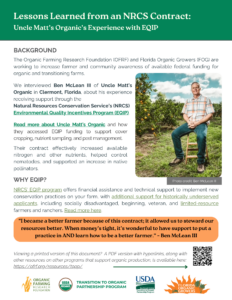
As part of our work with the Southeast region of the USDA’s Transition to Organic Partnership Program (TOPP), we’re spotlighting the experience of Uncle Matt’s Organic and McLean Family Farms in Clermont, Florida, that received funding and support through the Natural Resource Conservation Service’s Environmental Quality Incentives Program (EQIP).

Their story offers a transparent look at what it’s really like to work with NRCS: the benefits, the obstacles, and the lessons they’ve learned. We hope other farmers can use their experience to navigate the process of applying for and implementing contracts more easily.

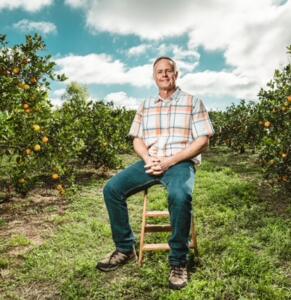
Meet Ben McLean III of Uncle Matt’s Organic and McLean Family Farms

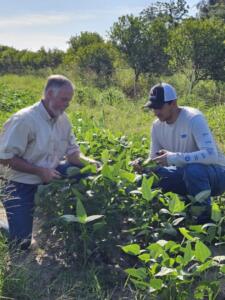
Photo Courtesy of Ben McLean III

Location: Clermont, Florida (Lake County, west of Orlando)

Established: family farm established in the 1880s, Uncle Matt’s Organic established in 1999

Acres: 50

Production: Citrus

Certification: USDA Certified Organic via QCS since 2003

Staff: 15 full-time employees (as of EQIP contract phase)

Markets: Sell directly to grocery outlets including Whole Foods, Target, Publix, and more (20,000+ locations)

As the Head of Research with Uncle Matt’s Organic and a fourth-generation citrus farmer with McLean Family Farms, Ben McLean III is harnessing science, a robust network of experts and support, and family legacy to help safeguard the future of citrus in Florida and around the world.

Members of the OFRF team recently spoke to Ben to learn more about his experience accessing NRCS’ Environmental Quality Incentives Program (EQIP) and how this program and its resulting wins and learnings can help fellow growers. 

>> Learn more: Listen to Ben McLean III on the Food for You and the Planet podcast.

About the Farmers

Angus Benjamin McLean, Ben McLean III’s great-grandfather, began citrus farming on the family’s Bartow, Florida, property in the 1880s. Ben’s grandfather, father, and siblings have continued the family legacy, weathering the uncertainties of ecological and economic change to help keep citrus farming alive in central Florida.

Ben received his master’s degree in Horticulture Science from the University of Florida and consistently works closely with university researchers and members of the USDA’s Agricultural Research Service (ARS) to explore and advance citrus research and conservation efforts. He’s traveled to Mexico, Costa Rica, Brazil and South Africa to learn from citrus growers around the world and to share his knowledge, including learnings from his EQIP contract with NRCS.

His ability to activate a synergistic network of grower organizations, learning opportunities through these organizations and the USDA, and a community of experts, researchers, and farming peers continues to create opportunities for him to grow the family farm business and act as a leader in the citrus and sustainable agriculture spaces.

Context & Challenges

The top concern of Ben, his team, and the researchers they work with is citrus greening disease, also known as Citrus Huanglongbing, or Citrus HLB.  Within the last 30 years, this disease caused by the bacterium (Candidatus Liberibacter asiaticus) and vectored by the Asian citrus psyllid has destroyed over 75% of Florida’s citrus production.

Citrus greening continues to cripple Florida’s citrus production, and Ben is on a mission to facilitate research to protect Florida citrus. His NRCS EQIP contract, discussed below, played a role in the promising research they’re facilitating towards this mission.

The McLean family originally managed over 1,200 acres in organic citrus production in 2008, which dropped to 600 acres in 2015, and now hovers around 50 acres, with 15 acres focused heavily on research to combat the disease. 

This dramatic drop in acreage is also the result of weather events and real estate development. Since 2004, Ben cites five major hurricanes (with landfall), tropical storms, and dramatic variations in temperature and precipitation with wreaking significant damage to their citrus groves. Their humid, subtropical climate means that weeds thrive almost year-round and represent a key challenge and focus point in their organic research and practices.

Real estate development has impacted both land and labor availability. In the past, farmers like the McLeans  could rely on a steady supply of H-2A workers (temporary agricultural labor), particularly during harvest season. However, many of those workers are now drawn to the abundance of higher paying job opportunities associated with urban development.

Why Organic?

In Ben’s almost 30-year career farming organically, he and his family have witnessed the resilience and fortifying biodiversity that organic practices bring to their crops. “Trying to withstand these increased environmental, pest, and other pressures, you have to create resilience. And conservation practices help you create that resilience in your property, your soil, with your own biology.”

Ben credits his grandfather, a vocal proponent of conservation practices like cover cropping, for introducing him to the benefits of organic farming practices. In the era before conventional herbicides and pesticides became the norm, his grandfather was using methods that are now labeled as organic and sustainable, but were then considered reliable, “old way” farming practices. From the focus on hand labor and simple tools to organic fertilizers such as Feather Meal, to natural pesticides such as botanical oils derived from Neem trees to liquid lime sulfur, Ben cites that today “the toolbox for the organic production of citrus is solid.”

Practically speaking, as Ben and his father and brother were establishing Uncle Matt’s Organic Farm Plan and citrus acreage: “we wanted to be price makers, not price takers,” focusing on high quality and nutrient density- and the market for organic fresh fruit and juices supported their decision to certify and remain organic.

Ben first learned about the opportunity to receive reimbursements for organic practices through farming peers in the Florida Organic Growers network who had success with NRCS programs such as EQIP and CSP.

Working with NRCS

Application Process

Ben’s first experience with federal funding for farmers came via Farm Service Agency (FSA) support after a series of hurricanes devastated central Florida in the early 2000s. Registering with the FSA became a catalyst for other emergency relief and would eventually streamline their application process for their EQIP contract around 2009.

Ben shared: “I encourage any grower to go visit your local FSA office, get your property registered, and get on their mailing list. You’ll find out about workshops, visiting researchers, conferences, and programs.” 

One challenge farmers often cite in both the organic certification process and the process of applying for NRCS support is paperwork and recordkeeping. This presented a unique challenge for the McLeans as portions of their farm plan included separate groves that were leased, or were owned by other investors. While the Farm Plan as a whole is managed organically and operates cohesively, the individual leased or separately owned components required more complex recordkeeping, with some properties required to have their own EQIP contracts. Fortunately, their office manager, a trained accountant and bookkeeper, plus a supportive NRCS rep ensured a relatively smooth process.

“Ask your NRCS agent. I asked a lot of questions, and I got a lot of help. We can’t be afraid to ask the questions.”

Implementation

Between 2009 and 2012, Ben and his team implemented an EQIP contract focused on cover cropping (primarily cowpea), nutrient sampling (through soil and leaf analysis), and pest management.

Why cover cropping? “One last challenge we all face is water, right?” Ben shared, “With our location and development along the coastlines, we get saltwater intrusion and limitations on water usage, which is why these conservation efforts, especially cover crops and composting, are so important for water use and drought management.”

While cover cropping was already a familiar practice to the McLeans, getting EQIP compensation for this work helped propel them towards better testing and enabled them to bring on a full-time team member to manage the practices. 

They continue cover cropping and conducting related research to this day, thanks in part to their successful EQIP contract.

Cowpea cover crop planted working with UF Researcher, Courtesy of Ben McLean III

Outcomes & Challenges

For him, the primary benefit of implementing cover cropping was the increase in available nitrogen and other nutrients; the secondary benefit was root exudates that help in managing  nematodes, and the unexpected benefit was the increase in native pollinators.

Through soil sampling and other analysis, they were able to measure 25% more manganese availability within 90 days of planting. And the resulting biodiversity from cover cropping meant that their orchard, with its 6-foot strips of flowering cowpea and sunn hemp, created wonderful insectaries with honeybees, bumblebees, native pollinators, beetles, and other deterrents to harmful insect pathogens.

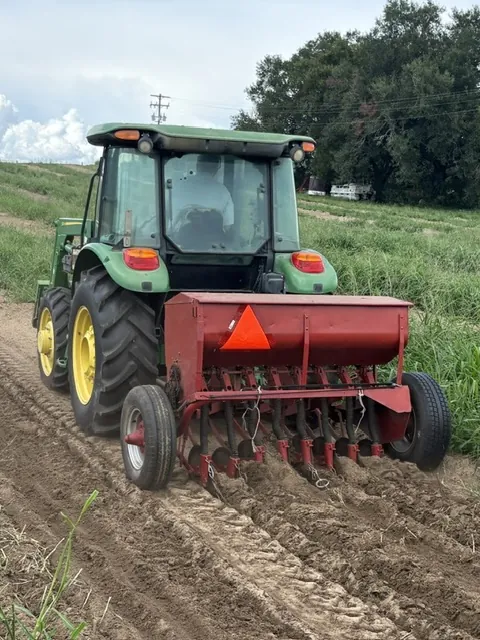
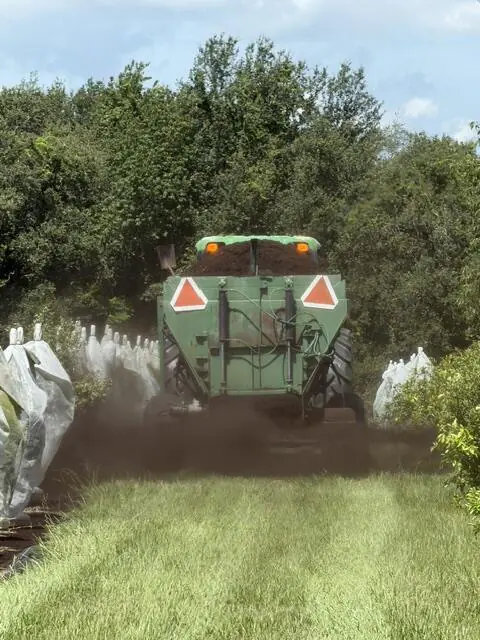
Cover cropping continues in 2026 with University of Florida researchers and Jarred Eddy of Central Florida Ag Services. Pictured above: a Massey Ferguson Grain Drill planting cover crops (left) and compost spreader utilizing Florida-based Veransa compost (right). Photos courtesy of Ben McLean III.

Advice to Farmers

“The good news that I would share with anybody considering either the transition to organic or applying for NRCS support: it can be done.” Ben continues, “It was easier than I thought, and I received excellent help from our local FSA and NRCS staff in both Lake County and Polk County. There is paperwork, but it’s worth doing, and it creates value in your long-term farm plan. It opens doors to you, and you’ll get access to information you may not have had.”

He also cites thorough recordkeeping and the support of staff and recordkeeping accountants as a key factor in the smoothness of the process.

Furthermore, he echoes familiar farmer advice: lean on other farmers and mentors. Networks and neighbors can both serve as tremendous support for growers at any experience level. 

“I encourage farmers to go to your Extension workshops, go to your university workshops, go to USDA workshops or field days.  And get to know your neighbors, get to know other farmers, join your grower organizations. This is where you’ll meet people from NRCS and can ask about their programs. Don’t be afraid to ask a lot of questions.”

Ready to Apply? Here Are a Few Helpful Resources

If you’re a farmer considering applying for EQIP or other NRCS programs, here are some helpful tools to get started:

Additional Resources & Reading:

Organic Farming Research Foundation Resources:

Connect with OFRF:

Building Organic Knowledge: OFRF’s Annual Research Report and Webinars for NRCS

By |2026-09-08T10:09:21-04:00September 7th, 2026|News|

By Rebecca Champagne, PhD, OFRF Conservation Scientist

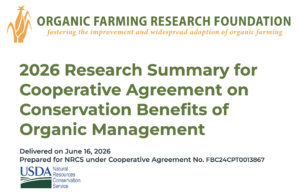
Each year, as part of our Cooperative Agreement with the USDA Natural Resources Conservation Service (NRCS), the Organic Farming Research Foundation (OFRF) publishes a research summary and holds webinars on various organic topics to help build NRCS staff knowledge of organic systems and equip them to better support the unique needs of organic and transitioning-to-organic farmers across the country. This summer we published our 2026 annual summary on the latest organic research and led accompanying webinars.

Annual Research Summaries from OFRF

These annual research summaries provide a look at the latest organic agriculture research across a variety of topics, and are meant to provide NRCS staff, service providers, organic farmers, and other interested parties with in-depth educational information on the conservation benefits of organic systems. These summaries provide both brief research highlights and comprehensive summaries for each topic, along with connections between the research and NRCS Resource Concerns and Conservation Practice Standards.

Our 2026 summary covered research on pest and nutrient management in organic production, diversified cropping systems, building soil health and soil organic carbon, and other agronomic research such as organic dry bean cultivar evaluations and organic sweet potato growing practices. You can check out these research summaries on our website!

> Read our 2026 Annual Research Summary on Conservation Benefits of Organic Management

Organic Research Updates: Two-Part Webinar Series

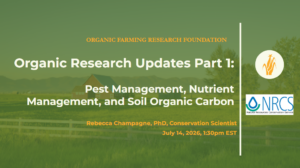
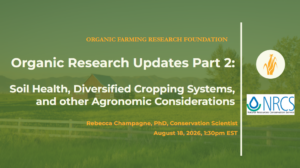
Rebecca Champagne, OFRF’s Conservation Scientist, led a two-part webinar series for NRCS this summer to accompany the 2026 research summary. The webinars provided detailed information on the different research areas, offering insight into peer-reviewed research treatments and results, and the connection between the research topics and National Organic Program (NOP) regulations for organic production.

The first webinar, held on July 14, dove into the topics of pest and weed management, nutrient management, and soil organic carbon. Some of the research covered included:

  • Cultural and mechanical weed control strategies.
  • Organic methods for managing insect pests such as spotted wing drosophila, alfalfa weevil, and wireworms.
  • Using cattle manure to supply nitrogen and phosphorus in semi-arid growing environments.
  • Practical conservation takeaways for building soil organic carbon.

The second webinar, held on August 18, covered research on soil health, diversified cropping systems, and other research such as organic crop cultivar evaluations and agronomic trials. Some of the research covered included:

  • Soil health challenges in high tunnel production.
  • Integrating chickens into diversified organic vegetable production.
  • Using mushrooms as feed additives for animal nutrition.
  • Living cover crop mulch versus plastic mulches.

Nearly 250 attendees tuned in across the two webinars. Both webinars concluded with a Q&A session so participants could ask follow-up questions and get clarification on the research and relevant NOP regulations.

Interested in viewing these webinars? Recordings are available online through Conservation Webinars — check out webinar one here and webinar two here!

Upcoming Organic Farming Webinars with NRCS

OFRF will be hosting several webinars for NRCS over the next few years, covering different topics related to organic farming. Webinar participants also have the chance to test what they learn and earn Certified Crop Advisor Continuing Education Units (CEU) by answering quiz questions at the end of each webinar. By identifying and summarizing the latest peer-reviewed research and highlighting practical conservation takeaways, we aim to help NRCS staff and Technical Service Providers better understand organic production requirements, challenges, and what successful conservation practice implementation on organic operations can look like.

To learn more about our Cooperative Agreement with NRCS, contact Rebecca Champagne at rebecca@ofrf.org. 

To stay up-to-date with the latest organic farming news, research updates, and opportunities for advocacy, sign up to receive the OFRF newsletter at https://ofrf.org/get-involved/receive-news/!

Predicting What the Rest of the Year Looks Like in D.C.

By |2026-09-04T15:38:42-04:00September 4th, 2026|Advocacy, News, Policy Corner|

By Vinnie Trometter, OFRF Policy Manager

It’s September, which means members of Congress are back in D.C. after a month away campaigning for reelection. They have returned to a massive slate of unfinished business and little time to do it before voters hit the polls.

One of the first things Congress did after the recess was pass a continuing resolution (CR) to fund the government at current levels until December 11. The CR also included a delay to the implementation of the White House’s proposed rule, which would give political appointees the final say over grant awards. OFRF is happy to see Congress being responsive to the over 160,000 public comments submitted overwhelmingly against the rule, and we hope that the rule is eventually revoked entirely.

However, the White House has found ways to get ahead of Congress through other means. For instance, the House Agriculture Appropriations bill for Fiscal Year 2027 contains language intended to prevent the closure of the Beltsville Agriculture Research Station. In response, the White House announced in August that it was redirecting all Fiscal Year 2026 funding intended to modernize Beltsville to create new research stations across the country. It remains to be seen how Congress will react, but Congressional appropriators are investigating whether the redirection of funds violates any existing laws.

Another thing that still needs to be done this year is, of course, the Farm Bill. Recapping from an earlier blog post, the Farm Bill failed in the Senate Agriculture Committee at the beginning of August largely because Senator Mitch McConnell (R-KY) was absent, and a compromise that delayed the state cost-share for SNAP was not enough to appease Democrats. It is expected that Senator McConnell will return sometime this month, when the Senate Agriculture Committee will reconvene to pass the Farm Bill out of Committee—without amendments. This would be a bad outcome in terms of organic research because the base text does not go beyond the status quo, which is not sufficient to meet the needs of the growing organic market.

Despite this possibility, the odds of the Farm Bill passing both the House and the Senate as a standalone bill are slim. Thus, another, more likely path is for the Farm Bill to be lumped into a must-pass government funding bill called an omnibus. Senate Majority Leader and member of the Senate Agriculture Committee, John Thune has already spoken life into this possibility. In this scenario, the main unknowns are what pieces of the Farm Bill would be included and whether the pieces left out would be picked up in next year’s new Congress.

There is much yet to be seen. Even yesterday, the House of Representatives cut two weeks from its in-session schedule. This means that after September 17, the House will not return until mid-November. However, rest assured that OFRF’s full-time presence in Washington, D.C., and engagement with our organic allies across the country, make us uniquely positioned to respond rapidly to any development.

Stay up to date with our policy work by signing up for our newsletter:

photo of cherry blossoms blooming with US Capitol building in the background and a button to "sign up for our newsletter"

Pest and Disease Management for Organic Farms in the Northwest

By |2026-09-03T08:45:45-04:00September 3rd, 2026|Certification & Compliance, Insects & Diseases, Resource|

Managing pests and disease organically isn’t easy. The Northwest throws a lot at growers, from crop-specific insect pressure to diseases that can wreck a harvest fast. Having the right tools and knowledge on hand can make all the difference.

The session opens with an overview of OFRF’s organic farming resources, followed by a panel discussion featuring experienced organic farmers and researchers:

  • Ellie Costello, Trust Land Farm (MT)
  • Sarahlee Lawrence, Rainshadow Organics (OR)
  • Robert Orpet, OSU Assistant Professor of Entomology

Panelists share field-tested strategies for managing pests and disease within organic systems, informed by both direct farming experience and current research. The discussion addresses real challenges facing growers today, alongside approaches that align with organic production standards.

About the Seeds of Success Series

OFRF has partnered with the Organic Farmers Association (OFA) and National Organic Coalition (NOC) to lead a series of virtual farmer-to-farmer networking sessions. These facilitated events will be engaging opportunities for farmers to share their challenges and successes, and will be accompanied with relevant resources you can use.

To learn more about these and other events from OFRF, visit: https://ofrf.org/events/. Funding for this series is provided by a cooperative agreement between OFRF and USDA-NIFA to highlight research investments made through both the OREI and ORG grant programs.

OFRF in Texas: A Researcher and Extension Regional Meetup, in the Heat!

By |2026-09-01T12:04:13-04:00September 1st, 2026|News|

By Maia Garby, Research & Education Junior Fellow

This summer, OFRF staff members converged in San Marcos, Texas to attend the Southern Family Farmers & Food Systems (SFFFS) Conference.

Despite the 100+ degree weather, farmers, ranchers, researchers, technical service providers, and organic consumers from across the state and beyond congregated at Texas State University for several days of learning, networking, and discussion.

As part of OFRF’s ongoing efforts to facilitate relationship-building and collaboration between individuals working within the organic sector, OFRF’s Rebecca Champagne (Conservation Scientist) and Maia Garby (Research & Education Junior Fellow) co-facilitated a Researcher and Extension Regional Meetup (RERM) at the conference.

What are the Researcher and Extension Regional Meetups (RERMs), and why are they important?

Researcher and Extension Regional Meetups (RERMs) are dedicated spaces for researchers, extension personnel, and technical service providers to network at regional agricultural conferences. These unique sessions were developed in response to feedback from organic researchers that (1) meeting other organic researchers/professionals within a region can be difficult, and (2) organic research is frequently left out of broader ag conversations.

These meetups provide a structured space and time for organic professionals, as well as those interested in organic, to:

  • Connect and exchange contact information;
  • Learn from one another about ongoing research projects;
  • Hear from technical service providers about the challenges currently being faced by organic producers in the region;
  • Identify knowledge and policy gaps; 
  • Brainstorm future collaborations;
  •  …and so much more!

Farmers are also welcome and encouraged to attend, as these sessions provide an excellent opportunity to meet local service providers and potentially connect with university researchers looking for organic farmers to participate in on-farm research trials.

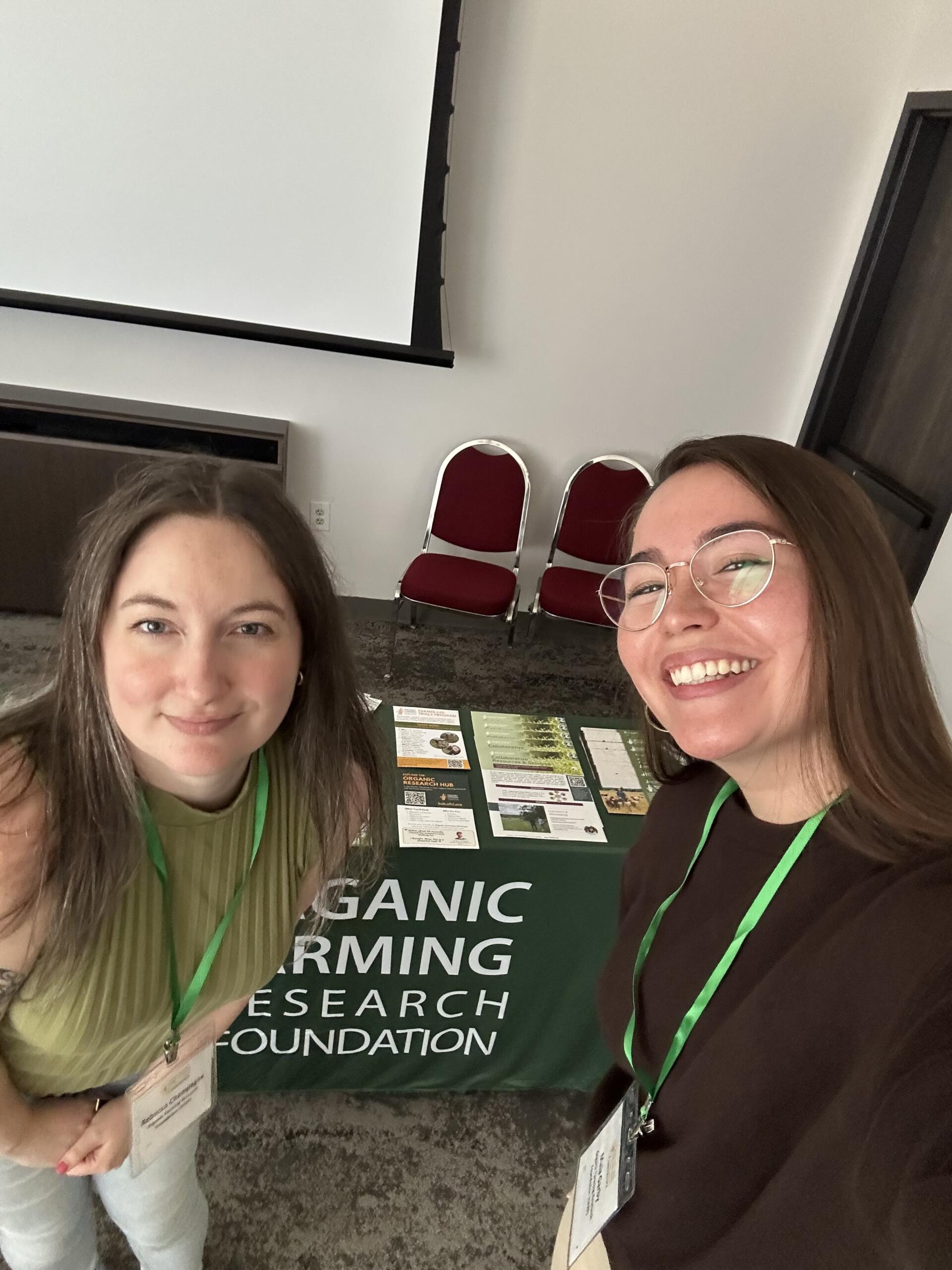
Rebecca Champagne (left) and Maia Garby (right) setting up for the Southern Family Farmers & Food Systems (SFFFS) Conference Research and Extension Regional Meetup in San Marcos, Texas, August, 2026.

How does a RERM work?

Every RERM begins with introductions and refreshments, followed by short federal policy updates. Policy updates may cover topics including: (1) how/when to apply for federal research grants through the USDA’s Organic Agriculture Research and Extension Initiative (OREI) and Organic Transitions Program (ORG), (2) Farm Bill and/or Agriculture Appropriations updates, and (3) participant advocacy opportunities, such as OFRF’s free, virtual Communicating with Legislators Course.

Afterwards, the floor is opened for structured networking, during which attendees may be sectioned into smaller groups. Participants are provided with a short list of prepared discussion questions to guide conversation, although they are encouraged to use these questions as launching points for deeper, more personalized discussions.

Sample discussion questions from the Texas RERM included:

What research projects are you or your colleagues currently working on (or recently completed)? What are some of the biggest takeaways from this work?

What are some of the most common production/non-production challenges that organic producers in your region deal with? Are there knowledge gaps pertaining to these challenges?

Where would you like to take your research next, and what resources would you need to make that happen? Is there a realistic collaboration within this room?

The Southern Family Farmers & Food Systems (SFFFS) RERM is the third of these unique sessions to take place in 2026. Other RERMs were conducted earlier this year, at the High Plains Organic Conference (Cheyenne, WY) and the Marbleseed Organic Farming Conference (La Crosse, WI), bringing together a combined 30+ organic researchers and professionals.

Small-group discussions at the Southern Family Farmers & Food Systems (SFFFS) Conference Research and Extension Regional Meetup in San Marcos, Texas, August, 2026.

A Snapshot of the SFFFS RERM: Who Attended, & What Was Discussed?

The Texas RERM attracted a variety of attendees, including researchers and extension staff from Texas A&M University, Tuskegee University, and Prairie View A&M University, business owners, and technical service providers from the USDA, but the majority were farmers. 

As it turns out, most of these farmers were not certified-organic, although many had experience with sustainable and/or regenerative management practices. Their reasons for attending the session were to learn more about the organic sector (i.e., What separates a ‘certified organic’ farm from a non-certified farm that uses organic practices? What is the process for obtaining an organic certification, and what resources and/or funding are available for farmers beginning the transition to organic?). 

In response to the farmer-driven attendance and interest in organic-sector resources, a portion of the discussion was spent presenting the resources available to organic/transitioning producers through the OFRF Homepage and the Organic Research Hub & Extension Directory. 

Additionally, attendees were eager to learn more about how to conduct on-farm research. Two attendees had recently developed a commercial, organic soil amendment and were interested in finding farmers or university researchers to collaborate with for field-level product trials. Several others were farmers struggling to manage weeds on their farm without using synthetic products, and were curious in trialling alternative weed management strategies. These comments led to a discussion about OFRF’s Farmer’s Guide to Conducting On-Farm Research, as well as the Farmer-Led Trials (FLT) Program. 

Conclusion

One of the most meaningful takeaways from the conference was that there is substantial interest among farmers, regardless of organic certification, in conducting on-farm research and trialling alternative agricultural practices (i.e. regenerative, organic). 

Farmers are professional problem-solvers, whose observations and curiosity about their cropping systems form the foundation for farmer-led research. In Texas, it was evident that the demand for farmer-led research funding, support, and skill-building is there. Farmers want to know how to put their observation-based questions to the test, but need funding and technical assistance in order to do so. 

Farming is a difficult profession, but it benefits when we foster collaboration among everyone in the agriculture sector. Organic production in particular has many complexities that require systems-based research and recommendations. Events like these Researcher and Extension Regional Meetups can help create a strong, active network of individuals and advance organic research and farming.

In addition to these RERMs, OFRF is now offering direct support to organic researchers and extension specialists with our Organic Research Amplification Services.

To stay up-to-date with the latest organic farming news, research updates, and opportunities for advocacy, sign-up to receive the OFRF newsletter at https://ofrf.org/get-involved/receive-news/!

Growing Perennials in the Pacific Northwest: Rodale Institute’s Summer Field Day

By |2026-08-26T10:11:37-04:00August 26th, 2026|Farmer Stories, News|

Written by Annika Sampson, OFRF’s Donor Stewardship & Engagement Manager
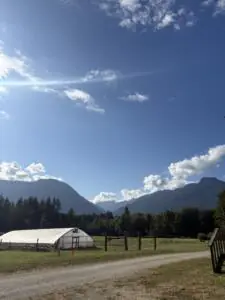
A greenhouse nestled in the mountains.

General Mills donated Cascadian Farms to Rodale in 2022 to become the site of their Pacific Northwest Center.

Nestled between the ice-blue Skagit River and the North Cascades foothills is Rodale Institute’s Pacific Northwest (PNW) Center. For decades, this 90-acre organic farm in Washington state was home to Cascadian Farm, General Mills’ organic grocery line. General Mills donated the farm site to Rodale in 2022, acknowledging the organization’s pivotal role in shaping the future of regenerative and organic agriculture. The site has a rich history–the original owner, Gene Khan, was an organic pioneer in the 1970s who changed the course of organic farming in Washington state.

Washington has a robust and growing organic food system. According to the Rodale Center, there are more than 900 certified organic farms in the state, representing 145,000 acres in certified organic production and $795 million in farmgate sales.

Decades of organic management, as well as current organic market conditions, have made the PNW Center a fertile ground for research, education, and outreach. In late July 2026, the Rodale team hosted a Field Day for local farmers, conservation district professionals, researchers, and regenerative stakeholders to learn more about their latest projects, including cover cropping, aronia, elderberry, and kiwi berry production, and hazelnut agroforestry. They hope these projects will inform and assist local farmers as they navigate increasing climate pressure (the Pacific Northwest faces wildfires, flooding, and drought) as well as manage pests and weeds.

Arianna Bozzolo, Western Region Research Director at Rodale Institute, has big dreams for Rodale’s impact on the region, driven by community. “I’m excited by the idea of being part of the community here. The center is relatively new, but people are really welcoming and looking forward to seeing us up and running, and understanding what we want to do.”
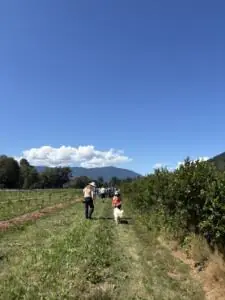
Field day participants walk the fields at Rodale's PNW Field Day.

Field day attendees tour Rodale’s perennial berry plantings.

One of the ongoing goals for the Center is to serve as a demonstration and research hub for farmers, showcasing organic and regenerative organic methods at work. Recently, the team PNW has established several new perennial plantings–aronia berries, elderberries, and hazelnuts–in addition to their established and beloved blueberry fields. Little research has been done on growing aronia in the region, but the initial results of the project look promising: “It has great potential.” Bozzolo reflects. “Our early observations are promising. Aronia is a hardy crop with relatively low water requirements, which makes it particularly interesting to evaluate for diversified perennial systems in this region.”

Rodale also strives to evaluate how organic and regenerative practices can support both environmental outcomes and farm viability. There’s a growing market for aronia berries and elderberries. Aronia is also attracting interest as a potential source of natural food colorants because of its high concentration of anthocyanins, and herbal and wellness companies increasingly seek domestic elderberries for their products. A representative from Mountain Rose Herbs, a supplier of organic herbs and botanicals, attended the Field Day to discuss the growing demand for domestically produced organic elderberries and the opportunity this emerging market could represent for regional growers. Bozzolo shares, “It’s a new market, and a really important one to have. [Mountain Rose Herbs] is a big company and they buy certified organic products and botanicals.”

The farm also has an established U-pick site, which Cascadian Farm ran for many years. “We have the blueberries, and they’re very, very well known. With crops such as raspberries, kiwi berries, and potentially aronia complementing the established blueberries, there may be opportunities to extend the U-pick season and diversify the farm’s direct-to-consumer offerings.”

These new and existing markets are a keystone of Rodale’s mission at the PNW Center. “Ideally, I’d like to see this be a farm that’s up and running as organic and regenerative, demonstrating to farmers that you can farm organic and regenerative and still have an income and support your crew and your employees,” Bozzolo says.

As the Field Day attendees strolled and nibbled their way through the u-pick blueberries, questions about soil health, weed management, and alley cropping floated through the air. As people shared about their own farms, projects, and ideas, it became clear–Rodale is well on its way to continuing the organic and regenerative legacy of this well-loved and well-tended land.
Go to Top