admin

About admin

This author has not yet filled in any details.
So far admin has created 267 blog entries.

Demystifying the National Organic Standards Board (NOSB) for Farmers

Organic producers and processors must follow strict standards to become certified—but who decides what is and isn’t allowed on organic farms? Not your certifier! The USDA National Organic Program (NOP), in consultation with the National Organic Standards Board (NOSB), sets these rules.

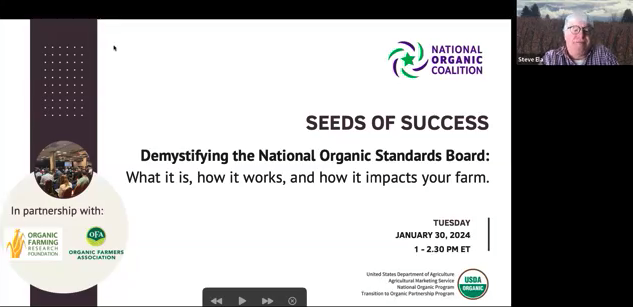
In 2024, the National Organic Coalition (NOC) hosted a Seeds of Success virtual session for organic and transitioning farmers, where a panel of farmers and advocates demystified the NOSB. Panelists explained the Board’s role in shaping organic standards, how decisions are made, and how written and oral comments can influence outcomes.

Panelists included Steve Ela (Former NOSB Chair, NOC NOSB Specialist, Ela Family Farms, CO), Harriet Behar (Former NOSB Chair, NOC Advisor, OFA Farmer Services Consultant, Sweet Springs Farm, WI), and Amy Bruch (Current NOSB Vice Chair, Cyclone Farms, NE).

screenshot of mp4 recording of Demystifying the NOSB webninar
By |2026-03-02T11:52:33-05:00January 30th, 2024|Certification & Compliance, Resource|

From Regulations to Legislation: Advocating for Organic Agriculture in 2024

Gordon’s Policy Corner, January 2024

The dawn of a new year always brings new opportunities. This year, we are continuing our work to advocate for expanded public investments in organic agriculture research. To be honest, 2024’s political landscape is admittedly daunting:

  • FY24 appropriations still need to be passed by the end of the month.
  • The Farm Bill is running up against a new March deadline.
  • The FY25 appropriations process is about to begin.
  • There’s a Presidential election on the horizon.

That being said, at OFRF, we see these events as opportunities to ensure organic agriculture gets the recognition it deserves.

As we highlighted last month, 2023 was a momentous year for organic policy development in the regulatory space. In 2024, we hope to bring that momentum to the legislative body and work with our coalition partners to amplify our voices and call for increased public investments in organic agriculture research.

To do this, we have two primary initiatives. First, we will continue to build broad support for the Organic Science and Research Investment (OSRI) Act in the Senate and the Strengthening Organic Agriculture Research (SOAR) Act in the House. If you still need to get familiar with these significant marker bills, check out those links for an overview and some information on how you can help spread awareness about them. Second, we are committed to ensuring that appropriators comprehend the urgent need for increased funding in agricultural research and the far-reaching impact these investments have on the nation- economically, ecologically, and socially.

Including the SOAR and OSRI Acts in the 2024 Farm Bill is more than just a step forward in achieving parity between organic agriculture’s share of USDA research funding (currently <2%) and its market share (>6%). More importantly, these investments will touch the lives of communities nationwide.

Agricultural research programs extend beyond answering producers’ queries or supporting early-career scientists—although they excel at both. These programs significantly benefit the rural communities actively participating in and hosting vital research projects. Notably, every dollar invested in public agricultural research generates an impressive $20 of benefits. Despite this documented impact, public funding for agricultural research has seen a 20% decline since the turn of the century, in stark contrast to increased funding in other research areas during the same period.

Recognizing the urgency of the situation, we are intensifying our efforts in appropriations advocacy, ensuring that the offices of appropriators understand the critical importance and impact of the programs under their control.

However, for us to maximize our effectiveness, we need your help! If you have a story involving a research finding, participation in a research project, or a persistent research question that needs answering, please use our story form to contribute and help us raise awareness!

As always, please reach out if you want to get involved or are curious about our work! gordon@ofrf.org

Eat well,

Gordon

By |2025-02-28T15:04:09-05:00January 12th, 2024|News, Policy Corner|

Annika La Fave (she/her/hers)

Policy & Communications Intern

Annika La Fave (she/her/hers) joins the OFRF team as the Fall 2023 policy & communications intern. Annika is a graduate student at Johns Hopkins Bloomberg School of Public Health, focusing on public health communications & food systems policy.

Annika began farming in 2010 while completing her B.A. in Education at Hampshire College in Amherst, MA. She has since had a varied career in sustainable agriculture raising livestock, vegetables, and cut-flowers, teaching organic farming and small business management at Clackamas Community College, founding her own small vegetable farm business promoting food equity in partnership with Oregon Health & Science University, and, most recently, managing Baltimore County’s Agricultural Center.

Annika is passionate about land stewardship and the pursuit of occupational tenability for small and beginning farmers. She aspires to help create a more equitable food system for producers and consumers. She spends most of her spare time walking and running with her two energetic greyhounds.

By |2025-09-02T16:58:43-04:00January 9th, 2024|Uncategorized|

Marina Vergara (she/her/hers)

Research & Education Intern

Marina Vergara (she/her/hers) joins the OFRF team as the Fall 2023 Research and Education intern. Marina is a graduate student at the University of California, Davis studying International Agricultural Development. Her interests lie in exploring participatory agricultural extension and ways to better support marginalized farmers. Her research examines a participatory silvopastoral extension program in Panama, and the ways in which this model facilitates an informal knowledge exchange amongst model farmers and farmers newly entering the program.

Marina discovered her passion for food and agriculture in college after being drawn to the interdisciplinary nature of food systems. After graduating from Cornell University in 2018 with a BS in Environmental and Sustainability Sciences, Marina moved to Panama to serve with the U.S. Peace Corps as an Agriculture Extension Agent, working with small-scale, organic cacao farmers in product development, marketing, and sales. Marina then served with AmeriCorps VISTA in South Texas, where she focused on coalition building for increasing food security and youth curriculum development for food justice and sovereignty in the Rio Grande Valley.

Marina is passionate about supporting marginalized farmers, through collaboration in projects and increasing equity in access to extension support and materials. In her free time, you can find Marina outside hiking, biking, or lounging with her dog Claudia, at the local coffee shop with a good book, or trying something new and tasty to eat.

By |2025-09-02T16:59:19-04:00January 9th, 2024|Uncategorized|

Rebecca Champagne (she/her/hers)

Conservation Scientist

email: rebecca[at]ofrf.org

Rebecca Champagne (she/her/hers) is the Conservation Scientist at OFRF and joined the team in September 2024. She is an agronomist by training with a research background in organic agriculture, having worked with a diverse array of crops and on practices such as cover cropping, reduced tillage, and managing weeds. She also brings experience in interdisciplinary science communications and policy work to the team. Rebecca previously worked for soil health non profit Land Core, and as an analyst for the ag-tech company Gro Intelligence. She is passionate about transforming our farm and food systems to be more sustainable and equitable for all people.

Rebecca has a PhD in Environmental Science from the University of Maine, an MS in Agronomy from The Pennsylvania State University, and a BS in Sustainable Agriculture from The University of Maine. In her free time you can find her at the gym, exploring Maine, reading, cooking, and finding more house plants to add to her collection.

By |2025-03-18T17:33:37-04:00January 1st, 2024|Staff|

Charlotte Vallaeys

Organic Consultant

Charlotte Vallaeys is a leading independent consultant dedicated to catalyzing the continued growth of the organic sector. With nearly 20 years of deep engagement in food system sustainability and the organic community, Charlotte’s career spans key roles at General Mills, The Cornucopia Institute and Consumers Union, as well as prior consulting for organizations like the National Organic Coalition and Funders for Regenerative Agriculture. She has cultivated a reputation as a prominent, passionate, dedicated, and science-driven voice for organic agriculture. She holds a Master of Theological Studies from Harvard University and a Master of Science in the Agriculture, Food and Environment program from Tufts University’s Friedman School of Nutrition Science and Policy. Charlotte lives in Massachusetts with her husband and two teenage sons.

By |2025-08-15T12:06:27-04:00December 20th, 2023|Board|

Organic Agriculture Shines in the Face of 2023’s Challenges

Gordon’s Policy Corner, December 2023

2023 was a historic year by many measures.  Many of those measures were, for lack of a better word, bad. We’ve written before about the climate effects of this year, and now we have confirmed that we’ve experienced the hottest summer ever recorded, which coincided with record low sea ice levels. In politics, we witnessed a tumultuous speaker election for the first time in nearly a century, followed by the first ever ouster of a speaker just months later. All while narrowly avoiding a government shutdown. We are once again in a political and financial environment that makes work on a new Farm Bill and Appropriations legislation feel somewhat futile. 

But, there were historic movements of progress for the organic sector this year as well: 

  • The National Organic Program has promulgated multiple long-awaited rules: the Organic Livestock and Poultry Standards, Strengthening Organic Enforcement, and Organic Livestock Origin Rules, among others. 
  • We at OFRF worked with Congressional partners and organic champions to introduce pieces of legislation that would continue to advance organic agriculture research by doubling the funds available to OREI and ORG research programs. 
  • Because of past efforts of OFRF and our allies, the Organic Research and Extension Initiative’s mandatory funding level was not at issue in Farm Bill extension negotiations, ensuring that this program is insulated from political turmoil. 
  • And OFRF board member April Thatcher was named “Organic Farmer of the Year” by the Organic Trade Association, which is a piece of history that hits close to home for us!  

Sometimes paying attention to the current events can lead to getting lost in the noise, but for every headline-warranting piece of bad news there’s certainly a positive development or generous act of kindness that goes unnoticed. As we enter the end of year period and reflect over the past year, try to take a moment and revisit some of those positive moments or acts of kindness.

As Albus Dumbledore in the Harry Potter series put it: “happiness can be found, even in the darkest of times, if one only remembers to turn on the light.” Wishing you all many moments of light and happiness this winter. 

Eat well,

Gordon

By |2025-02-28T15:04:38-05:00December 11th, 2023|News, Policy Corner|

Reflections on the 2023 Latino Farmer Conference

Kelsey Grimsley, OFRF’s Office and Administrative Manage (left) and Jose Perez, OFRF’s Research and Education Engagement Coordinator (right) at the Latino Farmer Conference.

By Jose Perez, OFRF’s Research and Education Engagement Coordinator 

Lea la versión en español abajo.

I recently had the fortune to take part in the 9th Latino Farmer Conference, November 1st and 2nd, organized by ATTRA/NCAT and NRCS in Stockton, California, the ancestral lands of the Confederated Villages of Lisjan, Miwok and Yokuts nations. Along with my OFRF colleague Kelsey Grimsley, I enjoyed making connections with Latinx farmers and introducing our new online Soil Health Course in Spanish, Los Fundamentos de la Salud del Suelo. As a native Guatemalan, it was exciting for me to connect with other farmers in my native language. At least two hundred farmers and farmer stakeholders were present. 

Latinx farmworkers have provided the great majority of labor that make farming possible in US agricultural fields for many decades. But Latinx farmers represent only 3.3% of all US farm owners, according to the 2017 USDA census of Agriculture. In this blog I want to share two themes that resonated throughout this event.

Perseverance and faith

On the first day of the conference, we heard the testimony of various Latinx farmers. Farmer Noel Ledesma, a farmworker turned farmer, shared his farming experiences with brutal honesty, recalling failed crops and ventures in farming that made his family lose everything they had worked for. Instead of giving up, he persisted. Eventually, he found niche markets that were profitable, but then again, the market changed when big operations got in the game. Yet, he persisted, and he learned. Step by step, using trial and error, he and his family found a way to create a successful farming operation.

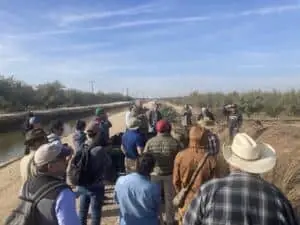
Participants at the Latino Farmer Conference on a field walk.

Todo es posible cuando hay perseverancia, cuando hay fe

Everything is possible when there is perseverance, when there is faith

– Farmer Noel Ledesma


Farming is a continuous process of experimentation and adaptation to change. The market and the weather rarely forgive a lack of innovation. Farmer Noel Ledesma’s testimony showed how constant dedication and a strong belief that you can make it are critical ingredients in the journey from farmworker to successful farm owner. Now he is passing his wisdom to other Latinx farmers.

Making connections

Jose Perez introducing OFRF’s new online Soil Health Course in Spanish, Los Fundamentos de la Salud del Suelo.

The importance of connections and relationships was apparent in the conference. Farming can be isolating, and there is much value in having a network of peers and service providers that can provide more ideas and resources. Latinx farmers often struggle to get support from farming programs due to additional language, education and immigration status barriers. Not all USDA offices or farming organizations have a Latinx or Spanish-speaking staff member who can connect with the culture, concerns and language of these farmers. The conference was the place to make these connections and facilitate access to farming support programs. Given that this event is the only farming conference conducted in Spanish for Latinx farmers in the country, it is essential for this farming community.

At the end of the day, the health of our farmers and our agricultural sector will be reflected in the health of our society. More effort and investment is needed to support Latinx farmers and farmworkers.

To access and learn more about OFRS’s Soil Health Course in Spanish, visit our website https://ofrf.org/online-courses/los-fundamentos-de-la-salud-del-suelo/

References: 

Starkweather, K., et al. (2011). Improving the use of USDA programs among Hispanic and Latino farmers and ranchers. Center for Rural Affairs and Cambio Center.  201204USDAHispanicFarmersRanchers.pdf

Reflexiones de la Conferencia de Agricultores Latinos 2023

Por Jose Perez, Coordinador de Educación e Investigación de OFRF.

Kelsey Grimsley, Oficina y Gestión Administrativa de la OFRF (izquierda) y José Pérez, Coordinador de Participación en Investigación y Educación de la OFRF (derecha) en la Conferencia de Agricultores Latinos.


Este pasado Noviembre 1 y 2, tuve la fortuna de participar en la Novena Conferencia de Agricultores Latinos organizada por ATTRA/NCAT y el Servicio de Conservación de Recursos Naturales (NRCS) en Stockton, California, que son tierras ancestrales de las naciones Villas Confederadas de Lisjan, Miwok y Yokuts. Mi colega Kelsey Grimsley y yo disfrutamos conectando con agricultoras y agricultores latinos. Además, tuvimos la oportunidad de presentar un nuevo curso gratuito en línea llamado Los Fundamentos del Suelo, que es un curso totalmente en español. Al menos doscientas personas participaron en este evento. 

Trabajadores agrícolas Latinos han proveído la mano de obra necesaria para que la agricultura funcione en Estados Unidos por muchas décadas. Por otro lado, solo el 3.3% de productoras y productores agrícolas de todo el país son latinos, de acuerdo al censo de agricultura del USDA del 2017. En este artículo quiero compartir dos temas que resonaron en este importante evento. 

Perseverancia y fe

En el primer día de la conferencia, escuchamos testimonios de varios productores latinos. Entre ellos estaba el productor Noel Ledesma, que comenzó en la agricultura como trabajador agrícola y ahora es un productor. Noel compartió sus experiencias con una honestidad rotunda, pues contaba sobre cultivos y cosechas perdidas, proyectos agrícolas que no fueron exitosos, que hicieron que su familia perdiera todo lo que habían conseguido hasta entonces. Pero en lugar de rendirse, él perseveró. Eventualmente, encontró un buen mercado produciendo cultivos para minorías étnicas. Cuando este mercado creció y otras empresas más grandes entraron a competir, las cosas se complicaron otra vez. Aun así, él perseveró y aprendió de estas experiencias. Paso a paso, probando varias cosas y aprendiendo de los errores, él y su familia encontraron una forma de crear una operación agrícola exitosa. 

Participantes de la Conferencia de Agricultores Latinos en una caminata por el campo.

Todo es posible cuando hay perseverancia, cuando hay fe

– Farmer Noel Ledesma

La producción agrícola es un proceso de experimentación y adaptación al cambio. El mercado y el clima casi nunca perdonan cuando hay falta de innovación. El testimonio del agricultor Noel Ledesma muestra que una dedicación constante y una fe sólida son ingredientes esenciales para convertirse de trabajador agrícola a productor agrícola exitoso. Ahora Noel comparte su sabiduría con otros productores latinos.

Creando conexiones

José Pérez presenta el nuevo curso en línea sobre salud del suelo de la OFRF en español, Los Fundamentos de la Salud del Suelo.

La importancia de crear y mantener buenas conexiones y relaciones con otros productores y organizaciones que asisten en la agricultura fue muy aparente en este evento. Los productores agrícolas pueden sentirse muy solos a veces, y es claro que tener una red de apoyo donde encontrar recursos e ideas puede ser de mucho valor. Para los productores latinos es muchas veces difícil

acceder a programas de asistencia agrícola, ya que enfrentan barreras adicionales de lenguaje, educación y estatus legal. No todas las oficinas de USDA y de otras organizaciones de apoyo al campo tienen algún personal latino o que pueda comunicarse en español, para poder conectar con el lenguaje, cultura e intereses de estos productores. Esta conferencia fue el lugar para hacer esas conexiones y facilitar el acceso a financiamiento y apoyo técnico. Dado que esta es la única conferencia agrícola llevada a cabo en español en todo el país, es de suma importancia para esta comunidad.

La salud de nuestras granjas y del sector agrícola tiende a ser reflejado en la salud de la sociedad. Más esfuerzo e inversión son necesarios para apoyar a productores y trabajadores agrícolas latinos.

Para acceder al nuevo curso de Salud del Suelo en Español, visite nuestro sitio web: https://ofrf.org/online-courses/los-fundamentos-de-la-salud-del-suelo/

Referencias: 

Starkweather, K., et al. (2011). Improving the use of USDA programs among Hispanic and Latino farmers and ranchers. Center for Rural Affairs and Cambio Center.  201204USDAHispanicFarmersRanchers.pdf

By |2024-06-18T18:04:29-04:00December 8th, 2023|News|

Organic Certification Cost Share Program (OCCSP)

Farmers across the U.S. may now receive up to $750 per scope for organic certification costs

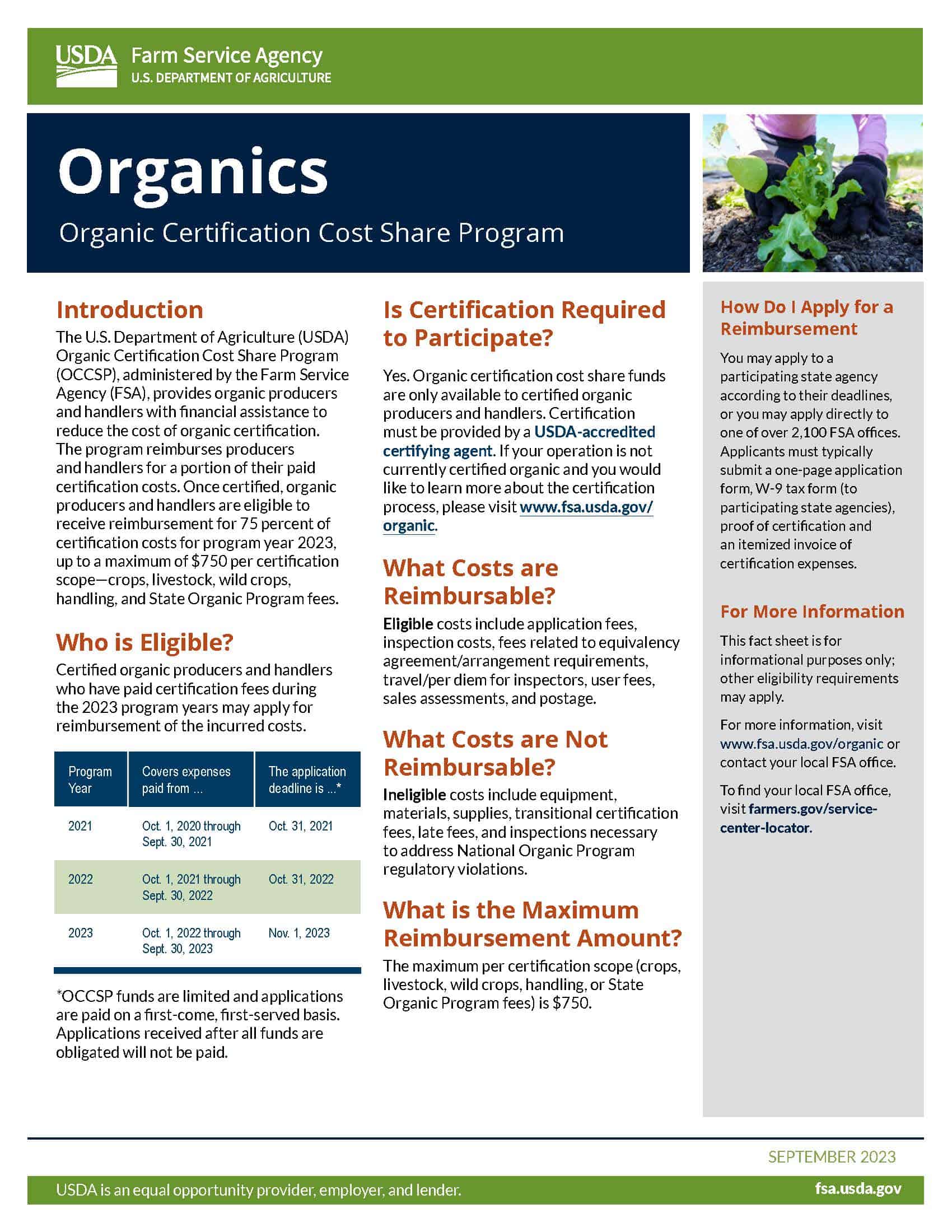
As a farmer or a technical service provider to farms, you understand the importance of organic certification. It not only adds value to your products but also opens doors to a growing market of health-conscious consumers. However, the process of obtaining and maintaining organic certification can be costly. Financial assistance was last available in 2024, through the Organic Certification Cost Share Program (OCCSP) to help ease this burden. In this blog post, we’ll walk you through the basic steps to access up to $750 in financial assistance for each organic certification scope if this program funding is available.

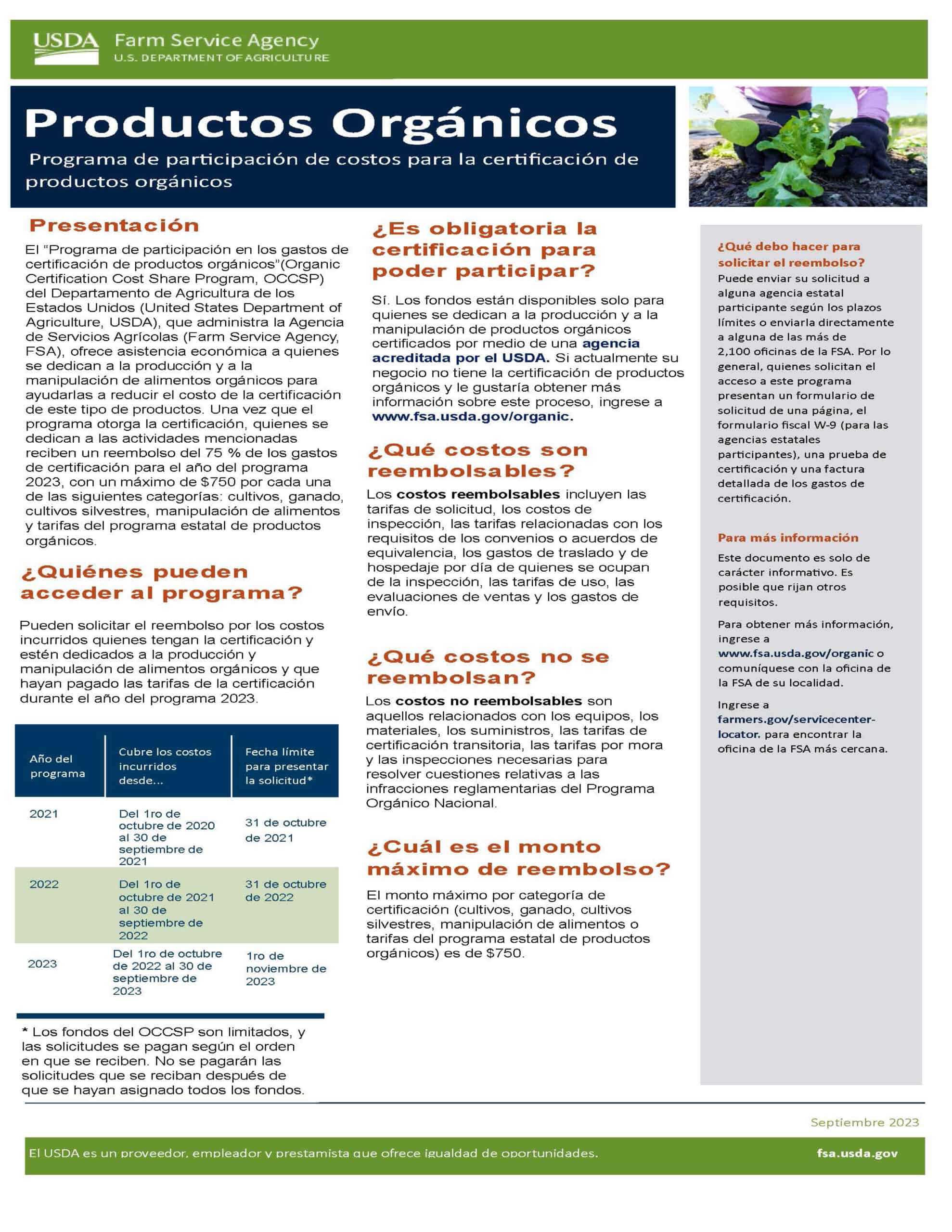
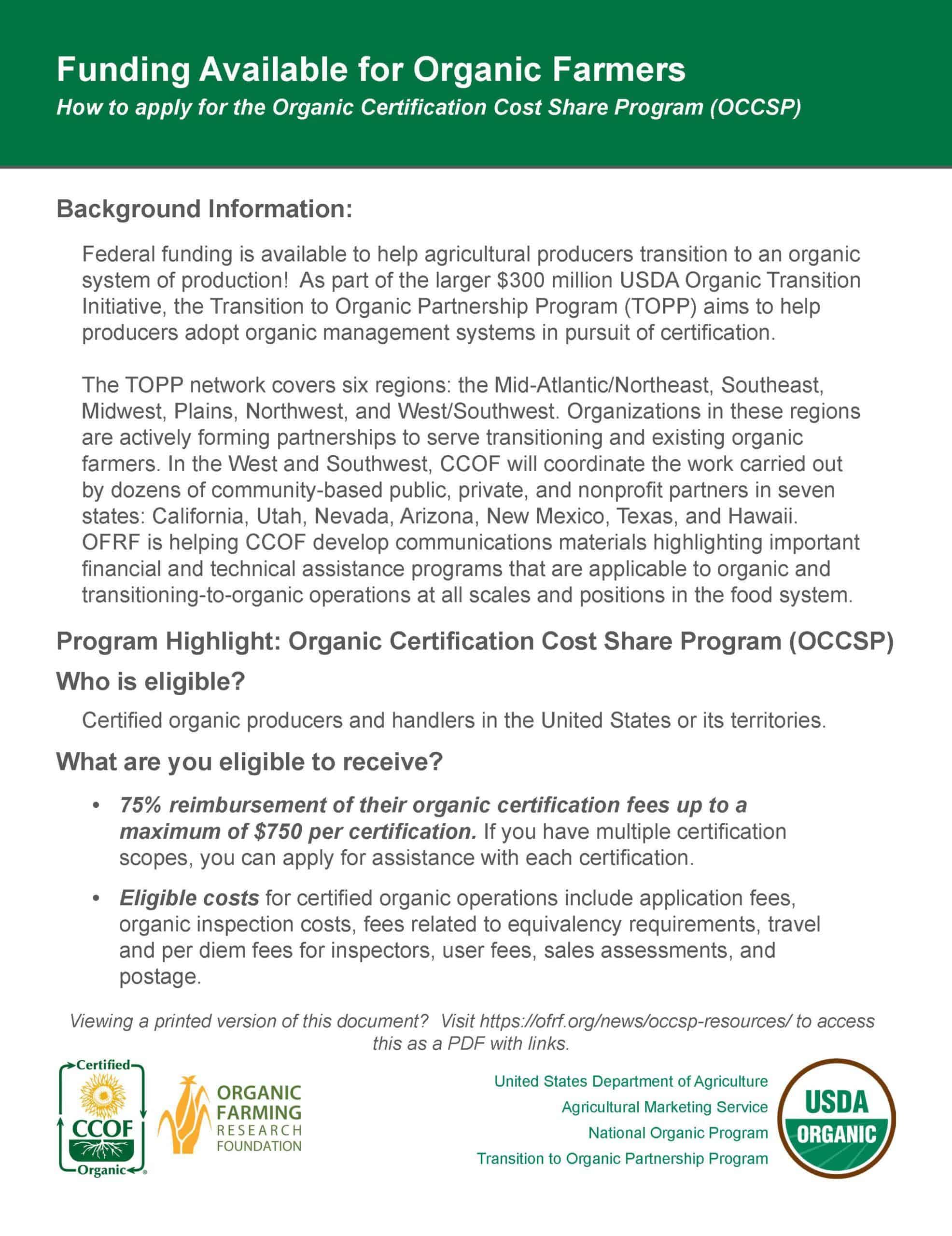
Note: all of this information is summarized in printable, downloadable PDF’s, available in English and Spanish, at the bottom of this blogpost.

Nota: toda esta información se resume en archivos PDF imprimibles y descargables, disponibles en inglés y español, al final de esta publicación de blog.

1. Start with Research

Before diving into the application process, it’s wise to build up some knowledge of the program and who you will apply to. The OCCSP is administered by the USDA, and their website provides a wealth of general information. Additionally, some states have their own supplements to the program. If you’re in Arizona, California, or Texas, consider checking your state’s agriculture agency website for state-specific resources.

Below are factsheets from the USDA about the OCCSP, one in English and one in Spanish.

2. Finding the Right Application 

Certified organic operations can apply for OCCSP assistance through their local Farm Service Agency (FSA) office or, in some cases, through a participating State Agency. Here’s how to proceed:

Through FSA: If you choose to apply through the FSA, you’ll need to use their specific OCCSP application form and follow the instructions provided. This ensures that your application is processed smoothly and efficiently.

Through a State Agency: If your state participates in the OCCSP, you likely have the option to apply through your state agency. In this case, use the application form provided by your state’s program. States like Arizona and California have their own forms, while Texas offers an online application platform along with a Request for Assistance (RFA) providing information.

3. Gathering Financial Information

To access government payments through OCCSP, you’ll need to provide certain financial information. The information must be provided in the correct format, depending on how you are applying. Here’s a brief explanation of the options in the Southwest: 

FSA: If you’re applying through the FSA, they typically require an IRS W-9 form as part of your application.

California: In California, you’ll need to complete a Payee Data Record Form as part of your application.

Arizona: In Arizona, they require an AZ W-9 form to be submitted along with your application.

Texas: If you’re applying through Texas’ online platform, you’ll need to provide a Tax ID to operate on their system, obtain one here.

4. Compiling Required Documents

Alongside your application and financial information, you’ll also need to include certain documents:

  • A copy of your organic certification.
  • Proof of payment for your certification fees.
  • Itemized receipts for any other covered expenses related to organic certification that you’re seeking reimbursement for.

Covered expenses under the OCCSP include application fees, inspection costs, fees related to equivalency agreement/arrangement requirements, travel/per diem for inspectors, user fees, sales assessments, and postage. However, covered expenses do not include equipment, materials, supplies, transitional certification fees, late fees, and inspections necessary to address National Organic Program regulatory violations.

5. Submission

Once you’ve gathered all the required information and documents, it’s time to submit your OCCSP application. Double-check your application to ensure everything is complete and accurate. Ensure you send this information to the appropriate state or federal agency office based on your chosen application method.

The OCCSP can be a valuable resource for farmers and technical service providers seeking financial assistance for their organic certifications. By following these steps and meeting the program’s requirements, you can access up to $750 to support your commitment to organic farming practices.

For more detailed information and access to specific application forms, be sure to visit the OCCSP USDA website or consult your state’s agriculture agency website if they operate their own OCCSP program (Arizona, California, Texas). Your organic journey just got a little more affordable.

Apply for OCCSP assistance now, and reap the benefits of a more affordable path to organic certification. Your commitment to organic farming deserves the support it needs.

All of this information is summarized in a printable, downloadable PDF below, available in English and Spanish.
Organic Researcher Spotlight: Dr. Amaya Atucha

Federal support is bringing new production systems and researchers to organic agriculture in the upper Midwest

Written by Brian Geier

Dr. Amaya Atucha is an Associate Professor at the University of Wisconsin-Madison (UW), specializing in crop ecophysiology and production of small fruit and cold climate viticulture. Until recently she had not worked with organic production systems. “One of the reasons why I was not working on organic production,” she explains, “is because of the difficulty of being able to produce organic fruit in climates like the upper midwest.”

While strawberries represent the third largest fruit crop in Wisconsin, and Wisconsin ranks in the top 10 states for organic production in the United States, organic strawberry production is negligible in the region. This is despite what preliminary research shows: that there is an interest among growers in organic strawberry production, there is an excess demand from consumers in the region, and premium prices are being fetched for organic strawberries at local markets.

Dr. Atucha’s current research project, Transitioning to organic day-neutral strawberry production in the upper midwest – A systems approach, funded by USDA/NIFA’s Organic Transitions Program (ORG), has provided opportunities for her to expand her research into organic production and is providing growers with research-based information on the profitability of new production systems for organic strawberries.

 “Something that I would share with other researchers like me who were not doing any research on organic production is that if you want to expand on organic production and you might not feel that you are an expert, the ORG is a wonderful opportunity to get your foot into doing organic research. It will allow you to become an expert and become familiar with organic practices, and then to expand into these great production systems that can have fantastic benefits for our stakeholders.”  -Dr. Amaya Atucha

To help increase organic production of strawberries, the project is taking a systems approach. The production system currently used in the region is a perennial matted row system that increases weed, insect, and disease pressure over multiple seasons that are challenging to control with organic practices. Her project proposes a shift from a perennial to an annual production system, and is evaluating yields, pest pressure, fruit quality, and profitability of day-neutral strawberries grown on four different mulches.

To keep up to date on this research project, visit UW’s Fruit Program website. See an excerpt from OFRF’s conversation with Dr. Amaya Atucha about the importance of the ORG program for her research and farmers in her region here:

This research is funded by the USDA/NIFA’s Organic Transitions Program. To learn more about OFRF’s advocacy work to protect and increase this type of funding, and how you can help become an advocate for organic farming with us, see our Advocacy page.

By |2025-12-17T18:08:48-05:00November 28th, 2023|Education, News, Plant Breeding & Variety Selection, Weeds|
Go to Top