Advocacy

Organic Farmers Deserve a Seat at the NRCS Table

By Brise Tencer (Organic Farming Research Foundation) and Ben Bowell (Oregon Tilth)

On September 16, we sat down with USDA Under Secretary for Farm Production and Conservation Richard Fordyce. We came with one message: organic farmers need a conservation agency that supports them, and key programs and funding they rely on at the Natural Resources Conservation Service (NRCS) are being lost as programs are reorganized.

We’re grateful for the Under Secretary’s time and willingness to listen. But organic and transitioning-to-organic producers deserve more than a hearing. They deserve programs built with their farms in mind.

Organic Is a Conservation Opportunity 

Organic is one of agriculture’s great growth stories. U.S. organic sales hit a record $76.6 billion in 2025. Yet domestic supply isn’t keeping pace with demand, which means more of that money leaves rural America than it should. Helping farmers start and stay in organic production is a direct investment in rural economies.

It’s also a natural fit for NRCS’s mission. Organic farmers already rely on the practices NRCS champions: conservation buffers, crop rotations, cover crops, rotational grazing, and on-farm biodiversity. And because organic is defined by USDA-regulated standards, those practices are already built into organic systems. 

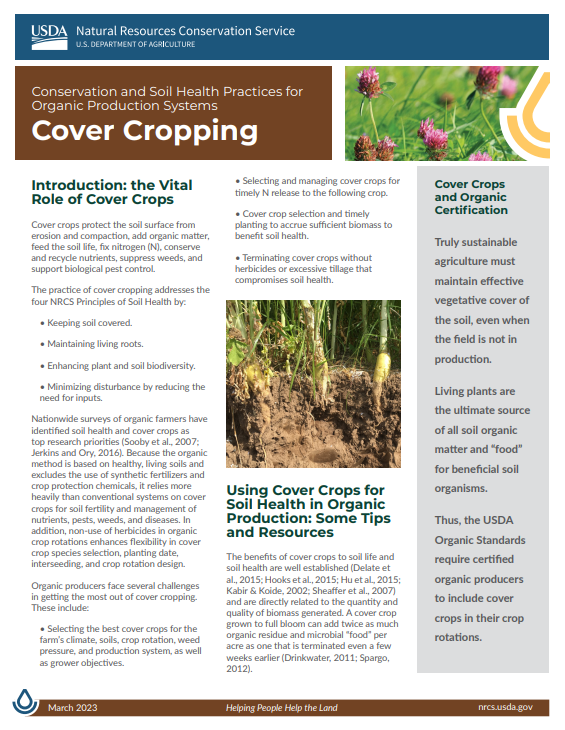
Those standards advance the same four soil health principles NRCS promotes: keep the soil covered, minimize disturbance, maximize living roots, and maximize biodiversity. Few groups of farmers are better positioned to deliver on the agency’s conservation goals.

What’s Changed: Direct Organic Support is Disappearing

Over the past several years, NRCS built a set of tools that finally made its programs work for organic farms. Recently, the agency has ended nearly all of them:

  • The Organic Management Conservation Practice Standard (CPS 823). This interim standard gave field staff a way to plan and fund conservation in organic systems. It was especially important for farmers in the difficult transition years, when income is often foregone.
  • The Environmental Quality Incentives Program (EQIP) Organic Initiative. A dedicated funding pool within EQIP that helped organic farmers compete for contracts.
  • The Organic Transition Initiative. Targeted support for farmers making the multi-year shift to certified organic.
  • The organic set-aside in the Conservation Stewardship Program (CSP). Funding reserved for organic operations ready to take conservation further.

NRCS has also stopped tracking organic producers in its contract management system, which included data on the number of contracts awarded to organic and transitioning-to-organic farms in each state, total acreage under these contracts, and contract funding amounts. Without that data, no one can measure whether the agency is serving organic farmers at all.

We understand USDA’s goal of streamlining initiatives and its commitment to locally led conservation. But organic production happens at a national scale, and organic farmers consistently tell us they struggle when working with field staff who aren’t familiar with their systems. Without national tools and dedicated funding, those gaps will only grow.

What We Asked USDA To Do

Our requests fall into three areas: measure, build capacity, and restore targeted support.

Count organic farmers again. NRCS should resume tracking organic producers in ProTracts and in the new contract tracking system it is developing for all programs. You can’t serve a group you can’t see.

Build lasting organic expertise. We asked for a long-term capacity plan that includes:

  • Consistent training for all field staff on organic regulations and production practices, drawing on the strong organic resources NRCS already has.
  • Hiring professionals with organic experience.
  • Long-term partnerships with organic experts to train staff and support farmers directly.
  • Two permanent organic positions on the agency’s science and technology team.
  • A national organic outreach plan to help states promote NRCS programs to organic farmers.

Restore support that works. Specifically, we urged NRCS to:

  1. Let producers identify as certified organic in EQIP without receiving a reduced payment.
  2. Reinstate dedicated national funding pools for organic producers.
  3. Work with state offices to replace CPS 823 with a workable national alternative.
  4. Make organic producers explicitly eligible for the new Regenerative Pilot Program (RPP), set aside a portion of its funding for them, incorporate the Conservation Plan Supporting Organic Transition (CEMA 138), and let an Organic System Plan (OSP) count toward RPP’s whole-farm planning requirement.

Where We Go From Here

Organic farmers are already doing the work NRCS exists to support. The question is whether the agency will meet them halfway. That means designing programs with organic practices in mind, training staff to understand organic systems, and tracking whether organic farmers are actually being served.

We’ll keep working with USDA to make that happen. In the meantime, we want to hear from you. If you’re an organic or transitioning-to-organic farmer, tell us about your recent experiences with NRCS, good or bad. Your stories help make the case for programs that work for every farm.

By |2026-10-22T22:40:58-04:00October 23rd, 2026|Advocacy, News|

Looking Local: Opportunities for Organic in State-Level Policy

By Katelyn Hemmer, OFRF’s Summer 2026 Policy Intern

Katelyn Hemmer headshot.

Katelyn Hemmer, OFRF Policy Intern.

For decades, the Farm Bill has been a consistent, bipartisan, omnibus piece of legislation passed every five years. However, as polarization becomes more and more entrenched in the federal government, the Farm Bill has become harder and harder to pass. The last Farm Bill passed in 2018, but despite a full negotiation process in 2023 under Senate Agriculture Committee Chairwoman Debbie Stabenow, Congress has failed to pass a Farm Bill since then. Since 2023, we have seen Congress pass yearly extensions of the 2018 Farm Bill, but fail to make meaningful updates to meet the moment for farmers across the country. The Farm Bill currently under consideration reflects a complete breakdown of the traditional bipartisan negotiation process, especially given both sides’ refusal to budge on the SNAP cuts passed as part of H.R. 1 in 2025. With farm issues in limbo at the federal level, OFRF and other organizations are looking again for opportunities to advance progress at the state and local levels.

In an industry as place-based as agriculture, states can tailor policy and programs to fit specific climate needs, sectors, and communities. For example, Hawaii’s Farm to School program allows flexibility in school lunch menu requirements, enabling schools to serve more locally grown, culturally relevant produce. In Maryland, producers must follow strict nutrient management protocols to protect the Chesapeake Bay from pollution. California has become a powerhouse of agricultural research following a 2001 law that directs the University of California to direct resources toward sustainable agriculture adoption and research. Some states have even begun passing their own “Farm Bill” to address agriculture and nutrition issues at once.

Due to the strength of the National Organic Program (NOP), states have largely spent their legislative power developing other areas of the food and agriculture system. USDA Organic has become a trusted food label and has driven rapid growth in the organic food and products market. State policy often focuses on promoting state-grown food, especially through farm-to-school and other institutional purchasing programs. While these programs don’t specifically promote organic, they are a crucial support for organic farms, especially small-scale specialty crop operations.

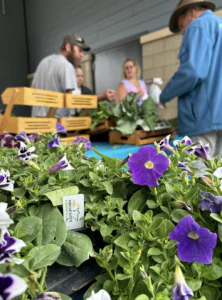
Petunia starts for sale at a farmers' market with the Minnesota Grown Label. Source: Minnesota Grown

The Minnesota Grown label at a local farmers’ market.

Across the country, labels like Jersey Fresh, Louisiana Grown, and Minnesota Grown have been developed to promote local food and agricultural products. Building on the state-grown label, states can create programs that further support the local food system. In New Mexico, Governor Michelle Lujan Grisham’s administration spearheaded an initiative addressing a number of food and nutrition issues in 2023, which included the creation of New Mexico Grown. New Mexico Grown works with local farmers, ranchers, and food businesses to connect them to preschools, K-12 schools, senior centers, and food banks. The program was specifically designed to support small-scale farmers and rural nutrition, with 67% of producers farming 10 or fewer acres and 85% of buyers reporting the program improved meal quality and food security. Many other states also have farm-to-school programs that provide grants going toward the purchase of local produce (like Pennsylvania, Alabama, and Iowa). Some states have also created programs in the last year that attempt to make up for the loss of the federal Local Food Purchase Assistance Cooperative Agreement Program (LFPA). In Maryland, the Maryland Food and Agricultural Resiliency Mechanism Grant Program (MFARM) allows Maryland’s food banks, charitable emergency food providers, and nonprofits to purchase agricultural products listed in the state’s Certified Local Farm and Fish Program.

These programs and others like them support a network of small-scale farmers and strengthen the local food network. While these state programs do not set aside specific funding for organic farmers, they create market opportunities that allow organic farmers to stay in business. Evidence suggests that small farms are more likely to adopt organic practices. Regardless of discourse surrounding the efficiency of small and large farms, small farms have much more flexibility to experiment with different farming systems and sustainable methods. Though they may have smaller harvests, small-scale farms are often more connected to the community, more responsive to public opinion and cultural shifts, and catalysts for larger changes in the agricultural industry. To support the transition to a healthier food system, state and federal policies should support not only existing organic producers, but also small and large farms that are likely to become certified or consider transitioning.

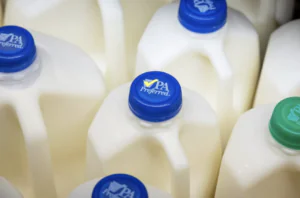
Milk jugs with the PA preferred logo on the cap. Source: PA Preferred

The PA preferred logo.

Some states are beginning to create programs that specifically support organic agriculture. Pennsylvania is the first and only state to create a label for Pennsylvania-grown, USDA Organic produce. The Pennsylvania Preferred Organic label builds on the state-grown Pennsylvania Preferred label. This policy initiative grew out of the Pennsylvania Center for Organic Excellence, which also offers free consultation to farmers considering a transition to organic. Their work focuses on breaking down silos and connecting producers with resources, especially technical assistance providers. As much as the organic label has boosted marketing, it can force producers into a box. Sometimes, organic farmers don’t realize they can participate in programs not specifically targeted to organic. This barrier is exacerbated by the fact that many grant approval committees have less experience with organic systems than with conventional ones. In collaboration with the Center for Organic Excellence, Pennsylvania’s ​Agricultural Business Development Center is attempting to address this through offering business planning support, including helping farmers find grants they are eligible for.

Another example of state policy supporting organic is California’s Farm to Community Food Hub. The program was created in 2021 with the express intent to “increase purchasing of local, environmentally sustainable, climate-smart, and equitably produced food by schools and other institutions, build a better food system economy, support the local farming economy, accelerate climate adaptation and resilience, and employ food system workers with fair wages and working conditions.” The same legislation defines sustainable practices as “including, but not limited to, organic methods, biological control, and integrated pest management, and ecologically beneficial means of soil improvement, irrigation, cultivation, harvesting, transportation, and marketing for California agriculture based on methods, as identified by the department.” This specifically incentivizes transition to sustainable agriculture systems, including organic, by opening a new, reliable market avenue for producers.

Programs like these are concentrated in states that pride themselves on a vibrant local agriculture network and prioritize sustainability concerns. The amount of focus and type of programs that states have regarding agriculture varies greatly. States in the Southeast generally have fewer state-level programs promoting organic or local agriculture, while regions like New England and the Pacific Northwest have implemented innovative agriculture policies and programs. State advocacy and sustainable agriculture organizations in regions with fewer agriculture policies in place face a harder road in implementing new programs. However, they benefit from other states’ trial and error. While it may be harder to convince conservative state legislatures of the positive impact of government-funded grant programs and other support for organic farming, reports from successful programs across the country can help make that case.

As Congress drags its feet on passing a federal Farm Bill, states have an opportunity to pick up the slack. States with similar agricultural landscapes and industries can look at what their neighbors are doing almost as a pilot program. If policies or programs have succeeded, they can build on existing policy language from other states instead of reinventing the wheel. The Center for Agriculture and Food Systems at Vermont Law and Graduate School has begun this work by cataloging more than 1,400 state and municipal policies. OFRF is working to foster communication among state-level agriculture and policy organizations and state departments of agriculture. It’s easy to get caught up in what Congress is doing, but improving the farm economy and working toward a more sustainable food system requires innovative legislation at every level of government.

Does your state have programs or policies that support organic agriculture? OFRF would love to hear about them. Vinnie Trometter, OFRF’s policy manager, is mapping what states across the country are doing to improve their local organic agricultural economies. You can get in touch with Vinnie at vinnie@ofrf.org.

photo of cherry blossoms blooming with US Capitol building in the background and a button to "sign up for our newsletter"
By |2026-10-17T08:43:07-04:00October 12th, 2026|Advocacy, News|

Organic Week Was Full of Certified Smiles!

By Vinnie Trometter, OFRF Policy Manager

Last month I joined OFRF’s Executive Director Brise Tencer at the Organic Trade Association’s (OTA) annual Organic Week conference in Washington D.C. We gathered at a momentous time for agriculture, as the Senate Agriculture Committee had just successfully marked up their version of the Farm Bill after failing in their first attempt in early August.

Executive Director Brise Tencer and Policy Manager Vinnie Trometter at the Capitol Building.

Executive Director Brise Tencer and Policy Manager Vinnie Trometter at the Capitol Building during Organic Week.

The return of Senate Agriculture Committee Member Senator Mitch McConnell (TN-R) made it possible to push the bill out of Committee on a party-line vote. Insiders informed us that there would be no chance to offer amendments. Thus, onlookers only had to look at the draft text—which did not include key organic priorities like improvements to organic research or organic infrastructure—to know what was going to be in the draft bill. The process made the outcome of the markup feel predetermined, outside of unexpected fireworks by the Senators from Iowa who tried to force amendments around nullifying Proposition 12 and finalizing Biden-era Packers and Stockyard Act anti-trust rules.

The bill now heads to the Senate Floor, where it is unlikely to pass due to disagreements over delaying the Supplemental Nutrition Assistance Program (SNAP) cost-share provision from the One Big Beautiful Bill—a disagreement I’ve explained in an earlier blog post. It is looking likely that parts of the Farm Bill will get lumped into a year-end funding bill.

The timing of Organic Week was a breath of fresh air, allowing me to focus on the enlightening presentations and meet fellow organic industry professionals, rather than getting bogged down in the lackluster results of the Senate Agriculture Committee.

And goodness me, there was lots to be impressed by! Some memorable moments included hearing how a potato farmer chose to transition over to organic because his farm’s small size made his spuds close to last in the pecking order in conventional processing. Choosing organic moved him up the line, as he was no longer so small in an organic supply chain.

I also heard from Whole Foods how organic accounts for 30% of their meat and 64% of their produce and floral sales. Additionally, “Better for You” brands (organic, grass-fed, regenerative, etc.) comprise about 25% of all sales across the grocery landscape. They also mentioned that about 40% of their organic sales come from Gen Z and Millennials. The take away was clear—the demand for organic products is there, and the industry is building momentum.

Inaction on Capitol Hill and being around all the wonderful conference attendees also helped me appreciate how just down driven organic farmers are. Things like private and public infrastructure, research, data collection, technical assistance, and risk management tools have skewed towards conventional agriculture because of the relatively small size of organic and profit margins. Despite this lack of resources, the organic industry punches above its weight. Federal and state programs that support farmers have to be amended to incorporate organic agriculture. In some cases, entirely new programs have to be created, like dedicated organic agriculture research. These actions are crucial in making sure that organic farmers have the assistance, tools, and insights that are necessary for any industry to thrive.

True to its roots, the organic industry remains “organically grown,” having nowhere near the same support as conventional agriculture, despite consumer demand. The farmers I spoke to during Organic Week not only believe in (and demonstrate) the success of organic systems, they also find deep fulfillment in using practices that better the earth and their community. To put it plainly, sometimes loving what you do overcomes the obstacles in your way. To me, it’s this determination that shows how unstoppable the future growth of organic will be.

Stay up to date with our policy work by signing up for our newsletter:

photo of cherry blossoms blooming with US Capitol building in the background and a button to "sign up for our newsletter"
By |2026-10-08T12:38:56-04:00October 8th, 2026|Advocacy, News, Policy Corner|

Predicting What the Rest of the Year Looks Like in D.C.

By Vinnie Trometter, OFRF Policy Manager

It’s September, which means members of Congress are back in D.C. after a month away campaigning for reelection. They have returned to a massive slate of unfinished business and little time to do it before voters hit the polls.

One of the first things Congress did after the recess was pass a continuing resolution (CR) to fund the government at current levels until December 11. The CR also included a delay to the implementation of the White House’s proposed rule, which would give political appointees the final say over grant awards. OFRF is happy to see Congress being responsive to the over 160,000 public comments submitted overwhelmingly against the rule, and we hope that the rule is eventually revoked entirely.

However, the White House has found ways to get ahead of Congress through other means. For instance, the House Agriculture Appropriations bill for Fiscal Year 2027 contains language intended to prevent the closure of the Beltsville Agriculture Research Station. In response, the White House announced in August that it was redirecting all Fiscal Year 2026 funding intended to modernize Beltsville to create new research stations across the country. It remains to be seen how Congress will react, but Congressional appropriators are investigating whether the redirection of funds violates any existing laws.

Another thing that still needs to be done this year is, of course, the Farm Bill. Recapping from an earlier blog post, the Farm Bill failed in the Senate Agriculture Committee at the beginning of August largely because Senator Mitch McConnell (R-KY) was absent, and a compromise that delayed the state cost-share for SNAP was not enough to appease Democrats. It is expected that Senator McConnell will return sometime this month, when the Senate Agriculture Committee will reconvene to pass the Farm Bill out of Committee—without amendments. This would be a bad outcome in terms of organic research because the base text does not go beyond the status quo, which is not sufficient to meet the needs of the growing organic market.

Despite this possibility, the odds of the Farm Bill passing both the House and the Senate as a standalone bill are slim. Thus, another, more likely path is for the Farm Bill to be lumped into a must-pass government funding bill called an omnibus. Senate Majority Leader and member of the Senate Agriculture Committee, John Thune has already spoken life into this possibility. In this scenario, the main unknowns are what pieces of the Farm Bill would be included and whether the pieces left out would be picked up in next year’s new Congress.

There is much yet to be seen. Even yesterday, the House of Representatives cut two weeks from its in-session schedule. This means that after September 17, the House will not return until mid-November. However, rest assured that OFRF’s full-time presence in Washington, D.C., and engagement with our organic allies across the country, make us uniquely positioned to respond rapidly to any development.

Stay up to date with our policy work by signing up for our newsletter:

photo of cherry blossoms blooming with US Capitol building in the background and a button to "sign up for our newsletter"
By |2026-09-04T15:38:42-04:00September 4th, 2026|Advocacy, News, Policy Corner|

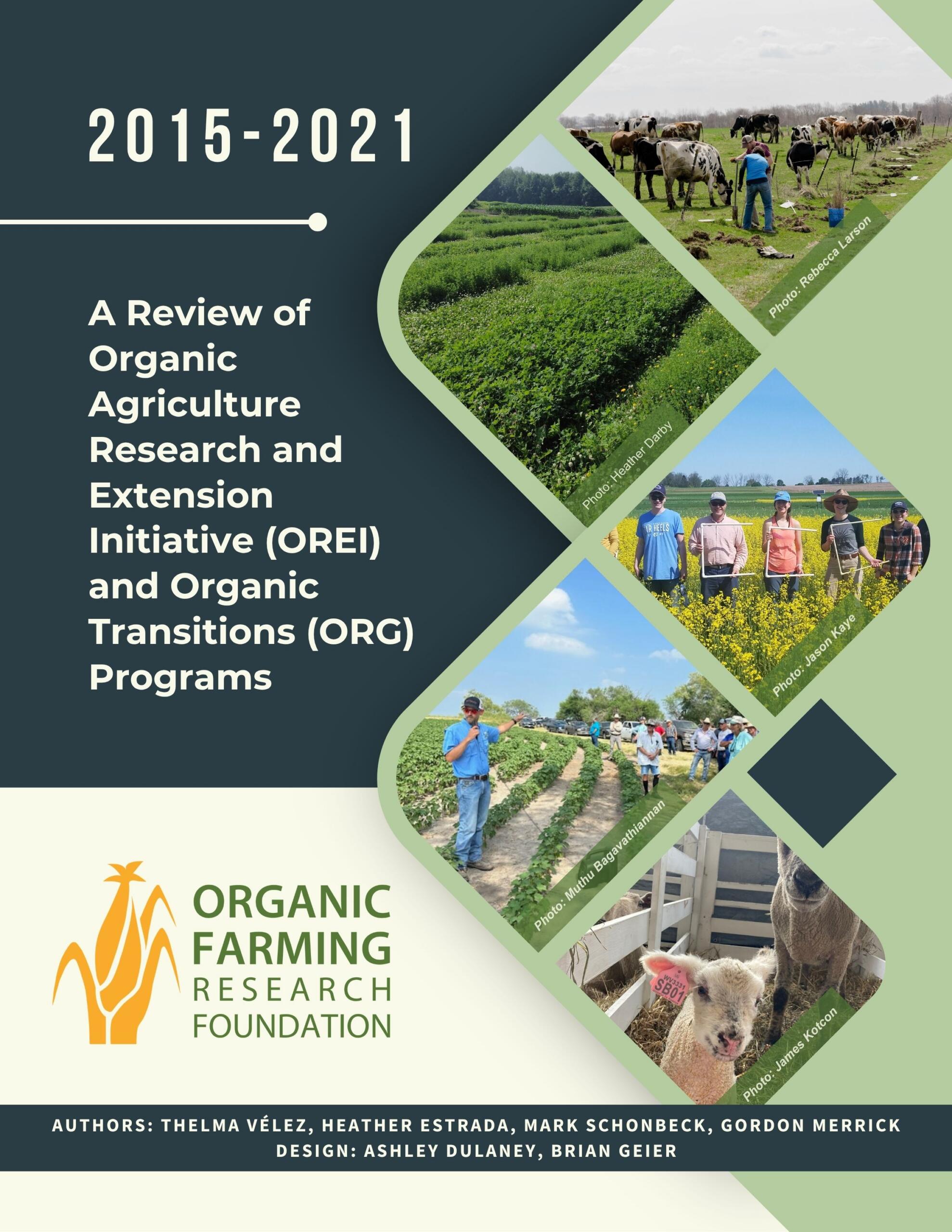
OFRF NIFA Organic Programs Evaluation Report

This report, commissioned by NIFA and conducted by the Organic Farming Research Foundation, evaluates the impacts of the OREI and ORG programs over a seven-year period, FY 2015-2021. The evaluation includes analysis on awards by institution type, priority area, commodity focus, and alignment with farmer-identified challenges. The findings of this report reveal that OREI projects addressed USDA legislative priorities through advances in soil health, pest management, and crop breeding, emphasizing practical, scalable solutions that contribute to ecosystem stability and production resilience, and ORG-funded projects made significant strides in supporting ecological services and site-specific solutions for transitioning farms.

This report is a component of a project funded through a three-year cooperative agreement between USDAʼs National Institute of Food and Agriculture (NIFA) and the Organic Farming Research Foundation (OFRF). This agreement was initiated by NIFA and did not use any program funds from the Organic Agriculture Research and Extension Initiative (OREI) or Organic Transitions (ORG) appropriations. Instead, NIFA used internal administrative funds to cover all project activities. As a cooperative agreement, rather than a standard competitive grant, the parties worked collaboratively to accomplish project goals. However, the authors acted independently in developing findings, conclusions and drafting the report.

By |2026-07-24T10:29:09-04:00July 23rd, 2026|Advocacy|

Congress Is Paying More Attention to Organic Research. Here’s Why It Matters.

By Vinnie Trometter, OFRF Policy Manager

OFRF has been working hard to increase support for organic research on Capitol Hill. Every year, OFRF submits requests for organic research priorities as part of the annual Congressional appropriations process. Our actions ensure that OFRF is fighting for more organic research funding that can result in breakthrough innovations for organic farmers each year, even outside of the Farm Bill.

Feedback from Congress shows that support for increasing organic research funding is growing. Ten Senators submitted an organic research support letter to the Senate Appropriations Committee. This was double the number from last year. In the House of Representatives, a bipartisan group of 31 members of Congress submitted a similar letter to the House Appropriations Committee. This was five more than last year. Last year’s letter was also not bipartisan.

The results of these letters indicate that more policymakers want more organic research funding to keep up with the rapidly growing organic market in the U.S. This increased support helped secure two victories in the FY2027 House Agriculture Appropriations bill that will benefit organic farmers. The first is the inclusion of language requiring the U.S. Department of Agriculture (USDA) to conduct an economic impact study to analyze how organic agriculture affects the labor market, environmental quality, land ownership, social dynamics, and vitality of local economies. Organic farmers and those interested in transitioning to organic agriculture will be able to use the results of this study to better understand holistically how organic agriculture affects their communities. Another victory is the language that tasks the Agriculture Research Service (ARS) with continuing support for organic research that studies critical producer-identified constraints in the Upper Midwest, such as weed management and soil fertility, and with supporting coordinated research on crops, livestock integration, soil health, and nutrient efficiency to meet demand for organic foods.

Though we were unsuccessful in increasing funding for important research programs like the Organic Transitions Program (ORG) and the Sustainable Agriculture Research and Education Program (SARE), this was largely because of the tight fiscal environment in Washington, D.C. However, we believe our small successes will be critical in better informing organic and organic interested farmers with farming decisions and innovations that, as a whole, will benefit organic agriculture.

Broadly, funding for organic agriculture research needs to increase in parallel with the growth of the overall organic market. In 2025, the domestic organic market grew by almost 7%, which was the largest annual growth rate since the pandemic. The market is now worth over $76.6 billion and is expected to reach $100 billion by the end of the decade. However, less than 2% of the USDA’s agricultural research budget is allocated to dedicated organic research, despite organics accounting for around 6% of all U.S. food sales, including 15% of all produce sales, across the country.

Publicly funded agricultural research has a high return on investment for both taxpayers and farmers. The USDA Economic Research Service states that every $1 invested in agriculture research generates $20 dollars of economic activity and that increases in productivity arising from innovation and changes in technology are the main contributors to economic growth in agriculture.

Imagine how much the organic market would grow if dedicated organic research got the same proportion of funding as its market penetration? This would mean more funding for researchers at state land-grant universities, non-profits, and ARS to find solutions for the most pressing organic agricultural issues in their regions and nationwide. Extension services would also expand in tandem since the bulk of all dedicated organic research are competitive grants under the National Institute of Food and Agriculture (NIFA), which must have extension activities built into each project. Additionally, many of these projects also help with market development. As a result, increased funding for organic research would not only provide more tools and best practices for organic farmers, but also more opportunities for them to learn from researchers and sell into expanded markets.

Regions with underdeveloped organic agricultural footprints but strong increases in demand for organic foods stand to benefit the most from broad increases in organic research funding. Take, for instance, the Southeastern U.S. This region had the highest growth in demand for organic produce, yet was among the least productive for organic agricultural output in the country. This dichotomy makes the Southeast a perfect region for projects that integrate research, extension, and market development. Regions with more established organic agricultural sectors will, of course, also benefit as their organic producers become even better positioned to capitalize on growing nationwide demand. Nationwide, increased organic research will improve the competitiveness of our domestic industry as a whole. This is particularly important for certain industries, such as organic beef, where the majority of its 44% growth seen last year was due to imports.

OFRF will continue to update organic farmers and researchers about changes to organic research as the United States Senate Agriculture Appropriations Committee develops its own FY2027 Agriculture Appropriations bill. OFRF will be tracking the markup, so be sure to sign up for our email list and follow us on social media (Facebook, Instagram, LinkedIn) to see how organic research is impacted!

photo of cherry blossoms blooming with US Capitol building in the background and a button to "sign up for our newsletter"
By |2026-05-05T11:22:55-04:00May 7th, 2026|Advocacy, News|

The Proposed USDA Restructuring Will Hurt Farmers, Not Bring the Agency Closer to Them

By Vinnie Trometter, OFRF Policy Manager

Record-high input costs, low commodity and specialty crop prices, and lack of access to markets are placing massive economic pressures on farmers. In January of this year, over 300 farm groups sent a letter to Congressional leadership issuing a dire warning that the long-term viability of American agriculture is under threat unless conditions change. 

Since then, the situation has only gotten worse. The war in Iran has spiked fertilizer prices during the peak spring planting season, affecting the vast majority of farmers who hadn’t pre-booked their fertilizer. Exacerbating pressures, a record-warm winter in the Western United States is contributing to a drought that covers over 70% of the acres for many major commodities. 

With this as the backdrop, the USDA plans to restructure its research, education, and economics agencies so they “can be closer to farmers” and coordinate better. Though OFRF has advocated for better USDA organic research coordination, this restructuring will only move the department further away from the producers it’s meant to serve due to lapses in service and the loss of USDA employees who fill important functions. 

The major part of this proposed restructuring is to move more personnel from the USDA’s core research and data agencies—the National Institute of Food and Agriculture (NIFA), Economic Research Service (ERS), and National Agricultural Statistics Service (NASS)—to Kansas City and St. Louis. Though the most recent restructuring proposal claims there will be no job losses or disruption to farmers’ services, recent history suggests otherwise. After NIFA and ERS were relocated to Kansas City in 2019 during the first Trump administration, about 75% of those slated to move left the USDA entirely, including large numbers of employees with decades of experience who are not easily replaced; it is not easy for career employees with homes, families, and lives to pick up and start again in a new state with little notice. As a result, the number of economic reports out of USDA agencies dropped by half, and funding for land-grant universities was significantly delayed. 

Another part of the recently announced restructuring is to close down the nation’s largest agricultural research station, the Beltsville Agriculture Research Station in Maryland, and move its research efforts to different stations across the country. Beltsville has been a center of advanced research in organic and non-organic agriculture for decades. It is currently developing state-of-the-art techniques to track and target weeds and improve soil health for organic corn, soybean, and cotton producers. It also houses the Electron and Confocal Microscopy Unit (ECMU), which researchers can access and use to identify plant diseases and pathogens that put crops at risk. Beltsville research also developed and licensed a patented antibody designed for the wide-spectrum identification of potyviruses, which has protected bean, potato, and hemp producers from billions of dollars in damage. It also houses long-term on-farm research trials that, by their nature, cannot be relocated yet are crucial for measuring slow-changing agricultural elements, such as soil organic carbon, and for testing farming systems against annual weather variations. Despite all of this, the USDA speaks about facilities at Beltsville being decrepit and behind on maintenance. Much of this is true. However, they have only been degraded due to the lack of seriousness shown by successive Congresses and presidential administrations toward agricultural research since 2002, when public agricultural research expenditures peaked. 

USDA restructuring and the closure of Beltsville will further erode the USDA workforce. 2025 alone saw the departure of almost 23% of USDA’s research, education, and economic staff through broad deferred resignations and separations caused by the Department of Government Efficiency (DOGE), which even the House Agriculture Committee Chairman, GT Thompson (R-PA-15), deemed as “short-sighted.”    

It is not clear whether the USDA has the legal authority to restructure its agencies without Congressional approval. In particular, regarding Beltsville’s closure, the Democratic Maryland Congressional Delegation sent a letter to the USDA on April 27th condemning the action. However, illegality did not stop the first Trump administration from restructuring back in 2019 when the USDA Inspector General found that the 2019 efforts violated appropriation law. 

Ultimately, any USDA claims that this restructuring will be a good thing because these jobs will be “closer to farmers” is a ruse. Farmers, researchers, and universities can judge for themselves how the 2019 restructuring went and how the 15,000 USDA employees who took deferred resignations last year have helped farmers. Considering the woeful farm economy that is forcing farmers to juggle a growing list of natural and man-made crises at once—without sufficient labor, markets, farm services, and amid rising costs—restructuring right now is the last thing that would bring the USDA closer to those it serves.

Take action today!

It’s free and takes less than a minute. Tell your representatives in Congress to oppose the USDA restructuring and protect Beltsville from closure. Fill out our action alert here or by clicking the image below.

By |2026-05-11T11:05:21-04:00April 29th, 2026|Advocacy, News|

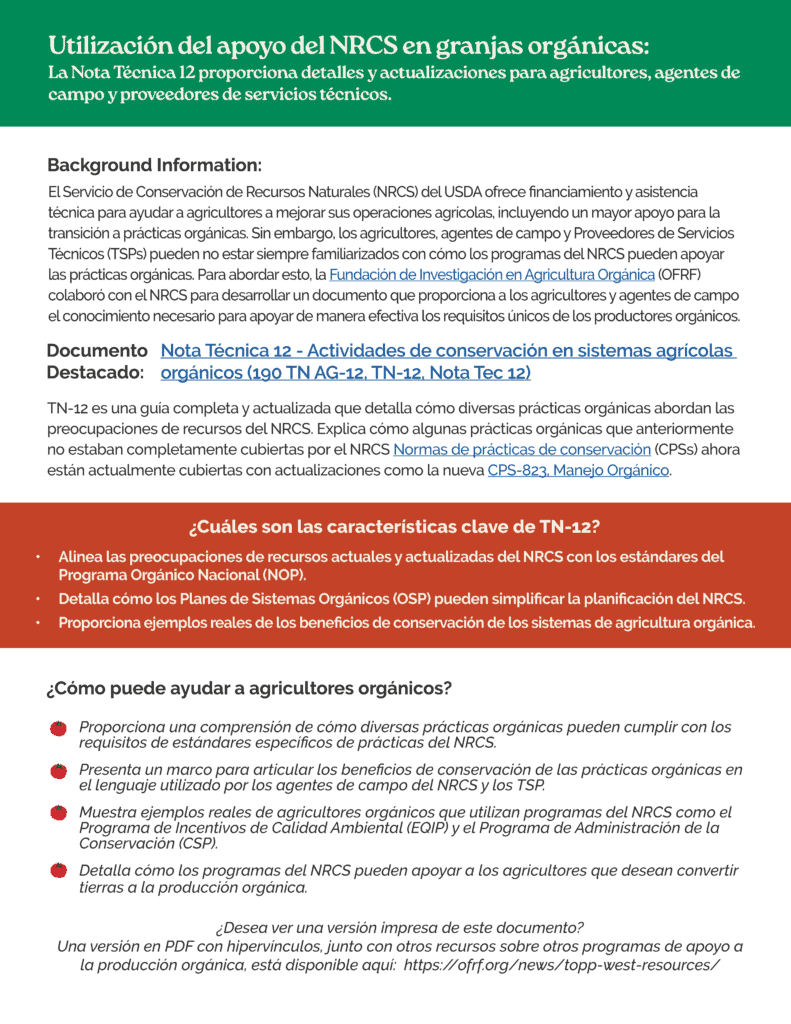
Why Technical Note 12 Is Such a Big Deal

By Gordon Merrick, OFRF’s Senior Policy & Programs Manager

Versión en español a continuación.

The Need that Technical Note 12 Meets

The Natural Resources Conservation Service of the United States Department of Agriculture (USDA-NRCS, NRCS) has been one of the most impactful modern agencies in the adoption of conservation practices and systems in the United States. Only recently did the NRCS publish a technical note that will aid Field Agents and other Technical Service Providers (TSPs) administer these programs on organic operations. Technical Note 12 – Conservation Activities in Organic Farming Systems (Tech Note 12) provides a wealth of knowledge needed to effectively support the unique requirements of organic producers. Recently, as part of our work for the Transition to Organic Partnership Program (TOPP) in the West/Southwest region, we have developed a toolkit designed to raise awareness among farmers of this resource, which is now in the hands of NRCS staff and TSPs. In this blog post, we’ll briefly discuss what Tech Note 12 is, how it benefits farmers, and how it helps NRCS staff and TSPs.

What Is Tech Note 12?

A technical note, as defined by the NRCS, is an authoritative document designed to provide detailed guidance on specific technical subjects relevant to conservation planning and implementation. These documents serve as essential resources for NRCS field staff, TSPs, and producers, offering in-depth information and practical instructions to support the effective management of natural resources and address resource concerns. Technical notes are developed to address a wide range of topics, including soil health, water quality, wildlife habitat, and agricultural practices. They offer step-by-step procedures, best management practices, and innovative solutions to common challenges faced in the field. By standardizing and disseminating this knowledge, technical notes help ensure consistency and quality in applying NRCS conservation programs and practices.

Tech Note 12 is intended to provide all this information—as it relates to organic agricultural production. It offers detailed guidance on conservation activities that are compatible with organic standards and provides real-world examples that illustrate how conservation activities have been implemented.  

How Tech Note 12 Helps Farmers

Tech Note 12 helps organic producers articulate the conservation benefits of their practices in the language used by NRCS field agents and TSPs. This clarity is crucial for accessing NRCS programs such as the Environmental Quality Incentives Program (EQIP) and the Conservation Stewardship Program (CSP), which provide financial and technical assistance to improve farm operations.

How Tech Note 12 Helps NRCS Staff and TSPs

For NRCS field agents and TSPs, Technical Note 12 is an invaluable tool for conducting thorough assessments of organic farming operations. By referencing the document, agents can identify appropriate conservation practices that address resource concerns while complying with organic standards. This approach ensures that the proposed solutions are both effective and aligned with the unique traits of organic farming, such as soil fertility, water management, pest control, and habitat conservation.

How to Access and Use Tech Note 12

To effectively use Tech Note 12 for your organic farming practices, start by contacting your regional Natural Resource Conservation Service (NRCS) office. Your NRCS field agent can provide helpful guidance on applying the recommendations in Tech Note 12 to your conservation planning while meeting organic standards.

For additional information and resources, download our Tech Note 12 flyer here. The flyer includes a summary of Tech Note 12, practical tips for using it, and suggested questions to ask your NRCS agent. This will help you get the most out of your NRCS support and prepare for your discussion.

Don’t miss out on valuable resources like this one—subscribe to our newsletter for groundbreaking organic farming research, educational guides, and critical funding and policy updates.

Brochure of how to utilize NRCS support on organic farms (includes background information, link to Tech Note 12, features, resources).

¿Por qué es tan importante la Nota Técnica 12?

La Necesidad que Satisface la Nota Técnica 12

El Servicio de Conservación de Recursos Naturales del Departamento de Agricultura de los Estados Unidos (USDA-NRCS, NRCS) ha sido una de las agencias más influyentes en la adopción de prácticas y sistemas de conservación en Estados Unidos. Recientemente, el NRCS publicó una nota técnica que ayudará a los Agentes de Campo y otros Proveedores de Servicios Técnicos (TSP) a administrar estos programas en operaciones orgánicas. Nota Técnica 12 – Actividades de conservación en sistemas agrícolas orgánicos (Nota técnica 12) proporciona una gran cantidad de conocimientos necesarios para apoyar de manera efectiva los requisitos únicos de los productores orgánicos. Recientemente, como parte de nuestro trabajo para el Programa de Asociación para la Transición a la Agricultura Orgánica (TOPP) en la región Oeste/Suroeste, hemos desarrollado un kit de herramientas diseñado para concienciar a los agricultores sobre este recurso, que ahora está en manos del personal del NRCS y los TSP. En esta publicación del blog, discutiremos brevemente qué es la Nota Técnica 12, cómo beneficia a los agricultores y cómo ayuda al personal del NRCS y a los TSP.

¿Qué es la Nota Técnica 12?

Una nota técnica, según lo define el NRCS, es un documento autoritativo diseñado para proporcionar orientación detallada sobre temas técnicos específicos relevantes para la planificación e implementación de conservación. Estos documentos sirven como recursos esenciales para el personal de campo del NRCS, los TSP y productores, ofreciendo información detallada e instrucciones prácticas para apoyar la gestión efectiva de los recursos naturales y abordar las preocupaciones de recursos. Las notas técnicas se desarrollan para tratar una amplia gama de temas, incluyendo la salud del suelo, calidad del agua, hábitat de la vida silvestre y prácticas agrícolas. Ofrecen procedimientos paso a paso, mejores prácticas de gestión y soluciones innovadoras a desafíos comunes enfrentados en el campo. Al estandarizar y difundir este conocimiento, las notas técnicas ayudan a garantizar la consistencia y la calidad en la aplicación de los programas y prácticas de conservación del NRCS.

La Nota Técnica 12 está destinada a proporcionar toda esta información, en lo que respecta a la producción agrícola orgánica. Ofrece orientación detallada sobre las actividades de conservación que son compatibles con los estándares orgánicos y proporciona ejemplos reales que ilustran cómo se han implementado las actividades de conservación.

Como la Nota Técnica 12 ayuda a los agricultores

La Nota Técnica 12 ayuda a los productores orgánicos a articular los beneficios de conservación de sus prácticas en el lenguaje utilizado por los agentes de campo y los proveedores de servicios de conservación del NRCS. Esta claridad es crucial para acceder a programas del NRCS como el Programa de Incentivos a la Calidad Ambiental (EQIP) y el Programa de Administración de Conservación (CSP), que de asistencia financiera y técnica para mejorar las operaciones agrícolas.

¿Cómo Ayuda la Nota Técnica 12 al Personal del NRCS y a los TSP?

Para los agentes de campo del NRCS y los TSP, la Nota Técnica 12 es una herramienta invaluable para realizar evaluaciones exhaustivas de las operaciones de agricultura orgánica. Al consultar el documento, los agentes pueden identificar las prácticas de conservación apropiadas que aborden las preocupaciones de recursos mientras cumplen con los estándares orgánicos. Este enfoque asegura que las soluciones propuestas sean tanto efectivas como alineadas con las características únicas de la, (agricultura orgánica) tales como fertilidad del suelo, manejo del agua, control de plagas y conservación del hábitat.

Cómo Acceder y Utilizar la Nota Técnica 12

Para utilizar eficazmente la Nota Técnica 12 en sus prácticas de agricultura orgánica, comience contactando a su oficina regional del Servicio de Conservación de Recursos Naturales (NRCS) (Oficina del Servicio Regional de Conservación de Recursos Naturales (NRCS) Su agente de campo del NRCS puede ofrecerte orientación útil sobre cómo aplicar las recomendaciones de la Nota Técnica 12 en su planificación de conservación mientras cumple con los estándares orgánicos.

Para más información y recursos, descargue nuestro folleto sobre la Nota Técnica 12 aquí. El folleto incluye un resumen de la Nota Técnica 12, consejos prácticos para su uso y preguntas sugeridas para hacerle a su agente del NRCS. Esto le ayudará a aprovechar al máximo el apoyo del NRCS y prepararse para su conversación.

No se pierda recursos valiosos como este: (Suscríbase a nuestro boletín) para recibir investigaciones innovadoras en agricultura orgánica, guías educativas y actualizaciones importantes sobre financiamiento y políticas.

By |2026-01-15T10:31:41-05:00September 13th, 2024|Advocacy, Federal Assistance, News, Spanish Resources, TOPP West|

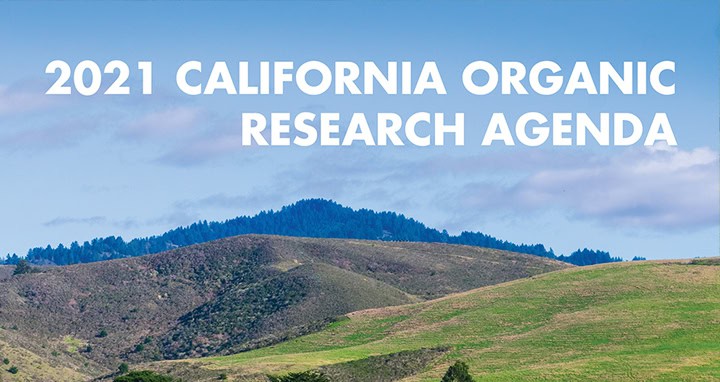
2021 CALIFORNIA ORGANIC RESEARCH AGENDA

California is the nation’s top producer of organic agricultural commodities and specialty crops. Thus, it
is imperative to understand the unique needs of the organic growers in the nation’s most agriculturally
productive state. The 2021 CORA report provides up-to-date information on the stewardship practices
used by organic producers across the state and identifies the most pressing production and non-production
challenges faced by organic California growers. The findings presented in this report: 1) highlight the soil
health management practices that organic producers in California are currently implementing, 2) outlines the most pressing challenges and needs of certified organic producers in California, and 3) outlines priorities and recommendations to address those needs through public policy, research, and Extension programs.

2021 California Organic Research Agenda report
By |2026-03-02T11:40:58-05:00April 7th, 2022|Advocacy, Insects & Diseases, On-Farm Research, Resource|
Go to Top