2025 Research Summary on Conservation Benefits of Organic Management

2025 Research Summary on Conservation Benefits of Organic Management

By |2026-03-02T12:16:49-05:00January 15th, 2026|Climate Change, Resource|

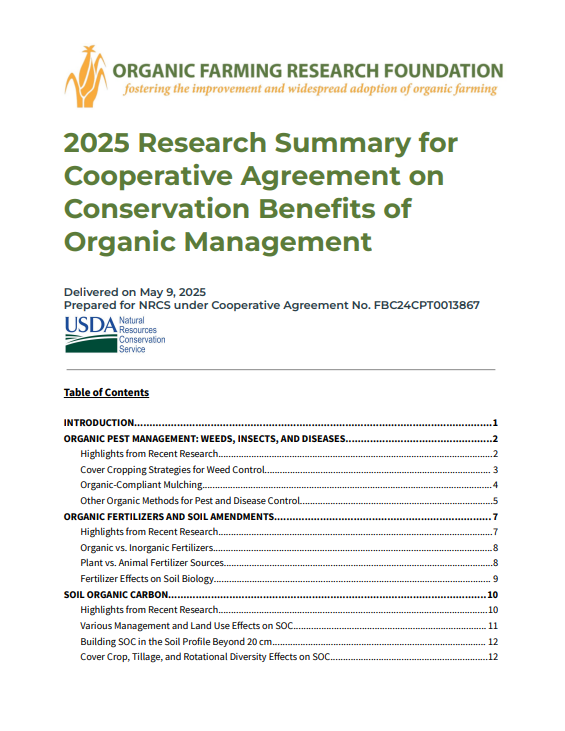
This report provides a summary of the latest organic agriculture research (as of 2025) across a variety of topics, meant to provide NRCS staff, organic producers, and other interested parties with in-depth educational information on the conservation benefits of organic management.

This research summary was produced with support from the United States Department of Agriculture’s Natural Resources Conservation Service (USDA-NRCS) under Cooperative Agreement No. FBC24CPT0013867. The contents are solely the responsibility of the authors and do not necessarily reflect the views of USDA-NRCS.

Adding the “O”: Farmer Perspectives and Experiences Transitioning to Organic in the Northwest

By |2026-03-02T12:28:14-05:00January 15th, 2026|Certification & Compliance, Resource|

Farmers transitioning to organic production face unique challenges that require technical assistance on a wide range of production and non-production issues. During the transition period, farmers must consider financially viable strategies for the three-year transition period, how to restore soil health while learning to manage weeds without herbicides, acquiring new equipment and infrastructure needed for organic production, and navigating NOP-related paperwork during the last year of transition and first year of certification. This webinar features three farmers who have worked through these issues and share their experiences and thoughts for demystifying some of the challenges they faced in the process. In this session, we feature three farmers in the Northwest who have built resilience and a dynamic organic system:

  • Lynn Schaal, Life Springs Farm in Idaho
  • Tracey Dion, Yellowstone River Farms in Montana
  • Aaron Flansburg, Flansburg Farm in Washington

About the Seeds of Success Series

OFRF has partnered with the Organic Farmers Association (OFA) and National Organic Coalition (NOC) to lead a series of virtual farmer-to-farmer networking sessions. These facilitated events will be engaging opportunities for farmers to share their challenges and successes, and will be accompanied with relevant resources you can use.

To learn more about these and other events from OFRF, visit: https://ofrf.org/events/. Funding for this series is provided by a cooperative agreement between OFRF and USDA-NIFA to highlight research investments made through both the OREI and ORG grant programs.

New Year, Same Farm Bill… Again.

By |2026-01-08T08:15:23-05:00January 8th, 2026|Gordon's Policy Corner, News|

By Gordon Merrick, OFRF Policy Program Director 

If it feels like we’ve been talking about the Farm Bill forever, you’re not wrong. As we turn the calendar to a new year, we are still operating under an extended version of the 2018 Farm Bill, once again kicking the can down the road on a comprehensive, bipartisan update to one of the most consequential pieces of legislation for U.S. agriculture.

Here’s a quick reset on where things stand, what key players are signaling, and how OFRF is approaching the year ahead.

A Quick Catch-Up: How We Got Here

Last year was defined less by progress and more by procedural survival. Congress passed multiple short-term extensions to avoid a lapse in Farm Bill authorities, ultimately extending the 2018 Farm Bill into the new year. While this kept critical programs operating, it also delayed meaningful updates to research, conservation, and rural development policy, areas that increasingly need modernization.

At the same time, Farm Bill negotiations were repeatedly sidelined by larger political dynamics: leadership changes, appropriations brinkmanship, reconciliation debates, and an overall lack of floor time. The result was a familiar outcome: temporary certainty paired with long-term stagnation.

For organic farmers and researchers, this has real consequences. Programs authorized by the Farm Bill can’t evolve, funding levels can’t be right-sized, and emerging challenges—climate volatility, supply chain disruptions, market consolidation—remain inadequately addressed.

What Key Players Are Saying About the Farm Bill This Year

As Congress returns, there’s no shortage of rhetoric about getting a Farm Bill “done this year.” Committee leadership in both chambers continues to express support for a bipartisan process, and USDA officials have reiterated the importance of predictability for farmers and rural communities.

That said, the signals are mixed. Some members are focused on a “skinny” Farm Bill approach. Others are openly questioning whether the traditional Farm Bill coalition can hold together. Meanwhile, broader debates over federal spending and agency structure continue to loom over the process.

What’s clear is this: nothing will move on autopilot. A successful Farm Bill this year will require sustained engagement, coalition-building, and pressure from outside Washington to remind lawmakers what’s at stake.

What OFRF Is Doing This Year for Organic Agriculture Policy

OFRF is approaching this Farm Bill cycle with clarity and intention. Our priorities remain consistent: ensuring that organic agriculture is fully recognized as a research-driven, conservation-forward, and economically significant part of U.S. agriculture.

This year, that means:

  • Advocating for robust investments in organic research, including OREI, ORG/RTOP, and USDA intramural research.
  • Working to ensure that technical and financial assistance programs actually function for organic and transitioning-to-organic producers, not just on paper.
  • Elevating the role of organic agriculture as an economic engine, particularly in rural communities.
  • Supporting bipartisan policy solutions, like the Organic Science and Research Investment (OSRI) Act, that can be integrated into a final Farm Bill.

Just as importantly, we’re continuing to ground-truth these priorities through direct conversations with farmers, researchers, and partners across the country. Policy that isn’t informed by lived experience doesn’t hold up, and we’re committed to making sure that doesn’t happen.

How You Can Get Involved

If there’s one lesson from the last year, it’s that silence doesn’t move policy. Whether this Farm Bill becomes another extension or a meaningful reset depends in part on how clearly lawmakers hear from the communities they serve.

You can:

  • Talk with your members of Congress about why organic research and conservation matter in your district.
  • Share your experiences navigating USDA programs: what works, what doesn’t, and what needs to change.
  • Engage with OFRF’s and our partner’s policy updates, sign-on letters, and action alerts as opportunities arise.
  • Encourage colleagues, partners, and neighbors to stay engaged, even when the process feels slow or opaque.

A new year doesn’t automatically bring a new Farm Bill. But sustained, informed engagement can.

We’ll keep doing our part to make sure organic agriculture is not an afterthought in this process. We hope you’ll stay in it with us.

Eat well and breathe deeply,

Gordon

Organic Agriculture Research in Action: Navigating Urban Farming with Little Lighthouse Farm

By |2026-01-06T13:04:46-05:00January 6th, 2026|Farmer Stories, News|

Written by Rebecca Champagne, PhD, OFRF Conservation Scientist

Meet Little Lighthouse Farm

Little Lighthouse Farm is a half-acre, certified-organic urban farm founded in 2022. Located in central Phoenix, Arizona, Rachel Opio runs the farm at the house she was born and raised in. She aims to grow everything that’s in season: produce, leafy greens like collards, dandelion greens, and swiss chard, as well as herbs, pasture-raised chickens for egg production, and a beehive for honey. She also cultivates native plants that many people don’t realize they can eat, like purslane.

Rachel sells her produce and other products at the local farmer’s market, at the farm stand right on the farm, and at the food bank. She accepts SNAP, WIC, and the Senior Nutrition Program, and she’s one of only a few places in the area to do so.

“As a black female farmer, I want to ensure my neighbors of all races, backgrounds, and ethnicities have nutrient-rich foods,” Rachel said. “I also offer garden consulting for my neighbors who want to learn how to grow their own edible landscapes.”

Little Lighthouse Farm gained USDA organic certification in February 2025. It is currently the only black-owned, certified organic urban farm in Arizona. Given the history of discrimination in federal lending programs against black farmers by the USDA, it was important to Rachel to seek certification and build trust in what she produces.

(Recommended reading → USDA issues payments to address discrimination against Black farmers; Racial Equity in Organic)

Although Little Lighthouse Farm is only half an acre in size, producing crops on even a small scale comes with its challenges. Additionally, there are unique challenges to urban farming. That’s why federal funding for organic agriculture research is so important and helps producers of all sizes.

The Importance of Organic Agriculture Research

Rachel was motivated to implement conservation practices to reduce the risks associated with irrigation costs, one of the biggest concerns on her farm. During the very hot Arizona summers, Rachel can spend up to four hours a day hand-watering her crops. Not only is this time-consuming, but because she operates an urban farm that’s reliant on city water, it can be expensive. She is also passionate about soil health and providing habitat for beneficial insects, like pollinators.

Rachel is already seeing the benefits of implementing conservation practices. She began using cover crops and set up a pollinator garden when she started the farm three years ago. Cover cropping, in particular, has helped alleviate compaction that is typical of the soil in Phoenix.

“If I hadn’t used cover crops, I would have never been able to grow anything in this soil. The first day I put a trowel in the soil after amending it for over a year, the trowel just slid in like a glove. And then I saw the worms. I was crying. Soil life is amazing.”

Investments in organic agriculture research can help farmers of all backgrounds and farms of all sizes. Urban farms face unique challenges of their own but can implement conservation practices just like larger-scale farms, which means they benefit from research findings, too. Organic research projects focused on urban agriculture have published studies that can help with conservation goals such as guides about water management and access and strategies for hydroponic strawberry production.

At Little Lighthouse Farm, soil health was restored because of the years of research on the benefits of cover cropping. Better soil health allows Rachel to grow better crops, which provide nutritious products to community members. Research funding makes this all possible and demonstrates that innovations in organic agriculture research can result in widespread adoption of beneficial practices, helping farms of all sizes and production types meet conservation goals. And the benefits of research extend beyond the farm, too. According to an analysis done by the USDA Economic Research Service (ERS), every $1 invested into agricultural research triggers a $20 economic benefit. This provides long-term benefits in addressing agronomic issues, increases farm productivity and profitability, and ultimately benefits the economies and resiliency of communities.

You can support farmers like Rachel and help strengthen the agricultural research all farmers depend on by:

  • Letting us know about the impact agricultural research has had on your farm (contact communications[at]ofrf.org!).
  • Enrolling in our free Communicating with Legislators email-based course and sharing your story with elected officials.
  • Writing a letter to the editor or an opinion piece in your local newspaper, talking about how research projects/programs have benefited your farm.

Environmental Quality Incentives Program (EQIP)

By |2026-01-15T10:21:50-05:00January 5th, 2026|Federal Assistance, News, Spanish Resources, TOPP West|

Farmers across the U.S. are eligible for significant technical and financial assistance from the Natural Resources Conservation Service (NRCS).

Farmers and technical service providers know firsthand that the most significant barriers to developing sustainable infrastructure and production practices are due to time and resource scarcity. NRCS’ EQIP program offers financial assistance and technical support to implement new conservation practices on your farm, with additional support for historically underserved applicants, including socially disadvantaged, beginning, veteran, and limited-resource farmers and ranchers. In this blog post, we’ll provide an overview of what EQIP has to offer and the steps to utilizing this program.

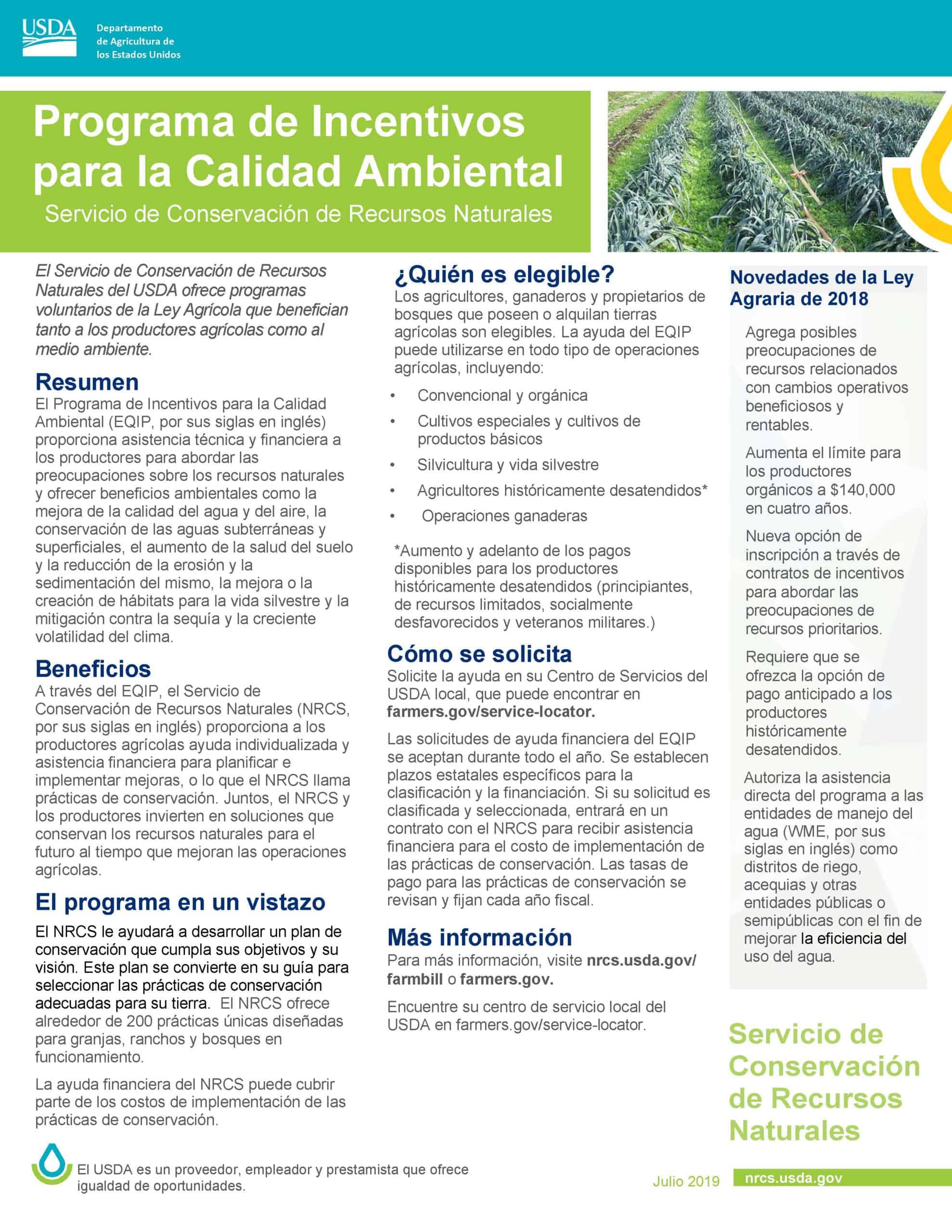
Obtain additional translated materials, or schedule interpretation services for phone calls or in-person visits, at farmers.gov/translations, or request personalized Spanish language support for any USDA resource, at farmers.gov/translations#spanish-request.

Important Points:

  • EQIP is a reimbursement program; most operations will have to pay for improvements up-front and get funding to cover those costs.
  • Do not begin reimbursable conservation activities and projects prior to completion of your application process and contract with NRCS.
  • Contacting your local NRCS office is a key step in determining your eligibility and beginning your application process.
  • Applications are accepted on a rolling basis and will be reviewed on the next ranking date for your state. Begin your application process as soon as possible to ensure completion by the next deadline! Applications are prioritized by local resource concerns and the applicant’s level of need.
    • The 2026 batching deadline is January 15, 2026, for all states. 
  • You will need to create a free online account at Farmers.gov and ensure that it is up to date.
  • If you do not own your land, you will need to submit written permission from the owner with your application.

Step 1. Research Your Options.

EQIP offers support for a broad scope of conservation activities & projects to producers, including both financial and technical support. EQIP provides funds to reimburse costs associated with specific practices or infrastructure projects on a farm. EQIP’s most popular sub-programs include the High Tunnel Initiative, which covers the cost of high tunnel installation for production farms, the On Farm Energy Initiative, which covers the cost of energy-saving equipment and infrastructure improvements such as refrigeration units or greenhouse improvements, and the Organic Initiative, which provides up to $140k to certified organic or transitioning farms to implement conservation practices such as design and installation of efficient irrigation systems, nutrient & pest management strategies, or developing a grazing plan. Funding availability varies by state. As of 2026, not all initiatives are offered in every state. Check with your local NCRS office to determine what funding pools are available in your state.

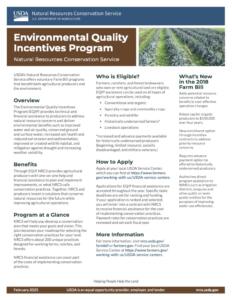
Front page of a CSP factsheet in English

Step 2. Connect with USDA.

Create or update your account at Farmers.gov, and contact your local NRCS office to get started. Your conservation specialist will confirm your eligibility and help you identify which projects & practices best suit your operation. 

Guiding questions for initial contact with NRCS:

  • “I’m interested in applying for EQIP’s  _initiative(s) of interest_ for my farm to help finance _conservation project of interest_. What do you need from me to get started on my application?”
  • “What additional funding opportunities are available to my farm?”
  • “How soon can a conservationist help me set up a conservation plan (AD 1026)?”
  • “When is the deadline for the next EQIP ranking period?”
  • “I am eligible for the increased and advanced payment option for Historically Underserved farmers. How will this change my application process?”
  • “I _(own/rent)_ my land. What documents will you need for completion of my EQIP application by the deadline?”
  • “My farm is _certified/transitioning_ to organic. What additional will you need for completion of my conservation plan and application by the deadline?”

Step 3. Schedule your conservation plan development.

Your NRCS conservation specialist will work with you to develop a conservation plan for your operation and complete the AD 1026 form.

Step 4. Gather your application documents.

You’ll need your: 

  • Official tax ID (Social Security Number or Employer Identification Number)
  • Adjusted gross income certification (Form CCC-941), which requires your Taxpayer ID Number and AGI from the previous 3 tax years.
  • Deed, or property lease agreement, and written authorization from the landowner to install structural or vegetative practices.
  • Farm tract number (obtained from Farmers.gov or FSA membership).
  • Documentation of organic certification (if applicable).
  • Documentation of your land’s irrigation history (if applicable to project).

Step 5. Complete your application & submit!

Your NRCS conservation specialist will complete & submit your application form (CPA 1200) with you using your established conservation plan and the above documents. 

Step 6. Implement your plan.

If you’re selected, you can choose whether to sign the contract for the work to be done. You’ll be provided with guidelines and a timeframe for implementing your plan. Once the work is implemented and inspected, you’ll be paid the rate of compensation for the work.

Apply for EQIP now and unlock a more affordable path to sustainable agriculture. Your farm deserves the support it needs.

All of this information is summarized in a printable, downloadable PDF below, available in English and Spanish.

Building Successful Farmer-Researcher Collaboration

By |2025-12-19T12:51:02-05:00December 19th, 2025|On-Farm Research, Resource|

Farmers and ranchers are natural researchers, regularly using trial-and-error to address on-farm questions and challenges. Research shows that farmers greatly benefit when they lead on-farm research trials.

Programs like the OFRF’s Farmer-Led Trials and the Sustainable Agriculture Research and Education’s Farmer-Rancher Grant put farmers in the driver’s seat, allowing them to conceive and carry out research on their farms.

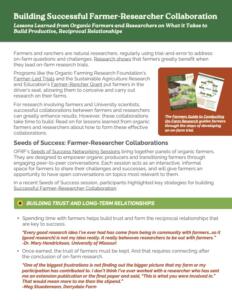
For research involving farmers and University scientists, successful collaborations between farmers and researchers can greatly enhance results. However, these collaborations take time to build. Read our report on for lessons learned from organic farmers and researchers about how to form these effective collaborations.

Front cover of seeds of success resource

An Organic Approach to Increasing Resilience

By |2026-01-16T11:26:29-05:00December 18th, 2025|Climate Change, Cover Crops & Crop Rotation, Insects & Diseases, Livestock, On-Farm Research, Plant Breeding & Variety Selection, Resource, Soil Health|

Few farmers need official reports to tell them that “increasing weather volatility” and climate change threaten their livelihoods and the resilience of their farming and ranching operations. With historic droughts, wildfires, flooding, and hurricanes in recent years, more farms are facing variable yields, crop losses, increased weed, pest, and disease pressures, and intensifying soil degradation, erosion, and compaction.

By utilizing organic and sustainable practices to build soil health, farmers and ranchers can improve their resilience and reduce risk as our climate changes. While practices can vary depending on your operation, establishing optimum soil organic matter (SOM) and biological
activity will help your operation through the difficult times to come.

Three Springs Farm: Small-scale Farming Rooted in Organic Principles

By |2025-12-18T11:47:59-05:00December 17th, 2025|Farmer Stories, News|

By Clare Boland, Communications & Outreach Fellow, and OFRF staff

Three Springs Farm is a certified organic farm located in eastern Oklahoma in the Ozark Hills. Farmers Mike Appel and Emily Oakley cultivate over forty different crops and more than 150 individual varieties on three acres of land. Their goal is to maintain a family operation that demonstrates the economic viability of small-scale farming.

Originally, Three Springs sold the majority of their produce at farmers’ markets, but since the pandemic, they’ve transitioned into being majority Community Supported Agriculture (CSA). Instead of giving customers a pre-packed box like a traditional CSA, they offer a free choice model, allowing customers to pick what veggies they want to receive at their weekly pick-up in Tulsa. CSA members also receive a newsletter containing recipes, photos, and stories from the farm. “It’s non-traditional, but we still have that community support,” says Mike. In addition to their CSA, they also sell wholesale to a restaurant and a Food is Medicine Program.

For Mike and Emily, farming organically was their intention from the start. Both studied agriculture in college, and afterward gained experience working at organic farms like Full Belly Farm in California. After Emily finished her graduate degree at the University of California-Davis, they relocated to Oklahoma, where Emily was raised, to start a farm of their own.

But finding a permanent home for their farm took a bit longer than they had hoped. They looked at more than 100 properties over the course of three years. During this time, they farmed on leased land, but were unable to become certified because of soil amendments used on the land prior to their lease. Eventually, they found land in Eastern Oklahoma, about an hour east of Tulsa, where they have been farming for the past 22 years.

“Oklahoma is really difficult because there’s not a lot of good soil,” Mike explains. “The best land tends to be river valleys, but they’re prone to flooding. Or, there might be really great land but no water. The best land we saw was south of Tulsa, but it was too expensive for us. We were at the eleventh hour when we just kind of stumbled upon our place.”

Why Organic

The land they purchased hadn’t been farmed before, so they didn’t have to go through the three-year organic transition period to obtain organic certification. “It’s why we do what we do,” Michael said when asked about the decision to be certified organic. “There was never a question of doing anything other than that… We actually don’t need it for marketing purposes.”  

Despite that, Mike says their CSA customers are still interested in the organic label – what it means and the integrity behind it. He also thinks the bashing of big organics doesn’t do a lot to support the label overall. “When you’re doing that consistently, the consumer doesn’t understand and is going to equate organics as something that is fraudulent. That’s a worry. It has to be a lot more delicate and balanced. There are a lot of us out there doing it right. There’s a lot of concern, and I think we’re riding a very fine line of losing consumer support if we don’t make integrity and strict standards the priority.”

In addition to being USDA-certified organic, Three Springs Farm is also certified through the Real Organic Project. Emily served on the National Organic Standards Board from 2016-2021 and advocated against the inclusion of hydroponic vegetables under the USDA label. The USDA’s decision to include hydroponics was what led to the founding of the Real Organic Project, where Emily currently serves on the standards board. The Real Organic Project label goes beyond the USDA organic label, differentiating organic food produced in concert with healthy soils and pasture, and offering customers greater transparency.

Mike’s top reasons why people should choose organic whenever possible start with the obvious. “You don’t want poisons in your food. That to me is fundamental. We don’t want to eat food grown with chemicals and we don’t want other people to either. 

“Also, farmworkers shouldn’t be working in fields that have nasty chemicals. We have a long way to go to ensure people have good working conditions, but at least we can ensure people aren’t being exposed to bad chemicals when they’re growing our food.”

Then there are the larger environmental impacts. “Living near a creek and seeing the life that’s there is incredible. While it is resilient, it’s also very vulnerable to our influences. It’s important to make sure your food choices don’t impair that. When we buy organic, we think beyond ourselves. Our choices have huge impacts in other parts of the world. Just try to make the best choices you can with what you have in front of you.

Cover Cropping for Scale and Climate Extremes

Although Mike and Emily own around 100 acres, they only keep three to four acres in production since it’s just the two of them and their daughter. The majority of their land is in conservation for wildlife habitat and native ecosystem restoration. Determining the right schedule for their cover cropping has helped not only to build biomass, but also to manage their farm with minimal staff.

”Anything that was spring crops gets turned into a summer cover crop. And then any land that isn’t gonna be utilized at all that year is also in summer cover crop. We end our season on Labor Day to get our winter cover crop planted. So we spend most of September, and a little bit of October, cleaning up fields and just selling to the restaurant and the Food is Medicine program.” The goal, Mike says, is to get the entire farm into cover crop by mid-fall. “Over time, we’ve figured out how to sustain the farm as two people; not growing year-round is one way to do that.”

Though, climate irregularities have caused them to adapt their plans season to season. “ Our falls have been a lot drier, so we’re not able to plant until we get a rain, and those rains haven’t been coming until October. So we’ve modified our winter cover crop a little bit because of that, adding more winter-hardy [varieties].”

In addition to fall droughts, they’ve also been experiencing heavy rains in the spring. This past year was “the wettest spring we’ve ever had, which is saying a lot for this region because we have pretty wet springs. We get pretty severe storms. It’s usually a deluge. And this spring was the worst in our 20 years of farming. We just could not get back into the field. And there were a lot of disease problems in our potatoes and onions because of it.”

Along with the changes they’ve made to their cover crop mix, Mike and Emily are also experimenting with reduced tillage to combat climate extremes. This year, instead of rototilling their summer crop prior to winter planting, they tried discing it in instead. “We’re really happy the way that turned out. The soil is a lot less abused when we don’t rototill.” In the coming year, they are hoping to experiment with interseeding, planting cover crops alongside cash crops, to combat soil erosion and build resilience for rain events.

Learning Through On-Farm Research

Mike and Emily have also developed a good relationship with Oklahoma State University. “We’ve done some varietal trials with them, which helped us figure out what works,” says Mike. “What’s been interesting is to see the extension agents become more interested in cover cropping. They’re still very conventional, but they’ve become more interested after seeing what cover crops have done for us—the fact that we’re organic, our plants are healthy, and our yields are good—without having to put down chemical fertilizers.”

“We’re a bit far away from the university, so it makes it harder to collaborate, but we’ve told them to call us whenever they do variety trials. We have lots of ideas and have trialed a bunch of different crops.”

His best advice for new farmers? Perseverance.

“There are times I’ve definitely wanted to just throw in the towel. But in the end, things work out. You talk to people, figure out the problems. Each year it gets better, but you’ll still have setbacks, like the weather for us this year. Know that while nothing is static, each year you’ll be able to build on your experience.”
Lessons from the Plains on the Transition to Organic

By |2026-01-06T16:40:14-05:00December 16th, 2025|Farmer Stories, News|

A Farmer Panel recap from the Transitioning to Organic Farming Conference at the Eastern Nebraska Research, Extension, and Education Center in Ithaca, NE

By Brian Geier, OFRF Communications Manager.

“I used to write checks to chemical companies. Now I write them to my kids,” explains Tom Schwarz, a 5th-generation farmer from southern Nebraska, while discussing the advantages of organic production. The Schwarz Family Farm has been farming organically since transitioning the farm in 1988. Along with his wife and two kids, Tom raises corn, soybeans, wheat, field peas, alfalfa, oats, and numerous cover crops. He was speaking at the Transition to Organic Farming Conference hosted by the University of Nebraska, Lincoln, alongside two other organic farmers. 

As may be the case for many farmers in rural Nebraska, farming is not new to any of the organic farmers on this particular panel. Each spoke with a familiarity and vocabulary that comes with decades of experience. All three of them are from families who are farming hundreds or thousands of acres, some owned, many rented, in various stages of leases. And all of them had, at some point in the past few decades, switched a portion of their farming enterprises to certified organic production. For these farmers, who carry on family legacies of farming that survived the farm crises of the 1970s and 80s, organic is, among other things, a way to survive. It is also a path toward passing a farm operation onto the next generation that is better, safer, and more profitable than when they started. 

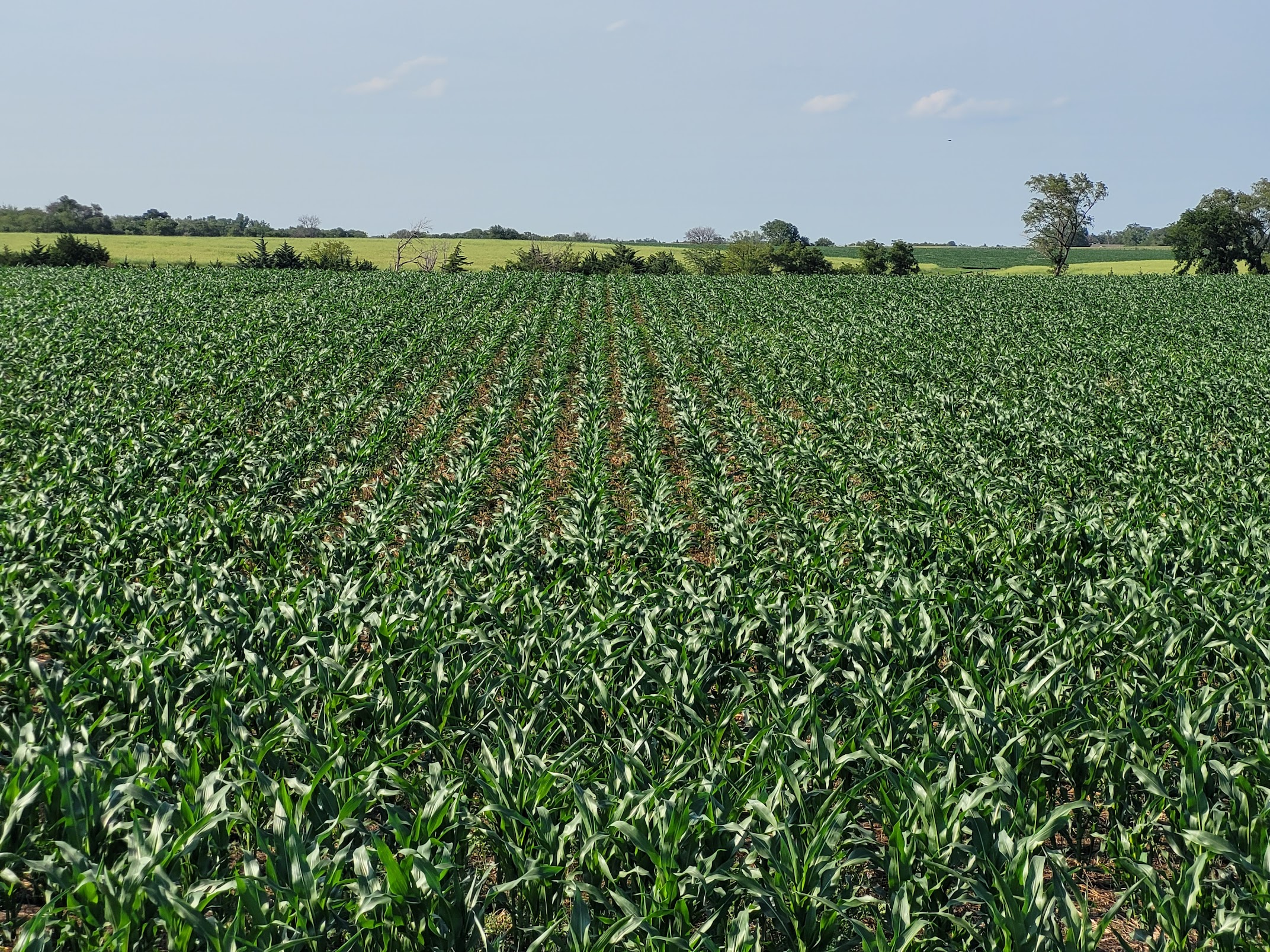
No-till, organic corn at Young Family Farm in Nebraska. Photo credit: Barry Young, farmer-presenter on the “Organic Production: Nebraska Growers’ Perspectives” panel. 

Like most farming, organic is not all easy. Tom presented what he sees as the disadvantages of organic: it is management-intensive (more machinery passes per season), requires extra recordkeeping, and WEEDS (emphasis via capitalization added from Tom’s presentation). “It’s just plain harder,” he explained, citing the need to be able to adapt on the fly and to creatively problem solve.

Matt Adams, who started farming with his dad in 2016 and operates about 600 acres in Seward, Nebraska, also spoke on the panel. He agreed that there can be difficulties with the transition to organic, particularly with having machinery settings or setups needed for larger-scale grain production. “Get everything ready way before,” he warns, “so the day you need to be out there, you’re ready.” 

Matt transitioned non-irrigated land that was previously in the Conservation Reserve Program (CRP) to organic hay and row crops. Since the fields were in CRP, there had been no prohibited substances applied to them, and they were ready to certify, meaning he did not have to steward them through the three-year transition period to organic. But since the land had not been fertilized or cultivated, Matt is finding that yields have been low and weed pressure high, putting extra strain on the need for timely, effective cultivation setups. 

When addressing challenges, the number one source of information for organic farmers is other farmers. And Nebraska’s organic farmers on this panel are no exception. 

“I do have some original thoughts. But I always throw them to the wolves first,” explains Barry Young, the third panelist who operates Young Family Farm in southeast Nebraska. “I should call it ‘Young Community Farm’”, he chuckles, giving credit to past mentors that first taught him about polyculture planting, and acknowledging fellow farmers and family members that he discusses ideas with before trying them. Barry finds that sourcing inputs is one of his biggest challenges. Despite living in farm country, “No one around me was doing what I’m doing,” he said. Still, by persistently asking questions of fellow organic and regenerative farmers, who he finds are more apt to share knowledge than many conventional growers, he has learned to meet main challenges like developing inter-species planting mixes for weed control. 

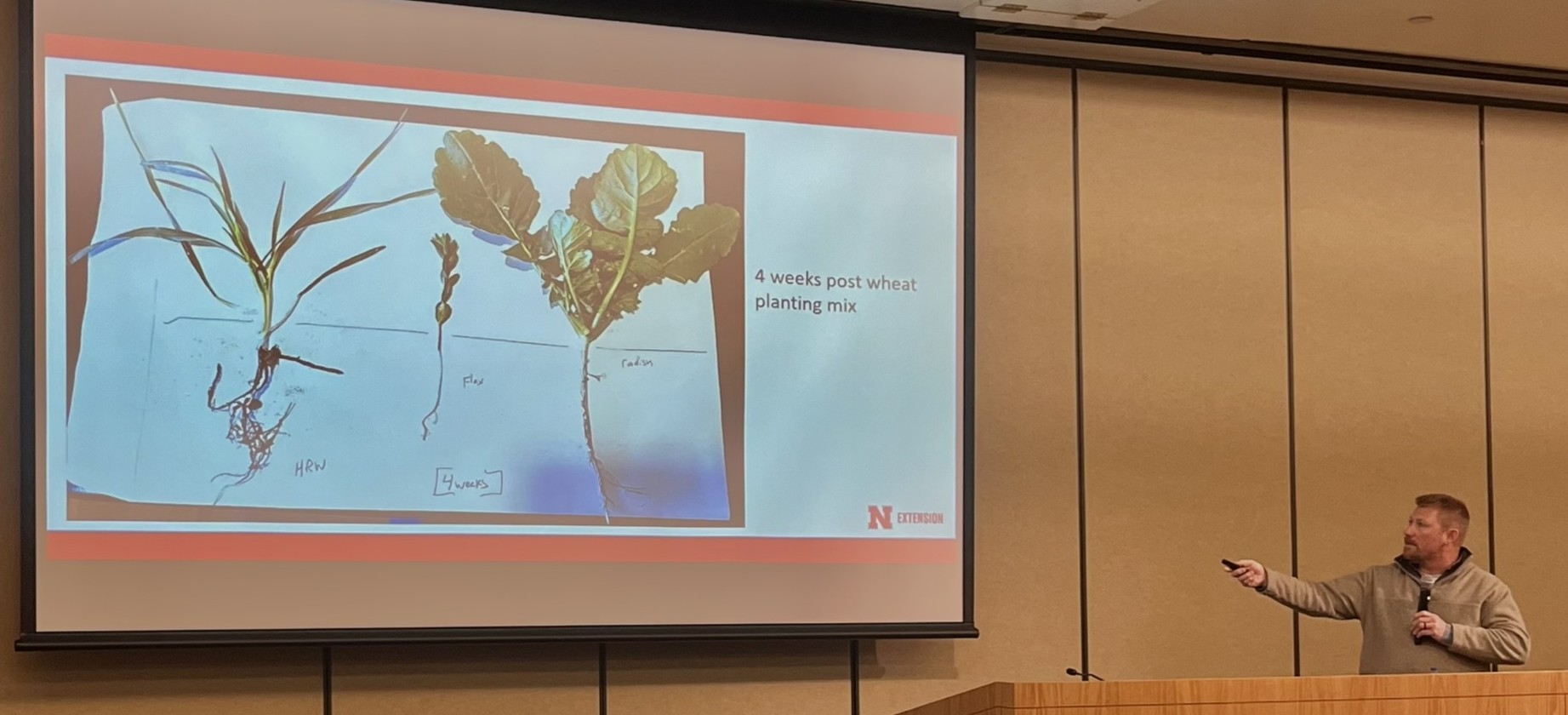
Organic farmer Barry Young explains his polyculture planting mix for organic wheat, which includes a custom mix of 120 pounds of wheat with 2 pounds of radish and 3 pounds of flax. The flax, a legume, helps enhance the soil microbiome while the radish helps break compaction especially following alfalfa. Both winterkill and the wheat matures as a pure stand for harvest the next season.

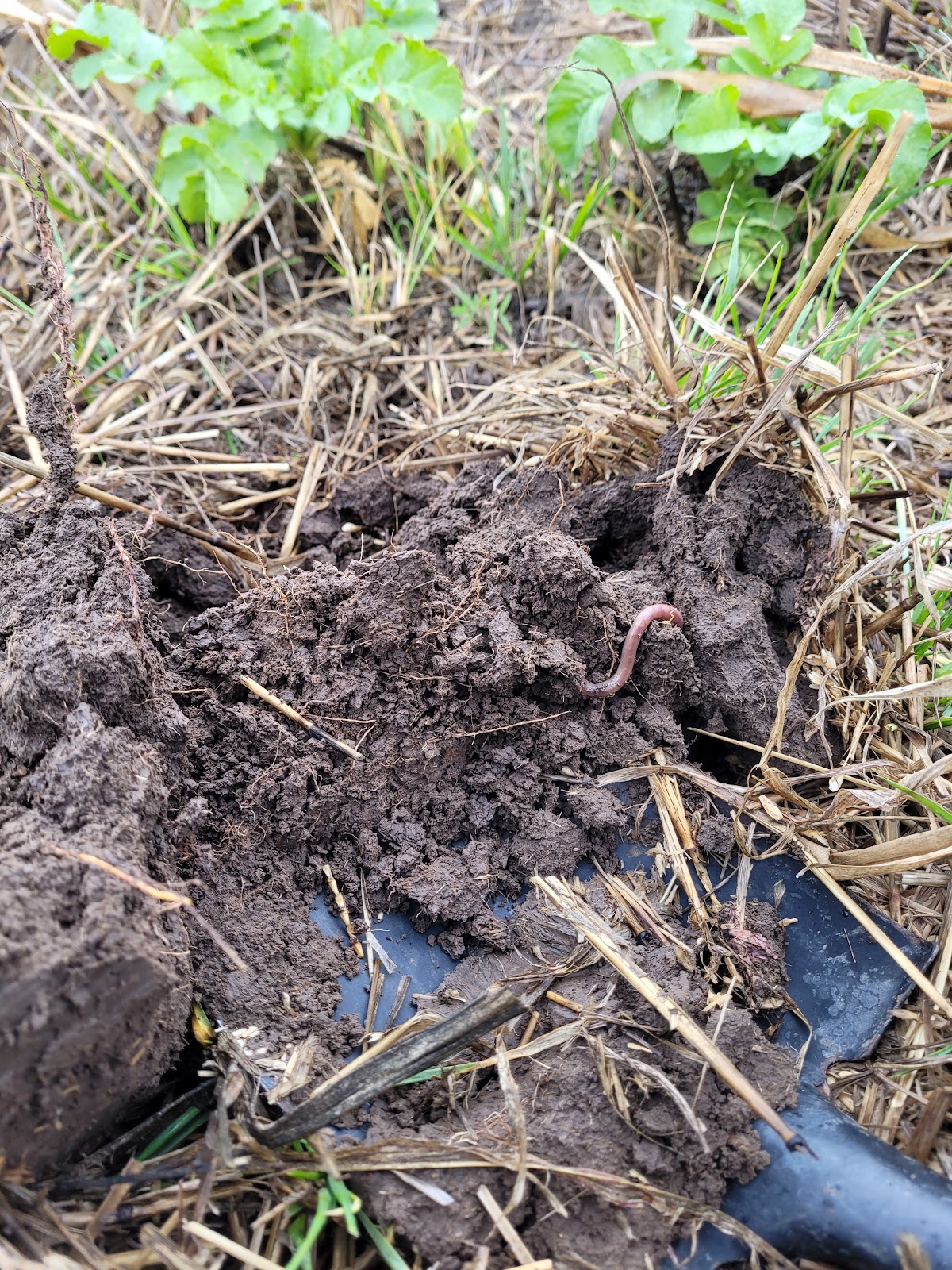
Earthworms and good soil structure in a November cover crop at Young Family Farm.

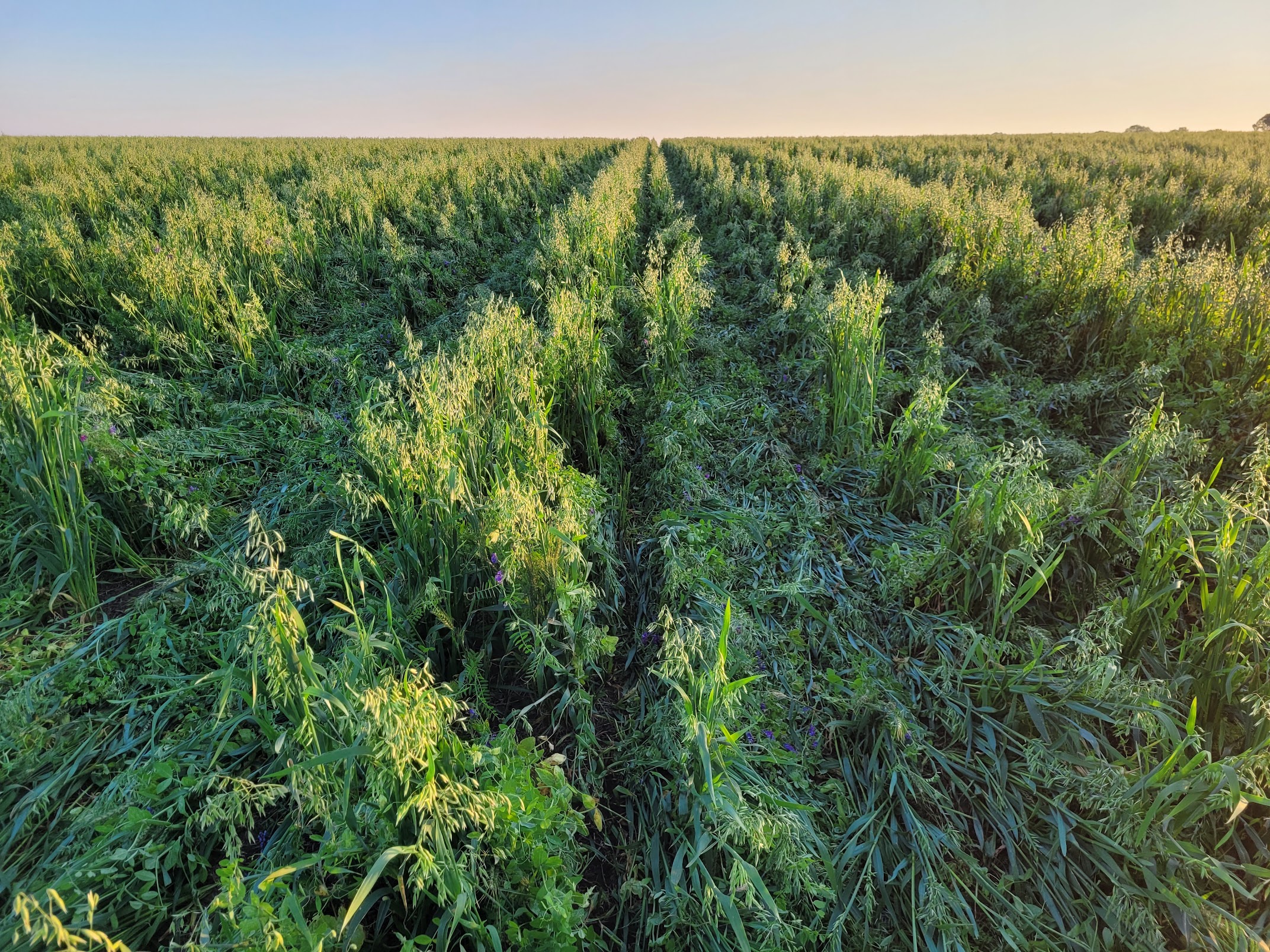
A high biomass (10-ton per acre) pea/oat cover crop following no-till corn planting at Young Family Farm

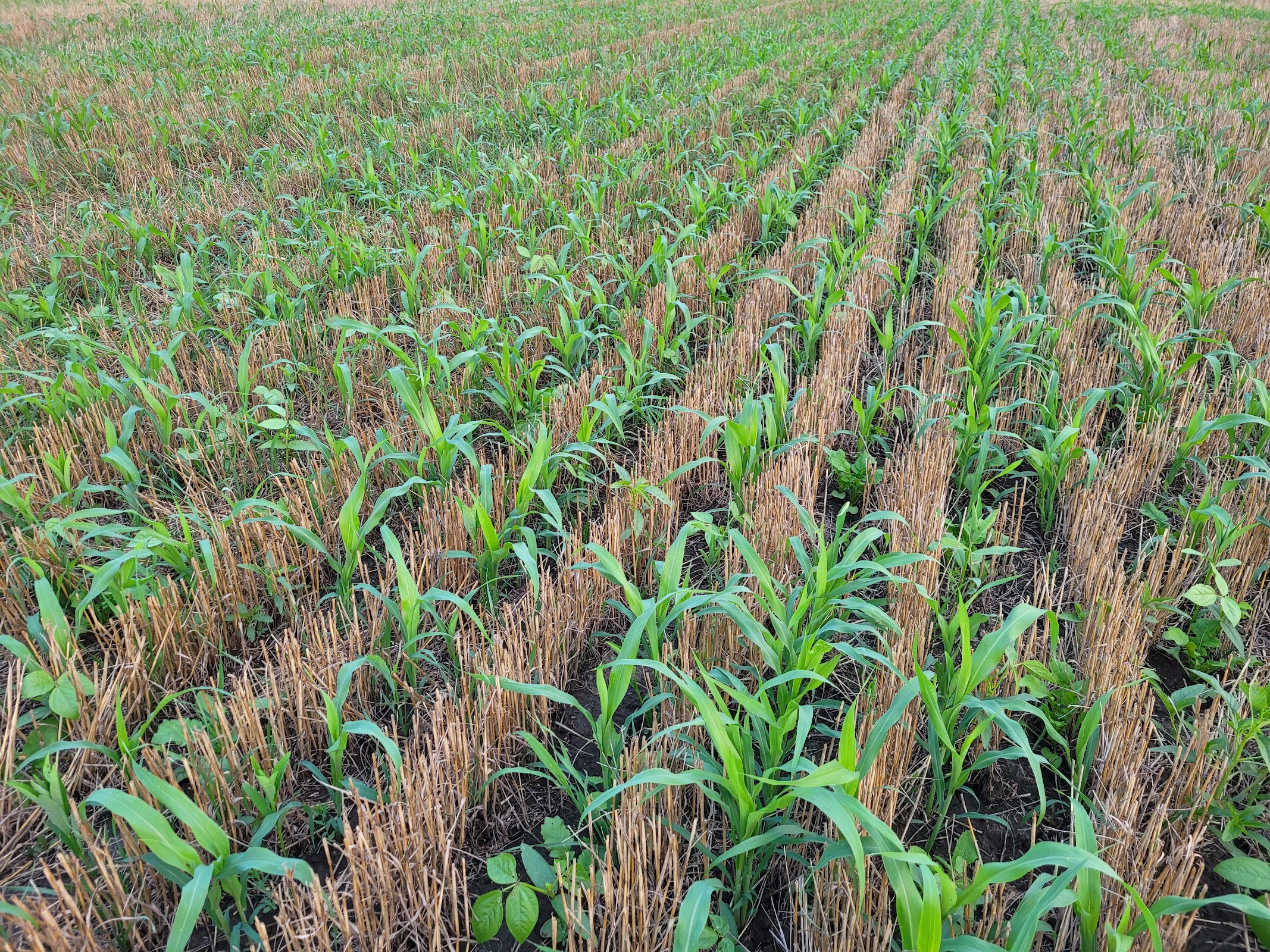
Corn grows with a soil-building mix in wheat stubble at Young Family Farm.

Secondary roots on organic, no-till corn at six weeks post-emergence at Young Family Farm.

“This is the way we’re intended to farm.”

-Nebraska organic farmer

All three of the farmers spoke about several advantages of organic production, too. One described lying down in a field, observing the increase in bug and bird life following the switch away from pesticides, and thinking, “This is the way we’re intended to farm.” 

Other advantages cited include organic’s market stability, and the regional control and accountability within the market chains. With organic grain production, many farmers are selling niche crops to regional processors who are then selling food back to the community. This creates a market and economy that farmers form long-term relationships with, and it stands in contrast to the volatility and lack of accountability from larger, conventional commodity crop markets where crops are shipped out of state or country for processing. It is “consumer-based as opposed to commodity-based,” Tom points out. 

But ultimately, for Tom and others on the panel, it is about their farms’ future, and that is about the quality of life of the next generation. Today, there are challenges with organic, for sure, but farming has been a difficult profession for generations of Nebraskans. With organic production as at least a part of the farm, Tom feels he is creating something that will be passed on to the next generation and be better than what he inherited. Aside from now being a paid part of the organic operation, Tom notes that “The kids will not be exposed to chemicals like I was,” adding, matter-of-factly, “that’s the biggest reason I do it.”

For Plains farmers interested in learning more about the USDA’s National Organic Program, we encourage you to explore resources and upcoming events hosted by the region’s Transition to Organic Partnership Program (TOPP). You may also want to explore OFRF’s step-by-step guides, printable tools, and farmer experiences to help you access USDA programs and funding, such as the NRCS’s Environmental Quality Incentives Program (EQIP) and the RMA’s Whole-Farm Revenue Protection (WFRP) program.

Go to Top