Crop-Livestock Integration Panel with Organic Farmers

Crop-Livestock Integration Panel with Organic Farmers

By |2025-12-15T14:48:08-05:00December 15th, 2025|Cover Crops & Crop Rotation, Crop Livestock Integration, Livestock, Resource, Soil Health|

Are you an organic farmer that is interested in using your livestock in your crop rotation? Are you wondering how others have overcome some of the complexities of integrating your farm system? Would you like to hear directly from farmers who have experience in this topic? If so, then this webinar is for you.

This Seeds of Success farmer-to-farmer networking session was an engaging opportunity where farmers came together to ask questions and share their lived experience in integrating crops and livestock in their production systems.

This session features three farmers that have built resilience and a dynamic organic system:

OFRF has partnered with the Organic Farmers Association (OFA) and National Organic Coalition (NOC) to lead a series of virtual farmer-to-farmer networking sessions. These facilitated events will be engaging opportunities for farmers to share their challenges and successes, and will be accompanied with relevant resources you can use.

Funding for this series is provided by a cooperative agreement between OFRF and USDA- NIFA to highlight research investments made through both OREI and ORG grant programs.

Seeds of Success Webinar Crop and Livestock Integration

Infrastructure and Crop-Livestock Integration

By |2026-01-28T14:24:47-05:00December 15th, 2025|Cover Crops & Crop Rotation, Crop Livestock Integration, FAFO Crop-Livestock Farmers, Livestock, Resource, Water Management & Irrigation|

In OFRF’s 2022 National Organic Research Agenda (NORA), organic farmers and ranchers across North America shared a common concern about the lack of technical assistance and educational resources available for Integrated Crop-Livestock Systems (ICLS). Integrating crops and livestock results in numerous benefits, however the process can also lead to increased complexity, especially for farmers who must adhere to National Organic Program rules and regulations.

This series of resources focused on Crop-Livestock Integration is informed by interviews with four highly-experienced organic producers that shared their challenges, successes, and advice for others interested in integrating livestock and crops on their organic farms.

Infrastructure for integrating animal and crop systems includes animal housing, watering systems, and fencing. Learn how farmers develop infrastructure that match the type and age of animal, are highly movable, and are adapted to soil and climate conditions.

Infrastructure for Crop Livestock Integration report cover

Dr. Erin Silva

By |2025-12-09T08:13:45-05:00December 9th, 2025|Board|

Director of the Center for Integrated Agricultural Systems, University of Wisconsin-Madison

Dr. Erin Silva is an Associate Professor and State Extension Specialist in Organic and Sustainable Cropping Systems in the Department of Plant Pathology, as well as the Director for the Center for Integrated Agricultural Systems in the College of Agricultural and Life Sciences at UW-Madison. After completion of a PhD in Horticulture at Washington State University, Dr. Silva obtained a faculty position at New Mexico State University. During her tenure at NMSU, Dr. Silva taught courses on organic vegetable production, an experiential learning course integrating the working student organic Community Supported Agriculture (CSA) farm on campus. Dr. Silva initiated several organic research projects at NMSU, including work on cover crop-based reduced tillage for organic vegetable crops and breeding vegetables for organic production systems.

Donna Holmes

By |2025-12-09T08:07:55-05:00December 9th, 2025|Board|

Managing Director, Investor Relations, Iroquois Valley Farmland REIT

Donna Holmes is the Managing Director of Investor Relations at Iroquois Valley Farmland REIT. There, she shares the company’s vision and investment strategy with investors and prospects. She is responsible for expanding their investor base by building a community of like-minded investors. Donna is passionate about creating an opportunity for all people to reap the health benefits of nutritional food, grown in a sustainable and socially just society. Using her knowledge of finance and investing, Donna structures investment vehicles to address investors’ different needs and goals. She believes in Iroquois Valley’s triple bottom line principles, actively securing social, environmental, and financial returns for our investors.

Prior to joining Iroquois Valley, Donna served in business development and investor relations roles at three alternative asset management firms. Before working in finance, she practiced law, specializing in tax and ERISA matters.

Something to be Grateful For: Northeastern State Secretaries of Agriculture Send Letter to Secretary Rollins about OREI

By |2025-12-09T09:02:15-05:00December 5th, 2025|Gordon's Policy Corner, News|

Written by Vinnie Trometter and Gordon Merrick of OFRF’s Policy Team

Before we all rushed to our dinner tables for Thanksgiving, we at the Organic Farming Research Foundation (OFRF), organic agriculture researchers, and organic farmers were thankful for actions taken by several state capitols across the country. On November 20th, the state secretaries of agriculture from Connecticut, Delaware, and New Jersey joined Pennsylvania Secretary Redding to submit a letter to the U.S. Secretary of Agriculture, Brooke Rollins, requesting unreleased FY2025 funding for the Organic Agriculture Research Extension Initiative (OREI) be included on top of new fiscal year funds for the program in FY2026.

OFRF’s policy team spurred this effort because we wanted to make sure that state departments of agriculture were aware that their land-grant universities did not have an opportunity to apply for the largest organic research program under USDA despite it being a permanent and mandatory program under the Farm Bill. OREI represents $50 million out of the $72.5 million which USDA dedicates to answering organic farmer’s questions each year. However, USDA did not release an RFA for the program for FY25, resulting in zero awards being given out. Consequently, researchers have endured disruptions in the continuation of their work and in the delayed study of organic topics that focus on many new and emerging issues facing organic farmers.

OREI recipients are overwhelmingly agriculture researchers at land-grant universities who develop projects in partnership with working certified-organic farms. These projects are critical steps towards finding ways to unlock organic producers’ ability to be more productive and better market their goods. The need for programs that study organic productivity and supply chains is becoming increasingly important because the U.S. has a spiraling organic trade deficit and has lost more than 16% of its certified acreage since 2021. Yet at the same time, domestic demand for organically produced goods grew 5.2% last year, more than double the rate of the overall marketplace.

Shortly after the release of this letter, OFRF received word from USDA that FY2026 OREI funding will include all of FY2025’s monies, which is an outcome we are very thankful for. State-level advocacy is an important and effective strategy that OFRF uses to inform federal officials about the localized impacts of federal policy.

We encourage organic farmers, researchers, and stakeholders to engage with their state representatives, senators, and departments of agriculture to amplify their challenges and successes as it comes to deployment of federal funds targeting organic agriculture research topics.

If you want to read more blogs like this, sign up for our newsletter here; if you want to take a next step in engaging with the policy process at a local, state, or federal level, sign up for our free, email-based Communicating with Legislators course!

Eat well and breathe deep,

Vinnie and Gordon

Farmer-Led Trials Program Spotlight: Oxbow Farm and Conservation Center

By |2025-12-17T17:31:33-05:00December 2nd, 2025|Farmer Stories, News|

Investigating Seeding Rate of Cover Crops for Biomass and Nutrient Content

Written by Mary Hathaway, OFRF’s Research & Education Program Manager, and Anthony Reyes, FLT Program participant

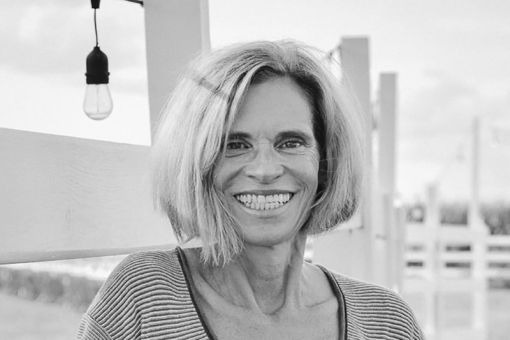
Anthony Reyes, FLT Program Participant. Photo credit Washington Soil Health Initiative, https://washingtonsoilhealthinitiative.com/2025/02/soil-health-ambassador-anthony-reyes-cover-crops/

Oxbow Farm & Conservation Center is a nonprofit farm in the floodplains of Snoqualmie Valley, WA. Anthony Reyes, the Agricultural Program Manager, manages 81 acres of certified organic land by experimenting and trialing climate adaptive and resilient agricultural practices. Along with his team, he works to reconcile our expanding human needs and the health of our ecosystem through sustainable agriculture, thoughtful management of our forests, ecological restoration, and education.

Oxbow Farm cultivates a variety of different crops well suited to the Snoqualmie Valley floodplain, and maintains a crop rotation to allow the soil to recover and regenerate. Anthony strategically removes fields from production each year and leaves them fallowed in cover crop to help protect the watershed, build up nutrients, and manage weeds, pests, and diseases.

Finding a Cover Crop that Works

Anthony was interested in understanding how to find a cover crop that would meet the needs of the farm – managing climatic challenges, erosion, and weed pressure. Ideally, anything that would be planted would help add biomass and could withstand drought conditions. Manipulating the seeding rate of the cover crops had been one way that the farm had considered better coverage of the soil, and Anthony was curious if the recommended seeding rate was the right density for their soil.

Farm Trial Plan

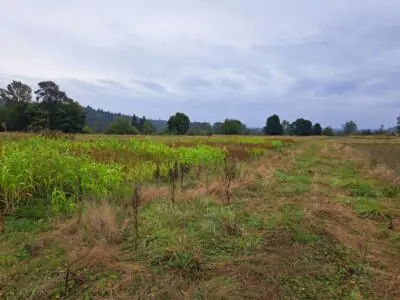
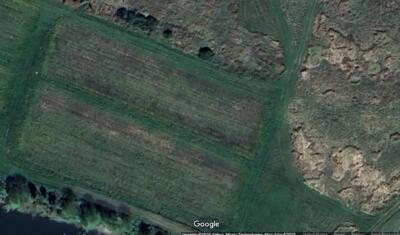
A portion of the cover cropped trial field.

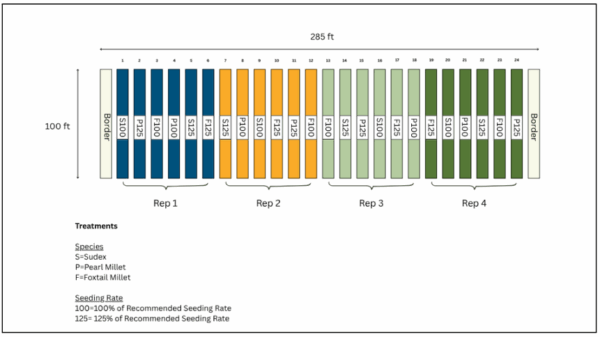
With technical support from OFRF, Anthony is investigating the impact of seeding rate on biomass and nutrient content for German Foxtail, Pearl Millet, and Sudex cover crops. He will plant single varieties at two different seeding rates: the recommended rate and 25% above the recommended drilling rate.

The trial was arranged in  a randomized complete block design, with 24 rows, each 100’ x 10’ wide, with 1’ pathways and borders on outside rows. Each of the 4 replications contained  6 plots (3 varieties at 2 different seeding rates), for a total of 24 plots.

Measurements were taken from a random 3×3’ quadrat from each plot, including a biomass and leaf tissue sample. These samples were sent to Ward Lab for analysis of biomass, nutrient content, dry matter, and C:N ratio of the crop matter.

Trial updates

The quadrat samples were taken in September and lab results were returned in late October. The OFRF team is now reviewing the data with Anthony, for a full report on how the trial went and findings from the data.

Trial fields at Oxbow Farm and Conservation Center

“I have long been interested in conducting and furthering our on-farm research, having worked on and set up many trials throughout my career. The Farmer-Led Trial Program goes beyond and centers the experience and voice of farmers by identifying us as the content experts and by playing a highly supportive and facilitative role in creating sound research from our identified goals. I have greatly valued the time and care given by OFRF staff and am so appreciative of this program.” 

– Anthony Reyes, Oxbow Farm and Conservation Center

An overhead drone shot of Oxbow Farm and Conservation Center

This is part of a series of blogs highlighting farmers who are participating in OFRF’s Farmer-Led Trials program. Farmers receive technical support to address their production challenges through structured on-farm trials. To learn more about OFRF’s Farmer-Led Trials Program, visit our website page at https://ofrf.org/research/farmer-led-research-trials/ 

To learn more about Oxbow Farm and Conservation Center, visit their website at https://www.oxbow.org/ 

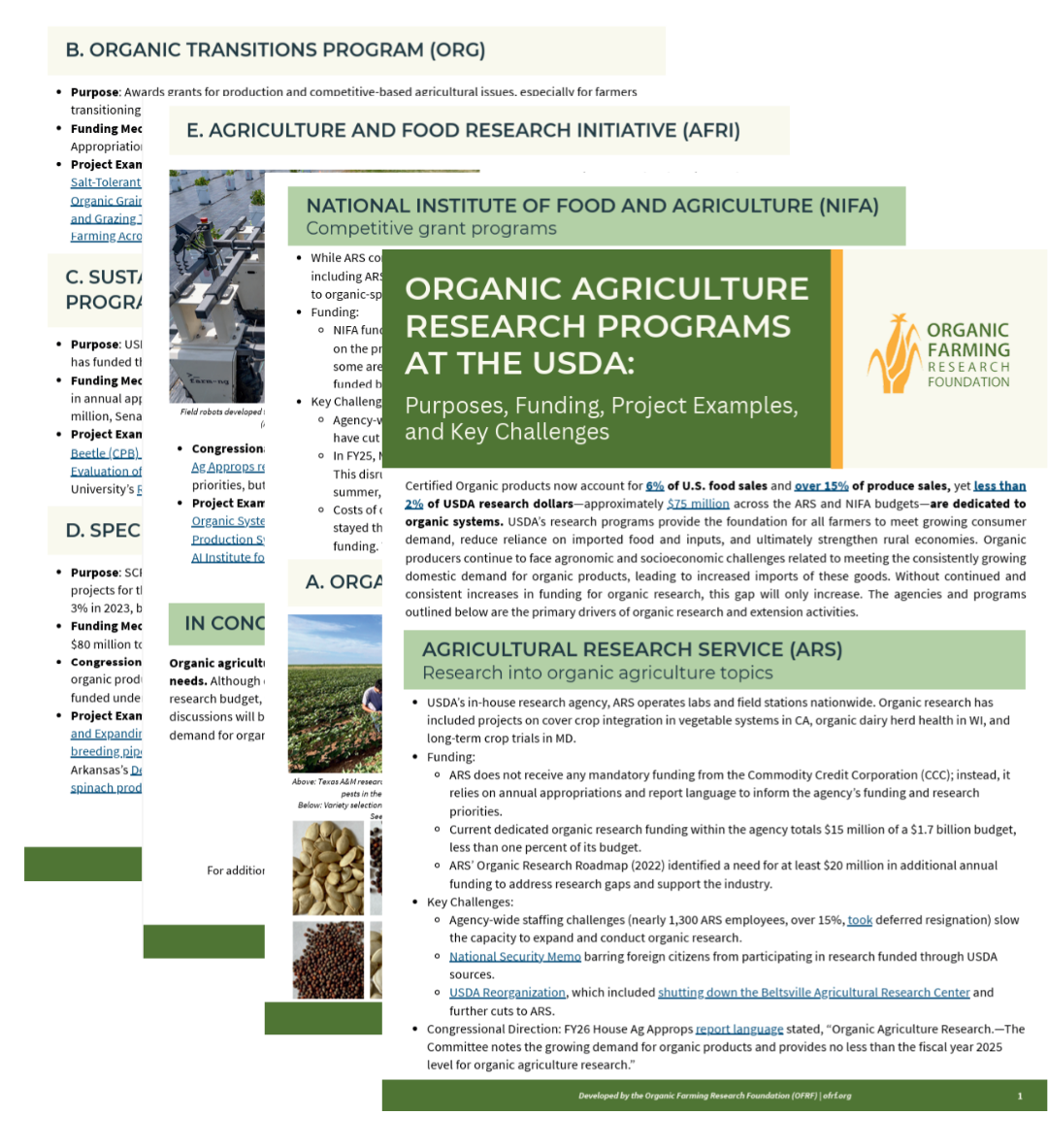
Organic Agriculture Research Programs at the USDA

By |2026-01-21T15:05:07-05:00November 25th, 2025|Uncategorized|

The USDA agencies and programs outlined below are the primary drivers of organic research and extension activities.

Agricultural Research Service (ARS)Research into organic agriculture topics

USDA’s in-house research agency, ARS operates labs and field stations nationwide. Organic research has included projects on cover crop integration in vegetable systems in CA, organic dairy herd health in WI, and long-term crop trials in MD.

National Institute of Food and Agriculture (NIFA)Competitive Grant Programs

While ARS conducts research for the USDA, NIFA’s mission is to provide grants to research institutions, including ARS and the Land-Grant Universities.

  • Organic Research and Extension Initiative (OREI) – The flagship NIFA competitive grant program is dedicated to organic agricultural research. It supports research, education, and extension programs that enhance the ability of organic producers and processors to grow and market high-quality products.
  • Organic Transitions Program (ORG) – Awards grants for production and competitive-based agricultural issues, especially for farmers transitioning to organic production systems.
  • Sustainable Agriculture Research and Education Program (SARE) – USDA’s longest-running sustainable agriculture grants program. While not exclusively organic, SARE has funded thousands of farmer-driven projects, including many led by organic and transitioning producers.
  • Specialty Crop Research Initiative (SCRI) – SCRI is a NIFA competitive grant program that provides resources for research and extension projects for the specialty crop industry. Organic’s share of SCRI-funded projects is highly variable — as low as 3% in 2023, but as high as 13% in 2021 — depending on applicant pool and USDA priorities.
  • Agriculture and Food Research Initiative (AFRI) – AFRI is a research, education, and extension competitive grant program that covers a wide range of topics, from improving rural economies, increasing food production, ensuring food safety and security, enhancing human nutrition, and training the next generation of the agricultural workforce. A range of 2-5% of AFRI funds are awarded to organic topics on an annual basis.

The best way to get these updates from OFRF is to join the OFRF newsletter.

OFRF’s newsletter provides regular updates to organic agriculture research programs at the USDA, including timeline updates, announcements of USDA’s calls for proposals, and advocacy updates via Gordon’s Policy Corner. We also provide details on how farmers, researchers, and advocates can work with us to protect and bolster federal support for organic farmers and researchers in the US.

USDA NIFA Announces 2025 Organic Transitions Program Awards

By |2025-11-20T12:57:32-05:00November 20th, 2025|News|

November 20, 2025

This week USDA-NIFA announced seven new research project awards through the Organic Transitions Program (ORG), totaling over $6 million to support a better understanding of the processes of organic transition and the best ways to support farmers who are in that process.

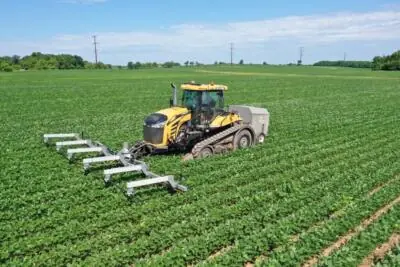
Photo of electric weed control equipment from https://theweedzapper.oldschoolmanufacturing.com/electric-weed-control-organic-farms/

The ORG program funds research and extension work that help those farmers stay competitive during the transition process, while also strengthening our understanding of the ecological benefits related to organic production. This program prioritizes the development of educational tools for farmers, technical service providers, and extension to support a farm during the sometimes tumultuous transition process.

The awards announced are going to Land Grant Universities across the country, and taken together, these projects are tackling some of the most pressing challenges facing organic and transitioning farms. 

The projects represent a continued step towards supporting practical, farmer-focused science that will help more producers transition successfully to organic systems, maintain profitability, and meet growing consumer demand for organic food. 

They also highlight the continued importance of programs like ORG and the Organic Research and Extension Initiative in driving innovation across the organic sector and beyond. We are looking forward to the release of the FY26 OREI and ORG Notice of Funding Opportunities (NOFOs).

Want to stay in the know about opportunities for funding like this? Sign up for our newsletter.

OFRF Launches National Organic Farmer Survey to Shape the Future of Organic Agriculture

By |2026-02-10T15:44:39-05:00November 19th, 2025|News, Press Release|

SANTA CRUZ, Calif., Nov. 19, 2025 — The Organic Farming Research Foundation (OFRF) has launched its 2025-2026 National Organic Farmer Survey, a nationwide effort to understand the challenges, priorities, and needs of organic and transitioning farmers. The survey will remain open through February 28, 2026, and will inform research, education, and policy decisions that directly impact the future of organic agriculture in the United States and across North America.

Since 1990, OFRF has worked to support the producers who grow the nation’s food and fiber. Farmer input is central to the organization’s work. Insights from previous surveys, including the 2022 National Organic Research Agenda (NORA), have guided farmer-led research projects, influenced university and Extension priorities, and helped policymakers direct more resources to organic producers.

“Organic farmers are experts in their fields, and their perspectives must guide decisions about agricultural research, education, and policy,” said Brise Tencer, executive director of OFRF. “This survey ensures that investments in the organic sector reflect the real needs of producers on the ground.”

The survey is open to all certified and in-transition organic farmers nationwide. Participation takes approximately 25 minutes, and upon completion, all respondents will receive a discount code to Johnny’s Selected Seeds and have the opportunity to enter to win prizes, including boots from The Original Muck Boot Company, FELCO pruners, and a farm consultation with a veteran organic farming expert.

Dr. Alex Woodley, associate professor in the Department of Crop and Soil Sciences at North Carolina State University, emphasizes the importance of this survey: “It’s important to make it clear that the surveys OFRF conducts on farmers’ needs are incredibly valuable. I’ve used the results to justify knowledge gaps in my grants, and that’s been really important. Getting a pulse on what farmers need right now is something we don’t always know—especially because I’m in research, not full Extension—so these surveys have been really important to me.”

Farmers can access by using this link or by emailing communications[at]ofrf.org. The survey is available in English and Spanish, and paper copies are available upon request. The 2022 NORA report, which shares the findings from the most recent survey, can be found at www.ofrf.org/research/nora/.

– end – 

About Organic Farming Research Foundation

The Organic Farming Research Foundation (OFRF), headquartered in Santa Cruz, California, with a remote team based across the U.S., works to foster the improvement and widespread adoption of organic farming systems. OFRF cultivates organic research, education, and federal policies that bring more farmers and acreage into organic production. For more information about OFRF, please visit our website: www.ofrf.org.


Media Contact

Ashley Dulaney, Communications Director, OFRF
ashley[at]ofrf.org, ‪(518) 310-6771‬‬
P.O. Box 440, Santa Cruz, CA 95061

Photo in featured image: Claire Lichtenfels, Whitestone Mountain Orchard in Tonasket, WA


*Updated Jan. 14, 2026, to reflect the extended survey close date.

Advancing Organic Agriculture: Examining How to Make the Midwest a Center of Organic Oat and Buckwheat Production with Congressman Scott Fitzgerald

By |2025-11-11T10:09:01-05:00November 10th, 2025|News|

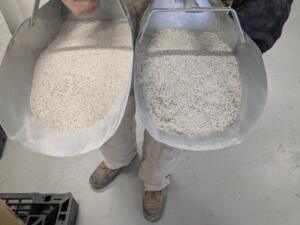
Different buckwheat flour formulations are being tested by evaluating different milling techniques. This photo shows light (left) vs. dark (right) buckwheat flours, which have different flavor and texture properties.

By Dr. Nicole Tautges with support from Vinnie Trometter, OFRF Policy Manager

As the Research Director of the Michael Fields Agricultural Institute in Wisconsin, I recently had the opportunity to meet with Congressman Scott Fitzgerald’s (R-WI-05) staff to discuss how the Organic Agriculture Research and Extension Initiative (OREI) program supports our research developing markets and supply chains for Midwestern organic oat and buckwheat producers.

Growing Small Grains for Big Impact

Carbohydrates make up about 75% of the calories in a typical diet, with most of those carbohydrate calories coming from grains. However, grains have received very little attention in terms of origins/sourcing, health benefits, quality factors, and organic share of consumption. Even for basic grain items like wheat flour, few consumers know where their flour comes from, or the differences among grains other than wheat.

This is where organic oat and buckwheat come in. Not only can these grains replace wheat for many uses but they are also more nutritious and excel in organic crop rotations. Our research focuses on how the Midwest can become a center of oat and buckwheat production in the United States. There is much work to do considering most of the oat and buckwheat consumed in the country is imported. However, there is no reason why these grains cannot be grown right here in the Midwest if the right markets and supply chains are in place.

Our research seeks to accomplish this by highlighting the nutritional and crop rotation benefits while building the knowledge and supply chains needed to make these grains more widely available. We do this by organizing focus groups with farmers and other grain supply chain actors to understand what the problems are, and design research trials to address management knowledge constraints.
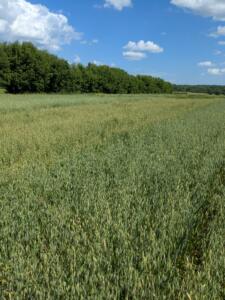
Oat variety trial—different oat varieties that are currently available are being tested in organic production environments (oats are typically not bred under organic conditions, and can perform differently in organic production systems).

Our trials cover all segments of the oat and buckwheat supply chain. On the grower side, we intend to perform organic fertility trials to improve nutrient recommendations for growers. For example, we are testing no-till establishment of spring oats, which helps ensure earlier planting and higher-quality food-grade oats. We have also completed a trial that demonstrates buckwheat can be planted after small grain harvest in the same season, with enough time to produce a harvestable crop. On the processing side, we are performing milling and processing trials with oats and buckwheat. Lastly, we are performing product testing with consumers, to better understand consumer preferences and to provide guidance to organic grain millers.

Collaboration and Networking are Key to Success

We are collaborating on this project with partners such as Dr. Jacob Jungers at the University of Minnesota, the Artisan Grain Collaborative, Rooster Milling in East Troy, WI, and several dedicated organic farmers across the Upper Midwest.

To share our results, we host field days, present at grower conferences, give webinars, and post videos on YouTube and Facebook. These efforts ensure that both farmers and consumers can see what’s happening and why it matters.

Support from the Organic Agriculture Research and Extension Initiative (OREI) has been fundamental for us. OREI is one of the few USDA programs that consistently supports organic research, which has often been neglected compared to conventional agriculture, despite rising consumer demand for agrochemical-free food.

Sharing Organic Research with Midwest Policymakers

It is important now more than ever to communicate to our legislators how organic agriculture research plays out on the ground. Agricultural science can feel abstract and difficult to understand for those outside the field. And let’s be honest—scientists aren’t always the best communicators! By sharing names, faces, and stories from real farms, we help policymakers connect research to human impact in their districts.

Buckwheat is a pseudocereal and a staple grain of northeastern Europe. It is actually in the rhubarb family! It has a pyramidal shaped grain (the dark brown part of the flower as seen above) that can be milled into flour, or dehulled and the “groat” eaten in porridge or granola.

I feel confident that I connected human impact with our research when I spoke with Congressman Fitzgerald’s staff. I deeply appreciated how receptive his office was to learning about innovative farming practices happening right here in the 1st Wisconsin Congressional District and across the Midwest. With so many demands on their time, it meant a lot to see agriculture innovation recognized as important.

I’m incredibly grateful to the Organic Farming Research Foundation (OFRF) for facilitating this meeting. Without their support, I wouldn’t have had the chance to share our stories directly with lawmakers.

Looking ahead, whether it be research trials or policymaker conversations, our work is about building bridges—between farms and markets, between science and consumers, and between research and policy. Oats and buckwheat may be small grains, but they represent a big opportunity for healthier diets, more resilient farming systems, and stronger local food economies in the Midwest.

Use Your Voice

Interested in sharing your research with legislators and the importance of continued public investment in organic research? Enroll in OFRF’s self-paced email course, Communicating with Legislators. This free, educational workshop is designed to equip researchers within the organic farming community with the tools and resources they need to effectively engage with and educate policymakers about the impact of their work.

Dr. Nicole Tautges
Go to Top