
Weed Management for Canada Thistle

Weed Management for Canada Thistle
By |2022-06-06T16:13:25-04:00May 25th, 2022|News|

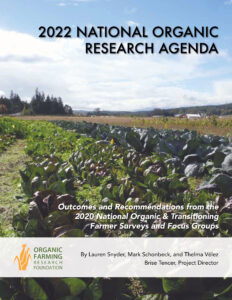
2022 National Organic Research Agenda CoverThe Organic Farming Research Foundation 2022 National Organic Research Agenda (NORA) is a report informed by surveys and focus groups conducted in 2020 with over 1,100 certified organic farmers and ranchers across North America.

What Farmers Said

  • In the NORA report, two-thirds of survey respondents (67%) cited weed management as a substantial production challenge.
  • Specific feedback from organic farmers also underscores the need for additional research on controlling weeds such as Canadian thistle.

Knowing Your Weeds
Farmers and researchers alike acknowledge that weeds pose the greatest barrier to building healthy soils in organic cropping systems. Management of weeds in an organic cropping system involves integration of many separate management tactics. Which tactics you use will depend on the weed species present, the crop, the time of year the crop is planted, the type of equipment you have available, other crops in the rotation, and other site and operation-specific factors.
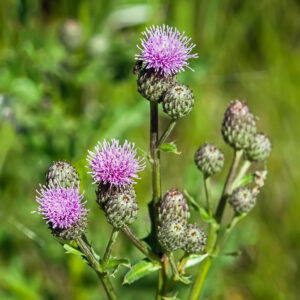
Cropped photo of flowering Canada thistle weedManaging Canada Thistle
Because Canada thistle has a deep root system, the only approach for controlling this weed is to exhaust the storage roots and prevent further weed seed contamination. Food reserves in the roots reach a minimum near the onset of hot weather when the shoots reach about 12” tall and then increase as energy flows from the shoots to the storage roots.

The following steps are key to soil health:

  • Keep the soil covered
  • Maximize living roots in thesis profile
  • Minimize soil disturbance
  • Energize the system with biodiversity

To reduce the impact of Canada thistle on production, farmers can:

  • Remove shoots by late spring
  • Consider cover cropping and institute crop rotations
  • Consider occultation
  • Implement rotational grazing

For more on weed management and applicable solutions that control this common weed, farmers can download OFRF’s Weed Management Guide and Weed Profile on Canada Thistle.
Applications Now Open for Two USDA Programs Geared Toward Organic and Transitioning Producers

By |2023-12-12T17:13:54-05:00May 17th, 2022|News, Press Release|

FOR IMMEDIATE RELEASE

(May 17, 2022) – Certified organic and transitioning to organic agricultural producers and handlers can now apply for the Organic and Transitional Education and Certification Program (OTECP) and the Organic Certification Cost Share Program (OCCSP). These United States Department of Agriculture (USDA) programs help producers and handlers cover organic certification cost and other related expenses. Applications are open now and due October 31, 2022.

The two USDA programs cover costs incurred from October 1, 2021, to September 30, 2022. Organic and transitioning agricultural producers should contact their local Farm Service Agency (FSA) office and/or participating State agency to apply. “The FSA, and the USDA broadly, are committed to making sure our Nation’s organic producers and handlers have the tools they need to continue positively shaping our local and regional food systems,” said FSA Administrator Zach Ducheneaux.

According to OFRF’s 2022 National Organic Research Agenda (NORA) report, cost of organic certification ranked third as a top non-production challenges among more than 1,100 organic producers surveyed. “By helping with organic certification costs – long identified as a barrier to certification – USDA has helped producers participate in new markets while investing in the long-term health of their operations,” said Ducheneaux.

The Organic and Transitional Education and Certification Program and the Organic Certification Cost Share Program are important to many organic and transitioning producers. OFRF has put significant effort into advocacy to ensure funding for these programs, such as championing organic provisions included in the 2018 Farm Bill. Most recently, OFRF and allied organizations authored a group letter of support to extend last year’s OTECP application due date which was successfully implemented.

“If someone is considering getting certified, they should definitely look into the program as it can reduce some of the financial burden,” says organic farmer and OFRF Board Chair Bryan Hager. Hager has previously participated in the cost share program to certify his farm, Crager Hager Farm.

More information is available on the OTECP and OCCSP webpages.

###

About Organic Farming Research Foundation

Organic Farming Research Foundation works to foster the improvement and widespread adoption of organic farming systems. OFRF cultivates organic research, education, and federal policies that bring more farmers and acreage into organic production.

https://www.ofrf.org/

Policy Contact

Gordon Merrick, gordon@ofrf.org

Media Contact

communications@ofrf.org

OFRF Awards 2021/22 Grant to Research Climate Resilience for Coffee Producers Using Organic Practices

By |2022-06-17T21:43:52-04:00May 11th, 2022|News|

Organic Farming Research Foundation (OFRF), in partnership with the Foundation for Food and Agriculture (FFAR), is pleased to award a 2021-22 Organic Research grant to Alejandra Guzman-Luna, affiliated with Universidad Veracruzana and in collaboration with the Agroecology and Livelihoods Collaborative at the University of Vermont. Guzman-Luna has nearly 15 years of experience working with farmers and Indigenous communities in Mexico.

OFRF’s grant program funds research on organic production systems and the dissemination of these research results to organic farmers and agricultural research communities. The 2021/22 grant cycle prioritized early career researchers and Black, Indigenous and People of Color (BIPOC) applicants, and awarded on-farm projects focused on climate mitigation and resilience.

The awarded team will research climate change resilience with coffee smallholder producers by extending organic practices to staple crops in Mexico. They have three objectives to address the perceived lack of viable organic alternatives in staple crop production: conduct a participatory diagnosis of the challenges of growing staple crops organically; co-design and establish four experimental and educational plots; and systematize the results and widely disseminate them. 

As a result of OFRF’s research, education, and outreach efforts, thousands of farmers have received pertinent research and training information. Results from all OFRF-funded projects are available to access for free in an online database.

Thank you to FFAR and our research partners for making the 2021/22 organic research grant program possible.

OFRF Research Grant Partners


OFRF Awards 2021/22 Grant to Research Organic Farming System Options Addressing Coffee Leaf Rust

By |2022-05-11T19:18:31-04:00May 11th, 2022|News|

Organic Farming Research Foundation (OFRF), in partnership with the Foundation for Food and Agriculture Research (FFAR), is pleased to award Kanalani Ohana Farm a 2021-22 Organic Research grant. OFRF’s grant program funds research on organic production systems and disseminates these research results to organic farmers and agricultural research communities. The 2021/22 grant cycle prioritized farmers, early career researchers and Black, Indigenous and People of Color (BIPOC) applicants, and awarded research projects focused on climate mitigation and building on-farm resilience.

Kanalani Ohana Farm will research organic farming system options for control of Coffee Leaf Rust on five organic farms in Kona, Hawaii. Colehour Bondera (MS and MEd) is a second generation farmer and will serve as research project lead. Their research team will test a systems-level approach to Coffee Leaf Rust management by increasing microbial biodiversity, using on-farm and island-made inputs, and sequestering more carbon through increased soil organic matter. This project was conceived, developed, and will be carried out by organic farmers. University of Hawaii organic system faculty will assist with analyses. 

As a result of OFRF’s research, education, and outreach efforts, thousands of farmers have received pertinent research and training information. Results from all OFRF-funded projects are available to access for free in an online database.

Thank you to FFAR and our research partners for making the 2021/22 organic research grant program possible.OFRF Research Grant Partners

Now is the Moment to Help OFRF Support Organic Farmers

By |2022-05-10T22:13:48-04:00May 10th, 2022|News|

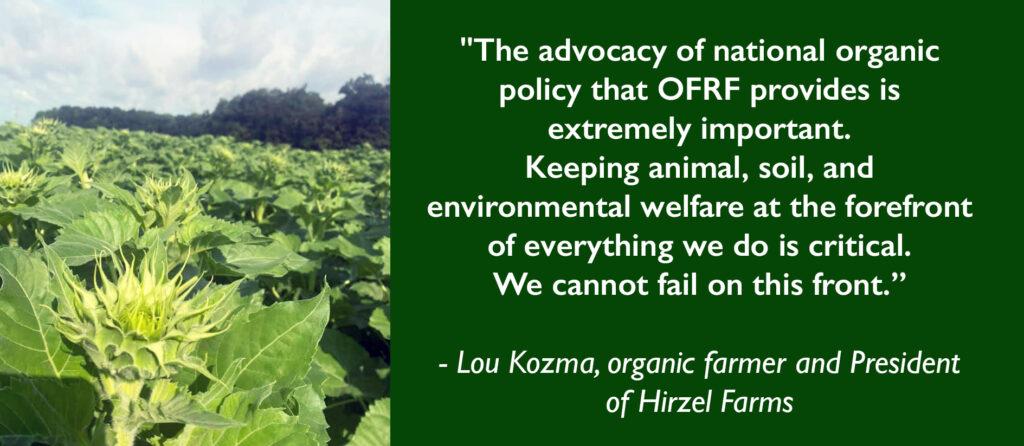
Sunflowers at Hirzel FarmsEvery five years a U.S. Farm Bill is voted into law by Congress, directing hundreds of billions of dollars to flow into the food and agriculture systems.
The 2023 Farm Bill is right around the corner and now is the moment to act.

Help support farmers and advance organic agriculture in the 2023 Farm Bill. Thanks to a generous donor, contributions made today will be matched dollar for dollar up to $5,000!

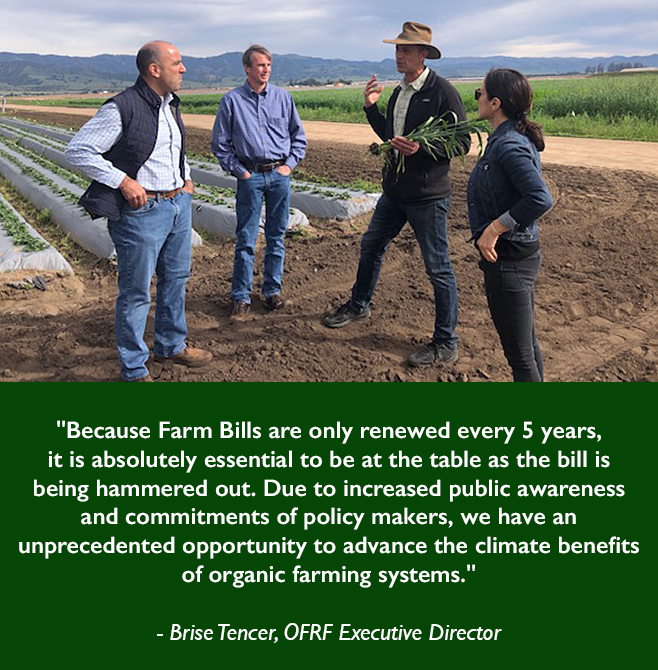
OFRF heard loud and clear from organic and transitioning farmers and ranchers about their needs in the 2022 National Organic Research Agenda and OFRF touring ARS fields with member of Congresswill be focusing our 2023 Farm Bill efforts on the following to address the challenges they are facing:

  • Increase the amount of funds dedicated to organic research at the USDA.
  • Push organic agriculture as a climate solution across USDA agencies and ensure organic and transitioning farmers receive resources they need to be successful.
  • Support the expansion of organic farming systems.

Together we can ensure organic farmers are properly supported for the following five years. And remember, the work to affect policy change isn’t just needed in the six months before a Farm Bill, but instead it requires constant pressure, collaboration, education, commenting, and relationship-building all year long.

There are many ways to give to OFRF. And don’t forget: donate today and your gift will be matched dollar for dollar, thanks to a generous donor.

Soil Health Practices Across the U.S.

By |2022-08-10T03:21:40-04:00May 10th, 2022|News|

2022 National Organic Research Agenda CoverThe Organic Farming Research Foundation 2022 National Organic Research Agenda (NORA) is a report informed by surveys and focus groups conducted in 2020 with over 1,100 certified organic farmers and ranchers across North America.

What Farmers Said

  • In the NORA report, 83% of respondents reported used crop rotations at least sometimes, with the majority responding usage as very often.
  • 88% of survey respondents used cover crops and green manures, with almost half of respondents indicating they cover crop very often.
  • Only 19% of respondents indicated they intercropped very often and 36% reported never intercropping.

Download OFRF’s Soil health and organic farming guide books.

Cover Cropping by Region
Respondents from the South tended to use cover crops more often than in other regions. This may reflect the greater need for cover crops in the rotation to replenish soil organic matter (SOM) and nitrogen (N) in Southern region soils, which tend to lose SOM rapidly and have lower inherent fertility than soils in cooler parts of the U.S. (Duncan, 2017).

Cover crop use frequency was second highest in the Corn Belt region, where two-thirds of respondents grow field crops.

Conversely, the colder climates and shorter growing seasons in the Great Lakes and Northeast regions can impose logistical and economic constraints on integrating cover crops into annual crop rotations (Delate, 2013; Sheaffer et al., 2007). These challenges could contribute to less frequent use of cover crops.

Crop Rotations by Region
At least 88% of respondents in the most agro-ecoregions used crop rotations to some extent. However, within in the Pacific region, 35% of respondents reported never using crop rotations.

Across All Agro-Ecoregions
Perennial conservation plantings play important roles in agro-ecosystem health and in meeting NOP requirements to conserve biodiversity in organic operations. Across all agro-ecoregions, 74% of survey respondents reported maintaining some of their certified land in one or more of the following:

  • buffer strips or border rows (54%);
  • hedgerows, windbreaks or shelterbelts (35%);
  • wildflower strips (17%);
  • and other plantings such as woodland, prairie, or other natural areas (7%).

Other Conservation Practices to Help Improve Soil Health

Conservation Cover: Establish and maintain either introduced or native grasses, legumes and forbs for permanent cover, pollinator habitat, and food for wildlife.

Forage and Biomass Planting: Plant specific grass and legumes suitable for pasture, hay, or biomass production improves livestock nutrition and health, and can provide forage supplies during periods of low forage.

Manure Management: Store and contain manure until conditions are appropriate for field applications. This addresses potential manure runoff, protects water quality, and reduces nutrient loss.

Rotational Grazing of Animals: Divide pastures into multiple paddocks to manage soil compaction and harvest of vegetation. This improves or maintains the volume and quality of forage for grazing animals and provides vigor to plant communities.

Tree and Shrub Establishment: Woody plants in non-forested areas via planting seedlings, container/potted plants, cuttings or by direct seeding can improve air and water quality, stores carbon in biomass, provides wildlife habitat, and controls snow drift.

Free Webinar Shares Findings from 2022 National Organic Research Agenda

By |2022-05-02T20:34:38-04:00May 2nd, 2022|News|

Join us online as OFRF Research & Education Manager Thelma Vélez, PhD, discusses results from the 2022 National Organic Research Agenda (NORA).

This free webinar from OFRF and eOrganic takes place on Thursday, May 5, 2022 at 11AM Pacific / 12PM Mountain / 1PM Central / 2PM Eastern Time. Advance registration is required.

“The 2022 NORA is the most comprehensive and thorough iteration of OFRF’s national farmer studies to date. Over 1,100 organic producers gave us their opinions and the stories the data tells is striking. We need to continue building capacity for organic growers across the nation and developing programs and policies to support them,” said Vélez.

About the Webinar
The Organic Farming Research Foundation (OFRF) regularly surveys organic growers, farmers, ranchers across North America to understand their challenges and research needs. The findings are published in the National Organic Research Agenda (NORA) report, which informs OFRF research, education and advocacy programs and has also historically served as a critical roadmap to inform the USDA and Congress on how to leverage public investments in organic research and technical assistance. In 2019-2020, OFRF surveyed over 1,000 farmers and held 16 focus groups with both established certified organic growers and transitioning growers. In this presentation we will summarize the findings of the most recent NORA report.

Survey respondents provided input and perspectives on their current organic production systems, including the use of regenerative soil health management practices, water conservation, organic inputs, and organic seed. Findings confirm that organic producers lead the nation in adoption of soil health management and climate-friendly practices. The 2022 NORA also examines current farmer concerns in organic agriculture, farmers’ preferred sources and modes for information-sharing, and the impacts of COVID on organic producers. Respondents also shared their production and non-production challenges, which OFRF then analyzed by region, farming experience, and race/ethnicity.

Organic Producers Lead the Nation in Soil Health Practices

By |2022-04-22T20:35:56-04:00April 22nd, 2022|News|

Organic production starts with healthy soils which regulate water, sustain plant and animal life, filter and buffer potential pollutants, manage nutrients, and provide physical structure to support strong plant roots. According to the 2022 National Organic Research Agenda (NORA), organic producers lead the nation in adoption of soil health and environmental stewardship practices. Such practices include cover cropping, crop rotations, and perennial conservation plantings.

Cover crop plants include legumes (such as clover, vetch, peas, and beans) and non-legumes (including cereals, grasses, and broadleaf species). Approximately 76% of organic field crop farmers plant cover crops regularly; in contrast, only 10% of conventional field crop farmers follow this soil-building practice.

The National Organic Program (NOP) defines crop rotation as “the practice of alternating the annual crops a grown on a specific field in a planned pattern or sequence.” Approximately 63% of 2022 NORA respondents reported using crop rotations very often. Among transitioning to organic farmers, three-quarters of respondents participate very often in crop rotations. In addition, 83% of transitioning farmers reported using soil-building intercropping practices as well.

To conserve biodiversity, organic producers also implement perennial conservation plantings. Nearly three-quarters of 2022 NORA survey respondents reported maintaining some of their certified land in one or more of the following:

  • buffer strips and border rows
  • hedgerows, windbreaks or shelter belts
  • wildflower strips
  • other plantings such as woodland, prairie, or natural areas.

Perennial conservation plantings promote beneficial and pollinator habitat, reduce the wind and water erosion, intercept runoff and pesticide drift, and enhance soil health and sequesters carbon within the area covered by perennial vegetation.

One National Organic Research Agenda respondent stated, “Soil is very important, and it is the building block of everything else. And if you treat it poorly, it will pay you poorly for years to come. If you treat it well, it will serve you well. You have to be constantly vigilant on your soil, and it is pretty darn important.” 

Soil health and organic farming guide books are available online to help beginning farmers implement practices such as cover cropping and  also provide additional information for more experienced producers.

Staff Spotlight on OFRF’s Deputy Director

By |2022-04-13T17:35:59-04:00April 12th, 2022|News|

Dominica Navarro Martinez (she/ella/they) is OFRF’s new Deputy Director. She brings to this role an extensive background in nonprofit management, finance, administration, and strategic programmatic development. She has direct organic farming experience and previously worked for OFRF in an office management and programs capacity from 2015-2018.

Dominica currently resides in Central Oregon with her family and dog Xochitl (pronounced Sochi), and enjoys sailing, hiking, seeking out hot springs in remote locations, growing food, and processing and preserving goods her family has grown, foraged, caught, or hunted.


Tell us about yourself.

I am a Chicana Borinqueña (Mexican and Puerto Rican American) with a strong food culture. I was raised in Southern California where I grew up cooking with family, sailing the pacific coast, and traveling Mexico.


I’ve always had a close relationship with my food and after a decade of veganism and two degrees from the University of California Santa Cruz (specializing in food, agriculture and social justice), I have devoted my professional career to food systems work. At home, I have a vegetable garden on an eighth of an acre where I grow using organic principles.

Why do you care about organic farming and/or organic research?

Organic agriculture is important to me because it protects people and the planet. I personally don’t agree with agricultural systems that depend upon toxic pesticides to grow food. Food is meant to nourish us, not make workers and consumers sick or poison natural ecosystems. Organic research is especially important because we must also learn to meet the growing demand for organic foods and growing pest pressure.

Who is your farming, research and/or food hero – and why?
My food hero is all the abuelitas (grandmothers) out there who have held onto their strong food cultures and who continue to share it with their loved ones. I am always amazed at how much knowledge we as a society have lost in the last few generations when it comes to food preparation and preservation. Some things should take time and be made with lots of love, food is one of them!

What are you excited about working on at OFRF?

It’s exciting to be a part of such a small yet mighty organization making real strides in the organic sector. From educational materials, to research grants, to federal policy feats, OFRF is always pushing for better representation and support for organic farmers. As a returning staff member, I am once again proud to be a part of this work!

2021 CALIFORNIA ORGANIC RESEARCH AGENDA

By |2026-03-02T11:40:58-05:00April 7th, 2022|Advocacy, Insects & Diseases, On-Farm Research, Resource|

California is the nation’s top producer of organic agricultural commodities and specialty crops. Thus, it
is imperative to understand the unique needs of the organic growers in the nation’s most agriculturally
productive state. The 2021 CORA report provides up-to-date information on the stewardship practices
used by organic producers across the state and identifies the most pressing production and non-production
challenges faced by organic California growers. The findings presented in this report: 1) highlight the soil
health management practices that organic producers in California are currently implementing, 2) outlines the most pressing challenges and needs of certified organic producers in California, and 3) outlines priorities and recommendations to address those needs through public policy, research, and Extension programs.

2021 California Organic Research Agenda report
Go to Top