
TOPP W

OFRF in Texas: A Researcher and Extension Regional Meetup, in the Heat!

By Maia Garby, Research & Education Junior Fellow

This summer, OFRF staff members converged in San Marcos, Texas to attend the Southern Family Farmers & Food Systems (SFFFS) Conference.

Despite the 100+ degree weather, farmers, ranchers, researchers, technical service providers, and organic consumers from across the state and beyond congregated at Texas State University for several days of learning, networking, and discussion.

As part of OFRF’s ongoing efforts to facilitate relationship-building and collaboration between individuals working within the organic sector, OFRF’s Rebecca Champagne (Conservation Scientist) and Maia Garby (Research & Education Junior Fellow) co-facilitated a Researcher and Extension Regional Meetup (RERM) at the conference.

What are the Researcher and Extension Regional Meetups (RERMs), and why are they important?

Researcher and Extension Regional Meetups (RERMs) are dedicated spaces for researchers, extension personnel, and technical service providers to network at regional agricultural conferences. These unique sessions were developed in response to feedback from organic researchers that (1) meeting other organic researchers/professionals within a region can be difficult, and (2) organic research is frequently left out of broader ag conversations.

These meetups provide a structured space and time for organic professionals, as well as those interested in organic, to:

  • Connect and exchange contact information;
  • Learn from one another about ongoing research projects;
  • Hear from technical service providers about the challenges currently being faced by organic producers in the region;
  • Identify knowledge and policy gaps; 
  • Brainstorm future collaborations;
  •  …and so much more!

Farmers are also welcome and encouraged to attend, as these sessions provide an excellent opportunity to meet local service providers and potentially connect with university researchers looking for organic farmers to participate in on-farm research trials.

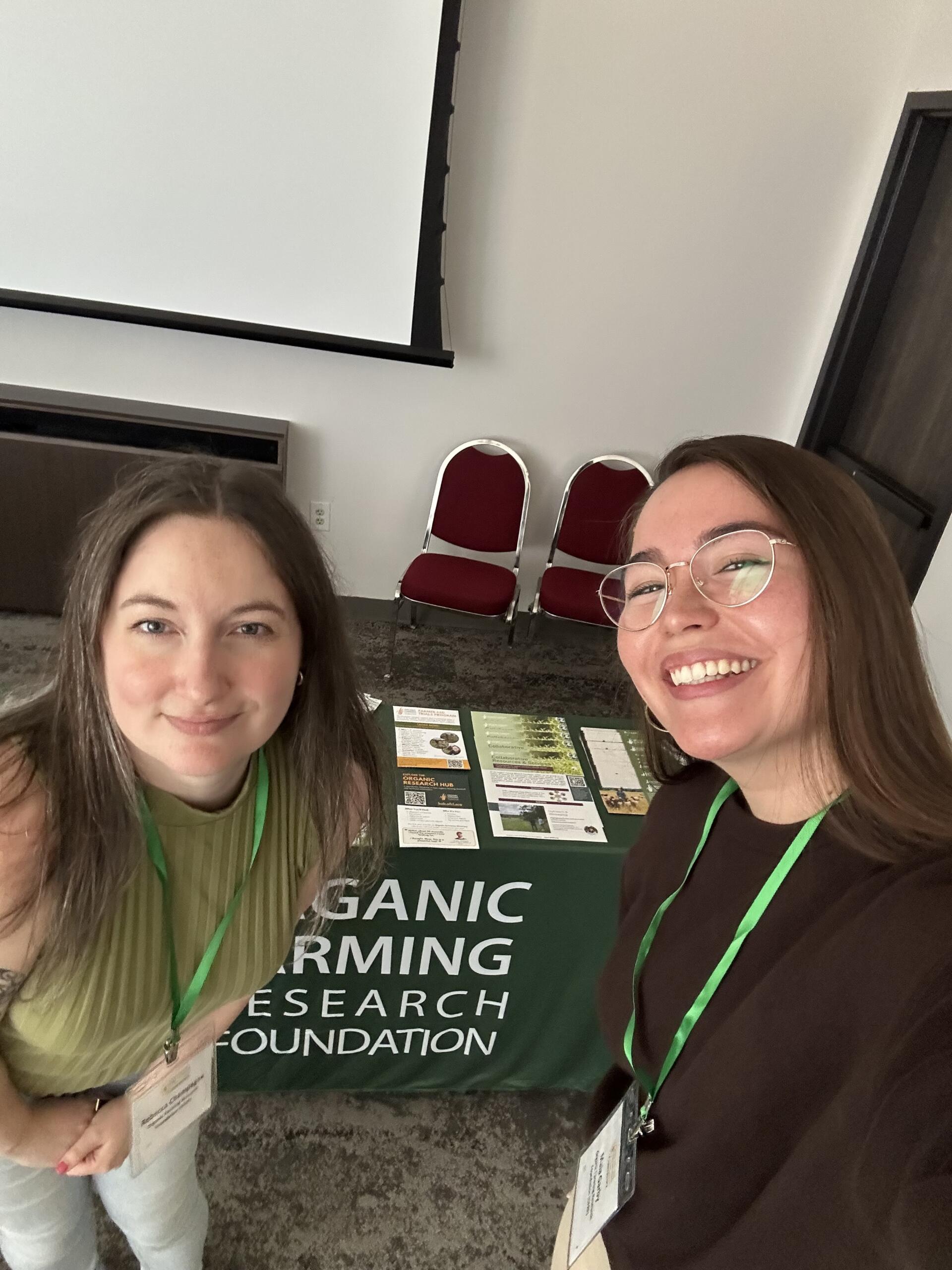
Rebecca Champagne (left) and Maia Garby (right) setting up for the Southern Family Farmers & Food Systems (SFFFS) Conference Research and Extension Regional Meetup in San Marcos, Texas, August, 2026.

How does a RERM work?

Every RERM begins with introductions and refreshments, followed by short federal policy updates. Policy updates may cover topics including: (1) how/when to apply for federal research grants through the USDA’s Organic Agriculture Research and Extension Initiative (OREI) and Organic Transitions Program (ORG), (2) Farm Bill and/or Agriculture Appropriations updates, and (3) participant advocacy opportunities, such as OFRF’s free, virtual Communicating with Legislators Course.

Afterwards, the floor is opened for structured networking, during which attendees may be sectioned into smaller groups. Participants are provided with a short list of prepared discussion questions to guide conversation, although they are encouraged to use these questions as launching points for deeper, more personalized discussions.

Sample discussion questions from the Texas RERM included:

What research projects are you or your colleagues currently working on (or recently completed)? What are some of the biggest takeaways from this work?

What are some of the most common production/non-production challenges that organic producers in your region deal with? Are there knowledge gaps pertaining to these challenges?

Where would you like to take your research next, and what resources would you need to make that happen? Is there a realistic collaboration within this room?

The Southern Family Farmers & Food Systems (SFFFS) RERM is the third of these unique sessions to take place in 2026. Other RERMs were conducted earlier this year, at the High Plains Organic Conference (Cheyenne, WY) and the Marbleseed Organic Farming Conference (La Crosse, WI), bringing together a combined 30+ organic researchers and professionals.

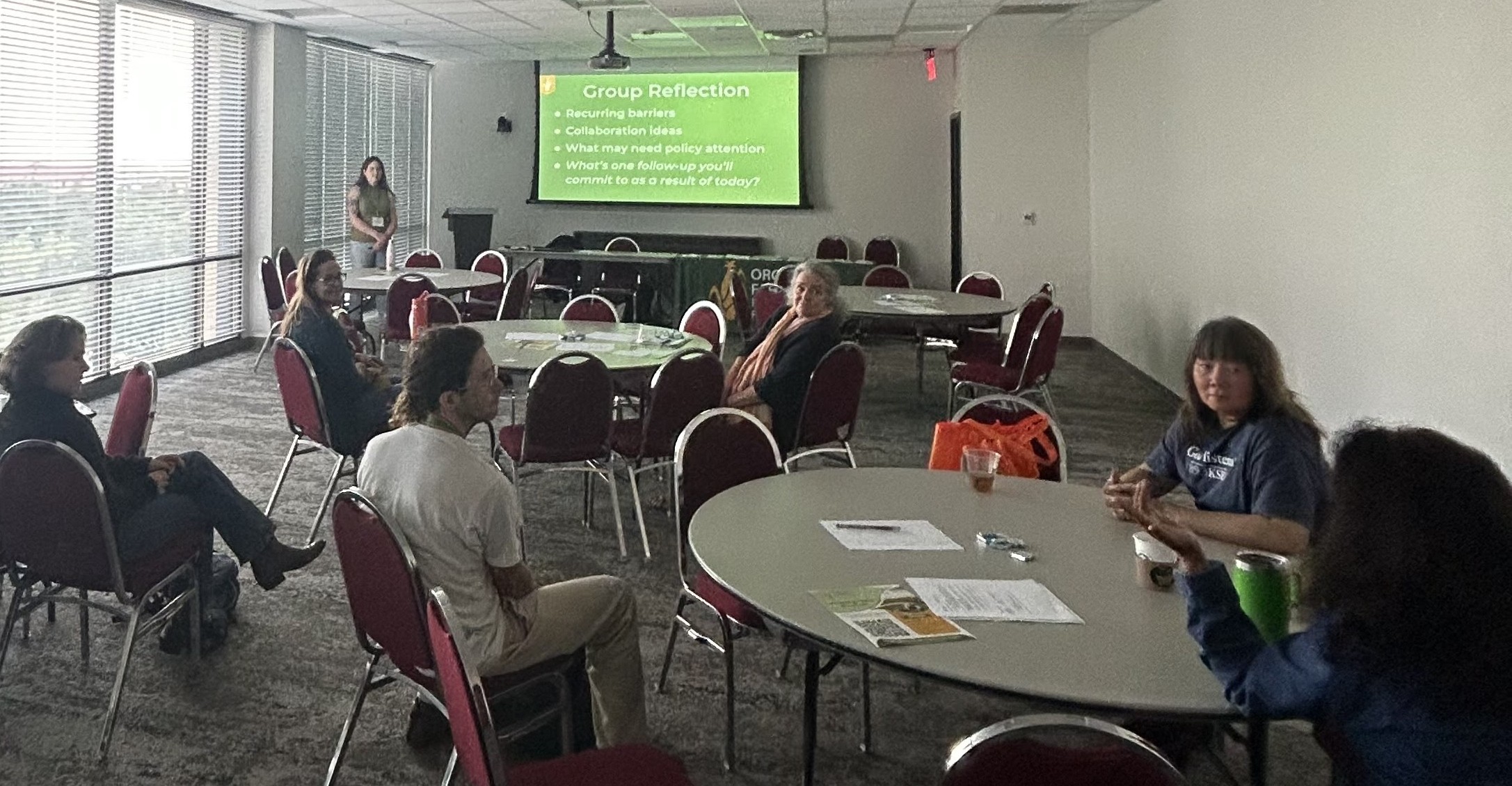
Small-group discussions at the Southern Family Farmers & Food Systems (SFFFS) Conference Research and Extension Regional Meetup in San Marcos, Texas, August, 2026.

A Snapshot of the SFFFS RERM: Who Attended, & What Was Discussed?

The Texas RERM attracted a variety of attendees, including researchers and extension staff from Texas A&M University, Tuskegee University, and Prairie View A&M University, business owners, and technical service providers from the USDA, but the majority were farmers. 

As it turns out, most of these farmers were not certified-organic, although many had experience with sustainable and/or regenerative management practices. Their reasons for attending the session were to learn more about the organic sector (i.e., What separates a ‘certified organic’ farm from a non-certified farm that uses organic practices? What is the process for obtaining an organic certification, and what resources and/or funding are available for farmers beginning the transition to organic?). 

In response to the farmer-driven attendance and interest in organic-sector resources, a portion of the discussion was spent presenting the resources available to organic/transitioning producers through the OFRF Homepage and the Organic Research Hub & Extension Directory

Additionally, attendees were eager to learn more about how to conduct on-farm research. Two attendees had recently developed a commercial, organic soil amendment and were interested in finding farmers or university researchers to collaborate with for field-level product trials. Several others were farmers struggling to manage weeds on their farm without using synthetic products, and were curious in trialling alternative weed management strategies. These comments led to a discussion about OFRF’s Farmer’s Guide to Conducting On-Farm Research, as well as the Farmer-Led Trials (FLT) Program

Conclusion

One of the most meaningful takeaways from the conference was that there is substantial interest among farmers, regardless of organic certification, in conducting on-farm research and trialling alternative agricultural practices (i.e. regenerative, organic). 

Farmers are professional problem-solvers, whose observations and curiosity about their cropping systems form the foundation for farmer-led research. In Texas, it was evident that the demand for farmer-led research funding, support, and skill-building is there. Farmers want to know how to put their observation-based questions to the test, but need funding and technical assistance in order to do so. 

Farming is a difficult profession, but it benefits when we foster collaboration among everyone in the agriculture sector. Organic production in particular has many complexities that require systems-based research and recommendations. Events like these Researcher and Extension Regional Meetups can help create a strong, active network of individuals and advance organic research and farming.

In addition to these RERMs, OFRF is now offering direct support to organic researchers and extension specialists with our Organic Research Amplification Services.

To stay up-to-date with the latest organic farming news, research updates, and opportunities for advocacy, sign-up to receive the OFRF newsletter at https://ofrf.org/get-involved/receive-news/!

By |2026-09-01T12:04:13-04:00September 1st, 2026|News|

Two Oʻahu Farmers Share Wins & Challenges Accessing CSP Support

(Versión en español a continuación / Spanish version below)

Written by Mary Elizabeth Kidd, OFRF Communications Associate

OFRF is currently working to increase farmer and community awareness of the federal funding opportunities available to organic and transitioning farms. 

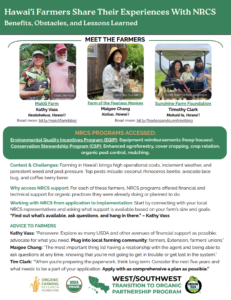
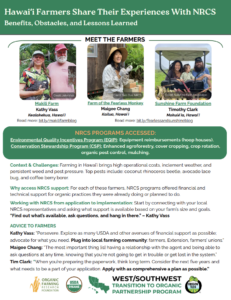
As part of our work with the West region of the USDA’s Transition to Organic Partnership Program (TOPP), we’re spotlighting two Hawaiʻi farms—Maigee Chang of Farm of the Fearless Monkey and Timothy Clark of Sunshine Farm Foundation—that received funding and support through the Natural Resource Conservation Service’s (NRCS) Conservation Stewardship Program (CSP).

Their story offers a transparent look at what it’s really like to work with NRCS: the benefits, the obstacles, and the lessons they’ve learned. We hope other farmers can use their experience to navigate the process of applying for and implementing CSP contracts more easily.

Meet Maigee Chang of Farm of the Fearless Monkey

Location: Kailua, Hawaiʻi (island of Oʻahu, Honolulu County)

Established: 2017

Acres: 2.25

Production: Okra, eggplant, pumpkin, ginger, turmeric, roselle/hibiscus, and perennials: ulu, dragonfruit, papaya, citrus, cacao, lilikoi, and jackfruit

Certification: Uses organic practices

Staffing: 2 volunteers (in exchange for living quarters)

Markets: CSA, a local organic grocery store, restaurants, and Facebook Marketplace; ulu is sold to a chip company

Social media: Instagram

Read more: Growing Organic at the Farm of the Fearless Monkey from the USDA’s Farmers.gov blog.

Meet Timothy Clark of Sunshine Farm Foundation

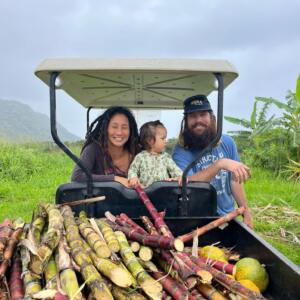
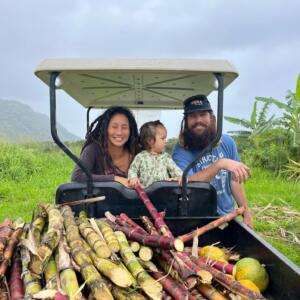
Farmer Timothy Clark and his family on a motorized cart transporting sugar cane.Source: Sunshine Farm Foundation

Location: Mokulēʻia, Hawaiʻi (island of Oʻahu, Honolulu County)

Established: 2020

Acres: 15

Production: Mangoes, bananas, ulu, citrus, avocados, plus grazing animals including sheep, pigs, goats

Certification: Uses organic practices, not yet certified

Markets: Bananas are marketed through a neighboring farmer’s CSA

Social media: Facebook

About the Farmers

Maigee Chang (Farm of the Fearless Monkey) has lived in Hawaiʻi for over 30 years and came into her farming career after working at the intersection of local politics and agriculture, where she met farmers and attended farming workshops.

As her passion for farming grew, she found the land that would become Farm of the Fearless Monkey and set about getting the training and support she needed.

Maigee began her journey through the University of Hawaiʻi’s College of Tropical Agriculture and Human Resources program: GoFarm Hawaiʻi, where she connected with farmers, mentors, and Extension agents, and continued to strategically plug into support systems.

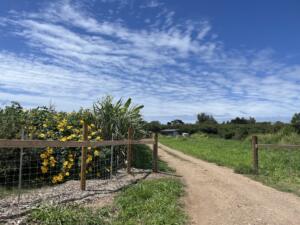
A dirt road with two fences on either side, showing the entrance to Sunshine Farm Foundation.Source: Sunshine Farm Foundation

The entrance to Sunshine Farm Foundation.

Timothy Clark (Sunshine Farm Foundation) was born and raised in Florida and moved to Oʻahu in 2012, where he started farmwork via permaculture and permablitz projects, working in community and volunteering to plant food and forestry yardscapes in Hawaiʻi.

In 2020, he and his partners acquired the 15-acre land site, which they continue to develop to provide education and, eventually, food for those experiencing hunger. Their first farm, established in 2018, focused on education and permaculture practices.

Their current property is structured as a tenants-in-common ownership model with 27 farming plots and the goal of one day becoming an organic farming zone. Working with CSP has represented a supportive bridge in the journey towards wider production and becoming USDA-certified organic.

We recently spoke to Maigee and Tim about their experience as organic farmers navigating NCRS support systems. Below, we’re sharing the conversation and their valuable insight.

Why Organic?

Maigee (Farm of the Fearless Monkey): I don’t like spraying, and I don’t want any of that near my workers or me. Also, chemicals are very expensive.

I trained with OMRI-approved products; I’m comfortable using those, and they’re a lot simpler. I mainly use soap, neem, and BT (Bacillus thuringiensis, organic pest control); if something’s awry, I pull the plant and toss it. We do a lot of crop rotations and companion planting, and I’ve seen the effect of that. With mulching and healthy soil, my plants are stronger.

Tim (Sunshine Farm Foundation): Growing up, my father was a medical doctor who later moved into alternative medicine, focusing on supporting patients who had cancers with organic diets and homeopathic treatments. We always ate organic foods. When I started farming, I didn’t think that there was another way.

And working with the permaculture crew and kind of learning that methodology, and getting into agroforestry, you know, it was never a question of whether or not to use organic treatments for pests or fertilization.

We try to use permaculture and agroforestry designs that make pest management easier, such as attracting beneficial insects and utilizing native plants. This is where NRCS has been helpful.

Context & Challenges

Perennial peanut cover crop growing on a hillside. Source: Farm of the Fearless Monkey

Perennial peanut cover cropping at Farm of the Fearless Monkey.

Maigee (Farm of the Fearless Monkey): The constant pest is the coconut rhinoceros beetle (CRB), so we’re trying to address that using various techniques. We do netting around the crown of the tree, we keep our mulch piles covered and rotate them at least every two months, and send the chickens in to scratch through.

We’re in a spot that hasn’t been hit too hard by the recent flooding; the water flows off of our area. Those storms came when we were doing cover crop, which helped the cover crop, and we didn’t lose anything. The vetiver (cover crop) is great and stopped everything from a massive flow.

Tim (Sunshine Farm Foundation): We had about 100 coconut trees wiped out by the coconut rhinoceros beetle. So we’re doing a pilot program to see if we can control the beetle with about 60 dwarf coconuts in high tunnels with netting (supported by EQIP).

We had about three or four storms this spring (2026), which caused a lot of damage to our property. That said, we’re in a drought area on the island, and water supply and power are a concern.

Our main focus is planting drought-tolerant crops. Water can go out for several days when they’re fixing lines, so we’ve signed up for a backup storage and water-pump program through NRCS.

Working with NRCS

Application Process

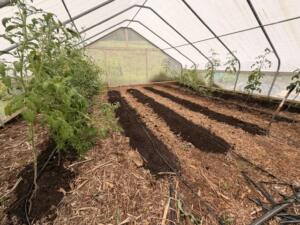
Mulched beds in a hoop house. Source: Farm of the Fearless Monkey

EQIP-funded hoop house with mulching at Farm of the Fearless Monkey.

Maigee (Farm of the Fearless Monkey): From working with the agriculture committee and then as secretary of the Waimānalo chapter of the Hawaii Farmers Union, I was familiar with NRCS representatives. I got a hoop house through the Environmental Quality Incentives Program (EQIP), and then we started working on a conservation plan.

Getting through the CSP application process was straightforward. I knew what I wanted to do, it was covered by the program, and my CSP agent walked me through everything. It’s been a smooth process; she sends me documents and deadline reminders, so it feels manageable.

Tim (Sunshine Farm Foundation): I found CSP through research and initially found it difficult to navigate until I connected with the first in a series of very helpful representatives who helped me begin a windbreak program and subsequent plans. You have to persevere. Our first contract phase was three years ago; now we’re in the second year of our second contract.

Implementation

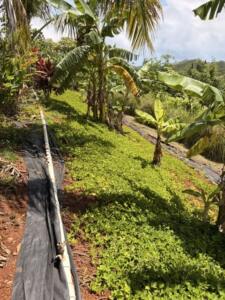
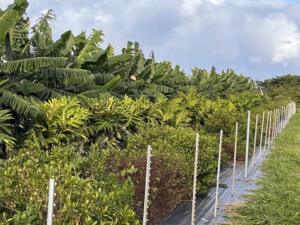
A row of banana trees and shrubs with fencing.Source: Sunshine Farm Foundation

A row of banana trees and shrubs serves as a windbreak to protect crops at Sunshine Farm Foundation.

Maigee (Farm of the Fearless Monkey): We’re doing mulching and cover cropping and crop rotation, paid in bulk at the end of every year. For mulching, it was a five-year contract; payment started at $2,000 a year, then jumped to $4,000. Cover cropping started as a three-year contract, which has been renewed. The reimbursements mainly help cover labor costs for practices I’d do anyway.

Tim (Sunshine Farm Foundation): Our CSP contract includes $6,000 per year for five years ($4,000 cropland and $2,000 homestead), and practices include perennial cover crop (Bermuda grass) and establishing a native forestry zone.

We’re getting compost reimbursements (paying only for the delivery charges), and we have a contract to mulch over our orchard. It’s been great. And I was able to get a tree trimmer as well.

Outcomes & Challenges

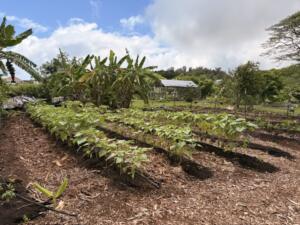
Mulched rows of tropical crops. Source: Farm of the Fearless Monkey

Mulching and labor was covered by CSP contract at Farm of the Fearless Monkey.

Maigee (Farm of the Fearless Monkey): My soil is amazing right now. The plants are really happy. Mulching has reduced water use, and soil testing showed a pH shift from acidic to alkaline, which changed my fertilizer approach.

One big challenge is soil testing, not just getting the tests, but shipping them to the mainland (Oregon) in refrigerated/cooler boxes within 24 hours, and the airport where we ship them from is almost an hour away. If we could do that locally, it would save a lot of hassle.

Tim (Sunshine Farm Foundation): We get support from everyone at NRCS, they’re great! They’ve really helped us navigate programs.

I am in a predicament, however, because when they came out to inspect, even though I had the animals and I had the orchard, we were categorized as orchard-only, meaning I can’t transition to my original plan of getting the animal management care, such as internal grazing fencing.

So we missed something there and can’t go back or risk losing the program and having to reapply. So we’ll complete the contract as is and then apply for this longer-term plan.

Advice to Farmers

Maigee (Farm of the Fearless Monkey): If farmers are considering applying for CSP, you should totally do it. One, because it’s good practice. And two, it’s a good program. For a farm of my size, it wasn’t that complicated.

Tim (Sunshine Farm Foundation): When you’re preparing the paperwork, be sure to think long term. Consider the next five years and what may need to be a part of your application.

I also recommend applying with as comprehensive a plan as possible, including multiple conservation practices, to potentially give your application a higher ranking and likelihood of success.

And don’t forget outreach to other farmers, we have to share what programs we’re benefiting from.

Next Steps & Resources

Interested in transitioning your farm for organic certification in the West/Southwest or beyond? Explore these key resources and connect with mentors, certifiers, and Technical Support Providers (TSP) near you.

Locating Support Providers and Mentors:

Organic Farming Research Foundation resources:

USDA resources:

Connect with OFRF:

Dos agricultores de Oʻahu comparten sus logros y desafíos al acceder al apoyo del CSP del NRCS

Por Mary Elizabeth Kidd, asociada de comunicaciones

La OFRF trabaja actualmente para aumentar la conciencia de los agricultores y las comunidades sobre las oportunidades de financiamiento federal disponibles para las granjas orgánicas y en transición hacia lo orgánico. 

Como parte de nuestro trabajo con la región Oeste del Programa de Alianzas para la Transición a lo Orgánico (Transition to Organic Partnership Program, TOPP) del USDA, destacamos dos granjas de Hawaiʻi —Maigee Chang, de Farm of the Fearless Monkey, y Timothy Clark, de Sunshine Farm Foundation— que recibieron financiamiento y apoyo a través del Programa de Administración de la Conservación (Conservation Stewardship Program, CSP) del Servicio de Conservación de Recursos Naturales (NRCS).

Su historia ofrece una mirada transparente de lo que realmente implica trabajar con el NRCS: los beneficios, los obstáculos y las lecciones aprendidas. Esperamos que otros agricultores puedan aprovechar su experiencia para transitar más fácilmente el proceso de solicitar e implementar los contratos del CSP.

Conozca a Maigee Chang, de Farm of the Fearless Monkey

Ubicación: Kailua, Hawaiʻi (isla de Oʻahu, condado de Honolulu)

Fundada: 2017

Superficie: 2.25 acres

Producción: Okra, berenjena, calabaza, jengibre, cúrcuma, roselle/hibisco, y perennes: ulu (fruta del pan), pitahaya, papaya, cítricos, cacao, lilikoi (maracuyá) y yaca

Certificación: Usa prácticas orgánicas

Personal: 2 voluntarios (a cambio de alojamiento)

Mercados: Agricultura apoyada por la comunidad (CSA), una tienda local de comestibles orgánicos, restaurantes y Facebook Marketplace; el ulu se vende a una empresa de snacks (chips)

Redes sociales: Instagram

Lea más: Growing Organic at the Farm of the Fearless Monkey del blog Farmers.gov del USDA.

Conozca a Timothy Clark, de Sunshine Farm Foundation

Farmer Timothy Clark and his family on a motorized cart transporting sugar cane.Source: Sunshine Farm Foundation

Ubicación: Mokulēʻia, Hawaiʻi (isla de Oʻahu, condado de Honolulu)

Fundada: 2020

Superficie: 15 acres

Producción: Mangos, plátanos, ulu (fruta del pan), cítricos, aguacates, además de animales de pastoreo como ovejas, cerdos y cabras

Certificación: Usa prácticas orgánicas, aún no certificada

Mercados: Los plátanos se comercializan a través de la CSA (agricultura apoyada por la comunidad) de un agricultor vecino

Redes sociales: Facebook

Sobre los agricultores

Maigee Chang (Farm of the Fearless Monkey) ha vivido en Hawaiʻi por más de 30 años y llegó a su carrera agrícola tras trabajar en la intersección entre la política local y la agricultura, donde conoció a agricultores y asistió a talleres de agricultura. 

A medida que crecía su pasión por la agricultura, encontró el terreno que se convertiría en Farm of the Fearless Monkey y se dedicó a conseguir la capacitación y el apoyo que necesitaba.

Maigee comenzó su camino a través del programa College of Tropical Agriculture and Human Resources de la University of Hawaiʻi: GoFarm Hawaiʻi, donde se conectó con agricultores, mentores y agentes de Extensión, y siguió integrándose estratégicamente a los sistemas de apoyo.

Timothy Clark (Sunshine Farm Foundation) nació y creció en Florida y se mudó a Oʻahu en 2012, donde comenzó el trabajo agrícola mediante proyectos de permacultura y permablitz, trabajando en comunidad y como voluntario para plantar alimentos y paisajes forestales en Hawaiʻi.

A dirt road with two fences on either side, showing the entrance to Sunshine Farm Foundation.Source: Sunshine Farm Foundation

Entrada a Sunshine Farm Foundation.

En 2020, él y sus socios adquirieron el terreno de 15 acres, que siguen desarrollando para brindar educación y, con el tiempo, alimentos para las personas que padecen hambre. Su primera granja, fundada en 2018, se centró en la educación y las prácticas de permacultura. 

Su propiedad actual está estructurada como un modelo de propiedad en común (tenants-in-common) con 27 parcelas de cultivo y la meta de convertirse algún día en una zona de agricultura orgánica. Trabajar con el CSP ha representado un puente de apoyo en el camino hacia una mayor producción y hacia obtener la certificación orgánica del USDA.

Hablamos recientemente con Maigee y Tim sobre su experiencia como agricultores orgánicos al desenvolverse en los sistemas de apoyo del NRCS. A continuación, compartimos la conversación y sus valiosas reflexiones.

¿Por qué orgánico?

Maigee (Farm of the Fearless Monkey): No me gusta fumigar y no quiero nada de eso cerca de mis trabajadores ni de mí. Además, los productos químicos son muy caros.

Me capacité con productos aprobados por OMRI; me siento cómoda usándolos y son mucho más simples. Uso principalmente jabón, neem y BT (Bacillus thuringiensis, control orgánico de plagas); si algo anda mal, arranco la planta y la desecho. Hacemos muchas rotaciones de cultivos y siembra asociada, y he visto el efecto de eso. Con el acolchado (mulch) y un suelo sano, mis plantas son más fuertes.

Tim (Sunshine Farm Foundation): Cuando yo crecía, mi padre era médico y luego se pasó a la medicina alternativa, enfocándose en apoyar con dietas orgánicas y tratamientos homeopáticos a pacientes con cáncer. Siempre comíamos alimentos orgánicos. Cuando empecé a cultivar, no pensé que hubiera otra manera.

Y trabajando con el equipo de permacultura y aprendiendo esa metodología, y adentrándome en la agrosilvicultura, nunca fue cuestión de si usar o no tratamientos orgánicos para las plagas o la fertilización. 

Procuramos usar diseños de permacultura y agrosilvicultura que facilitan el manejo de plagas, como atraer insectos benéficos y utilizar plantas nativas. Aquí es donde el NRCS ha sido de ayuda.

Contexto y desafíos

Perennial peanut cover crop growing on a hillside. Source: Farm of the Fearless Monkey

Cultivo de cobertura de maní perenne en Farm of the Fearless Monkey.

Maigee (Farm of the Fearless Monkey): La plaga constante es el escarabajo rinoceronte del cocotero (coconut rhinoceros beetle, CRB), así que intentamos enfrentarlo con varias técnicas. Colocamos malla alrededor de la corona del árbol, mantenemos cubiertas nuestras pilas de acolchado (mulch) y las rotamos al menos cada dos meses, y metemos a las gallinas para que escarben.

Estamos en un lugar que no ha sido muy afectado por las inundaciones recientes; el agua se escurre de nuestra zona. Esas tormentas llegaron cuando estábamos sembrando cultivo de cobertura, lo que benefició al cultivo de cobertura, y no perdimos nada. El vetiver (cultivo de cobertura) es excelente y frenó todo de un flujo enorme.

Tim (Sunshine Farm Foundation): El escarabajo rinoceronte del cocotero acabó con unos 100 cocoteros. Así que estamos realizando un programa piloto para ver si podemos controlar el escarabajo con unos 60 cocoteros enanos en túneles altos con malla (financiado por el EQIP).

Tuvimos unas tres o cuatro tormentas esta primavera (2026), que causaron muchos daños a nuestra propiedad. Dicho esto, estamos en una zona de sequía de la isla, y el suministro de agua y de electricidad es una preocupación. 

Nuestro enfoque principal es plantar cultivos tolerantes a la sequía. El agua puede cortarse por varios días cuando reparan las tuberías, así que nos inscribimos en un programa de almacenamiento de reserva y bombeo de agua a través del NRCS.

Trabajar con el NRCS

Proceso de solicitud

Mulched beds in a hoop house. Source: Farm of the Fearless Monkey

EQIP-invernadero financiado por el EQIP con acolchado. Foto cortesía de Farm of the Fearless Monkey.

Maigee (Farm of the Fearless Monkey): Por trabajar con el comité de agricultura y luego como secretaria del capítulo de Waimānalo del Hawaii Farmers Union, ya conocía a los representantes del NRCS. Obtuve un invernadero a través del EQIP, y luego empezamos a trabajar en un plan de conservación.

Superar el proceso de solicitud del CSP fue sencillo. Sabía lo que quería hacer, estaba cubierto por el programa y mi agente del CSP me guio en todo. Ha sido un proceso fluido; ella me envía documentos y recordatorios de fechas límite, así que se siente manejable.

Tim (Sunshine Farm Foundation): Encontré el CSP investigando y al principio me resultó difícil de manejar, hasta que me contacté con el primero de una serie de representantes muy serviciales que me ayudaron a iniciar un programa de cortavientos (windbreak) y planes posteriores. Hay que perseverar. Nuestra primera fase de contrato fue hace tres años; ahora estamos en el segundo año de nuestro segundo contrato.

Implementación

A row of banana trees and shrubs with fencing.Source: Sunshine Farm Foundation

Una hilera de plátanos y arbustos sirve de cortavientos para proteger los cultivos. Foto cortesía de Sunshine Farm Foundation.

Maigee (Farm of the Fearless Monkey): Estamos haciendo acolchado, cultivo de cobertura y rotación de cultivos, que se pagan en conjunto al final de cada año. El acolchado fue un contrato de cinco años; el pago comenzó en $2,000 al año y luego subió a $4,000. El cultivo de cobertura empezó como un contrato de tres años, que se ha renovado. Los reembolsos ayudan principalmente a cubrir los costos de mano de obra de prácticas que yo haría de todos modos. 

Tim (Sunshine Farm Foundation): Nuestro contrato del CSP incluye $6,000 al año durante cinco años ($4,000 para tierras de cultivo y $2,000 para la propiedad familiar), y las prácticas incluyen un cultivo de cobertura perenne (pasto Bermuda) y el establecimiento de una zona forestal nativa.

Estamos recibiendo reembolsos de compost (pagando solo los cargos de entrega), y tenemos un contrato para aplicar acolchado sobre nuestro huerto. Ha sido estupendo. Y también pude conseguir una podadora de árboles.

Resultados y desafíos

Mulched rows of tropical crops. Source: Farm of the Fearless Monkey

Acolchado y mano de obra cubiertos por el contrato del CSP. Foto cortesía de Farm of the Fearless Monkey.

Maigee (Farm of the Fearless Monkey): Mi suelo está increíble en este momento. Las plantas están muy contentas. El acolchado ha reducido el uso de agua, y los análisis de suelo mostraron un cambio de pH de ácido a alcalino, lo que cambió mi enfoque de fertilización. 

Un gran desafío son los análisis de suelo: no solo hacer las pruebas, sino enviarlas al continente (Oregon) en cajas refrigeradas o con hielera dentro de las 24 horas, y el aeropuerto desde donde las enviamos está a casi una hora. Si pudiéramos hacerlo localmente, nos ahorraría muchas complicaciones.

Tim (Sunshine Farm Foundation): Recibimos apoyo de todo el personal del NRCS, ¡son excelentes! De verdad nos han ayudado a desenvolvernos en los programas.

Sin embargo, estoy en un aprieto, porque cuando vinieron a inspeccionar, aunque yo tenía los animales y el huerto, nos clasificaron solo como huerto, lo que significa que no puedo pasar a mi plan original de obtener el cuidado del manejo de animales, como el cercado interno para pastoreo. 

Así que se nos escapó algo ahí y no podemos retroceder, o correríamos el riesgo de perder el programa y tener que volver a solicitar. Por eso completaremos el contrato tal como está y luego solicitaremos este plan de más largo plazo.

Consejos para los agricultores

Maigee (Farm of the Fearless Monkey): Si un agricultor está considerando solicitar el CSP, definitivamente debería hacerlo. Primero, porque es una buena práctica. Y segundo, porque es un buen programa. Para una granja de mi tamaño, no fue tan complicado. 

Tim (Sunshine Farm Foundation): Cuando esté preparando la documentación, asegúrese de pensar a largo plazo. Considere los próximos cinco años y lo que podría necesitar incluir en su solicitud. 

También recomiendo presentar la solicitud con un plan lo más completo posible, que incluya varias prácticas de conservación, para dar potencialmente a su solicitud una mejor clasificación y mayor probabilidad de éxito. 

Y no olvide difundir la información entre otros agricultores; tenemos que compartir de qué programas nos estamos beneficiando.

By |2026-09-02T16:39:53-04:00July 29th, 2026|Farmer Stories, Insects & Diseases, News, On-Farm Research, TOPP West|

How One Kona Farm Made Federal Funding Work for Organic Agriculture

(Versión en español a continuación / Spanish version below)

Written by Mary Elizabeth Kidd, OFRF Communications Associate

OFRF is currently working to increase farmer and community awareness of the federal funding opportunities available to organic and transitioning farms. As part of our work with the West region of the USDA’s Transition to Organic Partnership Program (TOPP), we’re spotlighting the experience of one farm—Makili Farm in Kealakekua, Hawaiʻi—that received funding and support through the Natural Resource Conservation Service’s Conservation Stewardship Program (CSP).

Their story offers a transparent look at what it’s really like to work with NRCS: the benefits, the obstacles, and the lessons they’ve learned. We hope other farmers can use their experience to navigate the process of applying for and implementing CSP contracts more easily.

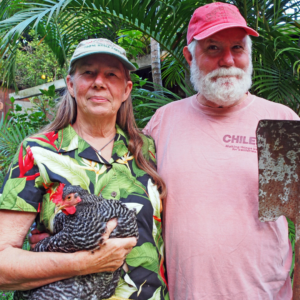
Meet Kathy Vass of Makili Farm

Location: Kealakekua, Hawaiʻi (west coast of Hawaiʻi Island)

Established: 2013

Acres: 5.8

Production: Coffee, macadamia nuts, cacao, citrus, vanilla, vegetables, tropical fruit, and pineapples

Certification: USDA Certified Organic since 2017

Staffing: Two part-time team members, plus seasonal staff (macadamia harvest)

Markets: Wholesale (grocery stores and local distributors)

Context & Challenges

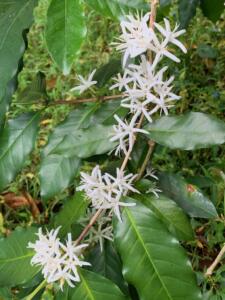
Coffee flowers.Source: Makili Farm

Coffee flowers in bloom.

OFRF team members recently spoke to Kathy Vass, owner and primary farmer at Makili Farm, sitting on almost 6 acres at an elevation of 1,500 feet on the west coast of Hawaiʻi Island.

She shared a realistic and dedicated vision of organic farming on Hawaiʻi Island, where approximately 85% of food is imported, operational costs are high, and pest and environmental pressures are tremendous. Seasonal cyclones and recent earthquakes bring even more obstacles.

Her commitment to provide organic, locally-produced food for her community is palpable and powerful: “We’re all struggling financially. I know very few farms that aren’t. We’re providing enough income to live on. But the ones I know who are succeeding are organic.”

Kathy has been working in the soil for over 55 years, from her previous career as a landscape contractor in Long Island, New York, to her 13 years of farming at Makili Farm.

Kathy notes that in the last 5-10 years, pests and invasive weeds have surged. The avocado lace bug and the coffee berry borer, in addition to nematodes, continue to wreak particular damage to her key crops; coffee leaf rust has also led to crop loss.

>> Read more: Kathy and five other farms participated in a 2021 OFRF research grant exploring Organic Farming Systems Options for Controlling Coffee Leaf Rust (CLR) in Kona Coffee.

The impact of these pests and diseases is the primary reason Kathy sought support from programs like the Natural Resource Conservation Service’s (NRCS) Conservation Stewardship Program (CSP). The knowledge and financial support they provide have been a lifeline for her business.

Why Organic?

Vanilla bean orchid. Source: Makili Farm

Vanilla bean orchid.

“I have always, for 55 years, done nothing but organic methods.”

Despite so many challenges, Kathy’s commitment to organic practices remains unshaken. She continues, “organic farming is, whether certified or not, so important for the health of our soil, our water, and our air. It’s just so important to me to have healthy food from healthy soil.”

The higher market value for organic products was also appealing; organic coffee cherries get $1 more per pound than conventional ones.

That said, each year Kathy questions her desire to remain certified. “It feels like a burden,” she shared, “Every year when it’s time for me to start doing the paperwork, I weigh whether I really want to keep doing the certification. I would always continue to be organic, regardless of whether I’m certified or not. I’m not sure that the price difference makes a big difference.”

Accessing Support through NRCS CSP

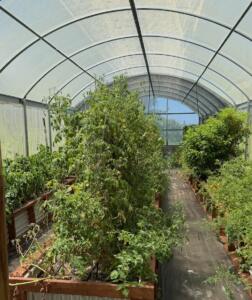
Plants growing in raised beds inside a hoop house. Source: Makili Farm

EQIP-supported hoop house.

Kathy’s daughter-in-law, also a local farmer, suggested Kathy contact Laura Nelson, who leads the Kealakekua Natural Resources Conservation Service (NRCS) office.

Kathy first worked with Laura to secure Environmental Quality Incentives Program (EQIP) reimbursement for approximately half the cost of a 20-foot-by-72-foot hoophouse, enabling her to increase production.

Laura then encouraged and supported Kathy through the CSP application process. While Kathy was initially apprehensive of another paperwork-laden application process, her existing documentation for organic certification was already comprehensive and helped expedite the CSP application.

Kathy then worked with Laura to develop goals and objectives for a 5-year contract, which reimburses her $5,000 per year to support her conservation efforts.

CSP Goals & Learnings

Together, Kathy and Laura honed in on two goals for the 5-year CSP contract:

  1. Enhance agroforestry with additional trees and shrubs (primarily fruit-bearing).
  2. Continue ongoing organic pest control practices on the farm.
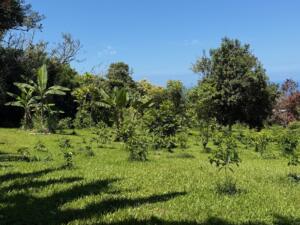
Various trees, including bananas, planted on a farm. Source: Makili Farm

Agroforestry in motion.

In her first year, she successfully planted cacao, bananas, breadfruit, and cherimoya, expanding her market offerings.

She’s now in the fourth year of her five-year contract and continuing the focus on pest management. A few recent tasks supported by her CSP contract: planting 600 new coffee trees, mulching them, and planting a nitrogen-fixing ground cover, perennial peanut.

While much of her work remains the same—tenacious, focused, and curious—the financial and community support help her stay the course and represent her primary CSP wins. “Having those connections with other farmers has been good…really, really good.”

After her current contract winds down, Kathy is considering another CSP offering focused on native plants. She heavily cites the expertise and accessibility of her NRCS agent, Laura Nelson, as a success-driving factor in her experience with CSP.

Advice to Farmers

“Persevere,” Kathy shared without hesitation. She urges farmers to explore as many USDA and other avenues of financial support as possible, never shying away from doggedly advocating for what they need with USDA agents and representatives. She also recommends plugging into the local farming community, including other farmers, your local Extension, and farmers’ unions.

“Find out what’s available, ask questions, and hang in there.”

Ready to Apply? Here Are a Few Helpful Resources

If you’re a farmer considering applying for CSP or other NRCS programs, here are some helpful tools to get started:

Additional Resources & Reading

Cómo una granja de Kona logró que los fondos federales funcionaran para la agricultura orgánica

Por Mary Elizabeth Kidd, asociada de comunicaciones

La OFRF trabaja actualmente para aumentar la conciencia de los agricultores y las comunidades sobre las oportunidades de financiamiento federal disponibles para las granjas orgánicas y en transición hacia lo orgánico. Como parte de nuestro trabajo con la región Oeste del Programa de Alianzas para la Transición a lo Orgánico (Transition to Organic Partnership Program, TOPP) del USDA, destacamos la experiencia de una granja —Makili Farm, en Kealakekua, Hawaiʻi— que recibió financiamiento y apoyo a través del Programa de Administración de la Conservación (Conservation Stewardship Program, CSP) del Servicio de Conservación de Recursos Naturales (NRCS).

Su historia ofrece una mirada transparente de lo que realmente implica trabajar con el NRCS: los beneficios, los obstáculos y las lecciones aprendidas. Esperamos que otros agricultores puedan aprovechar su experiencia para transitar más fácilmente el proceso de solicitar e implementar los contratos del CSP.

Conozca a Kathy Vass, de Makili Farm

Source: Makili Farm, Credit: John Vass

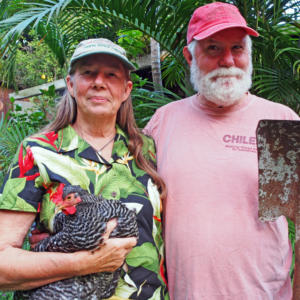
Los agricultores Kathy y Rob Vass.

Ubicación: Kealakekua, Hawaiʻi (costa oeste de Hawaiʻi Island)

Fundada: 2013

Superficie: 5.8 acres 

Producción: Café, nueces de macadamia, cacao, cítricos, vainilla, hortalizas, fruta tropical y piñas

Certificación: Certificada como orgánica por el USDA desde 2017

Personal: Dos integrantes de tiempo parcial, más personal de temporada (cosecha de macadamia)

Mercados: Venta al por mayor (tiendas de comestibles y distribuidores locales)

Contexto y desafíos

Coffee flowers.Source: Makili Farm

Flores de café.

Integrantes del equipo de la OFRF hablaron recientemente con Kathy Vass, dueña y agricultora principal de Makili Farm, ubicada en casi 6 acres a una altitud de 1,500 pies en la costa oeste de Hawaiʻi Island. 

Ella compartió una visión realista y comprometida de la agricultura orgánica en la isla de Hawaiʻi, donde aproximadamente el 85 % de los alimentos son importados, los costos operativos son altos y las presiones de plagas y ambientales son enormes. Los ciclones estacionales y los terremotos recientes suman aún más obstáculos.

Su compromiso de brindar alimentos orgánicos y de producción local a su comunidad es palpable y poderoso: “Todos tenemos dificultades económicas. Conozco muy pocas granjas que no las tengan. Generamos ingresos suficientes para vivir. Pero las que conozco que están teniendo éxito son orgánicas.”

Kathy lleva más de 55 años trabajando la tierra, desde su carrera anterior como contratista de paisajismo en Long Island, New York, hasta sus 13 años de agricultura en Makili Farm.

Kathy señala que en los últimos 5 a 10 años han aumentado las plagas y las malezas invasoras. El chinche de encaje del aguacate (avocado lace bug) y la broca del café (coffee berry borer), además de los nematodos, siguen causando un daño particular a sus cultivos clave; la roya del café (coffee leaf rust) también ha provocado pérdidas de cosecha.

>> Lea más: Kathy y otras cinco granjas participaron en 2021 en una subvención de investigación de la OFRF que exploró Opciones de sistemas de agricultura orgánica para controlar la roya del café (Coffee Leaf Rust, CLR) en Kona Coffe. 

El impacto de estas plagas y enfermedades es la razón principal por la que Kathy buscó apoyo en programas como el Programa de Administración de la Conservación (Conservation Stewardship Program, CSP) del Servicio de Conservación de Recursos Naturales (NRCS). El conocimiento y el apoyo económico que brindan han sido un salvavidas para su negocio.

¿Por qué orgánico?

Orquídea de vainilla.Source: Makili Farm

Orquídea de vainilla.

“Siempre, durante 55 años, no he usado más que métodos orgánicos.” 

A pesar de tantos desafíos, el compromiso de Kathy con las prácticas orgánicas permanece firme. Ella continúa: “La agricultura orgánica, esté certificada o no, es muy importante para la salud de nuestro suelo, nuestra agua y nuestro aire. Para mí es fundamental tener alimentos sanos que provengan de un suelo sano.”

El mayor valor de mercado de los productos orgánicos también resultaba atractivo; las cerezas de café orgánico se pagan $1 más por libra que las convencionales. 

Dicho esto, cada año Kathy se cuestiona su deseo de mantener la certificación. “Se siente como una carga”, compartió. “Cada año, cuando llega el momento de empezar con la documentación, me planteo si de verdad quiero seguir con la certificación. Siempre seguiría siendo orgánica, esté certificada o no. No estoy segura de que la diferencia de precio marque una gran diferencia.”

Cómo acceder al apoyo a través del CSP del NRCS

Invernadero tipo túnel financiado por el EQIP.Source: Makili Farm

Invernadero tipo túnel financiado por el EQIP.

La nuera de Kathy, también agricultora local, le sugirió que contactara a Laura Nelson, quien dirige la oficina del Servicio de Conservación de Recursos Naturales (NRCS) de Kealakekua.

Kathy trabajó primero con Laura para obtener el reembolso del Programa de Incentivos para la Calidad Ambiental (Environmental Quality Incentives Program, EQIP) por aproximadamente la mitad del costo de un invernadero de 20 por 72 pies, lo que le permitió aumentar la producción.

Luego, Laura animó y acompañó a Kathy durante el proceso de solicitud del CSP. Aunque al principio a Kathy le inquietaba otro proceso de solicitud lleno de trámites, la documentación que ya tenía para la certificación orgánica era muy completa y ayudó a agilizar la solicitud del CSP. 

Después, Kathy trabajó con Laura para desarrollar las metas y los objetivos de un contrato de 5 años, que le reembolsa $5,000 al año para apoyar sus esfuerzos de conservación.

Metas y aprendizajes del CSP

Juntas, Kathy y Laura se enfocaron en dos metas para el contrato del CSP de 5 años: 

  1. Fortalecer la agrosilvicultura con árboles y arbustos adicionales (principalmente frutales).
  2. Continuar las prácticas de control orgánico de plagas ya existentes en la granja.
Various trees, including bananas, planted on a farm. Source: Makili Farm

Agrosilvicultura en acción,

En su primer año, plantó con éxito cacao, plátanos, fruta del pan (ulu) y chirimoya, ampliando su oferta de mercado.

Ahora está en el cuarto año de su contrato de cinco años y sigue enfocada en el manejo de plagas. Algunas tareas recientes apoyadas por su contrato del CSP: plantar 600 cafetos nuevos, aplicarles acolchado (mulch) y sembrar una cobertura vegetal fijadora de nitrógeno, el maní perenne.

Aunque gran parte de su trabajo sigue igual —tenaz, enfocado y curioso—, el apoyo económico y comunitario le ayuda a mantener el rumbo y representa sus principales logros con el CSP. “Tener esas conexiones con otros agricultores ha sido bueno… muy, muy bueno.”

Cuando termine su contrato actual, Kathy está considerando otra oferta del CSP centrada en plantas nativas. Ella destaca en gran medida la experiencia y la disponibilidad de su agente del NRCS, Laura Nelson, como un factor clave del éxito de su experiencia con el CSP.

Consejos para los agricultores

“Perseveren”, compartió Kathy sin dudarlo. Ella insta a los agricultores a explorar tantas vías de apoyo económico del USDA y de otras fuentes como sea posible, sin dudar en defender con tenacidad lo que necesitan ante los agentes y representantes del USDA. También recomienda integrarse a la comunidad agrícola local, incluidos otros agricultores, el servicio de Extensión local y los sindicatos de agricultores.

“Averigüen qué hay disponible, hagan preguntas y no se rindan.”

¿Listo para solicitar? Aquí tiene algunos recursos útiles

Si es un agricultor que está considerando solicitar el CSP u otros programas del NRCS, aquí tiene algunas herramientas útiles para comenzar:

Recursos y lecturas adicionales

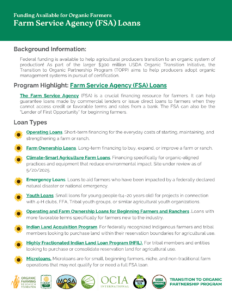
Financial Options for Your Farm: Farm Service Agency (FSA) Loans

Versión en español a continuación.

Access to affordable financing is one of the biggest barriers organic and transitioning farmers face. Whether you’re looking to buy land, cover certification costs, or simply keep your operation running through a tough season, knowing where to turn for capital can make all the difference. 

The USDA’s Farm Service Agency (FSA) offers a range of low-interest loan programs designed for farmers like you and can help you secure better rates through a commercial lender. Unfortunately, many of these programs go underutilized simply because farmers don’t know they exist. Let’s fix that. If you’re just starting out or looking to grow your farm, there’s likely an FSA loan designed for your situation.

Which FSA loan is right for me? 

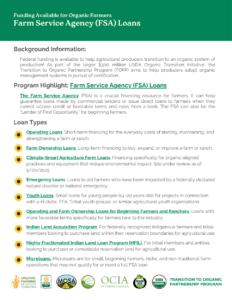
The FSA offers various loan types tailored to specific farming operations, circumstances, and experiences. Read through the list below to find an FSA loan that best suits your needs. You can also use FSA’s free Loan Assistance Tool

Operating Loans.

Short-term financing for the everyday costs of starting, maintaining, and strengthening a farm or ranch.

  • Uses: Purchasing essential items like livestock, poultry, farm equipment, feed, seed, fuel, farm chemicals, insurance, and other operating expenses; Covering costs related to minor improvements, family living expenses, and refinancing certain debts; Covering certification costs, approved organic inputs, and the cash flow gaps during the transition period for USDA-certified or transitioning organic producers. 
  • Can be issued directly from FSA, or FSA can guarantee a loan from a commercial lender for a larger line of credit.
    • Maximum loan amount: $400,000.

Farm Ownership Loans.

Long-term financing to buy, expand, or improve a farm or ranch.

  • Uses: Regular loans, joint financing, or down payment options for purchasing land, essential farm improvements, or soil and water conservation and protection.
  • Can be issued directly from FSA, or FSA can guarantee a loan from a commercial lender for a larger line of credit.
    • Maximum loan amount: $600,000 ($300,150 for Beginning Farmer Down Payment).

Climate-Smart Agriculture Farm Loans.

Financing specifically for organic-aligned practices and equipment that reduce environmental impact. Site under review as of 5/20/2025.

  • Uses: Investing in climate-smart practices and equipment, like the establishment of rotational grazing systems, precision agriculture equipment, or machinery for conversion to no-till residue management.
  • Can be issued directly from FSA, or FSA can guarantee a loan from a commercial lender for a larger line of credit. Loan amounts:
    • Direct Farm Ownership Loans: Up to $600,000.
    • Direct Operating Loans: Up to $400,000.
    • Guaranteed Loans: Up to $1,825,000.
    • Microloans: Up to $50,000. 

Emergency Loans.

Loans to aid farmers who have been impacted by a federally declared natural disaster or national emergency.

  • Uses: Restoring/replacing property, reorganizing a family farm; Refinancing non-real estate debts; Assisting with production costs or family living expenses.
  • Direct loans through FSA.
    • Maximum loan amount: $500,000, but the amount a loan applicant may receive is limited to the actual production or physical loss caused by the disaster.

Youth Loans.

Small loans for young people (14–20 years old) for projects in connection with 4-H clubs, FFA, Tribal youth groups, or similar agricultural youth organizations. 

  • Uses: Purchasing livestock, seed, equipment, supplies, or paying operating expenses for the project.
  • Maximum loan amount: $10,000

Operating and Farm Ownership Loans for Beginning Farmers and Ranchers.

Loans with more favorable terms specifically for farmers new to the industry. To see if you qualify as a beginner farmer or rancher, read the definition here

Direct Farm Ownership Down Payment Loan

  • Uses: Covering a down payment on a farm for beginning farmers who can’t finance the full purchase alone.
  • Can be issued directly from FSA, or FSA can guarantee a loan from a commercial lender for a larger line of credit.
    • Maximum Loan Amount for a “regular” Direct Farm Ownership loan: $600,000. 
    • Maximum Loan Amount for a Joint Financing or Participation Farm Ownership: $600,000.
    • Maximum Loan Amount for a Direct Farm Ownership Down Payment loan amount works differently. The maximum loan amount under this loan program will not exceed 45 percent of whichever is the lesser amount of:
      • the purchase price;
      • the appraised value of the farm being purchased; or
      • $667,000.

Indian Land Acquisition Program.

For federally recognized Indigenous farmers and tribal members looking to purchase land within their reservation boundaries for agricultural use. 

  • Maximum Loan Amount: No specified maximum loan amount; the amount is based on the tribe’s financial needs and repayment ability.

Highly Fractionated Indian Land Loan Program (HFIL).

For tribal members and entities looking to purchase or consolidate reservation land for agricultural use. 

  • Uses: Purchasing fractionated land with the intention to reduce fragmentation and promote more effective land management, agricultural productivity, and economic development within tribal areas.
  • Maximum Loan Amount: $500,000 per applicant.

Microloans.

Microloans are for small, beginning farmers, niche, and non-traditional farm operations that may not qualify for or need a full FSA loan. There are two types of microloans: 

    • Uses: Essential tools; Fencing and trellising; Hoop houses; Bees and bee equipment; Milking and pasteurization equipment; Maple sugar shack and processing equipment; Livestock, seed, fertilizer, utilities, land rents, family living expenses, and other materials essential to the operation; Irrigation; GAP (Good Agricultural Practices), GHP (Good Handling Practices), and Organic certification costs; Marketing and distribution costs, including those associated with selling through Farmers’ Markets and Community Supported Agriculture operations; Pay for qualifying OSHA compliance standards (Federal or State)
    • Maximum Loan Amount: Operating Microloans provide up to $50,000 per loan.
    • Uses: Making a down payment on a farm; Building, repairing, or improving farm buildings, service buildings, farm dwellings; soil and water conservation projects. May also be used as a Downpayment Farm Ownership Loan or in Joint Financing.
    • Maximum Loan Amount $50,000, which includes any possible outstanding FSA Direct Operating or Farm Ownership unpaid principal loan balances. A loan applicant may have a Guaranteed Operating loan, Farm Ownership loan or Emergency loan and still qualify for a Microloan.

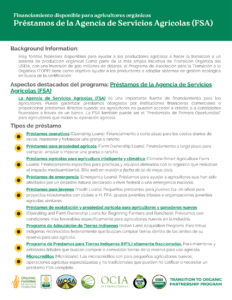
All of this information is summarized in a printable, downloadable PDF below, available in English and Spanish.

How to Apply for an FSA Loan

Step 1. Find your local FSA office.

All FSA loans, whether direct or guaranteed, are processed through your local FSA county office. Find your local office here.

Step 2. Schedule a meeting.

Call or visit your local office to discuss which loan types fit your situation. Bring any records you have about your farm operation, finances, and land. 

Here are some questions to consider: 

  • I’m interested in [loan type]. What do I need to bring to get started on an application?
  • Am I eligible for any loans with more favorable terms as a beginning, socially disadvantaged, or veteran farmer?
  • Can I apply for more than one loan type at the same time?
  • What is the repayment timeline for this loan?
  • Is funding currently available, and is there a better time of year to apply?

Step 3. Create a business plan. 

If you’re applying for a direct FSA loan or a commercial loan guaranteed by FSA, you’ll need a business plan. This doesn’t have to be intimidating! A farm business plan is essentially a clear picture of your operation, goals, and finances. FSA wants to see that you’ve thought through how your farm works and how you’ll repay the loan. 

Your detailed business plan should cover:

  • Your mission, vision, and goals for your farm or ranch.
  • Your current assets (property or investments you own) and liabilities (debts, loans, or payments you owe).
  • What your operation will produce, and how and where you will market and sell your products.
    • This is sometimes referred to as a marketing plan.
  • Whether the amount of income your operation will generate will be enough to pay your business and family living expenses.
  • For organic and transitioning producers, it’s worth being specific about your certification status or timeline, your expected transition costs, and how your marketing strategy accounts for the organic price premium.

FSA provides a step-by-step business plan builder to help you get started.

Step 4. Gather your documents.

Your loan officer will tell you exactly what’s needed, but commonly required documents include:

  • Government-issued ID.
  • Tax returns (typically 3 years).
  • Farm financial statements or records.
  • Proof of land ownership or lease agreement.
  • Business plan.
  • Organic certification or transition plan, if applicable.

Step 5. Submit your application.

Applications can be submitted directly through FSA or, for guaranteed loans, through a commercial lender. Your loan officer will guide you through this.

Step 6. Follow up.

Processing times vary by loan type. Stay in contact with your loan officer and respond quickly to any requests for additional information.

All of this information is summarized in a printable, downloadable PDF below, available in English and Spanish.

All of this information is summarized in a printable, downloadable PDF in English and Spanish below.

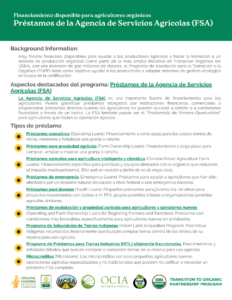
El acceso a financiamiento asequible es una de las mayores barreras a las que se enfrentan los agricultores orgánicos y en transición. Ya sea que busque comprar terrenos, cubrir los costos de certificación o simplemente mantener su operación en funcionamiento durante una temporada difícil, saber a dónde acudir para obtener capital puede marcar la diferencia. 

La Agencia de Servicios Agrícolas (FSA) del USDA  ofrece una variedad de programas de préstamos a bajo interés diseñados para agricultores como usted y puede ayudarle a conseguir mejores condiciones de financiamiento a través de un prestamista comercial.  Desafortunadamente, muchos de estos programas se usan poco simplemente porque los agricultores no saben que existen. Vamos a ayudar a cambiar eso. Si acaba de empezar o quiere hacer crecer su granja, probablemente haya un préstamo FSA diseñado para su situación.

¿Qué préstamo FSA es el adecuado para mí? 

La FSA ofrece diversos tipos de préstamos adaptados a operaciones agrícolas específicas, circunstancias y experiencias. Lea la lista a continuación para encontrar el préstamo FSA que mejor se adapte a sus necesidades. También puedes utilizar gratuitamente la herramienta de asistencia para préstamos de FSA. 

Préstamos operativos. (Operating Loans)

Financiamiento a corto plazo para los costos diarios de iniciar, mantener y fortalecer una granja o rancho.

  • Usos: Compra de artículos esenciales como ganado, aves, maquinaria agrícola, alimentos para animales, semillas, combustible, productos químicos agrícolas, seguros y otros gastos operativos; Cubrir costes relacionados con mejoras menores, gastos familiares y refinanciamiento de ciertas deudas; Cubrir los costos de certificación, insumos orgánicos aprobados y las carencias de flujo de caja durante el periodo de transición para productores orgánicos certificados o en transición por el USDA. 
  • Puede emitirse directamente desde FSA, o FSA puede garantizar un préstamo de un prestamista comercial para una línea de crédito mayor.
    • Monto máximo del préstamo: 400.000 dólares.

Préstamos para propiedad agrícola. (Farm Ownership Loans)

Financiamiento a largo plazo para comprar, ampliar o mejorar una granja o rancho.

  • Usos: Préstamos regulares, financiamiento conjunto u opciones de pago inicial (down payment) para la compra de tierras, mejoras agrícolas esenciales o conservación y protección del suelo y el agua.
  • Puede emitirse directamente desde FSA, o FSA puede garantizar un préstamo de un prestamista comercial para una línea de crédito mayor.
    • Importe máximo del préstamo: 600.000 $ (300.150 $ para el pago inicial de agricultores que están iniciando).

Préstamos agrícolas para agricultura inteligente y climática. (Climate-Smart Agriculture Farm Loans)

Financiamiento específico para prácticas y equipos alineados con lo orgánico que reduzcan el impacto medioambiental. La información sobre este programa estaba en revisión al 20 de mayo de 2025.

  • Usos: Invertir en prácticas inteligentes para el clima y equipos, como el establecimiento de sistemas de pastoreo rotativo, equipos de agricultura de precisión o maquinaria para sistemas de cultivo con labranza reducida o sin labranza (no-till).
  • Puede emitirse directamente desde FSA, o FSA puede garantizar un préstamo de un prestamista comercial para una línea de crédito mayor. 

Montos de los préstamos: 

  • Préstamos directos de propiedad agrícola: hasta 600.000 dólares.
  • Préstamos directos operativos: hasta 400.000 dólares.
  • Préstamos garantizados: hasta $1,825,000.
  • Microcréditos: hasta 50.000 dólares. 

Préstamos de emergencia. (Emergency loans)

Préstamos para ayudar a agricultores que han sido afectados por un desastre natural declarado a nivel federal o una emergencia nacional.

  • Usos: Restauración/reemplazo de propiedades, reorganización de una granja familiar; Refinanciamiento de deudas no inmobiliarias; Ayudar con los costos de producción o los gastos familiares.
  • Préstamos directos a través de FSA.
    • Importe máximo del préstamo: 500.000 $, aunque la cantidad que puede recibir un solicitante está limitada a las pérdidas reales de producción o daños físicos causados por el desastre.

Préstamos para jóvenes. (youth loans)

Pequeños préstamos para jóvenes (14–20 años) para proyectos relacionados con clubes 4-H, FFA, grupos juveniles tribales u organizaciones juveniles agrícolas similares. 

  • Usos: Compra de ganado, semillas, equipos, suministros o el pago de los gastos operativos del proyecto.
  • Cantidad máxima del préstamo: $10.000

Préstamo de Pago Inicial por Propiedad Directa de Operaciones Agrícolas

  • Usos: Cubrir un pago inicial en una granja para agricultores nuevos que no pueden financiar la compra completa por sí solos.
  • Puede emitirse directamente desde FSA, o FSA puede garantizar un préstamo de un prestamista comercial para una línea de crédito mayor.
    • Monto máximo del préstamo para un préstamo “regular” de propiedad directa agrícola: 600.000 dólares. 
    • Cantidad máxima del préstamo para una propiedad agrícola de financiamiento conjunto o participación: 600.000 dólares.
    • Monto máximo del préstamo para un préstamo de propiedad directa de una granja con pago inicial funciona de forma diferente. La cantidad máxima del préstamo bajo este programa no superará el 45 por ciento de la cantidad menor de:
      • el precio de compra;
      • el valor tasado de la granja que se estaba adquiriendo; o
      • $667.000.

Programa de Adquisición de Tierras Indígenas. (Indian Land Acquisition Program)

Para agricultores indígenas reconocidos a nivel federal y miembros tribales que buscan comprar tierras dentro de los límites de su reserva para uso agrícola. 

  • Cantidad máxima del préstamo: No se especifica una cantidad máxima del préstamo; La cantidad se basa en las necesidades financieras y la capacidad de pago de la tribu.

Programa de Préstamos para Tierras Indias (HFIL) altamente fraccionadas.

Para miembros y entidades tribales que buscan comprar o consolidar tierras de la reserva para uso agrícola. 

  • Usos: Compra de tierras fraccionadas con la intención de reducir la fragmentación y promover una gestión más eficaz de la tierra, productividad agrícola y desarrollo económico dentro de las áreas tribales.
  • Monto máximo del préstamo: $500.000 por solicitante.

Microcréditos. (Microloans)

Los microcréditos son para pequeños agricultores nuevos, operaciones agrícolas especializadas y no tradicionales que pueden no calificar o necesitar un préstamo FSA completo. Existen dos tipos de microcréditos: 

    • Usos: Compra de herramientas esenciales; instalación de cercas y sistemas de espaldera; construcción o adquisición de invernaderos tipo túnel (hoop houses); compra de abejas y equipo apícola; adquisición de equipos de ordeño y pasteurización; construcción, equipamiento y procesamiento relacionados con la producción de jarabe de arce; compra de ganado, semillas, fertilizantes y otros materiales esenciales para la operación agrícola; pago de servicios públicos, arrendamiento de tierras y gastos básicos de manutención familiar; instalación o mejora de sistemas de riego; pago de los costos de certificación GAP (Buenas Prácticas Agrícolas), GHP (Buenas Prácticas de Manejo) y certificación orgánica; costos de mercadeo y distribución, incluidos los relacionados con la venta en mercados de agricultores (Farmers’ Markets) y programas de Agricultura Apoyada por la Comunidad (CSA); y cubrir los costos necesarios para cumplir con las normas de seguridad y salud ocupacional (OSHA) (federales o estatales)
    • Monto máximo del préstamo: Los microcréditos operativos proporcionan hasta $50.000 por préstamo.
    • Usos: Hacer un pago inicial en una granja; Construir, reparar o mejorar edificios agrícolas, edificios de servicio, viviendas agrícolas; proyectos de conservación de suelo y agua. También puede utilizarse como Préstamo de Propiedad Agrícola con pago inicial o en Financiamiento Conjunto.
    • Monto máximo del préstamo: $50.000, que incluye cualquier posible saldo pendiente pendiente de préstamos principales de operación directa o propiedad agrícola de la FSA. Un solicitante de préstamo puede tener un préstamo operativo garantizado, un préstamo de propiedad agrícola o un préstamo de emergencia y aún así calificar para un micropréstamo. 

Cómo solicitar un préstamo FSA

Paso 1. Busque su oficina local de FSA.

Todos los préstamos de la FSA, ya sean directos o garantizados, se procesan a través de la oficina local de la FSA correspondiente a su condado. Encuentre su oficina local aquí.

Paso 2. Programe una reunión.

Llame o visite su oficina local para hablar sobre qué tipos de préstamos se adaptan a su situación. Lleve cualquier registro que tenga sobre su operación agrícola, finanzas y tierras. 

Aquí tiene algunas preguntas a considerar: 

  • Me interesa [tipo de préstamo]. ¿Qué necesito llevar para empezar con una solicitud?
  • ¿Soy elegible para algún préstamo con condiciones más favorables como agricultor nuevo, socialmente desfavorecido o veterano?
  • ¿Puedo solicitar más de un tipo de préstamo al mismo tiempo?
  • ¿Cuál es el plazo de devolución de este préstamo?
  • ¿Hay financiamiento disponible actualmente y hay una mejor época del año para solicitar?

Paso 3. Cree un plan de negocio. 

Si solicita un préstamo directo de FSA o un préstamo comercial garantizado por FSA, necesitará un plan de negocio. ¡Esto no tiene por qué ser intimidante! Un plan de negocio agrícola es esencialmente una imagen clara de su operación, objetivos y finanzas. FSA quiere asegurarse de que ha pensado bien cómo funciona su granja y cómo vas a devolver el préstamo. 

Su plan de negocio detallado debe cubrir:

  • Su misión, visión y objetivos para su granja o rancho.
  • Sus activos actuales (propiedades o inversiones que posee) y sus pasivos (deudas, préstamos o pagos que debe).
  • Qué producirá su granja, y cómo y dónde comercializará y venderá sus productos.
    • Esto a veces se denomina plan de marketing.
  • Si la cantidad de ingresos que generará su operación será suficiente para cubrir los gastos de su negocio y familia.
  • Para productores orgánicos y en transición, conviene ser específico sobre el estado o el calendario de la certificación, los costos de transición previstos y cómo su estrategia de marketing tiene en cuenta la prima del precio orgánico.

FSA ofrece un generador de planes de negocio paso a paso para ayudarle a empezar.

Paso 4. Reúna los documentos necesarios.

Su oficial de préstamos le dirá exactamente lo que se necesita, pero que es habitualmente los documentos incluyen:

  • Identificación emitida por el gobierno.
  • Declaraciones de impuestos (generalmente de los últimos 3 años)
  • Estados financieros o registros agrícolas
  • Comprobante de propiedad de la tierra o contrato de arrendamiento.
  • Plan de negocio.
  • Certificación orgánica o plan de transición, si corresponde.

Paso 5. Envíe su solicitud.

Las solicitudes pueden presentarse directamente a través de la FSA o, para préstamos garantizados, a través de una institución financiera comercial. Su oficial de préstamos le orientará durante todo el proceso.

Paso 6. De Seguimiento a su solicitud.

Los tiempos de procesamiento varían según el tipo de préstamo. 

Manténgase en comunicación con su oficial de préstamos y responda rapidamente a cualquier solicitud de información adicional.

Toda esta información se resume en un PDF imprimible y descargable a continuación, disponible en inglés y español.

Toda esta información se resume en un PDF imprimible y descargable a continuación, disponible en inglés y español.

By |2026-08-03T10:47:33-04:00June 25th, 2026|Federal Assistance, News, Spanish Resources|

Conservation Stewardship Program (CSP)

Farmers across the U.S. are eligible for significant technical and financial assistance from the Natural Resources Conservation Service (NRCS).

Versión en español a continuación.

If you are engaging in environmental stewardship and conservation efforts on your farm, the Conservation Stewardship Program (CSP) can help support your progress. CSP compensates agricultural producers who agree to increase conservation on their farm by adopting additional conservation activities or improving upon existing practices. With technical assistance from a conservation planner, farmers will work to increase conservation through practices best suited to their operation, like cover cropping, integrated grazing, or building wildlife habitats.

Obtain additional translated materials, or schedule interpretation services for phone calls or in-person visits, at farmers.gov/translations, or request personalized Spanish language support for any USDA resource, at farmers.gov/translations#spanish-request.

Important Points:

  • CSP provides annual payments for farmers, with the annual minimum being $4,000, for a 5-year contract for installing, maintaining, and improving existing conservation on a farm.
  • CSP payments are reported to the IRS and should be treated as taxable income.
  • Unlike the Environmental Quality Incentives Program (EQIP), there are no minimum acreage requirements, but the program requires whole-farm enrollment. The applicant’s farm must be in existing production; the program generally will not support land being cleared or prepared for future production.
  • Contacting your local NRCS office is a key step in determining your eligibility and beginning your application process.
  • Applications are accepted on a rolling basis and will be reviewed on the next ranking date for your state. Begin your application process as soon as possible to ensure completion by the next deadline! Applications are prioritized by local resource concerns and the applicant’s level of need.
    • The 2026 batching deadline was January 15, 2026, for all states. 
  • You will need to create a free online account at Farmers.gov and ensure that it is up to date.
  • If you do not own your land, you will need to submit written permission from the owner with your application.
  • New this year: the Regenerative Agriculture Initiative may be an opportunity for organic and transitioning-to-organic producers to leverage their operational status for qualifying for contracts.

Step 1. Research Your Options.

CSP offers support for a broad scope of conservation activities and projects to producers, including both financial and technical support. CSP contracts last 5 years, with the option for renewal. Read up on the program to determine your eligibility and brainstorm how you already are, or would like to, increase conservation on your farm. For some possible project inspiration, check out NCRS’s Conservation at Work video series.

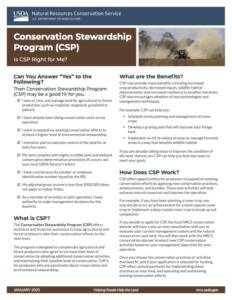
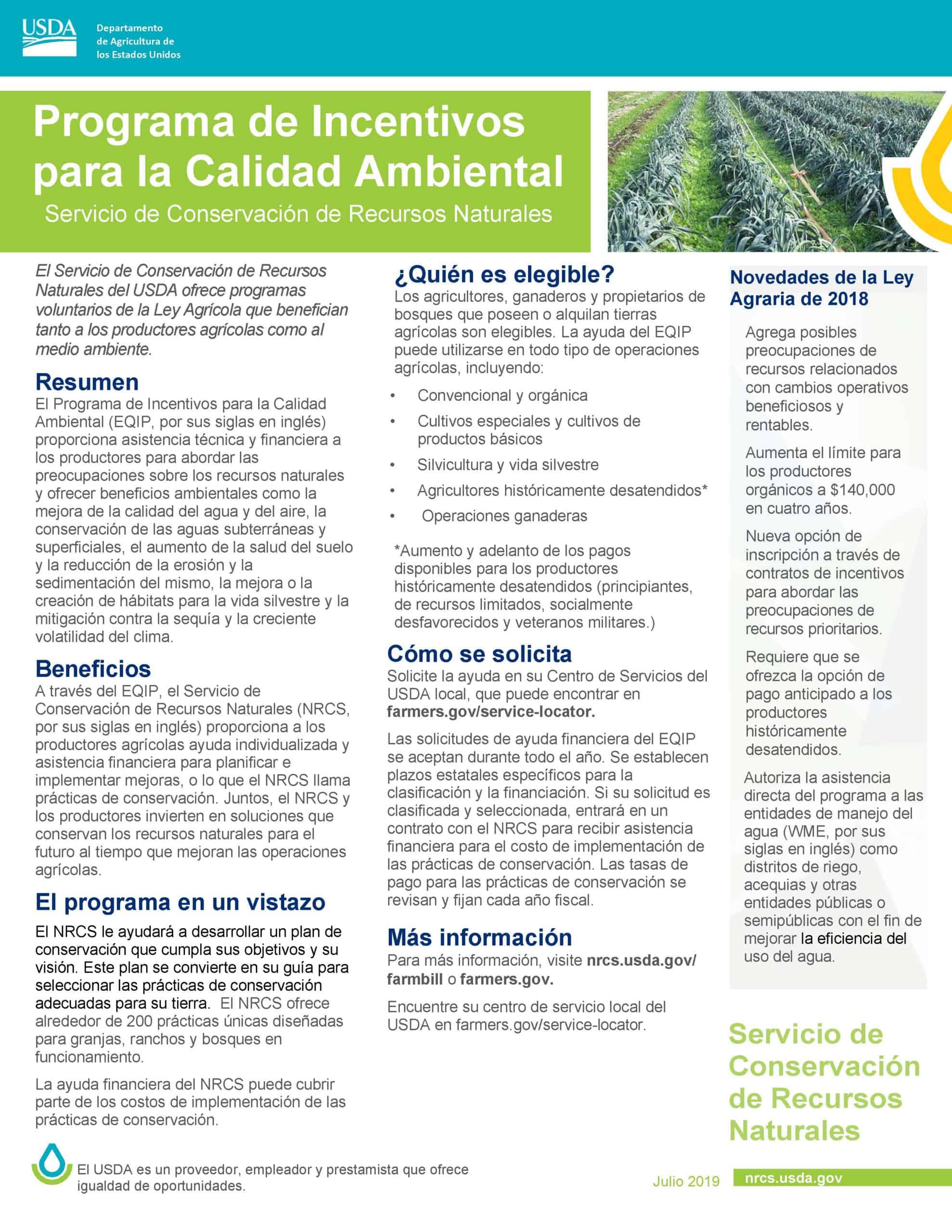
Front page of a CSP factsheet in English
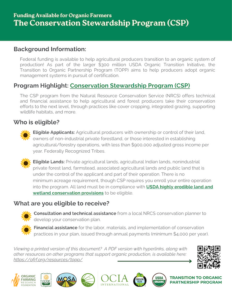
Front page of a CSP factsheet in Spanish

Step 2. Connect with USDA.

Create or update your account at Farmers.gov, and contact your local NRCS office to get started. Your conservation specialist will confirm your eligibility and help you determine your farm’s current stewardship thresholds. A stewardship threshold is NRCS’s benchmark for whether a CSP applicant is meeting or exceeding the level of conservation for a specific natural resource concern. To qualify, applicants must meet the threshold for at least two priority resource concerns across all land uses in their operation and commit to meeting or exceeding at least one additional concern by the end of their contract.

Guiding questions for initial contact with NRCS:

  • “I’m interested in  _conservation project(s) of interest_. What do you need from me to get started on my application?”
  • “What additional funding opportunities are available to my farm?”
  • “When is the deadline for the next CSP ranking period?”
  • “I _(own/rent)_ my land. What documents will you need for completion of my CSP application by the deadline?”
  • “My farm is _certified/transitioning_ to organic. What additional will you need for completion of my conservation plan and application by the deadline?”

Step 3. Gather your application documents.

You’ll need your:

  • Official tax ID (Social Security Number or Employer Identification Number)
  • Adjusted gross income certification (Form CCC-941), which requires your Taxpayer ID Number and AGI from the previous 3 tax years.
  • Deed, or property lease agreement, and written authorization from the landowner to install structural or vegetative practices.
  • A map showing all land uses and acres in the operation, and a map or other documentation identifying any known ineligible land and associated acreage amounts (NRCS staff will help you obtain this information if you don’t already have it).
  • Farm tract number (obtained from Farmers.gov or FSA membership).
  • Documentation of organic certification (if applicable).
  • Documentation of your land’s irrigation history (if applicable to project).

Step 4. Complete your application & submit!

Your NRCS conservation specialist will complete and submit your application form (CPA 1200) based on your established conservation plan.

Step 5. Implement your plan.

If your application is selected, NRCS will offer a contract outlining the approved conservation activities, payment rates, and other terms. CSP contracts last five years and begin only after both the farmer and NRCS sign the agreement. NRCS provides technical assistance, verifies completion of contract activities, and issues annual payments after October 1 each year.

Apply for CSP now to take conservation efforts on your farm to the next level! 

All of this information is summarized in a printable, downloadable PDF below in English and Spanish.

Los agricultores de todo Estados Unidos son elegibles para recibir asistencia técnica y financiera del Servicio de Conservación de Recursos Naturales (NRCS).

Si usted participa en esfuerzos de gestión ambiental y conservación en su granja, El Programa de Administración para la Conservación (CSP) puede ayudarle a apoyar su progreso. El CSP compensa a los productores agrícolas que aceptan aumentar la conservación en su granja adoptando actividades adicionales de conservación o mejorando prácticas existentes. Con la asistencia técnica de un planificador de conservación, los agricultores trabajarán para aumentar la conservación mediante prácticas más adecuadas a su explotación, como la construcción de cultivos de cobertura, el pastoreo integrado o la construcción de hábitats para la vida silvestre.

Obtenga materiales traducidos adicionales, programa servicios de interpretación para llamadas telefónicas o visitas presenciales, en farmers.gov/translations, o solicite apoyo personalizado en español para cualquier recurso del USDA, en farmers.gov/translations#spanish-request.

Puntos importantes:

  • CSP da pagos anuales a los agricultores, con un mínimo anual de 4.000 dólares, por un contrato de 5 años por instalar, mantener y mejorar la conservación existente en la granja.
  • Los pagos del CSP se reportan al IRS y deben considerarse ingreso sujeto a impuestos.
  • A diferencia del Programa de Incentivos para la Calidad Ambiental (EQIP), no existen requisitos mínimos de superficie, pero el programa exige la inscripción de toda la granja. La granja del solicitante debe estar en producción existente; El programa generalmente no apoya la limpieza o preparación de terrenos para futuras producciones.
  • Contactar con la oficina local del NRCS es un paso clave para determinar su elegibilidad y comenzar el proceso de solicitud.
  • Las solicitudes se aceptan de forma continua y se revisarán en la siguiente fecha de clasificación para su estado. ¡Comience su proceso de solicitud lo antes posible para asegurarse de finalizar antes de la próxima fecha límite! Las solicitudes se priorizan según los recursos locales y el nivel de necesidad del solicitante.
    • La fecha límite para 2026 fue el 15 de enero de 2026 para todos los estados. 
  • Tendrá que crear una cuenta online gratuita en Farmers.gov y asegurarse de que está actualizada.
  • Si no es propietario de su terreno, tendrá que presentar un permiso por escrito del propietario con su solicitud.
  • Novedad de este año: la Iniciativa de Agricultura Regenerativa podría ser una oportunidad para que los productores orgánicos y en transición a orgánicos aprovechen su estatus operativo para calificar para contratos.

Paso 1. Investigue sus opciones.

El CSP ofrece apoyo para un amplio alcance de actividades y proyectos de conservación a los productores, incluyendo apoyo financiero y técnico. Los contratos CSP duran 5 años, con opción de renovación. Infórmese sobre el programa para determinar su elegibilidad y haga una lluvia de ideas sobre cómo ya está, o le gustaría, aumentar la conservación en su granja. Para alguna posible inspiración en proyectos, revise la serie de videos sobre Conservación en el Trabajo de NCRS.

Front page of a CSP factsheet in Spanish
Front page of a CSP factsheet in English

Paso 2. Contacte con USDA.

Cree o actualice su cuenta en Farmers.gov y contacte con la oficina local del NRCS para empezar. Su especialista en conservación confirmará su elegibilidad y le ayudará a determinar los límites actuales de gestión de su granja. Un umbral de manejo responsable es el referente de la NRCS para determinar si un solicitante de CSP cumple o supera el nivel requerido de conservación para una inquietud específica de recursos naturales. Para calificar, los solicitantes deben cumplir el umbral para al menos dos inquietudes prioritarias de recursos naturales en todos los usos del suelo en su operación y comprometerse a cumplir o superar al menos una inquietud adicional antes de finalizar su contrato.

Preguntas orientadoras para el contacto inicial con el NRCS:

  • “Me interesa el/los _proyecto(s) de conservación(es) que le interese. ¿Qué necesitan de mí para empezar con mi solicitud?”
  • “¿Qué oportunidades adicionales de financiación hay disponibles para mi granja?”
  • “¿Cuándo es la fecha límite para el próximo periodo de clasificación CSP?”
  • “Yo _(poseo/alquilo)_ mi tierra. ¿Qué documentos necesitarán para completar mi solicitud CSP antes de la fecha límite?”

Paso 3. Reúna sus documentos de solicitud.

Necesitará su:

  • Identificación fiscal oficial (Número de Seguro Social o de Identificación del Empleador)
  • Certificación de ingreso bruto ajustado (Formulario CCC-941), que requiere su número de identificación de contribuyente y AGI de los 3 años fiscales anteriores.
  • Escritura, o contrato de arrendamiento de propiedad, y autorización por escrito del propietario para instalar prácticas estructurales o vegetativas.
  • Un mapa que muestre todos los usos del suelo y acres en la operación, y un mapa u otra documentación que identifique cualquier terreno no elegible conocido y las extensiones asociadas (el personal de NRCS le ayudará a obtener esta información si aún no la tiene).
  • Número de parcela de la granja (obtenido de Farmers.gov o de la membresía FSA).
  • Documentación de certificación orgánica (si procede).
  • Documentación del historial de riego de su terreno (si es aplicable al proyecto).

Paso 4. ¡Complete su solicitud y envíela!

Su especialista en conservación del NRCS completará y enviará su formulario de solicitud (CPA 1200) en base a su plan de conservación establecido.

Paso 5. Implemente su plan.

Si su solicitud es seleccionada, el NRCS ofrecerá un contrato que detalle las actividades de conservación aprobadas, las tarifas de pago y otros términos. Los contratos CSP duran cinco años y solo comienzan después de que tanto el agricultor como el NRCS firmen el acuerdo. El NRCS proporciona asistencia técnica, verifica la finalización de las actividades contractuales y emite pagos anuales después del 1 de octubre de cada año.

¡Solicite CSP ahora para llevar los esfuerzos de conservación en su granja al siguiente nivel! 

Toda esta información se resume en un PDF imprimible y descargable a continuación, disponible en inglés y español.

By |2026-06-12T09:57:50-04:00January 15th, 2026|Federal Assistance, News, Spanish Resources, TOPP West|

Environmental Quality Incentives Program (EQIP)

Farmers across the U.S. are eligible for significant technical and financial assistance from the Natural Resources Conservation Service (NRCS).

Farmers and technical service providers know firsthand that the most significant barriers to developing sustainable infrastructure and production practices are due to time and resource scarcity. NRCS’ EQIP program offers financial assistance and technical support to implement new conservation practices on your farm, with additional support for historically underserved applicants, including socially disadvantaged, beginning, veteran, and limited-resource farmers and ranchers. In this blog post, we’ll provide an overview of what EQIP has to offer and the steps to utilizing this program.

Obtain additional translated materials, or schedule interpretation services for phone calls or in-person visits, at farmers.gov/translations, or request personalized Spanish language support for any USDA resource, at farmers.gov/translations#spanish-request.

Important Points:

  • EQIP is a reimbursement program; most operations will have to pay for improvements up-front and get funding to cover those costs.
  • Do not begin reimbursable conservation activities and projects prior to completion of your application process and contract with NRCS.
  • Contacting your local NRCS office is a key step in determining your eligibility and beginning your application process.
  • Applications are accepted on a rolling basis and will be reviewed on the next ranking date for your state. Begin your application process as soon as possible to ensure completion by the next deadline! Applications are prioritized by local resource concerns and the applicant’s level of need.
    • The 2026 batching deadline is January 15, 2026, for all states. 
  • You will need to create a free online account at Farmers.gov and ensure that it is up to date.
  • If you do not own your land, you will need to submit written permission from the owner with your application.

Step 1. Research Your Options.

EQIP offers support for a broad scope of conservation activities & projects to producers, including both financial and technical support. EQIP provides funds to reimburse costs associated with specific practices or infrastructure projects on a farm. EQIP’s most popular sub-programs include the High Tunnel Initiative, which covers the cost of high tunnel installation for production farms, the On Farm Energy Initiative, which covers the cost of energy-saving equipment and infrastructure improvements such as refrigeration units or greenhouse improvements, and the Organic Initiative, which provides up to $140k to certified organic or transitioning farms to implement conservation practices such as design and installation of efficient irrigation systems, nutrient & pest management strategies, or developing a grazing plan. Funding availability varies by state. As of 2026, not all initiatives are offered in every state. Check with your local NCRS office to determine what funding pools are available in your state.

Front page of a CSP factsheet in English

Step 2. Connect with USDA.

Create or update your account at Farmers.gov, and contact your local NRCS office to get started. Your conservation specialist will confirm your eligibility and help you identify which projects & practices best suit your operation. 

Guiding questions for initial contact with NRCS:

  • “I’m interested in applying for EQIP’s  _initiative(s) of interest_ for my farm to help finance _conservation project of interest_. What do you need from me to get started on my application?”
  • “What additional funding opportunities are available to my farm?”
  • “How soon can a conservationist help me set up a conservation plan (AD 1026)?”
  • “When is the deadline for the next EQIP ranking period?”
  • “I am eligible for the increased and advanced payment option for Historically Underserved farmers. How will this change my application process?”
  • “I _(own/rent)_ my land. What documents will you need for completion of my EQIP application by the deadline?”
  • “My farm is _certified/transitioning_ to organic. What additional will you need for completion of my conservation plan and application by the deadline?”

Step 3. Schedule your conservation plan development.

Your NRCS conservation specialist will work with you to develop a conservation plan for your operation and complete the AD 1026 form.

Step 4. Gather your application documents.

You’ll need your: 

  • Official tax ID (Social Security Number or Employer Identification Number)
  • Adjusted gross income certification (Form CCC-941), which requires your Taxpayer ID Number and AGI from the previous 3 tax years.
  • Deed, or property lease agreement, and written authorization from the landowner to install structural or vegetative practices.
  • Farm tract number (obtained from Farmers.gov or FSA membership).
  • Documentation of organic certification (if applicable).
  • Documentation of your land’s irrigation history (if applicable to project).

Step 5. Complete your application & submit!

Your NRCS conservation specialist will complete & submit your application form (CPA 1200) with you using your established conservation plan and the above documents. 

Step 6. Implement your plan.

If you’re selected, you can choose whether to sign the contract for the work to be done. You’ll be provided with guidelines and a timeframe for implementing your plan. Once the work is implemented and inspected, you’ll be paid the rate of compensation for the work.

Apply for EQIP now and unlock a more affordable path to sustainable agriculture. Your farm deserves the support it needs.

All of this information is summarized in a printable, downloadable PDF below, available in English and Spanish.

By |2026-01-15T10:21:50-05:00January 5th, 2026|Federal Assistance, News, Spanish Resources, TOPP West|

Funding On-Farm Innovation: SARE Farmer/Rancher Grants

By Gordon Merrick, Policy Program Director at OFRF

Versión en español a continuación.

At the Organic Farming Research Foundation, we’ve seen firsthand that some of the most meaningful innovation happens on working farms, not just research plots. When farmers take the lead in experimenting and observing what works on their land, they build confidence, share new knowledge, and drive progress across the organic movement. That’s the spirit behind our Farmer-Led Trials Program—and the reason why we’re excited to release a new toolkit to help producers who utilize organic farming systems to access the Sustainable Agriculture Research and Education (SARE) Farmer/Rancher Grant Program.

SARE provides direct funding for producers to test ideas and share solutions with their communities. This toolkit is designed to make that process more accessible than ever for organic and transitioning-to-organic producers.

What Is the Sustainable Agriculture Research and Education Program?

A farmer leans down in a field with a clip board, conducting research.The SARE Farmer/Rancher Grant Program is a competitive grant program that provides funding to producers who have designed their own research projects and teams. This program aims to award funding to projects that address real-world, on-farm challenges and include both research and outreach components.
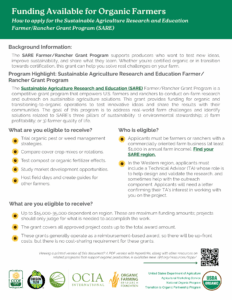
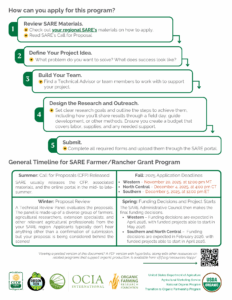
Farmers and ranchers apply as the Principal Investigator and work with Technical Advisors, like Extension agents, university researchers, or nonprofit organizations. Together, they run projects lasting one to three years, testing new practices while sharing their findings with others.

The 2026 Call for Proposals was recently released and offers a funding limit of $15,000-35,000 for projects, depending on your region! 

For farms in the SARE Western Region

(Alaska, Arizona, California, Colorado, Hawaii, Idaho, Montana, Nevada, New Mexico, Oregon, Utah, Washington, and Wyoming)

  • Up to $35,000 of funding available for 1-3 year projects. 
  • The submission deadline is Noon (12 pm Mountain Time) on October 28, 2026, and projects must start between April 1 and October 1, 2027. Learn more and apply here.

For farms in the SARE North Central Region

(North Dakota, South Dakota, Nebraska, Kansas, Wisconsin, Iowa, Missouri, Illinois, Michigan, Minnesota, Indiana, Ohio)

  • Up to $15,000 of funding for individuals and up to $30,000 for teams is available for 23-month projects. 
  • The submission deadline for 2026 has not yet been announced. For reference, the 2025 deadline was 4 pm Central Time on December 4, 2025. Learn more and apply here.

For farms in the SARE Southern Region

(Texas, Oklahoma, Arkansas, Louisiana, Georgia, Alabama, Mississippi, Tennessee, Kentucky, Florida, South Carolina, North Carolina, Virginia, Puerto Rico, and the U.S. Virgin Islands)

  • Up to $20,000 of funding for individuals, and up to $25,000 for teams, available for 2-year projects. 
  • The submission deadline for 2026 has not yet been announced. For reference, the 2025 deadline was Noon (12 pm Eastern Time) on December 5, 2025. Learn more and apply here.

Why Does SARE Matter for Organic and Transitioning-To-Organic Producers?

Organic producers have long been at the forefront of innovation, whether experimenting with cover cropping strategies, biological pest and disease controls, diversified rotations, or the interaction of all of these different practices.

Research shows that farmers benefit greatly when they lead on-farm research trials at their farms. Conducting your own research allows you to address your farm-specific questions and has historically supported the adoption and innovation of sustainable agricultural practices worldwide.

Programs like SARE’s Farmer/Rancher Grant Program give farmers the opportunity to test what works under real conditions on their farms and ensure that knowledge benefits others in their communities.

The outreach component required by the program guarantees that the benefits extend beyond a single farm. For operations transitioning to organic certification, this grant offers a valuable chance to research how best to manage that transition, making it easier for others to follow suit.

How To Get Started With a SARE Proposal

Our new toolkit walks you through the process, from project idea to submission, offering resources and general guidance tailored to organic operations. There are five primary steps:

  • Define Your Project Idea. Think about a real challenge on your farm. Use the SARE project database to make sure you’re not repeating a funded study, and ask how the project will improve sustainability for more than just your farm.
  • Build Your Team. In the Western region, a Technical Advisor is required, ideally this is a preexisting relationship with an Extension agent, university researcher, or a non-profit organization. In the North Central and Southern regions, you can apply as an individual farm, or as part of a group of multiple farms.
  • Design the Research and Outreach. Outline your methods, timeline, budget, and outreach plan. Use our free guidebook, Farmers Guide to Conducting On-Farm Research, to support you at every step of this process.
  • Submit Your Application Before Your Region’s Deadline. The best way to avoid any technical difficulties is to submit your application earlier than the deadline, and to make sure you have an active account on their platform!
  • Conduct Your Research and Share What You Learn. If awarded, you’ll conduct the research you’ve outlined and then report results, host outreach activities, and help build the region’s body of applied research and connected producers.

SARE In Action

Across the country, past SARE-funded projects have examined a wide range of topics. In the western region, a few funded projects look at organic pest control in pastured pork production and varroa mite management for beekeepers in Hawaii. These are tangible, farmer-driven projects that answer real questions and create resilient resources others can use—exactly the kind of work this grant aims to support.

Farmer-led research isn’t just a nice idea; it is essential for advancing organic production systems that are resilient, profitable, and rooted in ecological stewardship. With this toolkit and the updated SARE Farmer/Rancher Grant Program, we hope you’ll see a clear path to turning your ideas into action.

When good ideas aren’t kept bottled up, but are spread and shared abundantly within communities, that’s when real change happens.

All of this information is summarized in a printable, downloadable PDF.

visual of the first page of a SARE flyer made by OFRF
visual of the second page of a SARE flyer made by OFRF

Fondos para proyectos de innovación en la granja: becas de SARE para agricultores / ganaderos

En la Fundación de Investigación de Agricultura Orgánica (Organic Farming Research Foundation), hemos visto de primera mano que algunas de las innovaciones más significativas ocurren en granjas en funcionamiento, no solo en parcelas de investigación. Cuando los agricultores toman la iniciativa de experimentar y observar lo que funciona en sus tierras, generan confianza, comparten nuevos conocimientos e impulsan el progreso en todo el movimiento orgánico. Ese es el espíritu detrás de nuestro Programa de Ensayos Dirigidos por Agricultores, y la razón por la que estamos entusiasmados de lanzar un nuevo conjunto de herramientas para ayudar a los productores que utilizan sistemas de agricultura orgánica a acceder al Programa de becas para agricultores/ganaderos de Investigación y Educación en Agricultura Sostenible (SARE).

SARE proporciona fondos directos para que los productores prueben ideas y compartan soluciones con sus comunidades. Este kit de herramientas está diseñado para hacer que ese proceso sea más accesible que nunca para los productores orgánicos y en transición a orgánicos.

¿Qué es el Programa de Investigación y Educación sobre Agricultura Sostenible?

A farmer leans down in a field with a clip board, conducting research.El Programa de Becas para Agricultores/Ganaderos de SARE es un programa de becas competitivo que proporciona fondos a los productores que han diseñado sus propios proyectos y equipos de investigación. Este programa tiene como objetivo otorgar fondos a proyectos que abordan desafíos del mundo real en la granja e incluyen componentes de investigación y divulgación.

Los agricultores y ganaderos se postulan como Investigador Principal y trabajan con Asesores Técnicos, como agentes de extensión, investigadores universitarios u organizaciones sin fines de lucro. Juntos, ejecutan proyectos que duran de uno a tres años, probando nuevas prácticas mientras comparten sus hallazgos con otros.

¡La Convocatoria de Propuestas 2026 se publicó recientemente y ofrece un límite de financiamiento de $15,000-35,000 por proyecto, dependiendo de la región!

Para granjas en la región occidental de SARE

(Alaska, Arizona, California, Colorado, Hawái, Idaho, Montana, Nevada, Nuevo México, Oregón, Utah, Washington y Wyoming)

  • Hasta $35,000 de financiación para proyectos de 1 a 3 años.
  • La fecha límite de presentación es el mediodía (12 pm hora de la montaña) del 20 de noviembre de 2025, y los proyectos deben comenzar entre mayo y octubre de 2026. Obtenga más información y presente su solicitud aquí.

Para granjas en la región central norte de SARE

(Dakota del Norte, Dakota del Sur, Nebraska, Kansas, Wisconsin, Iowa, Missouri, Wisconsin, Illinois, Michigan, Indiana, Ohio)

Para granjas en la región sur de SARE

(Texas, Oklahoma, Arkansas, Louisiana, Georgia, Alabama, Mississippi, Tennessee, Kentucky, Florida, Carolina del Sur, Carolina del Norte, Virginia, Puerto Rico y las Islas Vírgenes de EE. UU.)

¿Por qué es importante SARE para productores orgánicos y en transición a orgánicos?

Los productores orgánicos han estado durante mucho tiempo a la vanguardia de la innovación, ya sea experimentando con estrategias de cultivos de cobertura, controles biológicos de plagas y enfermedades, rotaciones diversificadas o la interacción de todas estas prácticas diferentes.

La investigación muestra que los agricultores se benefician enormemente cuando lideran ensayos de investigación en sus granjas. Realizando su propia investigación le permite abordar sus preguntas específicas de la granja e históricamente ha apoyado la adopción e innovación de prácticas agrícolas sostenibles en todo el mundo.

Programas como el Programa de Becas para Agricultores/Ganaderos de SARE brindan a los agricultores la oportunidad de probar lo que funciona en condiciones reales en sus granjas y garantizar que el conocimiento beneficie a otros en sus comunidades.

El componente de divulgación requerido por el programa garantiza que los beneficios se extiendan más allá de una sola granja. Para las operaciones que hacen la transición a la certificación orgánica, esta beca ofrece una valiosa oportunidad para investigar la mejor manera de gestionar esa transición, lo que facilita que otros sigan su ejemplo.

Cómo empezar con una propuesta de SARE

Nuestro nuevo kit de herramientas lo guía a través del proceso, desde la idea del proyecto hasta la presentación, ofreciendo recursos y orientación general adaptados a las operaciones orgánicas. Hay cinco pasos principales:

  • Defina su idea de proyecto. Piense en un verdadero desafío en su granja. Utilice la base de datos del proyecto SARE para asegurarse de que no está repitiendo un estudio financiado y pregunte cómo el proyecto mejorará la sostenibilidad para algo más que su granja.
  • Construya su equipo. En la región occidental, se requiere un Asesor Técnico, idealmente se trata de una relación preexistente con un agente de Extensión, investigador universitario o una organización sin fines de lucro.
  • Diseñar la investigación y la divulgación. Describa sus métodos, cronograma, presupuesto y plan de divulgación. Utilice nuestra guía gratuita Guía Para Agricultores: Cómo Realizar Investigación en Su Campo para apoyarle en cada paso de este proceso
  • Envíe su solicitud antes de la fecha límite de su región. La mejor manera de evitar cualquier dificultad técnica es enviar su solicitud antes de la fecha límite y asegurarse de tener una cuenta activa en su plataforma.

Realice su investigación y comparta lo que aprende. Si se le otorga, llevará a cabo la investigación que ha descrito y luego informará los resultados, organizará actividades de divulgación y ayudará a construir el cuerpo de investigación aplicada y productores conectados de la región.

SARE en acción

En todo el país, los proyectos anteriores financiados por SARE han examinado una amplia gama de temas. En la región occidental, algunos proyectos financiados analizan el control orgánico de plagas en la producción de carne de cerdo de pastoreo y el manejo de ácaros varroa para apicultores en Hawái. Estos son proyectos tangibles impulsados por agricultores que responden preguntas reales y crean recursos resilientes que otros pueden usar, exactamente el tipo de trabajo que esta beca pretende apoyar.

Conclusión

La investigación dirigida por agricultores no es solo una buena idea; Es esencial para avanzar en sistemas de producción orgánica que sean resilientes, rentables y arraigados en la administración ecológica. Con este kit de herramientas y el Programa de Becas para Agricultores/Ganaderos de SARE actualizado, esperamos que vea un camino claro para convertir sus ideas en acción.

Cuando las buenas ideas no se mantienen reprimidas, sino que se difunden y comparten abundantemente dentro de las comunidades, es cuando ocurre el cambio real.

Toda esta información se resume en un PDF imprimible y descargable.

first page of a SARE info flyer created by OFRF in Spanish
visual of the second page of a SARE flyer made by OFRF

By |2026-08-28T07:14:27-04:00October 30th, 2025|News, TOPP West|

Field Day Toolkit: Build Community Through Sharing Knowledge

By Gordon Merrick, Senior Policy & Programs Manager at OFRF

Field days have been a longstanding tool in the agriculture community, both to disseminate research being done at Agricultural Experiment Stations and Land Grant Universities, but also communities and non-governmental organizations. These events provide a unique space for farmers, researchers, and agricultural professionals to come together to share insights, learn from one another, and foster future collaborations. At OFRF, we know that hosting a field day can feel like a daunting task, especially if it is your first go around! That’s why we are thrilled to announce the release of a new resource to guide you through the process of planning and hosting a field day, and it’s available in both English and Spanish!

Why Host a Field Day?

Field days are about a lot more than just showcasing research findings or demonstrating a new technique or technology. They are opportunities to create meaningful connections within the larger agricultural community. We know, through our NORA-22 report, that farmers are each other’s greatest source of knowledge, and in-person events like these can amplify the exchange of ideas and information tremendously. Additionally, they offer researchers and other professionals a chance to ground their work in the realities of farming, ensuring that their research continues to be relevant, practical, and impactful.

Hosting a field day on your own farm can have some additional co-benefits too, like having a group of experts look at your operation and discuss opportunities to improve it through implementing the latest research findings with USDA programs that provide detailed technical and financial assistance.

Making Field Days Easier: OFRF’s New Toolkit!

To make harnessing these benefits as easy as possible, we’ve developed a comprehensive Field Day Toolkit that provides a roadmap and customizable materials to plan, host, and follow up on a successful event. This guide includes practical tips, checklists, and resources to streamline the process, and maximize the impact of your field day! Whether you’re new to hosting events, or looking to refine your approach, the toolkit covers every phase of organizing one. 

Highlights of the toolkit include:

  • Step-by-Step Guidance: A detailed roadmap to plan, execute, and evaluate a successful field day.
  • Audience Engagement Tips: Best practices for creating interactive, farmer-focused events that maximize learning and participation.
  • Logistics Planning: Checklists for equipment, scheduling, and accessibility to ensure a seamless experience.
  • Outreach Strategies: Ideas to promote your event and attract attendees from diverse backgrounds.

This resource is also available in Spanish, ensuring that more communities have access to tools that help build knowledge and collaboration.

We at OFRF know that agriculture thrives when we can effectively and efficiently share knowledge with one another. As the challenges facing organic and non-organic producers continue to grow, the exchange of ideas and practices through events like field days are even more valuable. This toolkit helps make these events accessible, inclusive, and impactful; ultimately leading to a stronger foundation for the agricultural community and economy.

Start Planning Your Field Day Now!

Hosting a field day doesn’t have to be overwhelming. With the right tools and a clear plan, you can create and implement an event that inspires action, builds relationships, fosters growth, and can even better your operation! Download our Field Day Toolkit today and take the first step toward bringing your community together.

Together we can continue to grow, learn, and collaborate to create a sustainable future for American agriculture, one field day at a time.

By |2026-08-19T12:20:24-04:00January 9th, 2025|News, On-Farm Research, TOPP West|

Why Technical Note 12 Is Such a Big Deal

By Gordon Merrick, OFRF’s Senior Policy & Programs Manager

Versión en español a continuación.

The Need that Technical Note 12 Meets

The Natural Resources Conservation Service of the United States Department of Agriculture (USDA-NRCS, NRCS) has been one of the most impactful modern agencies in the adoption of conservation practices and systems in the United States. Only recently did the NRCS publish a technical note that will aid Field Agents and other Technical Service Providers (TSPs) administer these programs on organic operations. Technical Note 12 – Conservation Activities in Organic Farming Systems (Tech Note 12) provides a wealth of knowledge needed to effectively support the unique requirements of organic producers. Recently, as part of our work for the Transition to Organic Partnership Program (TOPP) in the West/Southwest region, we have developed a toolkit designed to raise awareness among farmers of this resource, which is now in the hands of NRCS staff and TSPs. In this blog post, we’ll briefly discuss what Tech Note 12 is, how it benefits farmers, and how it helps NRCS staff and TSPs.

What Is Tech Note 12?

A technical note, as defined by the NRCS, is an authoritative document designed to provide detailed guidance on specific technical subjects relevant to conservation planning and implementation. These documents serve as essential resources for NRCS field staff, TSPs, and producers, offering in-depth information and practical instructions to support the effective management of natural resources and address resource concerns. Technical notes are developed to address a wide range of topics, including soil health, water quality, wildlife habitat, and agricultural practices. They offer step-by-step procedures, best management practices, and innovative solutions to common challenges faced in the field. By standardizing and disseminating this knowledge, technical notes help ensure consistency and quality in applying NRCS conservation programs and practices.

Tech Note 12 is intended to provide all this information—as it relates to organic agricultural production. It offers detailed guidance on conservation activities that are compatible with organic standards and provides real-world examples that illustrate how conservation activities have been implemented.  

How Tech Note 12 Helps Farmers

Tech Note 12 helps organic producers articulate the conservation benefits of their practices in the language used by NRCS field agents and TSPs. This clarity is crucial for accessing NRCS programs such as the Environmental Quality Incentives Program (EQIP) and the Conservation Stewardship Program (CSP), which provide financial and technical assistance to improve farm operations.

How Tech Note 12 Helps NRCS Staff and TSPs

For NRCS field agents and TSPs, Technical Note 12 is an invaluable tool for conducting thorough assessments of organic farming operations. By referencing the document, agents can identify appropriate conservation practices that address resource concerns while complying with organic standards. This approach ensures that the proposed solutions are both effective and aligned with the unique traits of organic farming, such as soil fertility, water management, pest control, and habitat conservation.

How to Access and Use Tech Note 12

To effectively use Tech Note 12 for your organic farming practices, start by contacting your regional Natural Resource Conservation Service (NRCS) office. Your NRCS field agent can provide helpful guidance on applying the recommendations in Tech Note 12 to your conservation planning while meeting organic standards.

For additional information and resources, download our Tech Note 12 flyer here. The flyer includes a summary of Tech Note 12, practical tips for using it, and suggested questions to ask your NRCS agent. This will help you get the most out of your NRCS support and prepare for your discussion.

Don’t miss out on valuable resources like this one—subscribe to our newsletter for groundbreaking organic farming research, educational guides, and critical funding and policy updates.

Brochure of how to utilize NRCS support on organic farms (includes background information, link to Tech Note 12, features, resources).

¿Por qué es tan importante la Nota Técnica 12?

La Necesidad que Satisface la Nota Técnica 12

El Servicio de Conservación de Recursos Naturales del Departamento de Agricultura de los Estados Unidos (USDA-NRCS, NRCS) ha sido una de las agencias más influyentes en la adopción de prácticas y sistemas de conservación en Estados Unidos. Recientemente, el NRCS publicó una nota técnica que ayudará a los Agentes de Campo y otros Proveedores de Servicios Técnicos (TSP) a administrar estos programas en operaciones orgánicas. Nota Técnica 12 – Actividades de conservación en sistemas agrícolas orgánicos (Nota técnica 12) proporciona una gran cantidad de conocimientos necesarios para apoyar de manera efectiva los requisitos únicos de los productores orgánicos. Recientemente, como parte de nuestro trabajo para el Programa de Asociación para la Transición a la Agricultura Orgánica (TOPP) en la región Oeste/Suroeste, hemos desarrollado un kit de herramientas diseñado para concienciar a los agricultores sobre este recurso, que ahora está en manos del personal del NRCS y los TSP. En esta publicación del blog, discutiremos brevemente qué es la Nota Técnica 12, cómo beneficia a los agricultores y cómo ayuda al personal del NRCS y a los TSP.

¿Qué es la Nota Técnica 12?

Una nota técnica, según lo define el NRCS, es un documento autoritativo diseñado para proporcionar orientación detallada sobre temas técnicos específicos relevantes para la planificación e implementación de conservación. Estos documentos sirven como recursos esenciales para el personal de campo del NRCS, los TSP y productores, ofreciendo información detallada e instrucciones prácticas para apoyar la gestión efectiva de los recursos naturales y abordar las preocupaciones de recursos. Las notas técnicas se desarrollan para tratar una amplia gama de temas, incluyendo la salud del suelo, calidad del agua, hábitat de la vida silvestre y prácticas agrícolas. Ofrecen procedimientos paso a paso, mejores prácticas de gestión y soluciones innovadoras a desafíos comunes enfrentados en el campo. Al estandarizar y difundir este conocimiento, las notas técnicas ayudan a garantizar la consistencia y la calidad en la aplicación de los programas y prácticas de conservación del NRCS.

La Nota Técnica 12 está destinada a proporcionar toda esta información, en lo que respecta a la producción agrícola orgánica. Ofrece orientación detallada sobre las actividades de conservación que son compatibles con los estándares orgánicos y proporciona ejemplos reales que ilustran cómo se han implementado las actividades de conservación.

Como la Nota Técnica 12 ayuda a los agricultores

La Nota Técnica 12 ayuda a los productores orgánicos a articular los beneficios de conservación de sus prácticas en el lenguaje utilizado por los agentes de campo y los proveedores de servicios de conservación del NRCS. Esta claridad es crucial para acceder a programas del NRCS como el Programa de Incentivos a la Calidad Ambiental (EQIP) y el Programa de Administración de Conservación (CSP), que de asistencia financiera y técnica para mejorar las operaciones agrícolas.

¿Cómo Ayuda la Nota Técnica 12 al Personal del NRCS y a los TSP?

Para los agentes de campo del NRCS y los TSP, la Nota Técnica 12 es una herramienta invaluable para realizar evaluaciones exhaustivas de las operaciones de agricultura orgánica. Al consultar el documento, los agentes pueden identificar las prácticas de conservación apropiadas que aborden las preocupaciones de recursos mientras cumplen con los estándares orgánicos. Este enfoque asegura que las soluciones propuestas sean tanto efectivas como alineadas con las características únicas de la, (agricultura orgánica) tales como fertilidad del suelo, manejo del agua, control de plagas y conservación del hábitat.

Cómo Acceder y Utilizar la Nota Técnica 12

Para utilizar eficazmente la Nota Técnica 12 en sus prácticas de agricultura orgánica, comience contactando a su oficina regional del Servicio de Conservación de Recursos Naturales (NRCS) (Oficina del Servicio Regional de Conservación de Recursos Naturales (NRCS) Su agente de campo del NRCS puede ofrecerte orientación útil sobre cómo aplicar las recomendaciones de la Nota Técnica 12 en su planificación de conservación mientras cumple con los estándares orgánicos.

Para más información y recursos, descargue nuestro folleto sobre la Nota Técnica 12 aquí. El folleto incluye un resumen de la Nota Técnica 12, consejos prácticos para su uso y preguntas sugeridas para hacerle a su agente del NRCS. Esto le ayudará a aprovechar al máximo el apoyo del NRCS y prepararse para su conversación.

No se pierda recursos valiosos como este: (Suscríbase a nuestro boletín) para recibir investigaciones innovadoras en agricultura orgánica, guías educativas y actualizaciones importantes sobre financiamiento y políticas.

By |2026-01-15T10:31:41-05:00September 13th, 2024|Advocacy, Federal Assistance, News, Spanish Resources, TOPP West|

Organic Transition Initiative (OTI)

OFRF has developed a PDF to help farmers communicate with NRCS about accessing the Organic Transition Initiative.

It is available in both English and Spanish. >>>

“How to talk to your NRCS office about the
Organic Transition Initiative (OTI) resources available for you”

“Cómo hablar con su oficina del NRCS sobre los
programas de apoyo para la transición a orgánico”

Organic farmers must manage their land without prohibited inputs for 3 years for their products to be certified. This transitioning period can be incredibly challenging as farmers and their land adjust to new production practices. OTI is intended to help producers implement conservation activities required for certification, receive expert technical support, and recover foregone income due to reduced yields during the transition period through EQIP.

Step 1. Research your options.

Step 2. Connect with USDA. Create or update your account at Farmers.gov, and contact your local NRCS office to get started. Your conservation specialist will confirm your eligibility and help you identify which projects & practices best suit your operation. Directing the agent to NRCS-sponsored webinars and training modules the Organic Farming Research Foundation and Oregon Tilth have developed for NRCS field agents may be helpful.

Contact your state office for additional assistance:

Guiding Questions: Check out our “How to talk to NRCS about the OTI” PDF for additional topics, available above!

  • I __own/rent__ my land. What documents will you need for completion of my EQIP application by the deadline?
  • I am eligible for the increased and advanced payment option for Historically Underserved farmers. How will this change my application process?
  • My farm is __certified/transitioning_ to organic. What additional information will you need for completing my conservation plan and application by the deadline?
  • Can I get financial assistance for conservation work I have already started or completed?
  • Can NRCS help me develop and implement a comprehensive conservation plan that is tailored to my organic operation?
  • When is the deadline for the next EQIP ranking period?

Step 3. Schedule your conservation plan development. Your NRCS conservation specialist will work with you to develop a conservation plan for your operation and complete the AD 1026 form.

Step 4. Gather your application documents.

  • Official tax ID (Social Security Number or Employer Identification Number)
  • Adjusted gross income certification (Form CCC-941), which requires your Taxpayer ID Number and AGI from the previous 3 tax years.
  • Deed, or property lease agreement and written authorization from the landowner to install structural or vegetative practices.
  • Farm tract number (obtained from Farmers.gov or FSA membership).
  • Documentation of organic certification (if applicable).
  • Documentation of your land’s irrigation history (if applicable to project).
  • Documentation of previous improvements made to the property.

Step 5. Complete your application & submit! Your NRCS conservationist will assist you in finalizing your application. 

Step 6. Implement your plan. If you’re selected, you can choose whether to sign the contract for the work to be done. You’ll be provided with guidelines and a timeframe for implementing your plan. You will be reimbursed after your work is inspected and approved. Advanced payments not expended within 90 days of receipt must be returned to NRCS.

As essential stewards of the land, organic farmers deserve support. Don’t let funding be a barrier to realizing your farm’s potential. Take the first step towards growth and sustainability by applying for assistance through the Organic Transition Initiative before your state’s deadline.

Note: all of this information is available below in Spanish. Obtain additional translated materials, or schedule interpretation services for phone calls or in-person visits, https://www.farmers.gov/translations, or request personalized Spanish language support for any USDA resource, https://www.farmers.gov/translations#spanish-request.

By |2026-01-15T10:15:37-05:00January 31st, 2024|Certification & Compliance, Federal Assistance, News, Spanish Resources|
Go to Top