
TOPP Plains

Building Organic Connections through the Transition to Organic Partnership Program (TOPP)

Written by Clare Boland, OFRF Communications Manager

Chris Barnett: Finding a Path into Organic Farming
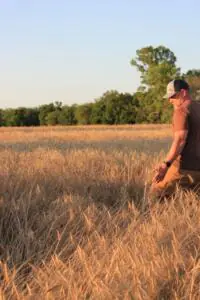
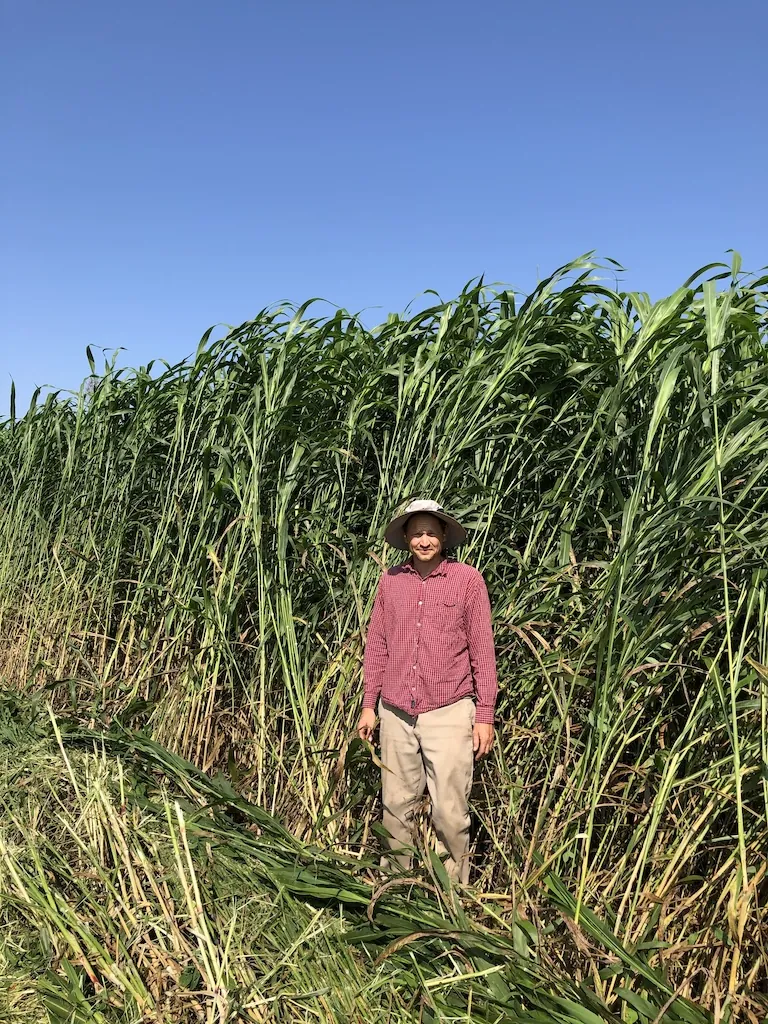
Farmer Chris Barnett walks through a wheat field. Source: Christopher Organic Farm

Chris Barnett of Christopher Organic Farm.

Chris Barnett describes himself as “a second-generation rancher and first-generation farmer.” He is the owner and operator of Christopher Organic Farm, a 1,600-acre livestock and organic row-crop farm in Fort Scott, Kansas. His family has been stewarding their land in Southeast Kansas for over 40 years, all without chemical inputs.

Returning to his family’s ranch as an adult, Chris took a leap into pursuing organic row crops in addition to ranching. In 2025, he began growing organic wheat, obtaining organic certification through OCIA.

After years of careful stewardship, Chris is beginning to see the results of his hard work: the native prairie is flourishing, wildlife is returning, and the health of his 300-head cow-calf herd is improving.

“It’s a whole ecosystem boost,” Chris says. “Everything is just flourishing out there. It’s been a beautiful process.”

As a first-generation farmer, and an organic farmer at that, mentorship was pivotal for Chris. Diving into certification, Chris said that the administrative side was daunting. He decided to enroll in the Transition to Organic Partnership Program (TOPP) to ease the process.

“I wouldn’t be where I’m at, doing what I’m doing, without the TOPP program,” Chris shared. Through the TOPP program, he was matched with mentor Jack Gieger, of Gieger Grains in Robinson, Kansas. Since Chris’s land had been farmed without synthetic inputs, he was able to break sod and plant organic row crops in his first year. Throughout the process, Jack was a go-to source of information. “Because of my mentor, I successfully harvested a wheat crop my first year farming.” 

Through the program, he was also able to plug into existing organic markets and build relationships with other farmers. One of these farmers was Alan Wilson, of Renegade Farms.

Alan Wilson: Starting From Scratch
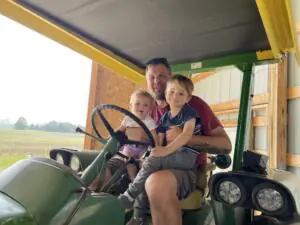
Alan Wilson poses on a tractor with his children.Source: Renegade Farms

Alan Wilson of Renegade Farms and his children.

Alan Wilson has started a farm from scratch—twice. A first-generation farmer, Alan began farming in 2015 with “zero acres and zero experience” in Northeast Kansas, before moving to Huntington, Indiana, where he has been farming for the last five years. Alan is the owner and operator of Renegade Farms, newly renamed, growing organic row crops including soybeans, corn, oats, and wheat. Cover crops are central to Alan’s farming philosophy: “We like to have something living in the ground 340 days out of the year, if we can get away with it.” 

Alan first turned to organic for a reliable income stream: “From the initial starting point, it was like how are we going to make farming work as a business and not a really expensive hobby?” But over time, the benefits to the land, and especially the soil, became more clear. “I understand that we’re taking [from the land], but we’re trying to give back at the same time.” 

Alan’s farm has been certified since 2018—of their 475 acres, 170 is certified organic, and about 275 are in transition. “I don’t think there’s been a year yet that we have not been transitioning land in some way, shape, or form.” Starting from scratch, starting over in a new location, and consistently transitioning land have had a steep learning curve for Alan, and, like Chris, he found guidance through peer networks and mentorship.

Alan first met Jack at a farming event and began to pick his brain about organic row crops to see if it would possibly be viable for his operation. Since then, Jack has been his main source of guidance. “I talk to him almost daily,” Alan shares.

Jack Geiger: Building a Network of Farmers

Jack Gieger speaking in front of his cattle. Source: Geiger Farms Youtube channel

Jack Geiger of Geiger Grains on his YouTube channel.

Jack Geiger’s family has been farming their land in Kansas since 1856, but the decision to farm organically was spurred by the 1980’s farm crisis. As the price of synthetic inputs became prohibitively expensive, organic methods presented a path to economic viability. Since Jack’s father certified the farm in the 1980s, they have been growing organically ever since.

Today, Jack owns and operates Geiger Grain in Robinson, Kansas, growing organic wheat and seed, and raising organically managed cattle. For Jack, sharing knowledge has been foundational to his farming career. At the time the farm became certified, “the organic movement” was still relatively new. To learn more about organic farming practices, he sought out other farmers in a similar situation. “I’m part of a class of five guys who all started out at basically the same time. We were young kids when the organic thing took off. And so we formed a peer network.”

In 2016, Jack began posting farming how-to videos on YouTube as Geiger Farms. The response was enthusiastic—the videos amassed over 3 million views on the platform, and farmers began reaching out to Jack for advice.

That’s how Jack met the first of his mentees. More recently, Jack became a mentor through the TOPP program. He says joining the program has encouraged him to “be more professional” in his mentoring. One example was creating a group chat for his mentees.

“Peer-to-peer learning is the most important. And the reality is, I am not a peer to most of them. They consider me to be like a subject matter expert. So when I started hooking the guys up amongst themselves, wonderful things happened.” 

Both Alan and Chris mentioned the 15-20 person group chat, where they share crop prices, input sources, marketing information, and practical advice. For Alan and Chris, who are both surrounded by conventional farming operations, the ability to get multiple perspectives from growers working in different regions, and quickly, has been a huge help. “I have the group listed as Jack’s Misguided Children,” Alan jokes.

Reciprocal Learning
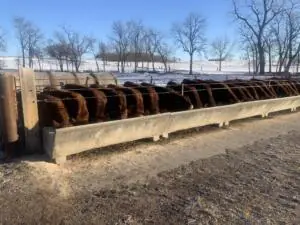
Cows on the bunk at Geiger GrainsSource: Geiger Grain

Calves on the bunk at Geiger Grain.

For organic farmers, learning is an essential principle. “So much of organic is knowledge-based, but it’s also learning how to fine-tune that knowledge base to your particular climate and your particular skill set,” Jack shares. He sees a fundamental difference between what he calls conventional agriculture’s “farming by prescription” and the management required in organic agriculture. “There are basic rules and principles that all organic farmers are bound to, in the National Organic Standard, but you have to tune them to your abilities and to your environment. And that is the trick, because everybody has different abilities, and everybody has different skills.”

What works on Jack’s farm might not be a perfect fit for his mentees’ farms, but through adaptation, they can still learn from these organic strategies. One example of this is Alan incorporating livestock into his operation. Jack’s farm benefits from the integrated use of cattle, reducing his need for soil inputs and increasing the overall health of his land through grazing. Alan doesn’t raise livestock, but his neighbor does. This year, Alan began bringing his neighbor’s cows onto his land to help with his soil fertility.

Jack’s mentees have also challenged him to rethink some of his own practices, particularly their interest in organic no-till and lower-mechanization systems. Jack is a mechanized, full-till farmer. Their questions have pushed him to reconsider his own approach. “Their pursuit of no-till has inspired me over the last, you know, decade to increase my use of cover crops and reduce my tillage.”

“Mentoring is a two-way street,” Jack shares. “My mentees actually teach me just as much as I teach them. It’s a wonderful exercise where we both learn from each other.” 
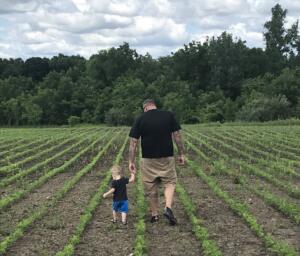
Farmer Alan Wilson walking through a field hand in hand with his son. Source: Renegade Farms

Alan walks the farm with his son.

Alan echoed this sentiment, reflecting on how his relationships with other farmers have improved his craft. Farming takes a lot of trial and error, and learning through the organic farming community, you can save yourself some mistakes. “If you can learn something that’s going to save you two or three years’ worth of mistakes, that’s a big deal. It can save you a lot of time and a lot of heartache and a lot of financial stress as well.”

“I think that the organic farming community is one of the most open groups of people that are in competition with each other, maybe on the planet,” Alan says.

Chris agreed, sharing “TOPP is the most meaningful and impactful program available to anyone seeking to start or transition into organic farming.” 

Fostering these types of relationships is what Jack sees as the greatest benefit of the TOPP program. “[It’s] a wonderful program. The things that we have built and the relationships, they’re going to continue on long after this.” The farmers who receive guidance today may become mentors themselves, carrying knowledge into new communities and new farms. “I think of it as teaching teachers.”

For Chris, Alan, and Jack, TOPP didn’t just create mentor-mentee relationships; it created a growing network of farmers learning from each other.

“The best way to go through life,” Alan says. “To be continuously learning. And when you find something you love doing, learning isn’t painful, it’s enjoyable.”

Learn more about the Transition to Organic Partnership Program: 
By |2026-09-30T13:09:03-04:00September 30th, 2026|Farmer Stories, News|

Your Region, Your Research: What’s New on the Organic Research Hub

Written by: Ashley Dulaney, OFRF’s Communications Director

Versión en español a continuación.

If you farm organic, you already know the problem: the research you need is out there, but finding it means digging through university extension sites, government databases, and search results that are built for conventional agriculture—not yours.
That’s exactly why OFRF built the Organic Research Hub and why we’re excited to share what’s new. 

What Is the Organic Research Hub?

OFRF's Organic Research Hub logo with an illustration of a hub-and-spoke visual with different illustrations in each spoke (farmers, cow, barn, wheat, magnifying glass over a leaf, beet in soil) with a map of the US with stars spread across it and a report-looking illustration below it, in the center of the illustration

The Organic Research Hub is a free, USDA-funded, searchable library of research-backed resources built specifically for organic and transitioning producers. Whether you’re navigating a conservation program like the Natural Resources Conservation Service’s Environmental Quality Incentives Program (EQIP) or Conservation Stewardship Program (CSP), working through your organic transition, or troubleshooting a challenge on the farm, the Hub puts practical, science-backed answers in one place, instead of scattered across the internet.

For many of the studies in the Hub, you don’t have to wade through a dense academic paper to get what you need. Our team translates the research into plain-language summaries that lay out the methods and outcomes up front, so you can see what was tested and what it means for your farm in a few minutes. Many resources already have summaries, and for those that don’t, we’re adding more all the time.

We’ve spent over three decades as a trusted source of organic farming research and technical guidance. The Hub makes that trove of knowledge searchable in one place for the first time.

What’s New on the Hub

Over the past few months, we’ve been adding new features based on what organic farmers have told us they need. Here’s what’s new:
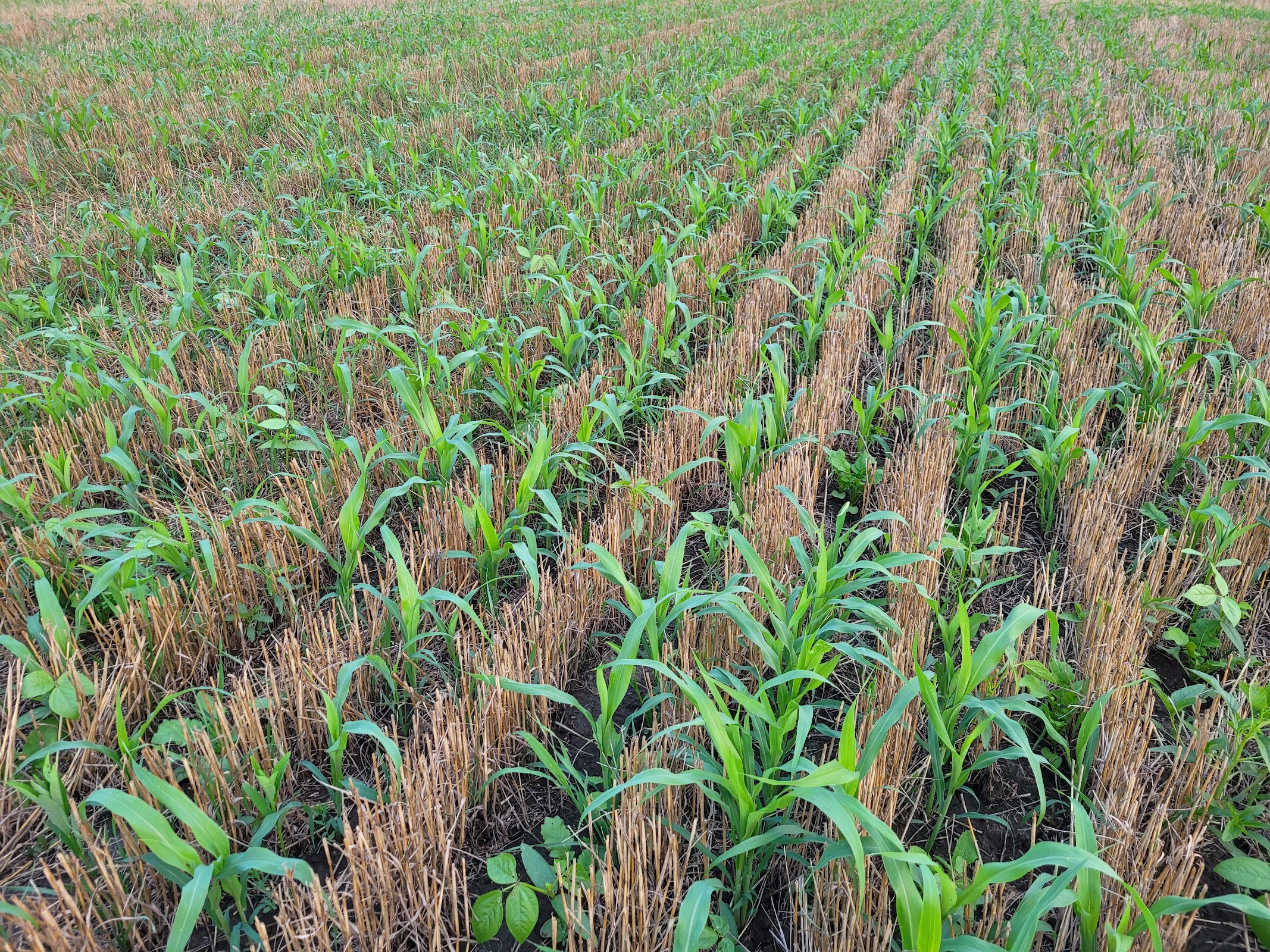
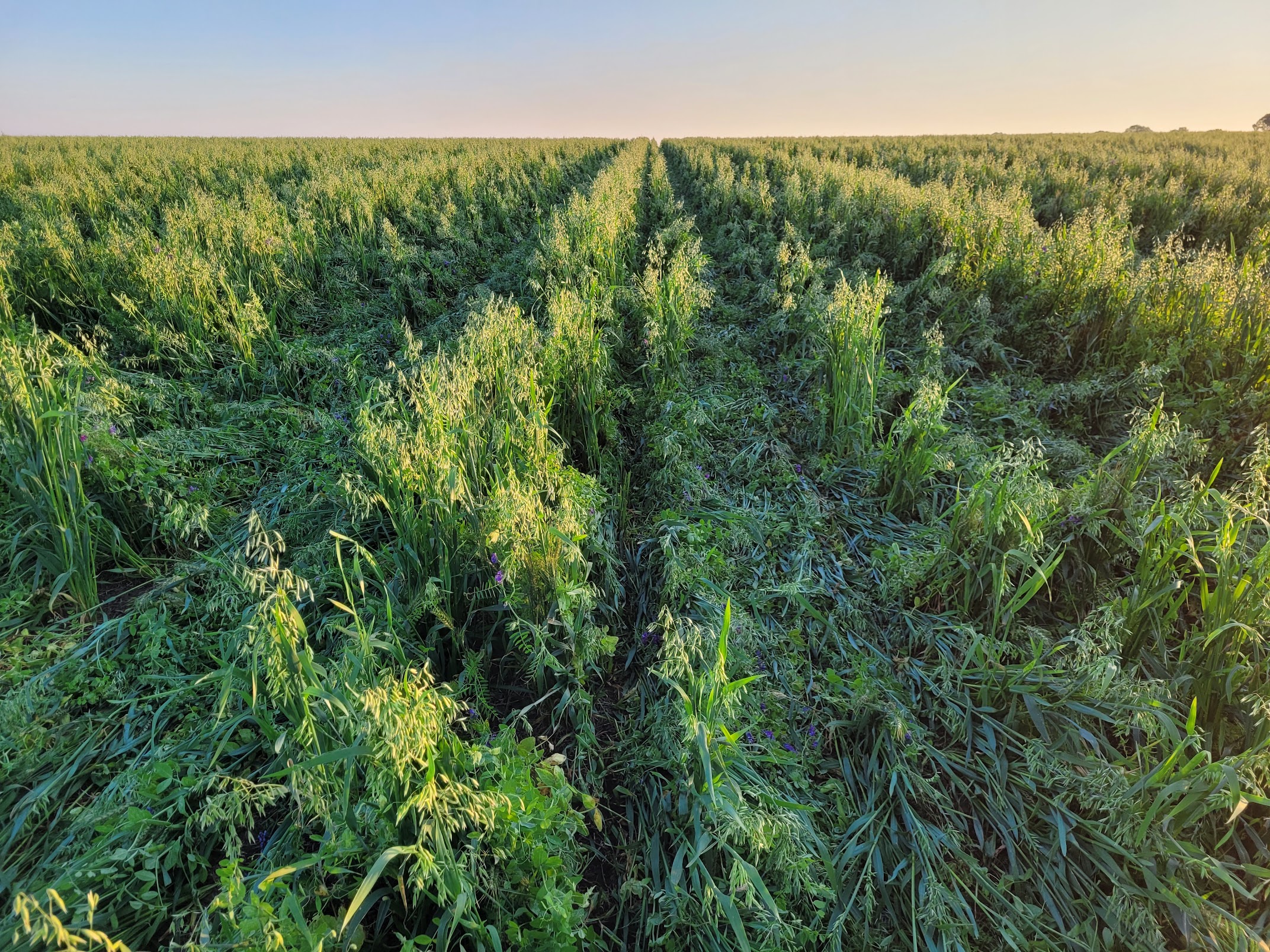
Pages built for your region. 

The Hub now has dedicated pages for each of the six TOPP regions—Midwest, Northeast, Northwest, Plains, Southeast, and West/Southwest—bringing together the resources, experts, and grants most relevant to your climate, soil, and growing conditions. No more filtering through results that don’t apply to you. 

A bigger Directory of Experts. 

You can now search over 300 verified Extension agents, researchers, and technical service providers nationwide by name, state, region, or on a clickable map of the U.S. Every person listed is vetted by OFRF and works in organic or organic-adjacent agriculture, so you’re not sorting through contacts who don’t know the difference between organic and conventional practices. If you’d rather talk through a decision with a real person than read another factsheet, this is where to start.

You can now view the Hub in Spanish.

Growers can select their preferred language, English or Spanish, so more research is accessible to more farmers.

A dedicated USDA Organic Research Grant Database. 

Curious what organic research is currently being funded? You can now browse USDA OREI (Organic Agriculture Research & Extension Initiative) and ORG (Organic Transition Program) grant projects and reports directly, searchable by keyword, program, year, or award number.

Alerts that do the searching for you.

Set up a free, personalized alert by topic, region, or keyword, and new matching resources will land in your inbox daily, weekly, monthly, or as soon as they’re posted. Subscribe once, and stop searching the same terms over and over.

Get Your Region’s Resource Factsheet

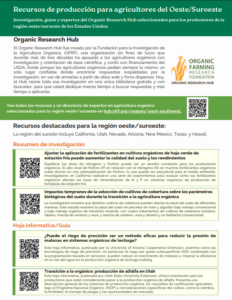
Alongside the Hub itself, we’ve put together a printable, one-page factsheet for each region. It’s a quick reference guide to the research, tools, and local experts curated specifically for your area, plus a QR code straight to your region’s page on the Hub. 

Download your region’s factsheet below as it becomes available:

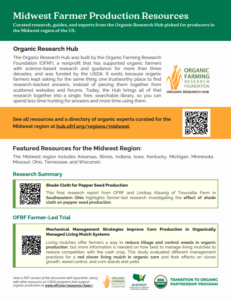
Front page of TOPP Midwest Organic Research Hub Regional factsheet

AR, IL, IN, IA, KY, MI, MN, MS, OH, TN, WI

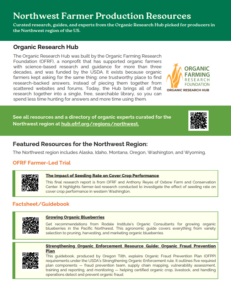
Front page of TOPP Northwest Organic Research Hub Regional factsheet

AK, ID, MT, OR, WA, WY

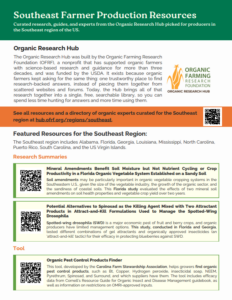
Front page of TOPP SE Organic Research Hub Regional factsheet

AL, FL, GA, LA, MS, NC, PR, SC, USVI

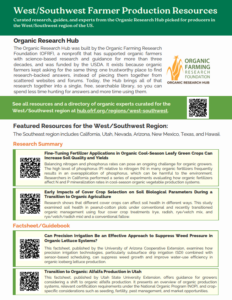
Front page of TOPP West/Southwest Organic Research Hub Regional factsheet

 AZ, CA, HI, NV, NM, TX, UT

Coming Soon!

Plains
(CO, KS, NE, ND, OK, SD)

Northeast/Mid-Atlantic
(CT, DE, ME, MD, MA, NH, NJ, NY, PA, RI, VT, VA, WV)

Want more organic farming resources for your region? Sign up here, and we’ll email them to you as they become available.

Explore What’s Been Built for You

The research, tools, and people you need to farm organically with confidence are already gathered in one place: the Organic Research Hub, built for your region, now in Spanish, and free to use.

Have a resource that should be included, or a question about what you find? Reach out to our team; we’re always adding to the Hub.

Su región, su investigación: lo nuevo en el Organic Research Hub

Si usted produce de manera orgánica, ya conoce el problema: la investigación que necesita existe, pero encontrarla implica rebuscar entre sitios de extensión universitaria, bases de datos gubernamentales y resultados de búsqueda pensados para la agricultura convencional, no para la suya.

Justamente por eso OFRF creó el Organic Research Hub y por eso nos entusiasma compartir las novedades. 

¿Qué es el Organic Research Hub?

OFRF's Organic Research Hub logo with an illustration of a hub-and-spoke visual with different illustrations in each spoke (farmers, cow, barn, wheat, magnifying glass over a leaf, beet in soil) with a map of the US with stars spread across it and a report-looking illustration below it, in the center of the illustration

El Organic Research Hub es una biblioteca gratuita, financiada por el USDA y con buscador, de recursos respaldados por la investigación, creada específicamente para productores orgánicos y en transición. Ya sea que usted esté gestionando un programa de conservación del Natural Resources Conservation Service (Servicio de Conservación de Recursos Naturales, NRCS) como el Environmental Quality Incentives Program (Programa de Incentivos para la Calidad Ambiental, EQIP) o el Conservation Stewardship Program (Programa de Administración de la Conservación, CSP), esté realizando su transición a lo orgánico o esté resolviendo un problema en la finca, el Hub reúne respuestas prácticas y con respaldo científico en un solo lugar, en vez de dispersas por todo el internet.

En muchos de los estudios del Hub, usted no tiene que abrirse paso entre un denso artículo académico para obtener lo que necesita. Nuestro equipo traduce la investigación a resúmenes en lenguaje sencillo que presentan los métodos y los resultados desde el inicio, para que en pocos minutos vea qué se puso a prueba y qué significa para su finca. Muchos recursos ya cuentan con resúmenes y, para los que aún no los tienen, seguimos agregando más todo el tiempo.

Llevamos más de tres décadas siendo una fuente confiable de investigación y orientación técnica sobre agricultura orgánica. El Hub hace que ese acervo de conocimiento sea consultable en un solo lugar por primera vez.

Lo nuevo en el Hub

Durante los últimos meses hemos agregado nuevas funciones a partir de lo que los agricultores orgánicos nos han dicho que necesitan. Esto es lo nuevo:

Páginas hechas para su región. 

El Hub ahora tiene páginas dedicadas a cada una de las seis regiones de TOPP — Medio Oeste, Noreste, Noroeste, Grandes Llanuras, Sureste y Oeste/Suroeste—que reúnen los recursos, expertos y subvenciones más pertinentes para su clima, su suelo y sus condiciones de cultivo. Ya no tendrá que filtrar resultados que no le aplican.

Un directorio de expertos más amplio. 

Ahora puede buscar entre más de 300 agentes de Extensión, investigadores y proveedores de servicios técnicos verificados de todo el país, por nombre, estado, región o en un mapa interactivo de los Estados Unidos. Cada persona incluida ha sido verificada por OFRF y trabaja en agricultura orgánica o afín a lo orgánico, así que usted no estará revisando contactos que no distinguen entre prácticas orgánicas y convencionales. Si prefiere conversar una decisión con una persona real en lugar de leer otra hoja informativa, este es el lugar para empezar.

Ahora puede ver el Hub en español.

Los productores pueden seleccionar su idioma preferido, inglés o español, para que más investigación sea accesible para más granjeros.

A dedicated USDA Organic Research Grant Database. 

Una base de datos dedicada a las subvenciones de investigación orgánica del USDA.
¿Le interesa saber qué investigación orgánica se está financiando actualmente? Ahora puede consultar directamente los proyectos e informes de las subvenciones OREI, Iniciativa de Investigación y Extensión en Agricultura Orgánica y ORG, Programa de Transición Orgánica del USDA con búsqueda por palabra clave, programa, año o número de adjudicación.

Alertas que buscan por usted.

Configure una alerta gratuita y personalizada por tema, región o palabra clave, y los nuevos recursos que coincidan llegarán a su correo a diario, semanalmente, mensualmente o apenas se publiquen. Suscríbase una vez y deje de buscar los mismos términos una y otra vez.

Obtenga la hoja informativa de recursos de oeste/suroeste

Junto con el Hub, hemos preparado una hoja informativa imprimible de una página para el oeste/suroeste. Es una guía de referencia rápida sobre la investigación, las herramientas y los expertos locales seleccionados específicamente para su zona, además de un código QR que lleva directamente a la página de su región en el Hub. 

Descargue la hoja informativa del oeste/suroeste:

Explore lo que se construyó para usted

La investigación, las herramientas y las personas que usted necesita para producir de manera orgánica con confianza ya están reunidas en un solo lugar: el Organic Research Hub, creado para su región, ahora en español y de uso gratuito.

¿Quiere más recursos de agricultura orgánica para su región? Regístrese aquí y se los enviaremos por correo electrónico conforme estén disponibles.

¿Tiene un recurso que debería incluirse o una pregunta sobre lo que encontró? Comuníquese con nuestro equipo; siempre estamos agregando contenido al Hub.

By |2026-10-02T11:56:28-04:00September 25th, 2026|News|

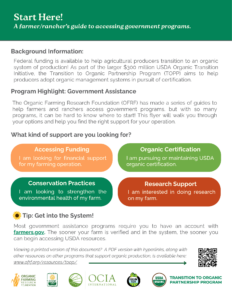
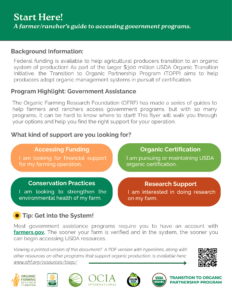
Start Here! An Organic Farmer/Rancher’s Guide to Government Programs

Versión en español a continuación.

The United States Department of Agriculture (USDA) offers myriad programs to farmers and ranchers seeking financial and technical assistance support. But with so many options, it can be hard to know where to start! OFRF has made a series of guides to demystify government programs, with easy, step-by-step application support. Use this guide to find the specific help you’re looking for, so you can get off your computer and back into the field!

What type of support do you need?

Tip: Get into the System Early! Most government assistance programs require you to have an account with farmers.gov. The sooner your farm is verified and in the system, the sooner you can begin accessing USDA resources.

Funding and Financial Resources

Accessing funding is a vital part of every farm’s journey. Whether you are looking to purchase land, insure your crops, fund a new conservation or research projects, or just cover day to day operation costs, financial resources are available to you!

Farm Service Agency (FSA) Loans

Accessing funding is a vital part of every farm’s journey. Whether you are looking to purchase land, insure your crops, fund a new conservation or research projects, or just cover day to day operation costs, financial resources are available to you!

The Farm Service Agency (FSA) is a crucial financing resource for farmers. It can help guarantee loans made by commercial lenders or issue direct loans to farmers when they cannot access credit or favorable terms and rates from a bank. The FSA can also be the “Lender of First Opportunity” for beginning farmers.

Eligible Applicants: Family-size farmers/ranchers who cannot obtain commercial credit from a bank, Farm Credit System institution, or other lender.

Funding Available: Direct and guaranteed farm ownership (FO) and operating loans (OL).

Projects Funded: FSA offers a variety of loan types including but not limited to: farm ownership and operating, beginning farmers, emergencies, and more.

Application Deadline: Applications are accepted on a rolling basis.

Whole Farm Revenue Program (WFRP)

The Whole-Farm Revenue Protection (WFRP) policy is a crop insurance option developed by the Risk Management Agency (RMA) and administered by the Federal Crop Insurance Corporation (FCIC). Through WFRP, farmers can get a single crop insurance policy for their entire farm, making it a great option for organic and diversified farms.

Eligible Applicants: Farmers/Ranchers in the U.S. or territories. It is best suited to farms with a range of commodities that sell to wholesale markets.

Insurance Coverage: WFRP protects against revenue loss due to natural disasters or market shifts, up to $17 million. Actual coverage amount will depend on the specific farm. Use our WFRP calculator to get an estimate!

Application Deadline: Dates will vary by crop and location, with the first filing date usually occurring in Spring.

More Financial Opportunities

If you are looking for financial support for organic certification, see OCCSP.

If you are looking for financial support for implementing conservation practices on your farm, see EQIP or CSP.

If you are looking for financial support for research projects on your farm, see SARE.

USDA Organic Certification

The USDA’s National Organic Program (NOP) is a federal regulatory program that enforces standards for organic products sold in the U.S. Farmers pursue organic certification for various reasons, including improving soil health, reducing reliance on synthetic inputs, enhancing biodiversity, contributing to a more sustainable food system, and taking advantage of the economic opportunities it presents, such as accessing new organic markets and higher price premiums. Certification requires additional recordkeeping, and may include a transitional period before certification can be administered. If you’ve decided that certification is the right path for your farm, we have resources to guide you through.

Organic Certification Cost Share Program (OCCSP)

The Organic Certification Cost Share Program (OCCSP) is a USDA program that helps cover part of your organic certification costs, including registration in a state organic program. In the past, the OCCSP has reimbursed 75% of fees up to a maximum of $750 per scope. Scopes include crops, wild crops, livestock, and processing/handling.

Eligible Applicants: Certified organic producers and handlers in the United States or its territories.

Funding Available: 75% reimbursement of their organic certification fees up to a maximum of $750 per certification. If you have multiple certification scopes, you can apply for assistance with each certification.

Covered Costs: Application fees, organic inspection costs, fees related to equivalency requirements, travel and per diem fees for inspectors, user fees, sales assessments, and postage.

Application Deadline: Applications are generally due at the end of the calendar year.

The Organic Transition Initiative (OTI)

The Organic Transition Initiative (OTI) is a USDA agency that works to help transitioning farmers. Before becoming certified organic, farmers must complete a 36-month period managing their land without prohibited inputs. This time period can present challenges for growers, as their land adapts to organic management and they are not yet benefiting from the higher price premium from the organic label. Explore OTI’s resources to aid with the transitional period.

Transition to Organic Partnership Program (TOPP)

The Transition to Organic Partnership Program (TOPP) is a collaborative partnership created to guide transitioning farmers. Through the program, producers can be matched with a mentor to guide them through becoming certified organic and offer ongoing support.

Natural Resources Conservation Service (NRCS) Support

NRCS offers help to producers implementing conservation activities required for certification, receiving expert technical support, and recovering foregone income due to reduced yields during the organic transition period through OTI. Read our guide to learn how to communicate with your NRCS agent about accessing support for your organic transition.

If you are looking for support on implementing conservation practices on your farm, see Increasing Conservation.

Learn more about USDA Organic Certification

The organic transition period and USDA requirements present a learning curve for farmers. Luckily, we have advice from farmers who have done it before!

Increasing Conservation

The Natural Resources Conservation Service (NRCS) is a federal agency that supports the adoption of conservation practices by providing farmers, ranchers, foresters, and landowners with technical and financial assistance. They work to address resource concerns related to soil, water, plants, animals, air, and energy; help producers and landowners achieve conservation goals; and enhance the long-term sustainability of US agriculture. If you are interested in increasing conservation practices on your land, your local NRCS office is a good place to start!

NRCS Farmer Stories:

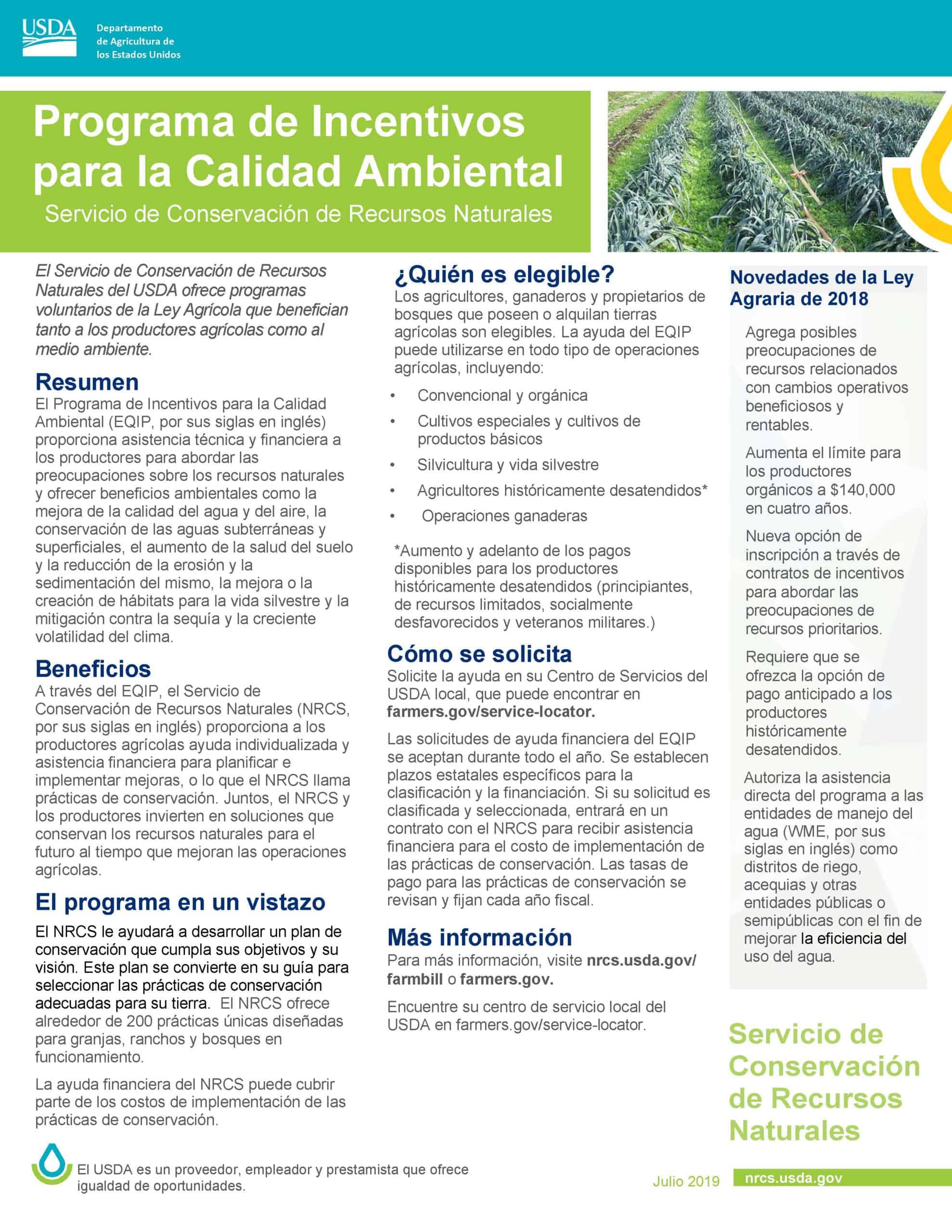
Environmental Quality Incentives Program (EQIP)

The Environmental Quality Incentives Program (EQIP) from NRCS offers a variety of technical and financial assistance opportunities for farmers and ranchers, including the High Tunnel Initiative, the On Farm Energy Initiative, and the Organic Initiative.

Eligible Applicants: Agricultural producers; non-industrial private forest-owners; federally recognized tribes; water management entities.

Funding Available: Cost-share covering building, resource, and labor costs. Amount of funding varies on availability.

Projects Funded: New projects or infrastructure addressing a natural resource concern. Ex. building a high tunnel, establishing a cover cropping system, fencing for rotational grazing.

Project Length: 1-10 years.

Application Deadline: Applications are accepted on a rolling basis throughout the year, with the first batching deadline generally falling in early January.

Conservation Stewardship Program (CSP)

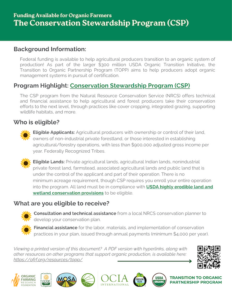
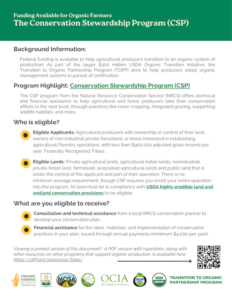
The Conservation Stewardship Program (CSP) from NRCS offers technical and financial assistance to help agricultural and forest producers take their conservation efforts to the next level, through practices like cover cropping, integrated grazing, supporting wildlife habitats, and more.

Eligible Applicants: Agricultural producers; non-industrial private forest-owners; federally recognized tribes.

Funding Available: Annual minimum payments of $4,000.

Projects Funded: Projects that maintain or enhance conservation efforts, e.g., trialing new cover crop mixes, planting agroforestry projects, increasing pollinator habitats.

Project Length: 5 years, with renewal available.

Application Deadline: Applications are accepted on a rolling basis throughout the year, with the first batching deadline generally falling in early January.

CSP Farmer Stories

EQIP and CSP: What’s the Difference? Both programs provide funding opportunities for conservation efforts, and many farmers use both on their farm. EQIP is a cost-share program for projects that address a specific natural resource concern and establish a new conservation practice (like establishing a cover cropping system or planting natives to reduce erosion). CSP provides annual payments to help farmers maintain or enhance existing conservation strategies on their farm (like trialing new cover crop mixes or planting natives to increase pollinator habitats). EQIP contracts are a specified length (1-10 years), while CSP contracts are 5 years and can be renewed. Farmers often start with an EQIP contract to address a specific issue, and then maintain the practice through an ongoing CSP contract.

Conservation Programs and Organic Certification

Despite both being administered by USDA, NRCS conservation practices and USDA certification requirements may not perfectly align. NRCS’s Technical Note 12 strives to bridge that gap, outlining the overlap between NRCS resource concerns and NOP organic standards.

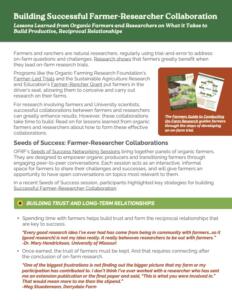
Conducting Research

Organic farmers and ranchers often test and experiment with new ideas to improve their farming operations. If you are looking to turn your informal farm research into more structured research projects, OFRF has the tools to get you started!

Sustainable Agriculture Research and Education (SARE)

The Sustainable Agriculture Research and Education (SARE) Farmer/Rancher Grant Program is a competitive grant program that provides funding to producers who have designed their own research projects and teams. This program aims to award funding to projects that address real-world, on-farm challenges and include both research and outreach components.

Eligible Applicants: Commercial farmers and ranchers with an income of at least $1,000 annually.

Funding Available: Financial assistance for the entirety of your proposed project, up $15,000-35,000; varies regionally.

Projects Funded: SARE provides grants for the entirety of a research project, from designing the trial to sharing the results. Ex. Trialing organic pest or weed management strategies, comparing cover crop mixes or rotations, testing compost or organic fertilizer effects.

Project Length: Between 1-3 years, depending on region.

Application Deadline: Applications vary by region between early fall and late winter.

Find your SARE Region: There are four SARE regions and requirements and funding availability may vary based on location.

Northeast SARE: Connecticut, Delaware, Maine, Maryland, Massachusetts, New Hampshire, New Jersey, New York, Pennsylvania, Rhode Island, Vermont, West Virginia.

North Central SARE: Illinois, Indiana, Iowa, Kansas, Michigan, Minnesota, Missouri, Nebraska, North Dakota, Ohio, South Dakota, Wisconsin.

Southern SARE: Alabama, Arkansas, Florida, Georgia, Kentucky, Louisiana, Mississippi, North Carolina, Oklahoma, Puerto Rico, South Carolina, Tennessee, Texas, U.S. Virgin Islands, Virginia.

Western SARE: Alaska, American Samoa, Arizona, California, Colorado, CNMI, FSM, Guam, Hawaii, Idaho, Montana, Nevada, New Mexico, Oregon, Utah, Washington, Wyoming.

Getting Started with On-Farm Research

SARE favors farmers who have a developed research proposal and have made connections with research professionals. If you are looking to dip your toe into more structured research before submitting a SARE proposal, explore our resources!

All of this information is summarized in a printable, downloadable PDF below, available in English and Spanish.

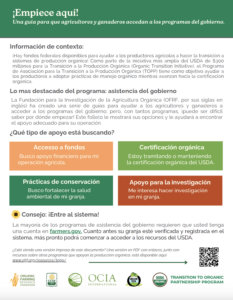
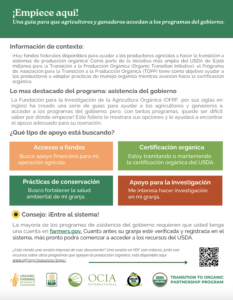
¡Empiece aquí! Guía de programas del gobierno para agricultores y ganaderos orgánicos

El Departamento de Agricultura de los Estados Unidos (USDA, por sus siglas en inglés) ofrece innumerables programas para agricultores y ganaderos que buscan apoyo con asistencia financiera y técnica. Pero, con tantas opciones, ¡puede ser difícil saber por dónde empezar! OFRF ha creado una serie de guías para quitar los mitos acerca de los programas del gobierno, con apoyo sencillo y paso a paso para aplicar. Use esta guía para encontrar la ayuda específica que está buscando, ¡para que pueda dejar la computadora y volver al campo!

¿Qué tipo de apoyo necesita?

Consejo: ¡entre al sistema con anticipación! La mayoría de los programas de asistencia del gobierno requieren que usted tenga una cuenta en farmers.gov. Cuanto antes su granja esté verificada y registrada en el sistema, más pronto podrá comenzar a acceder a los recursos del USDA.

Fondos y recursos financieros

El acceso a fondos es una parte vital del camino de toda granja. Ya sea que usted busque comprar tierras, asegurar sus cultivos, financiar un nuevo proyecto de conservación o de investigación, o simplemente cubrir los costos de operación del día a día, ¡hay recursos financieros disponibles para usted!

Préstamos de la Agencia de Servicios Agrícolas (FSA)

La Agencia de Servicios Agrícolas (FSA, por sus siglas en inglés) es un recurso de financiamiento crucial para los agricultores. Puede ayudar a garantizar préstamos otorgados por prestamistas comerciales o emitir préstamos directos a los agricultores cuando estos no pueden acceder a crédito o a condiciones y tasas favorables en un banco. La FSA también puede ser el “prestamista de primera oportunidad” para agricultores que están iniciando.

Solicitantes elegibles: Agricultores y ganaderos de escala familiar que no pueden obtener crédito comercial de un banco, de una institución del Farm Credit System o de otro prestamista.

Fondos disponibles: Préstamos directos y garantizados para propiedad agrícola (FO, por sus siglas en inglés) y de operación (OL, por sus siglas en inglés).

Proyectos financiados: La FSA ofrece una variedad de tipos de préstamos que incluyen, entre otros: propiedad y operación agrícola, agricultores que están iniciando, emergencias y más.

Fecha límite de solicitud: Las solicitudes se aceptan de forma continua.

Programa de Protección de Ingresos para Toda la Granja (WFRP)

La póliza de Protección de Ingresos para Toda la Granja (WFRP, por sus siglas en inglés) es una opción de seguro de cultivos desarrollada por la Agencia de Manejo de Riesgos (RMA, por sus siglas en inglés) y administrada por la Corporación Federal de Seguros de Cosechas (FCIC, por sus siglas en inglés). A través del WFRP, los agricultores pueden obtener una sola póliza de seguro de cultivos para toda su granja, lo que la convierte en una gran opción para granjas orgánicas y diversificadas.

Solicitantes elegibles: Agricultores y ganaderos en los Estados Unidos o sus territorios. Es más adecuada para granjas con una variedad de productos que venden a mercados mayoristas.

Cobertura del seguro: El WFRP protege contra la pérdida de ingresos debida a desastres naturales o cambios en el mercado, hasta $17 millones. El monto real de la cobertura dependerá de cada granja. ¡Use nuestra calculadora del WFRP para obtener un estimado!

Fecha límite de solicitud: Las fechas varían según el cultivo y la ubicación; la primera fecha de presentación suele ocurrir en la primavera.

Más oportunidades financieras

Si busca apoyo financiero para la certificación orgánica, consulte el OCCSP.

Si busca apoyo financiero para implementar prácticas de conservación en su granja, consulte el EQIP o el CSP.

Si busca apoyo financiero para proyectos de investigación en su granja, consulte SARE.

Certificación orgánica del USDA

El Programa Nacional Orgánico (NOP, por sus siglas en inglés) del USDA es un programa regulatorio federal que hace cumplir las normas para los productos orgánicos que se venden en los Estados Unidos. Los agricultores buscan la certificación orgánica por diversas razones, entre ellas: mejorar la salud del suelo, reducir la dependencia de insumos sintéticos, aumentar la biodiversidad, contribuir a un sistema alimentario más sostenible y aprovechar las oportunidades económicas que esta presenta, como el acceso a nuevos mercados orgánicos y a precios más altos. La certificación requiere llevar registros adicionales y puede incluir un período de transición antes de que la certificación pueda otorgarse. Si usted ha decidido que la certificación es el camino correcto para su granja, tenemos recursos para guiarle en el proceso.

Programa de Costos Compartidos para la Certificación Orgánica (OCCSP)

El Programa de Costos Compartidos para la Certificación Orgánica (OCCSP, por sus siglas en inglés) es un programa del USDA que ayuda a cubrir parte de sus costos de certificación orgánica, incluida la inscripción en un programa orgánico estatal. En el pasado, el OCCSP ha reembolsado el 75% de las tarifas, hasta un máximo de $750 por alcance. Los alcances incluyen cultivos, cultivos silvestres, ganado y procesamiento/manejo.

Solicitantes elegibles: Productores y manejadores orgánicos certificados en los Estados Unidos o sus territorios.

Fondos disponibles: Reembolso del 75% de las tarifas de certificación orgánica, hasta un máximo de $750 por certificación. Si usted tiene múltiples alcances de certificación, puede solicitar asistencia para cada certificación.

Costos cubiertos: Tarifas de aplicación, costos de inspección orgánica, tarifas relacionadas con requisitos de equivalencia, viáticos de los inspectores, tarifas de usuario, contribuciones sobre ventas y franqueo postal.

Fecha límite de solicitud: Las solicitudes generalmente vencen al final del año calendario.

La Iniciativa de Transición Orgánica (OTI)

La Iniciativa de Transición Orgánica (OTI, por sus siglas en inglés) es una iniciativa del USDA que trabaja para ayudar a los agricultores en transición. Antes de obtener la certificación orgánica, los agricultores deben completar un período de 36 meses manejando sus tierras sin insumos prohibidos. Este período puede presentar desafíos para los productores, mientras sus tierras se adaptan al manejo orgánico y aún no se benefician del precio más alto de la etiqueta orgánica. Explore los recursos de la OTI como apoyo durante el período de transición.

Programa de Asociación para la Transición Orgánica (TOPP)

El Programa de Asociación para la Transición Orgánica (TOPP, por sus siglas en inglés) es una alianza colaborativa creada para guiar a los agricultores en transición. A través del programa, los productores pueden ser emparejados con un mentor que les guíe en el proceso de obtener la certificación orgánica y les ofrezca apoyo continuo.

Apoyo del Servicio de Conservación de Recursos Naturales (NRCS)

A través de la OTI, el NRCS ofrece ayuda a los productores para implementar las actividades de conservación requeridas para la certificación, recibir apoyo técnico especializado y recuperar los ingresos no percibidos debido a la reducción de rendimientos durante el período de transición orgánica. Lea nuestra guía para aprender a comunicarse con su agente del NRCS sobre cómo acceder a apoyo para su transición orgánica.

Si busca apoyo para implementar prácticas de conservación en su granja, consulte Aumentar la conservación.

Conozca más sobre la certificación orgánica del USDA

El período de transición orgánica y los requisitos del USDA representan una curva de aprendizaje para los agricultores. Por suerte, ¡tenemos consejos de agricultores que ya lo han hecho!

Aumentando la conservación

El Servicio de Conservación de Recursos Naturales (NRCS, por sus siglas en inglés) es una agencia federal que apoya la adopción de prácticas de conservación brindando asistencia técnica y financiera a agricultores, ganaderos, silvicultores y propietarios de tierras. Trabaja para atender los problemas de recursos relacionados con el suelo, el agua, las plantas, los animales, el aire y la energía; ayudar a los productores y propietarios de tierras a alcanzar sus metas de conservación; y mejorar la sostenibilidad a largo plazo de la agricultura de los Estados Unidos. Si le interesa aumentar las prácticas de conservación en sus tierras, ¡su oficina local del NRCS es un buen lugar para empezar!

Historias de agricultores con el NRCS

Programa de Incentivos para la Calidad Ambiental (EQIP)

El Programa de Incentivos para la Calidad Ambiental (EQIP, por sus siglas en inglés) del NRCS ofrece una variedad de oportunidades de asistencia técnica y financiera para agricultores y ganaderos, incluidas la Iniciativa de Túneles Altos, la Iniciativa de Energía en la Granja y la Iniciativa Orgánica.

Solicitantes elegibles: Productores agrícolas; propietarios de bosques privados no industriales; tribus reconocidas a nivel federal; entidades de manejo del agua.

Fondos disponibles: Costos compartidos que cubren costos de construcción, recursos y mano de obra. El monto del financiamiento varía según la disponibilidad.

Proyectos financiados: Proyectos nuevos o infraestructura que atiendan un problema de recursos naturales. Ej.: construir un túnel alto, establecer un sistema de cultivos de cobertura, cercar para pastoreo rotativo.

Duración del proyecto: De 1 a 10 años.

Fecha límite de solicitud: Las solicitudes se aceptan de forma continua durante todo el año, y la primera fecha límite de agrupación generalmente cae a principios de enero.

Programa de Administración para la Conservación (CSP)

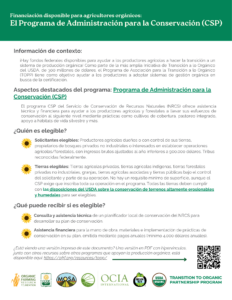
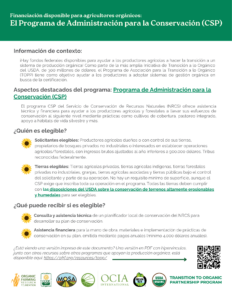
El Programa de Administración para la Conservación (CSP, por sus siglas en inglés) del NRCS ofrece asistencia técnica y financiera para ayudar a los productores agrícolas y forestales a llevar sus esfuerzos de conservación al siguiente nivel, mediante prácticas como cultivos de cobertura, pastoreo integrado, apoyo a los hábitats de vida silvestre y más.

Solicitantes elegibles: Productores agrícolas; propietarios de bosques privados no industriales; tribus reconocidas a nivel federal.

Fondos disponibles: Pagos anuales mínimos de $4,000.

Proyectos financiados: Proyectos que mantienen o mejoran los esfuerzos de conservación, p. ej., probar nuevas mezclas de cultivos de cobertura, plantar proyectos agroforestales, aumentar los hábitats de polinizadores.

Duración del proyecto: 5 años, con posibilidad de renovación.

Fecha límite de solicitud: Las solicitudes se aceptan de forma continua durante todo el año, y la primera fecha límite de agrupación generalmente cae a principios de enero.

Historias de agricultores con el CSP

El EQIP y el CSP: ¿cuál es la diferencia? Ambos programas ofrecen oportunidades de financiamiento para esfuerzos de conservación, y muchos agricultores usan ambos en su granja. El EQIP es un programa de costos compartidos para proyectos que atienden un problema específico de recursos naturales y establecen una práctica de conservación nueva (como establecer un sistema de cultivos de cobertura o plantar especies nativas para reducir la erosión). El CSP ofrece pagos anuales para ayudar a los agricultores a mantener o mejorar estrategias de conservación existentes en su granja (como probar nuevas mezclas de cultivos de cobertura o plantar especies nativas para aumentar los hábitats de polinizadores). Los contratos del EQIP tienen una duración determinada (de 1 a 10 años), mientras que los contratos del CSP son de 5 años y pueden renovarse. Los agricultores a menudo comienzan con un contrato del EQIP para atender un problema específico y luego mantienen la práctica mediante un contrato continuo del CSP.

Los Programas de Conservación y la Certificación Orgánica

A pesar de que ambos son administrados por el USDA, las prácticas de conservación del NRCS y los requisitos de certificación del USDA pueden no estar perfectamente alineados. La Nota Técnica 12 del NRCS busca cerrar esa brecha, describiendo la superposición entre los problemas de recursos del NRCS y las normas orgánicas del NOP.

Realizando investigaciones

Los agricultores y ganaderos orgánicos a menudo prueban y experimentan con nuevas ideas para mejorar sus operaciones agrícolas. Si usted busca convertir su investigación agrícola informal en proyectos de investigación más estructurados, ¡OFRF tiene las herramientas para que empiece!

Investigación y Educación en Agricultura Sostenible (SARE)

El Programa de Subvenciones para Agricultores/Ganaderos de Investigación y Educación en Agricultura Sostenible (SARE, por sus siglas en inglés) es un programa competitivo de subvenciones que otorga fondos a productores que han diseñado sus propios proyectos y equipos de investigación. Este programa busca financiar proyectos que atiendan desafíos reales dentro de la granja y que incluyan componentes tanto de investigación como de divulgación.

Solicitantes elegibles: Agricultores y ganaderos comerciales con un ingreso de al menos $1,000 anuales.

Fondos disponibles: Asistencia financiera para la totalidad del proyecto propuesto, de $15,000 a $35,000; varía según la región.

Proyectos financiados: SARE ofrece subvenciones para la totalidad de un proyecto de investigación, desde el diseño del ensayo hasta la difusión de los resultados. Ej.: probar estrategias orgánicas de manejo de plagas o malezas, comparar mezclas o rotaciones de cultivos de cobertura, evaluar los efectos del compost o de fertilizantes orgánicos.

Duración del proyecto: 

Fecha límite de solicitud: Las solicitudes varían por región entre principios del otoño y finales del invierno.

Encuentre su región de SARE: Hay cuatro regiones de SARE, y los requisitos y la disponibilidad de fondos pueden variar según la ubicación.

Northeast SARE: Connecticut, Delaware, Maine, Maryland, Massachusetts, New Hampshire, New Jersey, New York, Pennsylvania, Rhode Island, Vermont, West Virginia.

North Central SARE: Illinois, Indiana, Iowa, Kansas, Michigan, Minnesota, Missouri, Nebraska, North Dakota, Ohio, South Dakota, Wisconsin.

Southern SARE: Alabama, Arkansas, Florida, Georgia, Kentucky, Louisiana, Mississippi, North Carolina, Oklahoma, Puerto Rico, South Carolina, Tennessee, Texas, U.S. Virgin Islands, Virginia.

Western SARE: Alaska, American Samoa, Arizona, California, Colorado, CNMI, FSM, Guam, Hawaii, Idaho, Montana, Nevada, New Mexico, Oregon, Utah, Washington, Wyoming.

Cómo comenzar con la investigación en la granja

SARE favorece a los agricultores que tienen una propuesta de investigación desarrollada y que han establecido conexiones con profesionales de la investigación. Si usted quiere adentrarse en una investigación más estructurada antes de presentar una propuesta a SARE, ¡explore nuestros recursos!

Toda esta información se resume en un PDF imprimible y descargable a continuación, disponible en inglés y español.

By |2026-10-02T10:18:08-04:00September 16th, 2026|Federal Assistance, News, Spanish Resources|

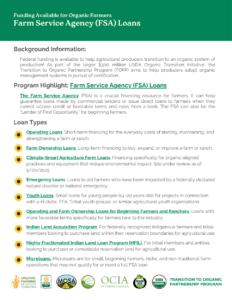
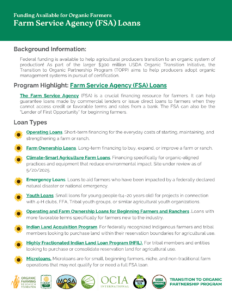
Financial Options for Your Farm: Farm Service Agency (FSA) Loans

Versión en español a continuación.

Access to affordable financing is one of the biggest barriers organic and transitioning farmers face. Whether you’re looking to buy land, cover certification costs, or simply keep your operation running through a tough season, knowing where to turn for capital can make all the difference. 

The USDA’s Farm Service Agency (FSA) offers a range of low-interest loan programs designed for farmers like you and can help you secure better rates through a commercial lender. Unfortunately, many of these programs go underutilized simply because farmers don’t know they exist. Let’s fix that. If you’re just starting out or looking to grow your farm, there’s likely an FSA loan designed for your situation.

Which FSA loan is right for me? 

The FSA offers various loan types tailored to specific farming operations, circumstances, and experiences. Read through the list below to find an FSA loan that best suits your needs. You can also use FSA’s free Loan Assistance Tool. 

Operating Loans.

Short-term financing for the everyday costs of starting, maintaining, and strengthening a farm or ranch.

  • Uses: Purchasing essential items like livestock, poultry, farm equipment, feed, seed, fuel, farm chemicals, insurance, and other operating expenses; Covering costs related to minor improvements, family living expenses, and refinancing certain debts; Covering certification costs, approved organic inputs, and the cash flow gaps during the transition period for USDA-certified or transitioning organic producers. 
  • Can be issued directly from FSA, or FSA can guarantee a loan from a commercial lender for a larger line of credit.
    • Maximum loan amount: $400,000.

Farm Ownership Loans.

Long-term financing to buy, expand, or improve a farm or ranch.

  • Uses: Regular loans, joint financing, or down payment options for purchasing land, essential farm improvements, or soil and water conservation and protection.
  • Can be issued directly from FSA, or FSA can guarantee a loan from a commercial lender for a larger line of credit.
    • Maximum loan amount: $600,000 ($300,150 for Beginning Farmer Down Payment).

Climate-Smart Agriculture Farm Loans.

Financing specifically for organic-aligned practices and equipment that reduce environmental impact. Site under review as of 5/20/2025.

  • Uses: Investing in climate-smart practices and equipment, like the establishment of rotational grazing systems, precision agriculture equipment, or machinery for conversion to no-till residue management.
  • Can be issued directly from FSA, or FSA can guarantee a loan from a commercial lender for a larger line of credit. Loan amounts:
    • Direct Farm Ownership Loans: Up to $600,000.
    • Direct Operating Loans: Up to $400,000.
    • Guaranteed Loans: Up to $1,825,000.
    • Microloans: Up to $50,000. 

Emergency Loans.

Loans to aid farmers who have been impacted by a federally declared natural disaster or national emergency.

  • Uses: Restoring/replacing property, reorganizing a family farm; Refinancing non-real estate debts; Assisting with production costs or family living expenses.
  • Direct loans through FSA.
    • Maximum loan amount: $500,000, but the amount a loan applicant may receive is limited to the actual production or physical loss caused by the disaster.

Youth Loans.

Small loans for young people (14–20 years old) for projects in connection with 4-H clubs, FFA, Tribal youth groups, or similar agricultural youth organizations. 

  • Uses: Purchasing livestock, seed, equipment, supplies, or paying operating expenses for the project.
  • Maximum loan amount: $10,000

Operating and Farm Ownership Loans for Beginning Farmers and Ranchers.

Loans with more favorable terms specifically for farmers new to the industry. To see if you qualify as a beginner farmer or rancher, read the definition here. 

Direct Farm Ownership Down Payment Loan

  • Uses: Covering a down payment on a farm for beginning farmers who can’t finance the full purchase alone.
  • Can be issued directly from FSA, or FSA can guarantee a loan from a commercial lender for a larger line of credit.
    • Maximum Loan Amount for a “regular” Direct Farm Ownership loan: $600,000. 
    • Maximum Loan Amount for a Joint Financing or Participation Farm Ownership: $600,000.
    • Maximum Loan Amount for a Direct Farm Ownership Down Payment loan amount works differently. The maximum loan amount under this loan program will not exceed 45 percent of whichever is the lesser amount of:
      • the purchase price;
      • the appraised value of the farm being purchased; or
      • $667,000.

Indian Land Acquisition Program.

For federally recognized Indigenous farmers and tribal members looking to purchase land within their reservation boundaries for agricultural use. 

  • Maximum Loan Amount: No specified maximum loan amount; the amount is based on the tribe’s financial needs and repayment ability.

Highly Fractionated Indian Land Loan Program (HFIL).

For tribal members and entities looking to purchase or consolidate reservation land for agricultural use. 

  • Uses: Purchasing fractionated land with the intention to reduce fragmentation and promote more effective land management, agricultural productivity, and economic development within tribal areas.
  • Maximum Loan Amount: $500,000 per applicant.

Microloans.

Microloans are for small, beginning farmers, niche, and non-traditional farm operations that may not qualify for or need a full FSA loan. There are two types of microloans: 

    • Uses: Essential tools; Fencing and trellising; Hoop houses; Bees and bee equipment; Milking and pasteurization equipment; Maple sugar shack and processing equipment; Livestock, seed, fertilizer, utilities, land rents, family living expenses, and other materials essential to the operation; Irrigation; GAP (Good Agricultural Practices), GHP (Good Handling Practices), and Organic certification costs; Marketing and distribution costs, including those associated with selling through Farmers’ Markets and Community Supported Agriculture operations; Pay for qualifying OSHA compliance standards (Federal or State)
    • Maximum Loan Amount: Operating Microloans provide up to $50,000 per loan.
    • Uses: Making a down payment on a farm; Building, repairing, or improving farm buildings, service buildings, farm dwellings; soil and water conservation projects. May also be used as a Downpayment Farm Ownership Loan or in Joint Financing.
    • Maximum Loan Amount $50,000, which includes any possible outstanding FSA Direct Operating or Farm Ownership unpaid principal loan balances. A loan applicant may have a Guaranteed Operating loan, Farm Ownership loan or Emergency loan and still qualify for a Microloan.

All of this information is summarized in a printable, downloadable PDF below, available in English and Spanish.

How to Apply for an FSA Loan

Step 1. Find your local FSA office.

All FSA loans, whether direct or guaranteed, are processed through your local FSA county office. Find your local office here.

Step 2. Schedule a meeting.

Call or visit your local office to discuss which loan types fit your situation. Bring any records you have about your farm operation, finances, and land. 

Here are some questions to consider: 

  • I’m interested in [loan type]. What do I need to bring to get started on an application?
  • Am I eligible for any loans with more favorable terms as a beginning, socially disadvantaged, or veteran farmer?
  • Can I apply for more than one loan type at the same time?
  • What is the repayment timeline for this loan?
  • Is funding currently available, and is there a better time of year to apply?

Step 3. Create a business plan. 

If you’re applying for a direct FSA loan or a commercial loan guaranteed by FSA, you’ll need a business plan. This doesn’t have to be intimidating! A farm business plan is essentially a clear picture of your operation, goals, and finances. FSA wants to see that you’ve thought through how your farm works and how you’ll repay the loan. 

Your detailed business plan should cover:

  • Your mission, vision, and goals for your farm or ranch.
  • Your current assets (property or investments you own) and liabilities (debts, loans, or payments you owe).
  • What your operation will produce, and how and where you will market and sell your products.
    • This is sometimes referred to as a marketing plan.
  • Whether the amount of income your operation will generate will be enough to pay your business and family living expenses.
  • For organic and transitioning producers, it’s worth being specific about your certification status or timeline, your expected transition costs, and how your marketing strategy accounts for the organic price premium.

FSA provides a step-by-step business plan builder to help you get started.

Step 4. Gather your documents.

Your loan officer will tell you exactly what’s needed, but commonly required documents include:

  • Government-issued ID.
  • Tax returns (typically 3 years).
  • Farm financial statements or records.
  • Proof of land ownership or lease agreement.
  • Business plan.
  • Organic certification or transition plan, if applicable.

Step 5. Submit your application.

Applications can be submitted directly through FSA or, for guaranteed loans, through a commercial lender. Your loan officer will guide you through this.

Step 6. Follow up.

Processing times vary by loan type. Stay in contact with your loan officer and respond quickly to any requests for additional information.

All of this information is summarized in a printable, downloadable PDF below, available in English and Spanish.

All of this information is summarized in a printable, downloadable PDF in English and Spanish below.

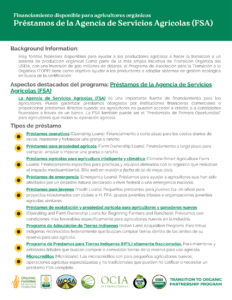
El acceso a financiamiento asequible es una de las mayores barreras a las que se enfrentan los agricultores orgánicos y en transición. Ya sea que busque comprar terrenos, cubrir los costos de certificación o simplemente mantener su operación en funcionamiento durante una temporada difícil, saber a dónde acudir para obtener capital puede marcar la diferencia. 

La Agencia de Servicios Agrícolas (FSA) del USDA  ofrece una variedad de programas de préstamos a bajo interés diseñados para agricultores como usted y puede ayudarle a conseguir mejores condiciones de financiamiento a través de un prestamista comercial.  Desafortunadamente, muchos de estos programas se usan poco simplemente porque los agricultores no saben que existen. Vamos a ayudar a cambiar eso. Si acaba de empezar o quiere hacer crecer su granja, probablemente haya un préstamo FSA diseñado para su situación.

¿Qué préstamo FSA es el adecuado para mí? 

La FSA ofrece diversos tipos de préstamos adaptados a operaciones agrícolas específicas, circunstancias y experiencias. Lea la lista a continuación para encontrar el préstamo FSA que mejor se adapte a sus necesidades. También puedes utilizar gratuitamente la herramienta de asistencia para préstamos de FSA. 

Préstamos operativos. (Operating Loans)

Financiamiento a corto plazo para los costos diarios de iniciar, mantener y fortalecer una granja o rancho.

  • Usos: Compra de artículos esenciales como ganado, aves, maquinaria agrícola, alimentos para animales, semillas, combustible, productos químicos agrícolas, seguros y otros gastos operativos; Cubrir costes relacionados con mejoras menores, gastos familiares y refinanciamiento de ciertas deudas; Cubrir los costos de certificación, insumos orgánicos aprobados y las carencias de flujo de caja durante el periodo de transición para productores orgánicos certificados o en transición por el USDA. 
  • Puede emitirse directamente desde FSA, o FSA puede garantizar un préstamo de un prestamista comercial para una línea de crédito mayor.
    • Monto máximo del préstamo: 400.000 dólares.

Préstamos para propiedad agrícola. (Farm Ownership Loans)

Financiamiento a largo plazo para comprar, ampliar o mejorar una granja o rancho.

  • Usos: Préstamos regulares, financiamiento conjunto u opciones de pago inicial (down payment) para la compra de tierras, mejoras agrícolas esenciales o conservación y protección del suelo y el agua.
  • Puede emitirse directamente desde FSA, o FSA puede garantizar un préstamo de un prestamista comercial para una línea de crédito mayor.
    • Importe máximo del préstamo: 600.000 $ (300.150 $ para el pago inicial de agricultores que están iniciando).

Préstamos agrícolas para agricultura inteligente y climática. (Climate-Smart Agriculture Farm Loans)

Financiamiento específico para prácticas y equipos alineados con lo orgánico que reduzcan el impacto medioambiental. La información sobre este programa estaba en revisión al 20 de mayo de 2025.

  • Usos: Invertir en prácticas inteligentes para el clima y equipos, como el establecimiento de sistemas de pastoreo rotativo, equipos de agricultura de precisión o maquinaria para sistemas de cultivo con labranza reducida o sin labranza (no-till).
  • Puede emitirse directamente desde FSA, o FSA puede garantizar un préstamo de un prestamista comercial para una línea de crédito mayor. 

Montos de los préstamos: 

  • Préstamos directos de propiedad agrícola: hasta 600.000 dólares.
  • Préstamos directos operativos: hasta 400.000 dólares.
  • Préstamos garantizados: hasta $1,825,000.
  • Microcréditos: hasta 50.000 dólares. 

Préstamos de emergencia. (Emergency loans)

Préstamos para ayudar a agricultores que han sido afectados por un desastre natural declarado a nivel federal o una emergencia nacional.

  • Usos: Restauración/reemplazo de propiedades, reorganización de una granja familiar; Refinanciamiento de deudas no inmobiliarias; Ayudar con los costos de producción o los gastos familiares.
  • Préstamos directos a través de FSA.
    • Importe máximo del préstamo: 500.000 $, aunque la cantidad que puede recibir un solicitante está limitada a las pérdidas reales de producción o daños físicos causados por el desastre.

Préstamos para jóvenes. (youth loans)

Pequeños préstamos para jóvenes (14–20 años) para proyectos relacionados con clubes 4-H, FFA, grupos juveniles tribales u organizaciones juveniles agrícolas similares. 

  • Usos: Compra de ganado, semillas, equipos, suministros o el pago de los gastos operativos del proyecto.
  • Cantidad máxima del préstamo: $10.000

Préstamo de Pago Inicial por Propiedad Directa de Operaciones Agrícolas

  • Usos: Cubrir un pago inicial en una granja para agricultores nuevos que no pueden financiar la compra completa por sí solos.
  • Puede emitirse directamente desde FSA, o FSA puede garantizar un préstamo de un prestamista comercial para una línea de crédito mayor.
    • Monto máximo del préstamo para un préstamo “regular” de propiedad directa agrícola: 600.000 dólares. 
    • Cantidad máxima del préstamo para una propiedad agrícola de financiamiento conjunto o participación: 600.000 dólares.
    • Monto máximo del préstamo para un préstamo de propiedad directa de una granja con pago inicial funciona de forma diferente. La cantidad máxima del préstamo bajo este programa no superará el 45 por ciento de la cantidad menor de:
      • el precio de compra;
      • el valor tasado de la granja que se estaba adquiriendo; o
      • $667.000.

Programa de Adquisición de Tierras Indígenas. (Indian Land Acquisition Program)

Para agricultores indígenas reconocidos a nivel federal y miembros tribales que buscan comprar tierras dentro de los límites de su reserva para uso agrícola. 

  • Cantidad máxima del préstamo: No se especifica una cantidad máxima del préstamo; La cantidad se basa en las necesidades financieras y la capacidad de pago de la tribu.

Programa de Préstamos para Tierras Indias (HFIL) altamente fraccionadas.

Para miembros y entidades tribales que buscan comprar o consolidar tierras de la reserva para uso agrícola. 

  • Usos: Compra de tierras fraccionadas con la intención de reducir la fragmentación y promover una gestión más eficaz de la tierra, productividad agrícola y desarrollo económico dentro de las áreas tribales.
  • Monto máximo del préstamo: $500.000 por solicitante.

Microcréditos. (Microloans)

Los microcréditos son para pequeños agricultores nuevos, operaciones agrícolas especializadas y no tradicionales que pueden no calificar o necesitar un préstamo FSA completo. Existen dos tipos de microcréditos: 

    • Usos: Compra de herramientas esenciales; instalación de cercas y sistemas de espaldera; construcción o adquisición de invernaderos tipo túnel (hoop houses); compra de abejas y equipo apícola; adquisición de equipos de ordeño y pasteurización; construcción, equipamiento y procesamiento relacionados con la producción de jarabe de arce; compra de ganado, semillas, fertilizantes y otros materiales esenciales para la operación agrícola; pago de servicios públicos, arrendamiento de tierras y gastos básicos de manutención familiar; instalación o mejora de sistemas de riego; pago de los costos de certificación GAP (Buenas Prácticas Agrícolas), GHP (Buenas Prácticas de Manejo) y certificación orgánica; costos de mercadeo y distribución, incluidos los relacionados con la venta en mercados de agricultores (Farmers’ Markets) y programas de Agricultura Apoyada por la Comunidad (CSA); y cubrir los costos necesarios para cumplir con las normas de seguridad y salud ocupacional (OSHA) (federales o estatales)
    • Monto máximo del préstamo: Los microcréditos operativos proporcionan hasta $50.000 por préstamo.
    • Usos: Hacer un pago inicial en una granja; Construir, reparar o mejorar edificios agrícolas, edificios de servicio, viviendas agrícolas; proyectos de conservación de suelo y agua. También puede utilizarse como Préstamo de Propiedad Agrícola con pago inicial o en Financiamiento Conjunto.
    • Monto máximo del préstamo: $50.000, que incluye cualquier posible saldo pendiente pendiente de préstamos principales de operación directa o propiedad agrícola de la FSA. Un solicitante de préstamo puede tener un préstamo operativo garantizado, un préstamo de propiedad agrícola o un préstamo de emergencia y aún así calificar para un micropréstamo. 

Cómo solicitar un préstamo FSA

Paso 1. Busque su oficina local de FSA.

Todos los préstamos de la FSA, ya sean directos o garantizados, se procesan a través de la oficina local de la FSA correspondiente a su condado. Encuentre su oficina local aquí.

Paso 2. Programe una reunión.

Llame o visite su oficina local para hablar sobre qué tipos de préstamos se adaptan a su situación. Lleve cualquier registro que tenga sobre su operación agrícola, finanzas y tierras. 

Aquí tiene algunas preguntas a considerar: 

  • Me interesa [tipo de préstamo]. ¿Qué necesito llevar para empezar con una solicitud?
  • ¿Soy elegible para algún préstamo con condiciones más favorables como agricultor nuevo, socialmente desfavorecido o veterano?
  • ¿Puedo solicitar más de un tipo de préstamo al mismo tiempo?
  • ¿Cuál es el plazo de devolución de este préstamo?
  • ¿Hay financiamiento disponible actualmente y hay una mejor época del año para solicitar?

Paso 3. Cree un plan de negocio. 

Si solicita un préstamo directo de FSA o un préstamo comercial garantizado por FSA, necesitará un plan de negocio. ¡Esto no tiene por qué ser intimidante! Un plan de negocio agrícola es esencialmente una imagen clara de su operación, objetivos y finanzas. FSA quiere asegurarse de que ha pensado bien cómo funciona su granja y cómo vas a devolver el préstamo. 

Su plan de negocio detallado debe cubrir:

  • Su misión, visión y objetivos para su granja o rancho.
  • Sus activos actuales (propiedades o inversiones que posee) y sus pasivos (deudas, préstamos o pagos que debe).
  • Qué producirá su granja, y cómo y dónde comercializará y venderá sus productos.
    • Esto a veces se denomina plan de marketing.
  • Si la cantidad de ingresos que generará su operación será suficiente para cubrir los gastos de su negocio y familia.
  • Para productores orgánicos y en transición, conviene ser específico sobre el estado o el calendario de la certificación, los costos de transición previstos y cómo su estrategia de marketing tiene en cuenta la prima del precio orgánico.

FSA ofrece un generador de planes de negocio paso a paso para ayudarle a empezar.

Paso 4. Reúna los documentos necesarios.

Su oficial de préstamos le dirá exactamente lo que se necesita, pero que es habitualmente los documentos incluyen:

  • Identificación emitida por el gobierno.
  • Declaraciones de impuestos (generalmente de los últimos 3 años)
  • Estados financieros o registros agrícolas
  • Comprobante de propiedad de la tierra o contrato de arrendamiento.
  • Plan de negocio.
  • Certificación orgánica o plan de transición, si corresponde.

Paso 5. Envíe su solicitud.

Las solicitudes pueden presentarse directamente a través de la FSA o, para préstamos garantizados, a través de una institución financiera comercial. Su oficial de préstamos le orientará durante todo el proceso.

Paso 6. De Seguimiento a su solicitud.

Los tiempos de procesamiento varían según el tipo de préstamo. 

Manténgase en comunicación con su oficial de préstamos y responda rapidamente a cualquier solicitud de información adicional.

Toda esta información se resume en un PDF imprimible y descargable a continuación, disponible en inglés y español.

Toda esta información se resume en un PDF imprimible y descargable a continuación, disponible en inglés y español.

By |2026-08-03T10:47:33-04:00June 25th, 2026|Federal Assistance, News, Spanish Resources|

Earth Day Spotlight: Organic Farming as Stewardship

By Clare Boland, Communications Manager

Earth Day is a reminder that the health of our planet is intrinsically tied to the way we grow food. No one understands that connection more than farmers! To celebrate Earth Day, we’re featuring four organic farms from across the country that prioritize the health of the planet through stewardship, working in partnership with natural systems, and caring for the land for future generations.

Vilicus Farms

Doug Crabtree and Anna Jones-Crabtree are the owners and operators of Vilicus Farms, a first-generation organic dryland crop farm in Northern Hill County, Montana. For Anna and Doug, organic farming is rooted in a deep commitment to stewardship and working with natural systems to improve the health of the land. As Doug explains, “We philosophically don’t believe you should grow food using poison or subject the earth to the kind of products that are used in non-organic production. We’re committed to stewardship. That really drives what we do, how we do it, and why.”

Anna echoes this philosophy, emphasizing that “organic farming is not a recipe… it’s not a checklist,” but rather “a process of continuous improvement and actually being a partner with your natural systems.” She highlights the importance of building relationships—with land, plants, animals, and customers—and using practices that support soil health, which in turn leads to healthier food and communities. Their approach is reflected in Vilicus Farms’ focus on soil-building, carbon sequestration, pollinator-friendly conservation, minimal-disturbance tillage practices, and utilizing a seven-year crop rotation.

You can follow Vilicus Farms on Facebook and Instagram (@vilicusfarms).

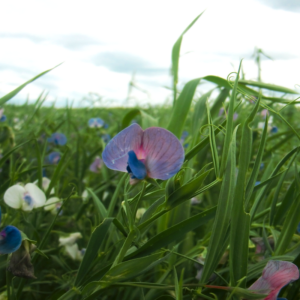
Pea flowers in a field.Source: Vilicus Farms

“We’re committed to stewardship. That really drives what we do, how we do it, and why.”

– Doug Crabtree, Vilicus Farms

Anna Crabtree-JonesSource: Vilicus Farms

Hiddendale Farm

Glen Philbrick is the operator of Hiddendale Farm, a fifth-generation family farm in Turtle Lake, North Dakota. The 700-acre farm includes certified organic cropland and rangeland, a cow-calf livestock system, and a wide range of experimental horticultural and specialty crops. Research is central to Glen’s farming operation: he regularly conducts variety trials, soil health experiments, and crop rotation testing, and collaborates with organizations like the Organic Seed Alliance and the Natural Resources Conservation Service (NRCS).

Growing up, the farm used some conventional practices, like spraying herbicides, and Glen noticed that 1.) it wasn’t working and 2.) it was adversely affecting the health of farmers and livestock.  ”I recognize the dangers of it over and over again,” he said of herbicides. Hiddendale Farm has been certified organic since 2016 and uses practices like limited tillage, rotational grazing, and cover cropping. And being a research-focused farm, Glen prioritizes soil testing, working from the results to balance PH and manage nutrient levels to inform overall soil health. “It is the health of me, of people, of my livestock, and of the whole ecosystem,” Glen shared. “That’s why organic is important to me.”

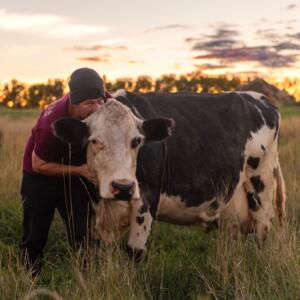
A farmer poses in a field with a cow.Source: Hiddendale Farm

“It is the health of me, of people, of my livestock, and of the whole ecosystem. That’s why organic is important to me.”

– Glen Philbrick, Hiddendale Farm

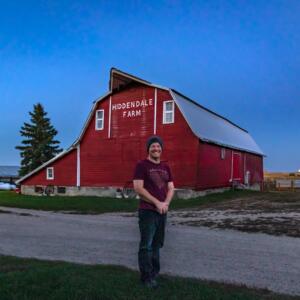
A farmer poses in front of a red barn at dusk.Source: Hiddendale Farm

Stephens Land & Cattle

Stephens Land & Cattle is a fifth-generation family farm located in Jennings, Kansas, managed by Demetria Stephens, who has been farming the land since she was a teenager. The farm raises livestock and grows organic Turkey Red wheat, which grows well in the semi-arid region of northwest Kansas. In addition to being certified organic for over 30 years, the farm is also certified biodynamic, a holistic approach to farming that centers on the interconnectivity of the natural landscape. Becoming certified biodynamic was a long-term goal of her parents, who studied anthropology and were interested in the human role in fostering ecological systems. Demetria uses organic and biodynamic principles as a framework: “I think of organic as a guide for me to be a better farmer, more than the rules that restrict me from doing things. It is more saying, no pesticides, no synthetics, no GMOs, and those kinds of things.”

Growing in a region with mostly conventional agriculture, and without formal agronomy training, organic principles propel her learning and investment in the land. Stephens Land & Cattle uses practices like limited tillage, cover cropping, and green manures. “I think [of organic as] a way for me to be a more professional farmer,” Demetria shares. “And also raise good food for the next generation.”

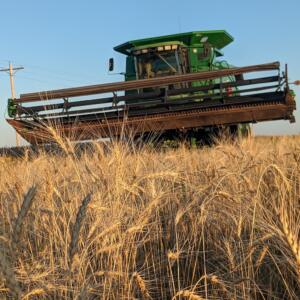
A tractor moves through a field of wheat.Source: Stephens Land & Cattle

“I think of organic as a guide for me to be a better farmer, more than the rules that restrict me from doing things. It is more saying, no pesticides, no synthetics, no GMOs, and those kinds of things.”

– Demetria Stephens, Stephens Land & Cattle

Source: Stephens Land & Cattle

PrairieSun Organics

PrairieSun Organics is a diversified organic, family farm in Vermillion, South Dakota, owned and operated by Angela Jackson-Pulse and her husband. Spanning about 20 acres, the farm integrates poultry (meat and eggs), livestock (sheep and cattle), fruits and vegetables, and specialty grains. Angela keeps half the land in crop production, and the other half in perennial pasture for livestock grazing. Angela originally managed the farm using more conventional organic methods, but transitioned into using regenerative organic practices in 2019 after experiencing declining soil health, and increased disease and livestock mortality. She is now certified regenerative through the Regenerative Organic Alliance. “It put the joy back into farming,” she said of the switch.

At the heart of her farming practices is land stewardship: “stewarding this beautiful ecosystem, that is interrelated and interconnected, and making sure it functions as healthy as it possibly can be.” By focusing on minimizing soil disturbance, expanding crop rotations, integrating cover crops, and prioritizing soil biology, Angela saw her farm come alive again. She highlights the importance of a systems-based approach, centering the overall health of the land to set her farm up for the best possible future: “It’s a blessing that we have [this land] and I want to take really good care of it. I know that it’s not going to be in my possession forever. And so I want to leave it to the next generation, whoever that is, so it can be the best possible thing for the next family.”

You can follow PrairieSun Organics on Facebook.

“At the heart of it is stewardship. Stewarding this beautiful ecosystem that is interconnected and making sure that the whole farm functions as healthy as it possibly can be.”

– Angela Jackson-Pulse, PrairieSun Organics

By |2026-06-09T15:35:27-04:00April 22nd, 2026|Farmer Stories, News|

Conservation Stewardship Program (CSP)

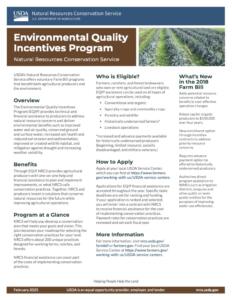
Farmers across the U.S. are eligible for significant technical and financial assistance from the Natural Resources Conservation Service (NRCS).

Versión en español a continuación.

If you are engaging in environmental stewardship and conservation efforts on your farm, the Conservation Stewardship Program (CSP) can help support your progress. CSP compensates agricultural producers who agree to increase conservation on their farm by adopting additional conservation activities or improving upon existing practices. With technical assistance from a conservation planner, farmers will work to increase conservation through practices best suited to their operation, like cover cropping, integrated grazing, or building wildlife habitats.

Obtain additional translated materials, or schedule interpretation services for phone calls or in-person visits, at farmers.gov/translations, or request personalized Spanish language support for any USDA resource, at farmers.gov/translations#spanish-request.

Important Points:

  • CSP provides annual payments for farmers, with the annual minimum being $4,000, for a 5-year contract for installing, maintaining, and improving existing conservation on a farm.
  • CSP payments are reported to the IRS and should be treated as taxable income.
  • Unlike the Environmental Quality Incentives Program (EQIP), there are no minimum acreage requirements, but the program requires whole-farm enrollment. The applicant’s farm must be in existing production; the program generally will not support land being cleared or prepared for future production.
  • Contacting your local NRCS office is a key step in determining your eligibility and beginning your application process.
  • Applications are accepted on a rolling basis and will be reviewed on the next ranking date for your state. Begin your application process as soon as possible to ensure completion by the next deadline! Applications are prioritized by local resource concerns and the applicant’s level of need.
    • The 2026 batching deadline was January 15, 2026, for all states. 
  • You will need to create a free online account at Farmers.gov and ensure that it is up to date.
  • If you do not own your land, you will need to submit written permission from the owner with your application.
  • New this year: the Regenerative Agriculture Initiative may be an opportunity for organic and transitioning-to-organic producers to leverage their operational status for qualifying for contracts.

Step 1. Research Your Options.

CSP offers support for a broad scope of conservation activities and projects to producers, including both financial and technical support. CSP contracts last 5 years, with the option for renewal. Read up on the program to determine your eligibility and brainstorm how you already are, or would like to, increase conservation on your farm. For some possible project inspiration, check out NCRS’s Conservation at Work video series.

Front page of a CSP factsheet in English
Front page of a CSP factsheet in Spanish

Step 2. Connect with USDA.

Create or update your account at Farmers.gov, and contact your local NRCS office to get started. Your conservation specialist will confirm your eligibility and help you determine your farm’s current stewardship thresholds. A stewardship threshold is NRCS’s benchmark for whether a CSP applicant is meeting or exceeding the level of conservation for a specific natural resource concern. To qualify, applicants must meet the threshold for at least two priority resource concerns across all land uses in their operation and commit to meeting or exceeding at least one additional concern by the end of their contract.

Guiding questions for initial contact with NRCS:

  • “I’m interested in  _conservation project(s) of interest_. What do you need from me to get started on my application?”
  • “What additional funding opportunities are available to my farm?”
  • “When is the deadline for the next CSP ranking period?”
  • “I _(own/rent)_ my land. What documents will you need for completion of my CSP application by the deadline?”
  • “My farm is _certified/transitioning_ to organic. What additional will you need for completion of my conservation plan and application by the deadline?”

Step 3. Gather your application documents.

You’ll need your:

  • Official tax ID (Social Security Number or Employer Identification Number)
  • Adjusted gross income certification (Form CCC-941), which requires your Taxpayer ID Number and AGI from the previous 3 tax years.
  • Deed, or property lease agreement, and written authorization from the landowner to install structural or vegetative practices.
  • A map showing all land uses and acres in the operation, and a map or other documentation identifying any known ineligible land and associated acreage amounts (NRCS staff will help you obtain this information if you don’t already have it).
  • Farm tract number (obtained from Farmers.gov or FSA membership).
  • Documentation of organic certification (if applicable).
  • Documentation of your land’s irrigation history (if applicable to project).

Step 4. Complete your application & submit!

Your NRCS conservation specialist will complete and submit your application form (CPA 1200) based on your established conservation plan.

Step 5. Implement your plan.

If your application is selected, NRCS will offer a contract outlining the approved conservation activities, payment rates, and other terms. CSP contracts last five years and begin only after both the farmer and NRCS sign the agreement. NRCS provides technical assistance, verifies completion of contract activities, and issues annual payments after October 1 each year.

Apply for CSP now to take conservation efforts on your farm to the next level! 

All of this information is summarized in a printable, downloadable PDF below in English and Spanish.

Los agricultores de todo Estados Unidos son elegibles para recibir asistencia técnica y financiera del Servicio de Conservación de Recursos Naturales (NRCS).

Si usted participa en esfuerzos de gestión ambiental y conservación en su granja, El Programa de Administración para la Conservación (CSP) puede ayudarle a apoyar su progreso. El CSP compensa a los productores agrícolas que aceptan aumentar la conservación en su granja adoptando actividades adicionales de conservación o mejorando prácticas existentes. Con la asistencia técnica de un planificador de conservación, los agricultores trabajarán para aumentar la conservación mediante prácticas más adecuadas a su explotación, como la construcción de cultivos de cobertura, el pastoreo integrado o la construcción de hábitats para la vida silvestre.

Obtenga materiales traducidos adicionales, programa servicios de interpretación para llamadas telefónicas o visitas presenciales, en farmers.gov/translations, o solicite apoyo personalizado en español para cualquier recurso del USDA, en farmers.gov/translations#spanish-request.

Puntos importantes:

  • CSP da pagos anuales a los agricultores, con un mínimo anual de 4.000 dólares, por un contrato de 5 años por instalar, mantener y mejorar la conservación existente en la granja.
  • Los pagos del CSP se reportan al IRS y deben considerarse ingreso sujeto a impuestos.
  • A diferencia del Programa de Incentivos para la Calidad Ambiental (EQIP), no existen requisitos mínimos de superficie, pero el programa exige la inscripción de toda la granja. La granja del solicitante debe estar en producción existente; El programa generalmente no apoya la limpieza o preparación de terrenos para futuras producciones.
  • Contactar con la oficina local del NRCS es un paso clave para determinar su elegibilidad y comenzar el proceso de solicitud.
  • Las solicitudes se aceptan de forma continua y se revisarán en la siguiente fecha de clasificación para su estado. ¡Comience su proceso de solicitud lo antes posible para asegurarse de finalizar antes de la próxima fecha límite! Las solicitudes se priorizan según los recursos locales y el nivel de necesidad del solicitante.
    • La fecha límite para 2026 fue el 15 de enero de 2026 para todos los estados. 
  • Tendrá que crear una cuenta online gratuita en Farmers.gov y asegurarse de que está actualizada.
  • Si no es propietario de su terreno, tendrá que presentar un permiso por escrito del propietario con su solicitud.
  • Novedad de este año: la Iniciativa de Agricultura Regenerativa podría ser una oportunidad para que los productores orgánicos y en transición a orgánicos aprovechen su estatus operativo para calificar para contratos.

Paso 1. Investigue sus opciones.

El CSP ofrece apoyo para un amplio alcance de actividades y proyectos de conservación a los productores, incluyendo apoyo financiero y técnico. Los contratos CSP duran 5 años, con opción de renovación. Infórmese sobre el programa para determinar su elegibilidad y haga una lluvia de ideas sobre cómo ya está, o le gustaría, aumentar la conservación en su granja. Para alguna posible inspiración en proyectos, revise la serie de videos sobre Conservación en el Trabajo de NCRS.

Front page of a CSP factsheet in Spanish
Front page of a CSP factsheet in English

Paso 2. Contacte con USDA.

Cree o actualice su cuenta en Farmers.gov y contacte con la oficina local del NRCS para empezar. Su especialista en conservación confirmará su elegibilidad y le ayudará a determinar los límites actuales de gestión de su granja. Un umbral de manejo responsable es el referente de la NRCS para determinar si un solicitante de CSP cumple o supera el nivel requerido de conservación para una inquietud específica de recursos naturales. Para calificar, los solicitantes deben cumplir el umbral para al menos dos inquietudes prioritarias de recursos naturales en todos los usos del suelo en su operación y comprometerse a cumplir o superar al menos una inquietud adicional antes de finalizar su contrato.

Preguntas orientadoras para el contacto inicial con el NRCS:

  • “Me interesa el/los _proyecto(s) de conservación(es) que le interese. ¿Qué necesitan de mí para empezar con mi solicitud?”
  • “¿Qué oportunidades adicionales de financiación hay disponibles para mi granja?”
  • “¿Cuándo es la fecha límite para el próximo periodo de clasificación CSP?”
  • “Yo _(poseo/alquilo)_ mi tierra. ¿Qué documentos necesitarán para completar mi solicitud CSP antes de la fecha límite?”

Paso 3. Reúna sus documentos de solicitud.

Necesitará su:

  • Identificación fiscal oficial (Número de Seguro Social o de Identificación del Empleador)
  • Certificación de ingreso bruto ajustado (Formulario CCC-941), que requiere su número de identificación de contribuyente y AGI de los 3 años fiscales anteriores.
  • Escritura, o contrato de arrendamiento de propiedad, y autorización por escrito del propietario para instalar prácticas estructurales o vegetativas.
  • Un mapa que muestre todos los usos del suelo y acres en la operación, y un mapa u otra documentación que identifique cualquier terreno no elegible conocido y las extensiones asociadas (el personal de NRCS le ayudará a obtener esta información si aún no la tiene).
  • Número de parcela de la granja (obtenido de Farmers.gov o de la membresía FSA).
  • Documentación de certificación orgánica (si procede).
  • Documentación del historial de riego de su terreno (si es aplicable al proyecto).

Paso 4. ¡Complete su solicitud y envíela!

Su especialista en conservación del NRCS completará y enviará su formulario de solicitud (CPA 1200) en base a su plan de conservación establecido.

Paso 5. Implemente su plan.

Si su solicitud es seleccionada, el NRCS ofrecerá un contrato que detalle las actividades de conservación aprobadas, las tarifas de pago y otros términos. Los contratos CSP duran cinco años y solo comienzan después de que tanto el agricultor como el NRCS firmen el acuerdo. El NRCS proporciona asistencia técnica, verifica la finalización de las actividades contractuales y emite pagos anuales después del 1 de octubre de cada año.

¡Solicite CSP ahora para llevar los esfuerzos de conservación en su granja al siguiente nivel! 

Toda esta información se resume en un PDF imprimible y descargable a continuación, disponible en inglés y español.

By |2026-06-12T09:57:50-04:00January 15th, 2026|Federal Assistance, News, Spanish Resources, TOPP West|

Environmental Quality Incentives Program (EQIP)

Farmers across the U.S. are eligible for significant technical and financial assistance from the Natural Resources Conservation Service (NRCS).

Farmers and technical service providers know firsthand that the most significant barriers to developing sustainable infrastructure and production practices are due to time and resource scarcity. NRCS’ EQIP program offers financial assistance and technical support to implement new conservation practices on your farm, with additional support for historically underserved applicants, including socially disadvantaged, beginning, veteran, and limited-resource farmers and ranchers. In this blog post, we’ll provide an overview of what EQIP has to offer and the steps to utilizing this program.

Obtain additional translated materials, or schedule interpretation services for phone calls or in-person visits, at farmers.gov/translations, or request personalized Spanish language support for any USDA resource, at farmers.gov/translations#spanish-request.

Important Points:

  • EQIP is a reimbursement program; most operations will have to pay for improvements up-front and get funding to cover those costs.
  • Do not begin reimbursable conservation activities and projects prior to completion of your application process and contract with NRCS.
  • Contacting your local NRCS office is a key step in determining your eligibility and beginning your application process.
  • Applications are accepted on a rolling basis and will be reviewed on the next ranking date for your state. Begin your application process as soon as possible to ensure completion by the next deadline! Applications are prioritized by local resource concerns and the applicant’s level of need.
    • The 2026 batching deadline is January 15, 2026, for all states. 
  • You will need to create a free online account at Farmers.gov and ensure that it is up to date.
  • If you do not own your land, you will need to submit written permission from the owner with your application.

Step 1. Research Your Options.

EQIP offers support for a broad scope of conservation activities & projects to producers, including both financial and technical support. EQIP provides funds to reimburse costs associated with specific practices or infrastructure projects on a farm. EQIP’s most popular sub-programs include the High Tunnel Initiative, which covers the cost of high tunnel installation for production farms, the On Farm Energy Initiative, which covers the cost of energy-saving equipment and infrastructure improvements such as refrigeration units or greenhouse improvements, and the Organic Initiative, which provides up to $140k to certified organic or transitioning farms to implement conservation practices such as design and installation of efficient irrigation systems, nutrient & pest management strategies, or developing a grazing plan. Funding availability varies by state. As of 2026, not all initiatives are offered in every state. Check with your local NCRS office to determine what funding pools are available in your state.

Front page of a CSP factsheet in English

Step 2. Connect with USDA.

Create or update your account at Farmers.gov, and contact your local NRCS office to get started. Your conservation specialist will confirm your eligibility and help you identify which projects & practices best suit your operation. 

Guiding questions for initial contact with NRCS:

  • “I’m interested in applying for EQIP’s  _initiative(s) of interest_ for my farm to help finance _conservation project of interest_. What do you need from me to get started on my application?”
  • “What additional funding opportunities are available to my farm?”
  • “How soon can a conservationist help me set up a conservation plan (AD 1026)?”
  • “When is the deadline for the next EQIP ranking period?”
  • “I am eligible for the increased and advanced payment option for Historically Underserved farmers. How will this change my application process?”
  • “I _(own/rent)_ my land. What documents will you need for completion of my EQIP application by the deadline?”
  • “My farm is _certified/transitioning_ to organic. What additional will you need for completion of my conservation plan and application by the deadline?”

Step 3. Schedule your conservation plan development.

Your NRCS conservation specialist will work with you to develop a conservation plan for your operation and complete the AD 1026 form.

Step 4. Gather your application documents.

You’ll need your: 

  • Official tax ID (Social Security Number or Employer Identification Number)
  • Adjusted gross income certification (Form CCC-941), which requires your Taxpayer ID Number and AGI from the previous 3 tax years.
  • Deed, or property lease agreement, and written authorization from the landowner to install structural or vegetative practices.
  • Farm tract number (obtained from Farmers.gov or FSA membership).
  • Documentation of organic certification (if applicable).
  • Documentation of your land’s irrigation history (if applicable to project).

Step 5. Complete your application & submit!

Your NRCS conservation specialist will complete & submit your application form (CPA 1200) with you using your established conservation plan and the above documents. 

Step 6. Implement your plan.

If you’re selected, you can choose whether to sign the contract for the work to be done. You’ll be provided with guidelines and a timeframe for implementing your plan. Once the work is implemented and inspected, you’ll be paid the rate of compensation for the work.

Apply for EQIP now and unlock a more affordable path to sustainable agriculture. Your farm deserves the support it needs.

All of this information is summarized in a printable, downloadable PDF below, available in English and Spanish.

By |2026-01-15T10:21:50-05:00January 5th, 2026|Federal Assistance, News, Spanish Resources, TOPP West|

Building Successful Farmer-Researcher Collaboration

Farmers and ranchers are natural researchers, regularly using trial-and-error to address on-farm questions and challenges. Research shows that farmers greatly benefit when they lead on-farm research trials.

Programs like the OFRF’s Farmer-Led Trials and the Sustainable Agriculture Research and Education’s Farmer-Rancher Grant put farmers in the driver’s seat, allowing them to conceive and carry out research on their farms.

For research involving farmers and University scientists, successful collaborations between farmers and researchers can greatly enhance results. However, these collaborations take time to build. Read our report on for lessons learned from organic farmers and researchers about how to form these effective collaborations.

Front cover of seeds of success resource
By |2026-06-12T09:42:00-04:00December 19th, 2025|On-Farm Research, Resource|

Three Springs Farm: Small-scale Farming Rooted in Organic Principles

By Clare Boland, Communications & Outreach Fellow, and OFRF staff

Three Springs Farm is a certified organic farm located in eastern Oklahoma in the Ozark Hills. Farmers Mike Appel and Emily Oakley cultivate over forty different crops and more than 150 individual varieties on three acres of land. Their goal is to maintain a family operation that demonstrates the economic viability of small-scale farming.

Originally, Three Springs sold the majority of their produce at farmers’ markets, but since the pandemic, they’ve transitioned into being majority Community Supported Agriculture (CSA). Instead of giving customers a pre-packed box like a traditional CSA, they offer a free choice model, allowing customers to pick what veggies they want to receive at their weekly pick-up in Tulsa. CSA members also receive a newsletter containing recipes, photos, and stories from the farm. “It’s non-traditional, but we still have that community support,” says Mike. In addition to their CSA, they also sell wholesale to a restaurant and a Food is Medicine Program.

For Mike and Emily, farming organically was their intention from the start. Both studied agriculture in college, and afterward gained experience working at organic farms like Full Belly Farm in California. After Emily finished her graduate degree at the University of California-Davis, they relocated to Oklahoma, where Emily was raised, to start a farm of their own.

But finding a permanent home for their farm took a bit longer than they had hoped. They looked at more than 100 properties over the course of three years. During this time, they farmed on leased land, but were unable to become certified because of soil amendments used on the land prior to their lease. Eventually, they found land in Eastern Oklahoma, about an hour east of Tulsa, where they have been farming for the past 22 years.

“Oklahoma is really difficult because there’s not a lot of good soil,” Mike explains. “The best land tends to be river valleys, but they’re prone to flooding. Or, there might be really great land but no water. The best land we saw was south of Tulsa, but it was too expensive for us. We were at the eleventh hour when we just kind of stumbled upon our place.”

Why Organic

The land they purchased hadn’t been farmed before, so they didn’t have to go through the three-year organic transition period to obtain organic certification. “It’s why we do what we do,” Michael said when asked about the decision to be certified organic. “There was never a question of doing anything other than that… We actually don’t need it for marketing purposes.”  

Despite that, Mike says their CSA customers are still interested in the organic label – what it means and the integrity behind it. He also thinks the bashing of big organics doesn’t do a lot to support the label overall. “When you’re doing that consistently, the consumer doesn’t understand and is going to equate organics as something that is fraudulent. That’s a worry. It has to be a lot more delicate and balanced. There are a lot of us out there doing it right. There’s a lot of concern, and I think we’re riding a very fine line of losing consumer support if we don’t make integrity and strict standards the priority.”

In addition to being USDA-certified organic, Three Springs Farm is also certified through the Real Organic Project. Emily served on the National Organic Standards Board from 2016-2021 and advocated against the inclusion of hydroponic vegetables under the USDA label. The USDA’s decision to include hydroponics was what led to the founding of the Real Organic Project, where Emily currently serves on the standards board. The Real Organic Project label goes beyond the USDA organic label, differentiating organic food produced in concert with healthy soils and pasture, and offering customers greater transparency.

Mike’s top reasons why people should choose organic whenever possible start with the obvious. “You don’t want poisons in your food. That to me is fundamental. We don’t want to eat food grown with chemicals and we don’t want other people to either. 

“Also, farmworkers shouldn’t be working in fields that have nasty chemicals. We have a long way to go to ensure people have good working conditions, but at least we can ensure people aren’t being exposed to bad chemicals when they’re growing our food.”

Then there are the larger environmental impacts. “Living near a creek and seeing the life that’s there is incredible. While it is resilient, it’s also very vulnerable to our influences. It’s important to make sure your food choices don’t impair that. When we buy organic, we think beyond ourselves. Our choices have huge impacts in other parts of the world. Just try to make the best choices you can with what you have in front of you.”

Cover Cropping for Scale and Climate Extremes

Although Mike and Emily own around 100 acres, they only keep three to four acres in production since it’s just the two of them and their daughter. The majority of their land is in conservation for wildlife habitat and native ecosystem restoration. Determining the right schedule for their cover cropping has helped not only to build biomass, but also to manage their farm with minimal staff.

”Anything that was spring crops gets turned into a summer cover crop. And then any land that isn’t gonna be utilized at all that year is also in summer cover crop. We end our season on Labor Day to get our winter cover crop planted. So we spend most of September, and a little bit of October, cleaning up fields and just selling to the restaurant and the Food is Medicine program.” The goal, Mike says, is to get the entire farm into cover crop by mid-fall. “Over time, we’ve figured out how to sustain the farm as two people; not growing year-round is one way to do that.”

Though, climate irregularities have caused them to adapt their plans season to season. “ Our falls have been a lot drier, so we’re not able to plant until we get a rain, and those rains haven’t been coming until October. So we’ve modified our winter cover crop a little bit because of that, adding more winter-hardy [varieties].”

In addition to fall droughts, they’ve also been experiencing heavy rains in the spring. This past year was “the wettest spring we’ve ever had, which is saying a lot for this region because we have pretty wet springs. We get pretty severe storms. It’s usually a deluge. And this spring was the worst in our 20 years of farming. We just could not get back into the field. And there were a lot of disease problems in our potatoes and onions because of it.”

Along with the changes they’ve made to their cover crop mix, Mike and Emily are also experimenting with reduced tillage to combat climate extremes. This year, instead of rototilling their summer crop prior to winter planting, they tried discing it in instead. “We’re really happy the way that turned out. The soil is a lot less abused when we don’t rototill.” In the coming year, they are hoping to experiment with interseeding, planting cover crops alongside cash crops, to combat soil erosion and build resilience for rain events.

Learning Through On-Farm Research

Mike and Emily have also developed a good relationship with Oklahoma State University. “We’ve done some varietal trials with them, which helped us figure out what works,” says Mike. “What’s been interesting is to see the extension agents become more interested in cover cropping. They’re still very conventional, but they’ve become more interested after seeing what cover crops have done for us—the fact that we’re organic, our plants are healthy, and our yields are good—without having to put down chemical fertilizers.”

“We’re a bit far away from the university, so it makes it harder to collaborate, but we’ve told them to call us whenever they do variety trials. We have lots of ideas and have trialed a bunch of different crops.”

His best advice for new farmers? Perseverance.

“There are times I’ve definitely wanted to just throw in the towel. But in the end, things work out. You talk to people, figure out the problems. Each year it gets better, but you’ll still have setbacks, like the weather for us this year. Know that while nothing is static, each year you’ll be able to build on your experience.”

By |2025-12-18T11:47:59-05:00December 17th, 2025|Farmer Stories, News|

Lessons from the Plains on the Transition to Organic

A Farmer Panel recap from the Transitioning to Organic Farming Conference at the Eastern Nebraska Research, Extension, and Education Center in Ithaca, NE

By Brian Geier, OFRF Communications Manager.

“I used to write checks to chemical companies. Now I write them to my kids,” explains Tom Schwarz, a 5th-generation farmer from southern Nebraska, while discussing the advantages of organic production. The Schwarz Family Farm has been farming organically since transitioning the farm in 1988. Along with his wife and two kids, Tom raises corn, soybeans, wheat, field peas, alfalfa, oats, and numerous cover crops. He was speaking at the Transition to Organic Farming Conference hosted by the University of Nebraska, Lincoln, alongside two other organic farmers. 

As may be the case for many farmers in rural Nebraska, farming is not new to any of the organic farmers on this particular panel. Each spoke with a familiarity and vocabulary that comes with decades of experience. All three of them are from families who are farming hundreds or thousands of acres, some owned, many rented, in various stages of leases. And all of them had, at some point in the past few decades, switched a portion of their farming enterprises to certified organic production. For these farmers, who carry on family legacies of farming that survived the farm crises of the 1970s and 80s, organic is, among other things, a way to survive. It is also a path toward passing a farm operation onto the next generation that is better, safer, and more profitable than when they started. 

No-till, organic corn at Young Family Farm in Nebraska. Photo credit: Barry Young, farmer-presenter on the “Organic Production: Nebraska Growers’ Perspectives” panel. 

Like most farming, organic is not all easy. Tom presented what he sees as the disadvantages of organic: it is management-intensive (more machinery passes per season), requires extra recordkeeping, and WEEDS (emphasis via capitalization added from Tom’s presentation). “It’s just plain harder,” he explained, citing the need to be able to adapt on the fly and to creatively problem solve.

Matt Adams, who started farming with his dad in 2016 and operates about 600 acres in Seward, Nebraska, also spoke on the panel. He agreed that there can be difficulties with the transition to organic, particularly with having machinery settings or setups needed for larger-scale grain production. “Get everything ready way before,” he warns, “so the day you need to be out there, you’re ready.” 

Matt transitioned non-irrigated land that was previously in the Conservation Reserve Program (CRP) to organic hay and row crops. Since the fields were in CRP, there had been no prohibited substances applied to them, and they were ready to certify, meaning he did not have to steward them through the three-year transition period to organic. But since the land had not been fertilized or cultivated, Matt is finding that yields have been low and weed pressure high, putting extra strain on the need for timely, effective cultivation setups. 

When addressing challenges, the number one source of information for organic farmers is other farmers. And Nebraska’s organic farmers on this panel are no exception. 

“I do have some original thoughts. But I always throw them to the wolves first,” explains Barry Young, the third panelist who operates Young Family Farm in southeast Nebraska. “I should call it ‘Young Community Farm’”, he chuckles, giving credit to past mentors that first taught him about polyculture planting, and acknowledging fellow farmers and family members that he discusses ideas with before trying them. Barry finds that sourcing inputs is one of his biggest challenges. Despite living in farm country, “No one around me was doing what I’m doing,” he said. Still, by persistently asking questions of fellow organic and regenerative farmers, who he finds are more apt to share knowledge than many conventional growers, he has learned to meet main challenges like developing inter-species planting mixes for weed control. 

Organic farmer Barry Young explains his polyculture planting mix for organic wheat, which includes a custom mix of 120 pounds of wheat with 2 pounds of radish and 3 pounds of flax. The flax, a legume, helps enhance the soil microbiome while the radish helps break compaction especially following alfalfa. Both winterkill and the wheat matures as a pure stand for harvest the next season.

Earthworms and good soil structure in a November cover crop at Young Family Farm.

A high biomass (10-ton per acre) pea/oat cover crop following no-till corn planting at Young Family Farm

Corn grows with a soil-building mix in wheat stubble at Young Family Farm.

Secondary roots on organic, no-till corn at six weeks post-emergence at Young Family Farm.

“This is the way we’re intended to farm.”

-Nebraska organic farmer

All three of the farmers spoke about several advantages of organic production, too. One described lying down in a field, observing the increase in bug and bird life following the switch away from pesticides, and thinking, “This is the way we’re intended to farm.” 

Other advantages cited include organic’s market stability, and the regional control and accountability within the market chains. With organic grain production, many farmers are selling niche crops to regional processors who are then selling food back to the community. This creates a market and economy that farmers form long-term relationships with, and it stands in contrast to the volatility and lack of accountability from larger, conventional commodity crop markets where crops are shipped out of state or country for processing. It is “consumer-based as opposed to commodity-based,” Tom points out. 

But ultimately, for Tom and others on the panel, it is about their farms’ future, and that is about the quality of life of the next generation. Today, there are challenges with organic, for sure, but farming has been a difficult profession for generations of Nebraskans. With organic production as at least a part of the farm, Tom feels he is creating something that will be passed on to the next generation and be better than what he inherited. Aside from now being a paid part of the organic operation, Tom notes that “The kids will not be exposed to chemicals like I was,” adding, matter-of-factly, “that’s the biggest reason I do it.”

For Plains farmers interested in learning more about the USDA’s National Organic Program, we encourage you to explore resources and upcoming events hosted by the region’s Transition to Organic Partnership Program (TOPP). You may also want to explore OFRF’s step-by-step guides, printable tools, and farmer experiences to help you access USDA programs and funding, such as the NRCS’s Environmental Quality Incentives Program (EQIP) and the RMA’s Whole-Farm Revenue Protection (WFRP) program.

By |2026-01-06T16:40:14-05:00December 16th, 2025|Farmer Stories, News|
Go to Top